
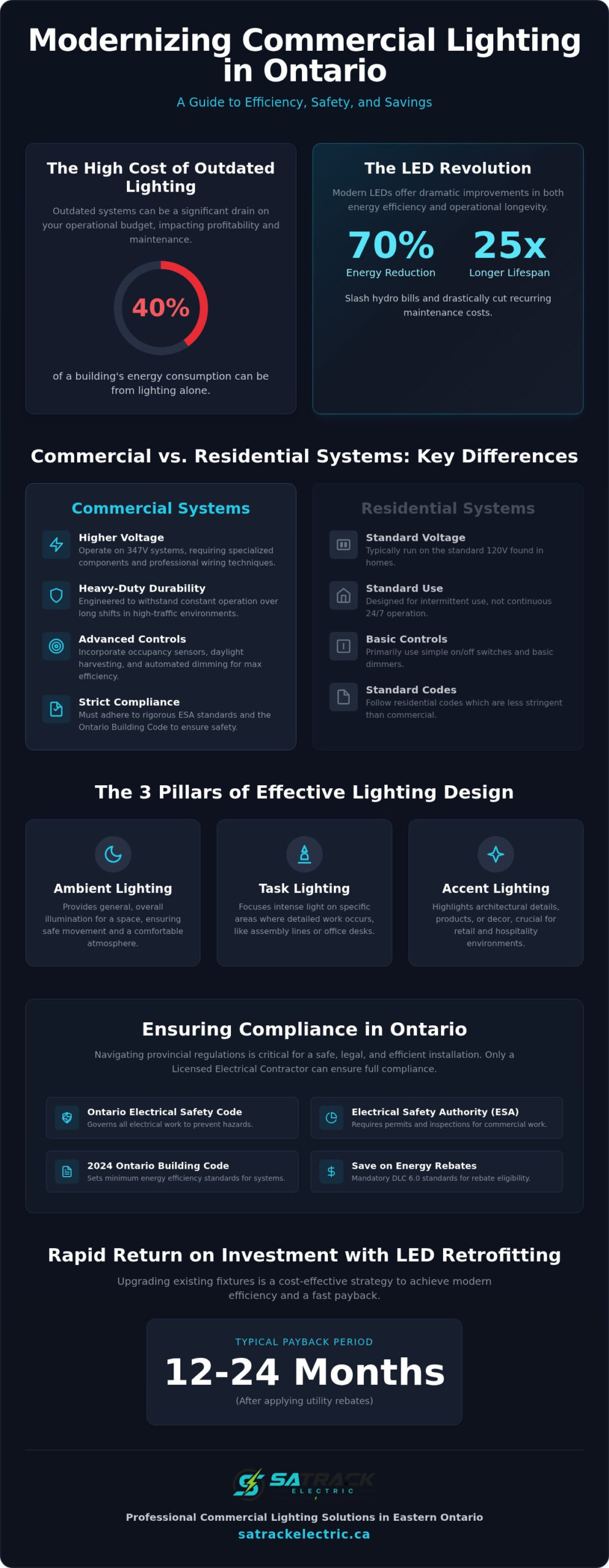
Lighting can account for up to 40% of a commercial building’s total energy consumption, yet modern LED systems can slash that figure by as much as 70%. You likely realize that outdated fixtures are doing more than just dimming your workspace; they’re actively draining your monthly budget and creating unnecessary maintenance hurdles. Finding a balance between reducing these high hydro bills and meeting strict provincial safety standards can feel like a daunting task for any facility manager in Eastern Ontario.
This 2026 guide explains how a professional commercial lighting installation Ontario project can improve your facility’s safety, energy efficiency, and long-term value. We will look at how the 2024 Ontario Building Code and the latest Electrical Safety Authority regulations impact your operations. You will also learn about the specific Save on Energy rebates available this year, including the mandatory shift to DLC 6.0 standards for eligibility. By prioritizing quality workmanship and local expertise, you can ensure your business remains fully compliant while significantly lowering your operational costs and enhancing your professional environment.
Key Takeaways
- Understand why specialized commercial systems are necessary to meet the unique demands of a professional workspace compared to standard residential setups.
- Discover how a modern commercial lighting installation Ontario project utilizing LED technology can reduce energy consumption by up to 70% and lower maintenance needs.
- Learn about the critical role of the Ontario Electrical Safety Code and why only a licensed electrical contractor should manage your permit process.
- Review the essential steps for planning an upgrade that minimizes operational disruptions while ensuring full compliance with 2026 standards.
- Recognize the value of partnering with a local, insured professional to guarantee quality workmanship and long-term facility safety.
Understanding Commercial Lighting Requirements in Ontario
A commercial lighting installation in Ontario represents more than just a functional necessity; it’s a specialized electrical service designed to support the specific operational demands of a business. Unlike residential setups, these systems must endure high-traffic usage and meet rigorous safety benchmarks. In Ontario, the Electrical Safety Authority (ESA) oversees all electrical work to ensure it aligns with the Ontario Electrical Safety Code. The primary objectives of a professional installation are to maximize workplace safety, boost employee productivity, and implement robust energy management strategies.
The Importance of Lighting Design in Commercial Spaces
Effective lighting design is a balance of art and science. It ensures that light distribution is optimized for the specific tasks performed within a facility, meeting the minimum lux levels required for safety and precision. By following established architectural lighting design principles, businesses can create environments that reduce eye strain and prevent accidents. Proper illumination directly impacts the bottom line; well-lit spaces improve employee focus and can reduce errors in high-precision environments.
A comprehensive layout typically categorizes lighting into three types:
- Ambient lighting: Provides the general illumination for a space, ensuring safe movement and a comfortable atmosphere.
- Task lighting: Focuses on specific areas where detailed work occurs, such as assembly lines, commercial kitchens, or office desks.
- Accent lighting: Highlights specific features, architectural details, or products, which is particularly vital in retail and hospitality settings.
A warehouse requires high-bay fixtures with wide distribution to eliminate shadows in aisles. Conversely, a retail centre needs focused beams to guide customer attention toward specific merchandise. This tailored approach ensures that every watt of energy is used effectively.
Commercial Lighting vs. Residential Systems
The gap between residential and commercial systems is significant. Commercial fixtures often operate on higher voltages, such as 347V, compared to the standard 120V found in homes. This requires specialized components and wiring techniques that can withstand constant operation over long shifts. When planning a commercial lighting installation Ontario businesses must account for these heavy-duty requirements and the specific mandates of the 2024 Ontario Building Code to avoid premature system failure.
Commercial systems also involve sophisticated control mechanisms, including occupancy sensors and automated dimming, which are often required by current energy codes. Professional installation is non-negotiable for business owners. Licensed contractors ensure the work is insured and meets ESA standards, protecting the property from fire hazards and ensuring that insurance claims remain valid in the event of an incident. This methodical approach provides peace of mind that the electrical infrastructure is both safe and reliable.
Energy-Efficient Solutions and Modern LED Technology
Lighting can account for 20% to 40% of a commercial building’s total energy consumption. In Ontario, the transition to high-efficiency LED systems has become a standard strategy for managing operational costs. These modern systems can reduce energy use by 50% to 70% compared to older technologies. This shift is driven by both fiscal responsibility and the need to comply with Ontario’s energy efficiency standards. Beyond the immediate energy savings, LEDs offer a lifespan up to 25 times longer than traditional high-pressure sodium HID bulbs; this drastically reduces the frequency and cost of maintenance cycles. By lowering energy demand, businesses also reduce their overall carbon footprint, aligning with provincial sustainability targets.
The Benefits of LED Retrofitting for Ontario Businesses
Many businesses choose retrofitting to modernize their facility while controlling initial capital expenditure. This process involves upgrading internal components while retaining the existing fixture housings. It is an efficient way to achieve a higher Return on Investment (ROI). For example, warehouse lighting retrofits typically see a payback period between 12 and 24 months after utility rebates are applied. Modern LEDs also provide superior colour rendering, which improves visibility and safety in industrial settings. If you are considering an upgrade, a professional electrical maintenance assessment can help determine which fixtures are suitable for retrofitting and identify where new installations are necessary.
Smart Controls and Automation Systems
The next phase of energy management involves smart lighting controls. These systems use occupancy sensors to eliminate waste in low-traffic areas like storage rooms, hallways, or back offices. Daylight harvesting technology further optimizes efficiency by automatically dimming interior lights when natural sunlight is sufficient. For 2026, the DesignLights Consortium (DLC) 6.0 listing is mandatory for most provincial rebate programs. This ensures that a commercial lighting installation Ontario project utilizes only the most efficient and high-performing products available. Integrating these controls with a building management system (BMS) allows facility managers to monitor usage patterns and refine their energy strategy in real time. This holistic approach ensures a disciplined, well-organized workflow that minimizes waste without compromising on light quality.
Compliance with Ontario Electrical Codes and ESA Standards
Adhering to the Ontario Electrical Safety Code (OESC) is a legal requirement for every business owner. The 28th Edition of this code, enforced by the Electrical Safety Authority (ESA), sets the definitive standard for all electrical work in the province. When you commission a commercial lighting installation Ontario project, ensuring the work is performed by a licensed electrical contractor is the only way to guarantee the job meets these rigid safety benchmarks. Unlicensed work often leads to severe consequences; during the 2026 fiscal year, the ESA issued 110 Administrative Penalty Orders to address non-compliant and unlicensed work. These penalties can reach $10,000, which far outweighs the perceived savings of hiring an uncertified person. Beyond fines, insurance providers may deny claims related to fire or property damage if the electrical work was not permitted and inspected.
Navigating the ESA Permit and Inspection Process
The permit process begins with filing a Notification of Work with the ESA. In a commercial setting, this notification must be filed by the licensed contractor before the work commences. Once the installation is complete, or at specific stages of a larger project, an ESA inspector will visit the site. They verify that the wiring, grounding, and fixture placements align with the OESC. Upon successful completion, the ESA issues a Certificate of Inspection. You should keep this document in your permanent business records. It serves as official proof that your facility’s lighting system is safe and compliant, which is often required during property appraisals or insurance renewals.
Emergency and Exit Lighting Regulations
Compliance also extends to life safety systems. The 2024 Ontario Building Code mandates specific requirements for emergency egress lighting and exit signs. These systems must provide reliable illumination along paths of travel during a power failure. Most commercial applications require battery backup systems that provide at least 30 minutes of emergency light. Regular maintenance is a legal obligation. You must conduct monthly functional tests and annual 30-minute discharge tests to ensure the batteries and lamps remain operational. Neglecting these standards compromises the safety of your employees and visitors, and it leaves your business vulnerable to liability in the event of an emergency. A methodical approach to these regulations ensures your facility remains a safe, well-organized environment.
Planning Your Commercial Lighting Installation
Planning a commercial lighting installation Ontario project requires a methodical approach to ensure both safety and efficiency. The process typically begins with a comprehensive site assessment and consultation. During this phase, a professional contractor evaluates the facility’s specific needs, whether it’s a retail showroom in Belleville or a manufacturing plant in Trenton. A clear roadmap includes the design phase, load calculations, permit application, and the physical installation, concluding with a final inspection. To minimize operational disruptions, work is often scheduled in phases or during off-peak hours. This disciplined strategy prevents downtime and ensures a smooth transition to the new system.
Assessing Your Current Electrical Capacity
Before adding new fixtures, it’s essential to evaluate your building’s infrastructure. In many cases, a commercial electrical upgrade is necessary to support modern lighting systems and their associated controls. This evaluation includes a thorough review of existing electrical panels and circuits to ensure they can accommodate the intended load. A load calculation is a critical safety step that determines if your existing system can handle the electrical demand of new lighting without overheating components. If your panel is already at capacity, pushing it further could lead to frequent breaker trips or even fire hazards.
Choosing the Right Contractor in Eastern Ontario
Selecting a contractor with deep roots in the Quinte region offers distinct advantages. A local professional understands the specific needs of businesses in Belleville, Trenton, and Quinte West, providing a level of reliability that outside firms might lack. When vetting potential partners, always verify their ECRA/ESA license and ensure they carry comprehensive liability insurance. These credentials protect your business and confirm that the contractor is authorized to pull the necessary permits.
Detailed quotes and realistic project timelines are vital for commercial clients. A professional proposal should outline every stage of the work, from material procurement to waste disposal. This transparency allows you to plan your budget and staffing accordingly. If you’re ready to start your project, we invite you to discuss your needs for commercial electrical services with a licensed professional who values quality workmanship and safety. Once the installation is complete, regular maintenance will preserve your investment and ensure your system continues to operate at peak efficiency for years to come.
Professional Lighting Solutions with Satrack Electric
Satrack Electric serves as a dependable local authority for businesses seeking a high-standard commercial lighting installation Ontario. We recognize that lighting is a fundamental pillar of your facility’s infrastructure. Our team prioritizes safety and competence above all else, ensuring that every fixture and circuit meets the rigorous demands of a professional environment. We provide a seamless transition from initial design to final inspection, allowing you to focus on your core operations while we manage the technical complexities of the Ontario Electrical Safety Code. Our status as a licensed and insured electrical contractor provides the assurance that your project is in capable, seasoned hands.
Our Approach to Commercial Electrical Excellence
We employ a methodical workflow that mirrors a well-organized industrial process. Every project begins with a thorough assessment of your existing capacity, ensuring that new lighting loads are supported by stable electrical panels. We utilize only high-quality, durable components that are specifically rated for commercial use. This commitment to quality workmanship minimizes the need for frequent commercial electrical maintenance and ensures your system remains reliable over the long term. Transparent communication remains the foundation of our service. We provide clear, functional updates and detailed project timelines to give you total peace of mind throughout the installation phase.
Serving Businesses Across the Quinte Region
Our expertise is deeply rooted in the Quinte region. We’ve established a strong presence in Belleville and Trenton, but our service area extends to Picton, Greater Napanee, Cobourg, and Brighton. This local focus means we’re intimately familiar with regional building requirements and the specific needs of Eastern Ontario businesses. Whether you’re upgrading a retail space in Picton or installing high-bay LEDs in a Brighton warehouse, we provide the consistent, skilled practice your project deserves. We value integrity and customer peace of mind, positioning ourselves as a stable partner for your domestic and professional electrical needs.
By choosing a local contractor for your commercial lighting installation Ontario project, you ensure your business remains compliant and efficient. We invite you to book a consultation for your next lighting project to see how professional electrical upgrades can benefit your facility. Our team is ready to provide a professional assessment and guide you toward an energy-efficient, compliant solution that aligns with your operational goals.
Secure Your Facility’s Future with Professional Lighting
Investing in a modern commercial lighting installation Ontario project is a strategic decision that balances operational savings with workplace safety. By transitioning to high-efficiency LED technology and integrating smart controls, you can significantly reduce energy consumption while meeting the latest 2026 provincial standards. Compliance with the Ontario Electrical Safety Code remains non-negotiable for protecting your assets and ensuring your facility remains fully insured. It’s a methodical step that provides long-term peace of mind for any business owner.
Selecting a licensed and insured electrical contractor is the most effective way to manage these complex technical requirements. Satrack Electric brings expertise in commercial code compliance and electrical upgrades to businesses throughout Belleville and the Quinte Region. We prioritize quality workmanship and transparent communication to ensure your project is completed without unnecessary disruption. We invite you to Contact Satrack Electric for a Professional Commercial Lighting Consultation to discuss your facility’s specific needs. Taking a proactive approach to your electrical infrastructure today will deliver a safer, more efficient workspace for years to come.
Frequently Asked Questions
Do I need a permit for commercial lighting installation in Ontario?
An ESA permit is required for most commercial lighting installation Ontario projects, especially when adding new circuits or upgrading electrical panels. While a like-for-like replacement of a single fixture on an existing circuit might not require one, most professional upgrades involve changes that mandate a permit. A licensed electrical contractor must file a Notification of Work before the project begins to ensure the installation is inspected and verified for safety.
How much can a business save by switching to LED lighting?
Businesses typically reduce their lighting energy consumption by 50% to 70% after switching to modern LED systems. Since lighting often accounts for 20% to 40% of a commercial building’s total hydro bill, the financial impact is substantial. These savings are further enhanced by the long lifespan of LEDs, which last up to 25 times longer than traditional bulbs, significantly lowering the frequency and cost of ongoing maintenance and replacement.
What is the Electrical Safety Authority (ESA) and why does it matter?
The Electrical Safety Authority (ESA) is the independent administrative body responsible for electrical safety across Ontario. It matters because it enforces the Ontario Electrical Safety Code, licenses electrical contractors, and conducts mandatory inspections of commercial work. Following ESA regulations protects your business from fire hazards and ensures that your insurance remains valid. Working with a licensed professional ensures that all work is legally compliant and meets the highest safety standards.
How often should commercial emergency lighting be tested in Ontario?
Commercial emergency lighting must undergo a functional test every month to ensure the lamps illuminate correctly during a power failure. Additionally, the Ontario Building Code requires a full 30-minute discharge test once per year to verify that the battery backup system remains operational for the legally mandated duration. Keeping a detailed log of these tests is a requirement for fire safety inspections and helps maintain a safe environment for employees and visitors.
Can I install commercial lighting myself if I own the building?
No, commercial electrical work in Ontario must be performed by a Licensed Electrical Contractor (LEC). Unlike residential properties where homeowners may perform some work, provincial law requires that businesses hire a licensed professional for any electrical installations or upgrades. This regulation ensures that complex commercial systems are installed safely and that the business remains compliant with the Electrical Safety Authority’s standards, protecting the property owner from significant liability and fines.
How long does a typical commercial lighting retrofit take?
The duration of a retrofit depends entirely on the scale of the facility and the complexity of the existing infrastructure. A small retail space might be completed in a few days, while a large warehouse or office complex could take several weeks. To minimize operational disruptions, a professional contractor will often work in phases or during off-peak hours. This methodical approach ensures that your business remains functional while the new lighting system is being installed.
Are there government rebates for commercial lighting upgrades in 2026?
Yes, several Save on Energy programs offer incentives for commercial lighting installation Ontario projects in 2026. Small businesses with 50 or fewer employees may qualify for up to $3,000 in lighting upgrades through specific incentive programs. To be eligible for most rebates this year, products must meet the DesignLights Consortium (DLC) 6.0 performance standards. These financial incentives are designed to help businesses offset the initial cost of upgrading to energy-efficient technology.
What is the difference between a lighting retrofit and a new installation?
A lighting retrofit involves upgrading the internal components of existing fixtures, such as replacing old ballasts and lamps with LED technology while keeping the original housings. This is often a cost-effective way to improve efficiency without major construction. A new installation involves removing old fixtures entirely and installing new, modern units and potentially new wiring. This approach is preferred when the existing layout is insufficient or when a complete redesign of the space is necessary.