
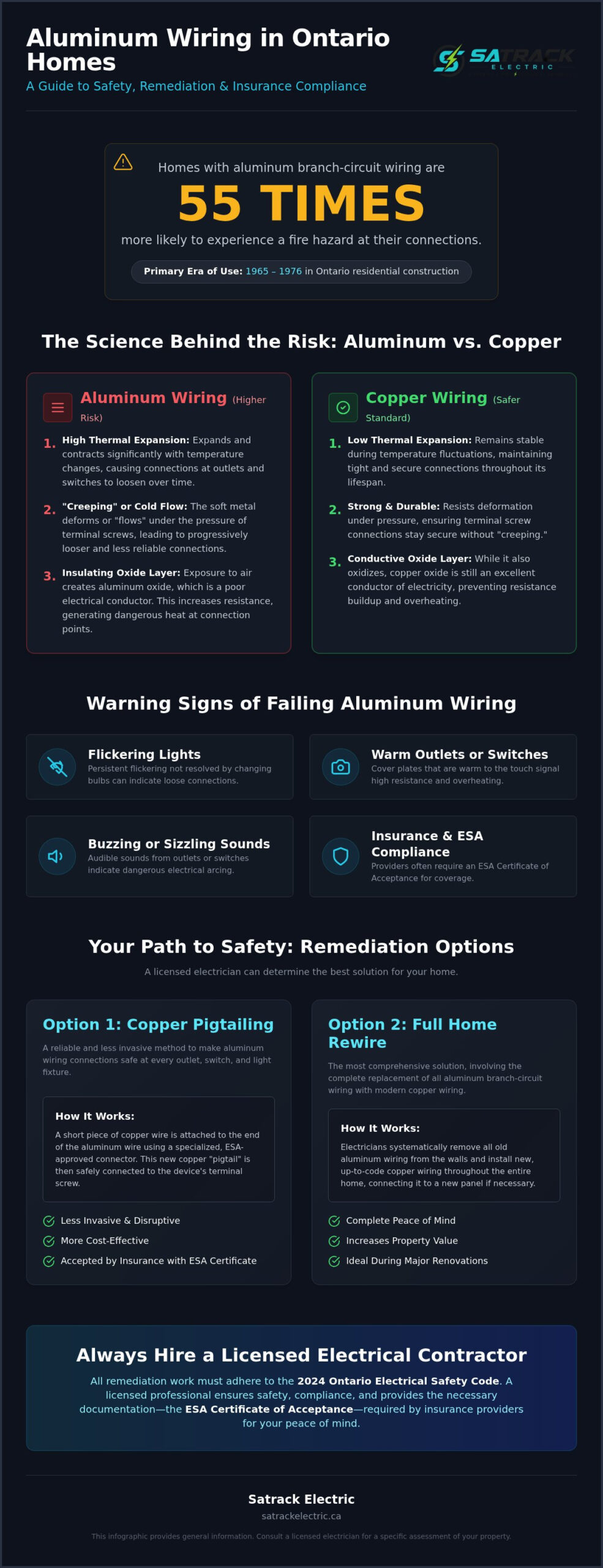
It is a sobering reality that homes with aluminum branch-circuit wiring are 55 times more likely to experience a fire hazard condition at their connections than those wired with copper. If you own a home built between the mid-1960s and late 1970s, you’ve likely felt the pressure of rising insurance premiums or the concern that your policy might be cancelled. You want a safe home and manageable insurance rates, but the technical jargon surrounding aluminum wiring replacement Ontario homeowners encounter can be confusing. This guide provides the professional assurance you need to make an informed decision for your property.
We will examine the safety risks detailed in the 2024 Ontario Electrical Safety Code and explain exactly what insurance providers require for a Certificate of Acceptance. You will also discover the most effective remediation methods, including how copper pigtailing offers a reliable, less invasive alternative to a full home rewire. By the end of this article, you’ll have a clear path toward achieving electrical safety compliance and securing your peace of mind in the Quinte region.
Key Takeaways
- Identify if your home was constructed between 1965 and 1976, the primary era when aluminum wiring was used in Ontario residential builds.
- Learn why an ESA Certificate of Acceptance is essential for satisfying insurance providers and ensuring your home remains covered.
- Evaluate the differences between copper pigtailing and a full aluminum wiring replacement Ontario residents use to achieve long-term safety.
- Understand how the number of outlets and switches in your home directly impacts the total labour and cost of remediation.
- Recognize the value of hiring a licensed contractor to ensure all electrical work adheres to the 2024 Ontario Electrical Safety Code standards.
Understanding Aluminum Wiring in Ontario Homes
Aluminum wiring served as the primary residential standard in Ontario between 1965 and 1976. During this decade, builders shifted away from copper because global copper prices had skyrocketed. While aluminum is an effective conductor of electricity, its physical properties differ significantly from the copper it replaced. This period is a central part of the History of aluminum building wiring, which details how these materials behave differently under a constant electrical load.
One specific concern for homeowners is a phenomenon known as “creeping” or cold flow. Unlike copper, aluminum wire tends to move or “flow” when it’s under pressure from terminal screws. Over time, this movement causes connections to loosen. It’s often the primary reason homeowners eventually seek aluminum wiring replacement Ontario services to restore their home’s long-term safety and stability.
The Era of Aluminum Wiring in the Quinte Region
In the Quinte region, mid-century expansion led to the development of several established neighbourhoods in Belleville, Trenton, and Quinte West. Homes built during the late 1960s and early 1970s are now over 50 years old. This age represents a critical threshold for any electrical system. The original connections weren’t designed to last indefinitely. As these components reach the end of their functional lifespan, the risks associated with older wiring methods become more pronounced. Professional maintenance is no longer just a recommendation; it’s a necessity for property preservation.
Aluminum vs. Copper: The Science of the Risk
The primary hazard isn’t the wire itself, but how it interacts with devices like outlets and switches. Aluminum has a high coefficient of thermal expansion. It expands significantly more than copper when heated by electrical current. This constant expansion and contraction cycle eventually pushes the wire out from under the terminal screws, creating a gap.
Additionally, aluminum reacts with oxygen to form aluminum oxide. While copper oxide still conducts electricity, aluminum oxide acts as an insulator. This creates high resistance at the connection point. High resistance generates intense heat, which leads to further loose connections and potential arcing. These scientific factors explain why insurance companies view these systems with caution. Understanding these properties is the first step in choosing a methodical remediation plan that prioritizes safety over a quick fix.
Insurance and Safety Risks of Aluminum Wiring in 2026
Ontario insurance companies have significantly increased their scrutiny of older homes in 2026. For many providers, aluminum wiring is no longer just a minor concern; it’s a high-risk factor that can lead to policy denials or skyrocketing premiums. The primary issue isn’t the wire itself, but the “hidden” fire risk at connection points. Unlike other household hazards, an electrical fire often begins deep within the wall cavity. You might not smell smoke or notice a problem until the fire has already gained significant traction behind your drywall.
To mitigate this risk, most insurers now require a Certificate of Acceptance from the Electrical Safety Authority (ESA) for policy renewals or new coverage. This document confirms that a licensed electrical contractor has inspected the system and performed the necessary remediation. The CPSC guidelines on repairing aluminum wiring highlight that these connections are significantly more likely to reach fire-hazard conditions than copper. Taking proactive steps toward aluminum wiring replacement Ontario homeowners can rely on is often the only way to maintain affordable, comprehensive property insurance.
Navigating Ontario Insurance Requirements
The insurance landscape in Ontario is increasingly rigid. Some providers will outright refuse to insure a home with untreated aluminum branch-circuit wiring. A licensed electrician plays a vital role here by providing the verified documentation your insurance broker needs to prove the home is safe. While the initial investment in remediation is a consideration, it often results in lower annual premiums over time. It transforms your home from a high-risk liability into a standard, insurable asset.
Recognizing Warning Signs in Your Home
Staying alert to the physical state of your electrical system can prevent a disaster. Many homeowners don’t realize that minor issues are actually symptoms of the cold flow process discussed earlier. If you encounter any of the following, your connections may be compromised:
- Flickering lights that persist even after changing the bulb.
- Outlet cover plates or switches that feel warm to the touch.
- Faint buzzing or sizzling sounds coming from behind the walls.
- Discoloured or charred plastic around plug-in points.
- Unexplained “fishy” or acrid odours near electrical devices.
If these warning signs appear, don’t wait for a breaker to trip. These symptoms indicate that arcing is likely occurring. Seeking Residential Electrical Services for a thorough inspection is the most responsible way to protect your family and your investment.
Remediation Options: Copper Pigtailing vs. Full Rewire
When considering an aluminum wiring replacement Ontario project, homeowners generally have two recognized paths for remediation. Pigtailing involves connecting short copper wire “leads” to your existing aluminum branch circuits using specialized, approved connectors. A full rewire, by contrast, is the complete removal of all aluminum branch wiring and the installation of new copper Romex cables throughout the structure. Both methods are safe when performed correctly, but they offer different levels of longevity. For any remediation to be valid and satisfy provincial safety standards, it must be completed by a licensed electrical contractor.
The Pigtailing Process: AlumiConn and Copalum
The choice of connector in pigtailing is vital. While standard twist-on connectors (often called purple wire nuts) are available, many experts and the ESA’s position on aluminum wiring favour more mechanical solutions. AlumiConn lug connectors use internal ports and screws to create a secure, gas-tight connection that physically separates the aluminum and copper wires. This prevents the oxidation and thermal expansion issues that lead to failure. The Copalum crimp method is another high-standard option. It uses a specialized hydraulic tool to create a permanent cold-weld connection, though it requires specific certification to install.
When is a Full Aluminum Wiring Replacement Necessary?
There are specific scenarios where a full aluminum wiring replacement Ontario homeowners opt for is the superior choice. If you’re undertaking a major home renovation that involves removing drywall, replacing the wiring is a logical and efficient upgrade. Modern households have significantly higher power demands than those of the 1970s. Smart home systems, electric vehicle chargers, and high-draw appliances often require the reliability and capacity that only a modern copper system can provide.
Choosing a full rewire also allows you to address the core of your electrical system. This process is frequently paired with an electrical panel upgrade in Belleville to ensure your home can handle a 100 or 200-amp load safely. While pigtailing addresses the risk at the connection points, a full rewire replaces the entire circuit. It’s a permanent solution that increases property value and ensures total compliance with the latest safety codes. You don’t have to worry about the legacy of older materials when the entire system is updated to modern standards.
Planning Your Aluminum Wiring Replacement: Process and Costs
Planning an aluminum wiring replacement Ontario project requires a methodical approach to ensure both safety and code compliance. The scope of work is largely determined by the total number of electrical devices in your home. Every outlet, switch, and light fixture represents a connection point that must be addressed. Because an electrician must physically open and inspect every single device box, pigtailing is a highly labour-intensive process. A standard medium-sized home typically requires one to three days to complete this remediation, though the complexity of an aluminum wiring replacement Ontario project can vary based on accessibility.
For homeowners choosing a full rewire, the process is more invasive. This method involves running new copper cables through the wall cavities, which often necessitates minor drywall cuts to navigate the house’s framing. While this results in a modern, robust system, you should budget for professional painting and plaster repairs once the electrical work is finished. This is why many residents in Belleville and Trenton prefer pigtailing when their walls are already in good condition.
The Step-by-Step Remediation Timeline
The process begins with a comprehensive initial assessment and circuit mapping. A Satrack Electric expert identifies every branch circuit that utilizes aluminum wiring to ensure nothing is overlooked. Following the assessment, the physical work commences. Our team accesses every device box to perform the pigtailing or replacement. This methodical approach ensures that every connection meets the 2024 Ontario Electrical Safety Code. Once the installations are complete, we conduct final testing to verify circuit integrity. The final step is the mandatory Electrical Safety Authority (ESA) inspection, which provides the official documentation required by your insurance provider.
Budgeting for Your 2026 Electrical Upgrade
Your budget is primarily dictated by the density of electrical devices in your property. A home with a high number of specialized light fixtures or extensive outdoor outlets will require more labour hours than a minimalist layout. While the initial cost of remediation is a consideration, it serves as a significant investment in the resale value of your Ontario home. Properties with certified copper or properly remediated wiring are far more attractive to buyers and easier to finance during a real estate transaction.
We believe in providing clear, professional guidance for our neighbours in Quinte West and Brighton. If you’re ready to secure your home’s electrical future, contact us for our Residential Electrical Services to receive a transparent, detailed quote for your project.
Safe Electrical Solutions with Satrack Electric
Choosing a partner for your aluminum wiring replacement Ontario project requires confidence in their technical proficiency and regulatory compliance. Satrack Electric operates as a fully licensed and insured electrical contractor, providing the professional assurance necessary for such critical residential upgrades. Our team adheres strictly to the 2024 Ontario Electrical Safety Code, ensuring that every connection we remediate or replace meets the highest provincial standards. We’ve built a reputation across the Quinte region for a calm, methodical approach that prioritizes the long-term integrity of your home’s electrical system.
Our commitment to safety extends from Picton and Bloomfield through to Greater Napanee and Cobourg. We understand that residents in these communities value reliability and transparent communication. At Satrack Electric, we maintain a “safety first” culture that dictates every step of our workflow. We don’t just fix wires; we provide the peace of mind that comes from knowing your property is protected against the risks associated with aging electrical infrastructure. This grounded approach has made us a trusted authority for homeowners throughout the region.
Expert Residential Services in Belleville and Beyond
Our extensive experience with home electrical repairs in Belleville allows us to navigate the unique challenges found in mid-century properties. When performing an aluminum wiring replacement Ontario residents can trust, we handle the coordination with the Electrical Safety Authority (ESA) on your behalf. This ensures your remediation is officially recognized and certified, which is a vital step for maintaining your home insurance coverage. We invite you to schedule a comprehensive wiring assessment to determine the current state of your connections and discuss the most efficient path forward for your specific property.
Your Partner for Long-Term Home Safety
Professional workmanship is the most effective way to ensure your home remains eligible for competitive insurance rates. Beyond aluminum remediation, our team offers a total suite of capabilities to modernize your living space. This includes specialized upgrades such as generator installation in Belleville, providing your family with year-round reliability during seasonal storms. We take pride in being a consistent, skilled practitioner for our neighbours in Trenton, Brighton, and Quinte West. Contact Satrack Electric today for a professional consultation and take the first step toward a safer, more compliant home.
Securing Your Home’s Electrical Future
Addressing the legacy of mid-century wiring is a necessary step for maintaining long-term property value and safety. By choosing an approved remediation method, such as copper pigtailing or a complete system update, you satisfy the strict requirements of Ontario insurance providers while eliminating underlying fire risks. These upgrades ensure your home remains compliant with the 2024 Ontario Electrical Safety Code and ready for modern power demands. Professional aluminum wiring replacement Ontario services transform a high-risk liability into a safe, reliable asset.
Satrack Electric is a licensed and insured ECRA/ESA contractor specializing in older home electrical safety. We have served the communities of Belleville, Trenton, and Quinte West for years, prioritizing methodical workmanship and customer peace of mind. Contact Satrack Electric today for a professional aluminum wiring assessment in Belleville and the Quinte region. Protecting your investment starts with a thorough inspection. We look forward to helping you achieve total electrical safety and securing your home for the years ahead.
Frequently Asked Questions
Is aluminum wiring illegal in Ontario?
No, aluminum wiring is not illegal in Ontario. It remains a recognized material in the Ontario Electrical Safety Code and is frequently used for high-load applications like main service feeders. The safety concerns primarily involve branch circuit wiring in homes built between 1965 and 1976. While not illegal, these systems require specific maintenance and approved connectors to ensure they remain safe and insurable under modern standards.
Can I pigtail aluminum wiring myself to save money?
You should not attempt to pigtail aluminum wiring yourself. In Ontario, all electrical work must be performed by a licensed electrical contractor with a valid ECRA/ESA licence. Improperly handled aluminum wire increases the risk of fire due to loose connections. Insurance providers require a Certificate of Acceptance from the Electrical Safety Authority, which is only granted after a professional installation and a subsequent mandatory safety inspection.
How much does aluminum wiring pigtailing cost in Ontario for 2026?
The cost of aluminum wiring pigtailing depends on the size of your home and the total number of outlets, switches, and light fixtures. Each device box must be opened and remediated individually, making labour the primary factor in the final price. Because every property has a unique electrical layout, we recommend requesting a detailed quote to understand the specific investment required for your home’s safety and insurance compliance.
Will my insurance company cancel my policy if I have aluminum wiring?
Many insurance companies in Ontario may threaten to cancel or refuse to renew policies for homes with uncertified aluminum wiring. Insurers view these systems as a high-risk factor for residential fires. To maintain your coverage, most providers require a formal inspection and a Certificate of Acceptance from the ESA. Completing a professional aluminum wiring replacement Ontario project or an approved pigtailing remediation usually satisfies these requirements and keeps your policy active.
What is the difference between AlumiConn and standard wire nuts?
AlumiConn connectors use a mechanical lug design with individual ports for each wire, which prevents the aluminum and copper from physically touching. This creates a gas-tight, secure connection that is less susceptible to thermal expansion. Standard wire nuts, including those rated for aluminum, rely on twisting the wires together. Many experts prefer AlumiConn because it effectively manages the cold flow properties of aluminum and offers a more durable, long-term safety solution.
How do I know for sure if my home has aluminum wiring?
You can identify aluminum wiring by examining the plastic jacket of the cables visible in your basement or attic. Look for the word “ALUMINUM” or the abbreviation “AL” printed on the insulation. Another method is to check your electrical panel for silver-coloured wires rather than the typical orange-gold of copper. If you’re uncertain, a professional assessment is the safest way to verify your home’s wiring material and its current condition.
Does aluminum wiring replacement increase my home’s resale value?
Yes, replacing or professionally remediating aluminum wiring significantly enhances your home’s resale value and marketability. Prospective buyers are often wary of older electrical systems due to the associated insurance challenges and perceived fire risks. By providing a Certificate of Acceptance, you demonstrate that the home is safe and fully compliant with modern codes. This transparency simplifies the closing process and makes your property more attractive to a wider range of qualified buyers.
How long does a full aluminum wiring replacement take for a standard house?
A full aluminum wiring replacement for a standard residential property typically takes between five and ten business days. This timeline depends on the size of the home and how easily the electrician can access the wall cavities. While pigtailing is faster, a full rewire is a more comprehensive project that involves removing all old cables and installing new copper circuits. This methodical process ensures your entire electrical system meets contemporary safety standards.