
Could the biggest factor in your automatic transfer switch cost Quinte West project be the work around the switch rather than the equipment itself? A transfer switch is only one part of connecting a generator safely to a property. The estimate can also depend on the generator, electrical panel, backup loads, and installation conditions.
Before arranging electrical work, it helps to understand how automatic and manual switching differ and what information will make an assessment more specific. This guide explains the main factors that shape project scope, how to compare the two switch types, and what to prepare for a local assessment.
Generator compatibility and code-compliant installation matter in Quinte West and nearby communities, including Belleville, Trenton, Picton, Brighton, Greater Napanee, and Cobourg. Satrack Electric provides generator installation and hookup services for residential and commercial properties. All services are subject to availability and may vary depending on project requirements, location, scheduling, and applicable regulations.
Key Takeaways
- The automatic transfer switch cost Quinte West property owners are quoted depends on the full generator connection and property requirements, not just the switch.
- Generator compatibility, existing electrical equipment, site conditions, and the circuits selected for backup can shape the project scope.
- Compare automatic and manual switching by how each operates, how much user involvement it requires, and whether it suits your generator and backup priorities.
- Prepare the generator make and model, available electrical details, and a prioritized list of circuits before arranging an assessment.
- Satrack Electric provides generator installation and hookup services in Quinte West and nearby communities. The company is licensed and insured, with ESA Licence #7009789.
Automatic transfer switch cost in Quinte West: what does the project include?
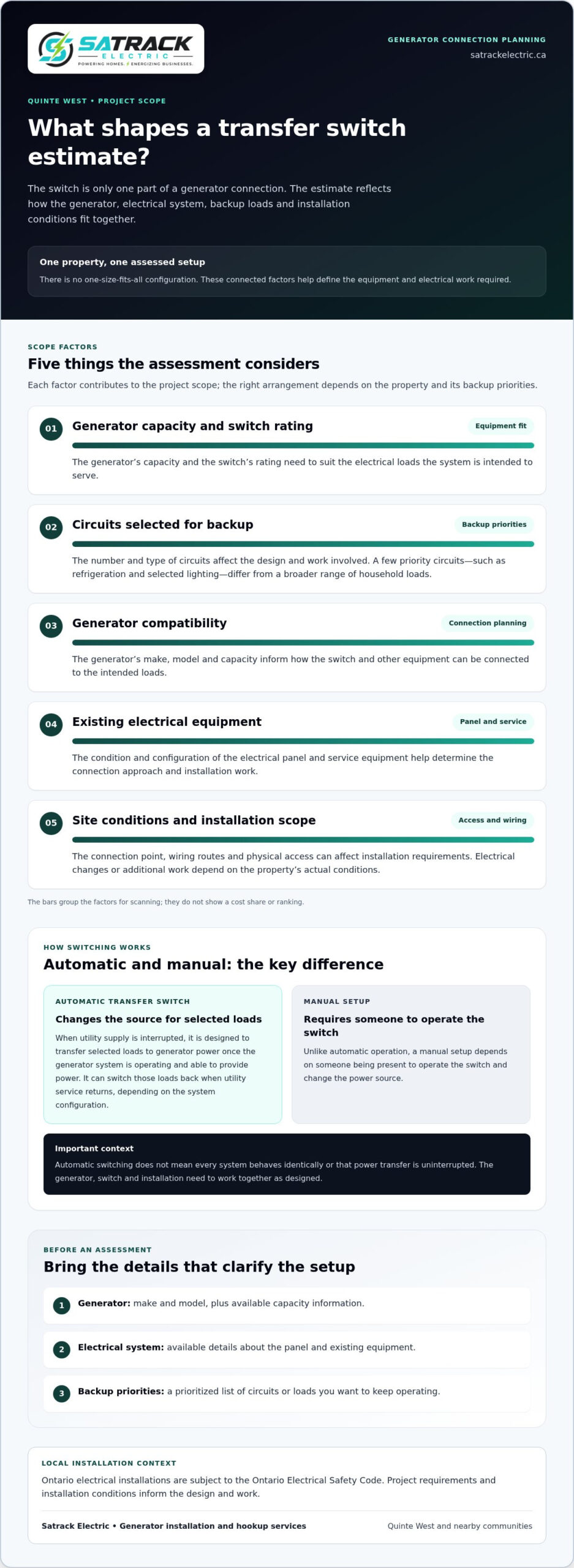
The switch is one part of a generator connection, not a complete measure of the work involved. If you’re researching automatic transfer switch cost Quinte West, start by looking at how the equipment, generator, electrical system, and installation conditions fit together. A useful estimate reflects that full scope rather than assuming every property needs the same setup.
An automatic transfer switch is equipment that changes selected electrical loads from utility power to generator power when utility supply is interrupted. The loads it serves depend on the system design and the property’s requirements. For a general overview of switch operation and applications, see What is an Automatic Transfer Switch?
What does an automatic transfer switch do?
Under normal conditions, selected loads receive power from the utility supply. If that supply is interrupted, an automatic transfer switch is designed to change the source supplying those loads to the generator once the generator system is operating and able to provide power. When utility service returns, the equipment can switch the selected loads back, depending on the system’s configuration.
Unlike a manual setup, automatic operation does not depend on someone being present to operate a switch and change the source. That does not mean every system behaves identically or that power transfer is uninterrupted. The result depends on the generator, switch, and installation working together as designed. Automatic switching changes how the system responds to an outage, but the equipment still needs to suit the property and its backup needs.
Why does the switch alone not determine project scope?
The generator and the loads you want to back up help determine the switch arrangement and electrical work. A setup for a few priority circuits, such as a refrigerator and selected lighting, has different requirements from one designed to support a broader range of household loads. The planned loads need to be considered alongside the generator’s capabilities and the equipment being connected.
Existing electrical equipment and site conditions also affect the work. The panel layout, intended connection point, and wiring route can influence installation requirements. An assessment considers these details instead of assuming a switch can be added without regard to the existing system.
- Equipment selection: The switch must suit the intended arrangement and the electrical system.
- Generator compatibility: The generator make, model, and capacity inform how the equipment can be connected.
- Electrical scope: The number and type of circuits selected for backup affect the design and work involved.
- Site conditions: Existing equipment and the installation layout help determine what the project requires.
Satrack Electric provides generator installation and hookup work tailored to each customer’s project requirements. All services are subject to availability and may vary depending on project requirements, location, scheduling, and applicable regulations. Service agreements are governed by the laws of Ontario and Canada.
What factors shape an automatic transfer switch estimate in Quinte West?
An estimate is shaped by how the generator, transfer switch, existing electrical system, and backup priorities work together. Transfer switch estimates depend on the generator, the electrical system, and the loads you want to keep operating during an outage. That’s why an automatic transfer switch cost Quinte West assessment needs to consider the property’s actual setup rather than assume a standard configuration.
Generator capacity, switch rating, and backed-up circuits
The generator’s capacity and the switch’s rating must suit the intended electrical loads. The design may focus on a defined group of essential circuits or support a broader portion of the property, depending on the system and backup priorities. Neither approach suits every property. Circuit selection involves considering what needs power, how those loads relate to the generator’s capacity, and how the equipment can be safely connected.
Make a practical list before an assessment. A homeowner might prioritize refrigeration, selected lighting, or another essential load, while a property manager may have different operational needs. The number and type of circuits can affect the switch arrangement and electrical work. Plan around the property and generator rather than choosing equipment by rating alone.
Existing electrical conditions and installation scope
The condition and configuration of the electrical panel and service equipment help determine what installation involves. The connection point, wiring routes, and physical access to the equipment can also affect the scope. Suitable existing equipment and a clear route may present different requirements from a setup that needs electrical changes or additional work.
Any changes should be based on the property’s actual electrical conditions, not assumptions. Applicable regulations and project requirements also inform the design and work. Ontario electrical installations are subject to the Ontario Electrical Safety Code. The NFPA’s National Electrical Code (NEC) is a separate US reference, not the code governing a Quinte West installation.
Local planning for a Quinte West property
Useful details help make an assessment specific to your property. Gather the generator’s make and model, the property address, and a list of priority circuits. If available, note relevant information about the existing panel and service equipment. These details provide a practical starting point and help show how the proposed backup loads relate to the generator.
Satrack Electric provides generator installation and hookup services in Quinte West, Belleville, Trenton, Picton, and surrounding Ontario communities, including Brighton, Greater Napanee, and Cobourg. Learn about Satrack Electric’s generator electrical work as you plan your project. Agreements are governed by the laws of Ontario and Canada.
Automatic vs. manual transfer switch: which setup fits your backup needs?
The main difference is how the power source changes during an outage. An automatic arrangement is designed to manage the transfer without someone operating the switch, while a manual arrangement requires user action. Neither option is right for every generator or property. Your backup priorities, generator compatibility, and electrical design all matter when comparing the two.
| Consideration | Automatic transfer switch | Manual transfer switch |
|---|---|---|
| Operation | Designed to change the selected loads between utility and generator supply automatically, according to system setup. | Requires a person to operate the switch to change the supply source. |
| User involvement | Less direct involvement in the transfer process; the generator and switch still need to be suitable and properly configured. | The user follows the system’s operating procedure and changes the source manually. |
| Generator pairing | Considered with generator systems designed for automatic operation, subject to equipment compatibility. | Often considered with portable generator arrangements, but the specific setup must suit the generator and property. |
| Backup priorities | Can be designed for selected loads or a broader backup arrangement, depending on system requirements. | Also depends on the circuits selected and the design of the electrical installation. |
When automatic switching may suit a property
Automatic switching may suit owners who want the generator system to manage the transfer process without requiring them to operate a changeover switch. This can be useful if you want backup operation to involve less direct action during an outage. The system’s behaviour depends on its setup, however. Automatic transfer does not by itself guarantee generator starting, a particular transfer speed, or uninterrupted power.
Fit depends on more than convenience. The generator must be compatible with the transfer equipment, and the selected loads must align with its capacity and the property’s electrical design. Consider which circuits matter most, how the system is intended to operate, and whether the arrangement suits the way the property is used.
What to weigh against a manual setup
With a manual arrangement, someone needs to follow the system’s operating procedure and change the supply source. Consider whether that involvement suits your outage plan, including whether someone is likely to be present and able to operate the equipment when needed. Think about your backup priorities, too. A defined group of essential circuits may require different planning from a broader set of loads.
For either option, the electrical arrangement must suit the generator and property. The choice is not simply between convenience and cost. It is a functional decision shaped by equipment compatibility and installation requirements. Those factors also help explain why automatic transfer switch cost Quinte West depends on the intended setup. A project-specific electrical assessment can establish which arrangement suits the electrical system and backup plan.
How to prepare for a transfer switch assessment in Quinte West
A little preparation helps an electrical assessment reflect your generator, property, and backup priorities. Gather the information you have, make a clear list of what you want powered, and describe known limitations accurately. This gives the assessment a useful starting point without assuming every property needs the same equipment or work.
Information to gather before discussing the project
Have the generator’s make and model available, and note whether it’s planned, installed, or already connected. If you have information about the electrical panel or service equipment, keep it handy. You do not need to diagnose the system yourself. Accurate details and access to the relevant equipment help the assessment account for actual conditions.
List the circuits or equipment you’d like to keep powered during an outage. Consider what matters most to your household or property instead of starting with a predetermined number of circuits. Also note known access constraints or concerns about the panel and wiring routes. Share what you know, and identify anything you’re unsure about rather than guessing.
What happens during a project-specific electrical assessment?
An electrician considers the generator and transfer equipment alongside the existing electrical system, intended backup loads, installation conditions, and applicable regulations. This helps establish a work scope for the property. It is not a generic estimate based only on the switch: generator compatibility, panel configuration, wiring routes, and site access can all inform the work required.
ESA requirements depend on the work and current Ontario rules, so they should be considered when planning the installation. A project assessment can account for applicable requirements without assuming every property has identical conditions. Existing equipment, for example, may affect the work differently from a system that requires electrical changes.
Safety decisions that shouldn’t be improvised
Generator transfer connections need a safe, professionally planned electrical arrangement. Improvised connections can create electrical hazards or energize circuits incorrectly. Don’t try to resolve compatibility or wiring questions by trial and error. A qualified assessment considers the generator, the property’s electrical system, and the intended loads together before work proceeds.
- Define your backup priorities. Write down the circuits or equipment you want considered, and note which are most important.
- Gather generator details. Record the make and model, and whether the generator is planned, installed, or connected.
- Describe the property. Provide the address and relevant details about the panel, service equipment, access, and known wiring constraints.
- Arrange an assessment. Share the information you’ve gathered and provide access to relevant electrical equipment so the project scope can reflect site conditions.
For related planning, see information about generator installation in Belleville and an electrical panel upgrade in Belleville. Satrack Electric provides generator installation and hookup work in Quinte West, Belleville, Trenton, Picton, Brighton, Greater Napanee, Cobourg, and surrounding communities. Agreements are governed by the laws of Ontario and Canada.
To discuss your project, arrange generator electrical work with Satrack Electric.
Plan generator installation and hookup work with Satrack Electric
Choosing between automatic and manual switching is only one part of planning backup power. The generator, the circuits you want to support, and the property’s electrical setup all help define the work involved. Satrack Electric provides generator installation and generator hookup services for residential and commercial properties in Quinte West and nearby Ontario communities.
Local electrical work grounded in safety and project requirements
Satrack Electric is a licensed and insured Ontario electrical contractor with ESA Licence #7009789. The company focuses on safe, code-compliant, high-quality electrical solutions tailored to each customer’s requirements. Generator installation and hookups are among its services, with the electrical scope shaped by the property and intended backup arrangement rather than an assumed package.
Agreements are governed by the laws of Ontario and Canada.
A clear next step for Quinte West property owners
Before discussing your project, gather the generator’s make and model, note whether it’s planned or already installed, and identify the circuits or equipment you want to prioritize during an outage. Accurate information about your electrical panel and service equipment can also help describe the property’s requirements. Be ready to explain access to the relevant equipment and any known site constraints.
This preparation keeps the conversation focused on your needs, whether you’re planning a generator installation or arranging a hookup for existing equipment. It also gives the electrical assessment a sound basis for considering compatibility, backup priorities, and the work the property may require. The goal is a project-specific scope, not a generic assumption about what every home or commercial property needs.
- Generator information: Share the make, model, and current installation status.
- Backup priorities: Identify the circuits or equipment you want considered.
- Property details: Provide the address and accurate information about electrical equipment and access.
If you’re researching automatic transfer switch cost Quinte West, discussing your generator and property requirements can help put the project scope in context. Satrack Electric serves Quinte West, Belleville, Trenton, Picton, Brighton, Greater Napanee, Cobourg, and surrounding communities in Ontario.
Discuss your generator installation or hookup project with Satrack Electric and share the details that will help inform a tailored electrical assessment.
Take the next step towards a well-planned backup system
Planning backup power is an opportunity to match your electrical setup to the way you use your property instead of choosing equipment in isolation. With a clear picture of your priorities and the generator you’re considering, a project assessment can help define a practical scope. That’s the most useful starting point for understanding what shapes the automatic transfer switch cost Quinte West property owners may be quoted.
Keep your intended backup use at the centre of the discussion. A careful review of the property and generator can help identify the electrical work involved and the factors to address before installation. Satrack Electric provides generator installation and hookup services. Agreements are governed by the laws of Ontario and Canada.
Discuss your generator installation and hookup requirements with Satrack Electric to take a considered next step towards backup power suited to your property.
Frequently Asked Questions
How much does an automatic transfer switch cost in Quinte West?
The cost depends on the equipment and electrical work your property requires, so a project-specific assessment is needed for a meaningful estimate. The phrase automatic transfer switch cost Quinte West does not correspond to one standard figure for every installation. An estimate should reflect the generator and property setup, the intended backup arrangement, and any work identified during assessment.
What affects the cost of installing an automatic transfer switch?
Equipment selection, generator compatibility, electrical work, and site conditions all contribute to the project scope. For example, the work may differ if the existing electrical arrangement needs changes or if the installation location affects access and wiring routes. A project-specific scope should explain the requirements identified for your property.
Is an automatic transfer switch better than a manual transfer switch?
Neither is universally better; the right choice depends on how you want to manage backup power and what equipment your property can support. Automatic switching is designed to change the supply without someone operating the switch, subject to system setup. A manual arrangement requires a person to operate it. Consider whether someone may be present during an outage and how much direct involvement suits your backup plan.
Can an automatic transfer switch work with any generator?
No. The generator and transfer switch need to be compatible with each other and with the property’s electrical configuration. Compatibility involves more than whether the equipment can be physically connected; the generator’s specifications and the system’s intended operation matter. Have the generator make and model available for assessment. Don’t assume a switch can be paired with any generator or attempt an improvised connection.
Does an automatic transfer switch power the whole house?
Not necessarily. An installation can be designed around selected circuits or a broader portion of the property, depending on the generator, electrical system, and intended backup loads. A whole-home arrangement does not mean every appliance can run at once; the generator’s capacity and the loads being used remain relevant. Identify which equipment matters most so the design can reflect your priorities rather than assume full-property coverage.
Do I need an ESA permit for an automatic transfer switch in Ontario?
Ontario transfer switch installations require an Electrical Safety Authority (ESA) notification of work and inspection. The notification is filed by a Licensed Electrical Contractor, and the installation must meet applicable Ontario electrical requirements. “Permit” is often used informally, but the relevant process is an ESA notification and inspection. The requirements for a particular installation depend on its scope and applicable Ontario rules.
What information should I have ready for a transfer switch estimate?
Have the generator’s make and model, its installation status, and your preferred backup loads ready. Details about the electrical panel, service equipment, access, and known wiring limitations can also help describe the property accurately. Include the address and note any planned changes to the electrical system. Agreements are governed by the laws of Ontario and Canada.