
Most homeowners view an EV charger as just another appliance, but it is actually a high-duty cycle infrastructure project that tests the limits of your home’s electrical system. Getting your EV charger wiring right is not just about convenience; it is about ensuring your property can handle sustained electrical loads for hours on end without the risk of overheating. It’s natural to feel overwhelmed by technical decisions like choosing between 6/3 and 8/3 wire gauges or worrying if your current panel can handle the new demand.
We understand that the anxiety of a DIY mistake leading to a fire or failing a mandatory ESA inspection is a significant concern for Belleville residents. This guide will help you master the technical requirements and safety standards for EV charger wiring to ensure your Ontario home is ready for the future of electric mobility. We will examine the 2024 Ontario Electrical Safety Code updates, explain why hiring a Licensed Electrical Contractor is a legal requirement, and clarify the specific components needed for a safe, reliable installation that protects your investment and provides total peace of mind.
Key Takeaways
- Distinguish between Level 1 and Level 2 systems to understand how 240V power significantly reduces charging times for modern vehicles.
- Identify the technical specifications for EV charger wiring, including how the 80% rule affects circuit breaker selection and wire gauge choices.
- Learn why obtaining an ESA permit and working with a Licensed Electrical Contractor is mandatory for insurance and legal compliance in Ontario.
- Assess your current electrical panel capacity to determine if a service upgrade is required to support your home’s growing power needs safely.
- Understand the methodical installation process used by local experts to ensure safety and longevity throughout the Belleville and Quinte area.
Understanding EV Charger Wiring: Level 1 vs. Level 2 Systems
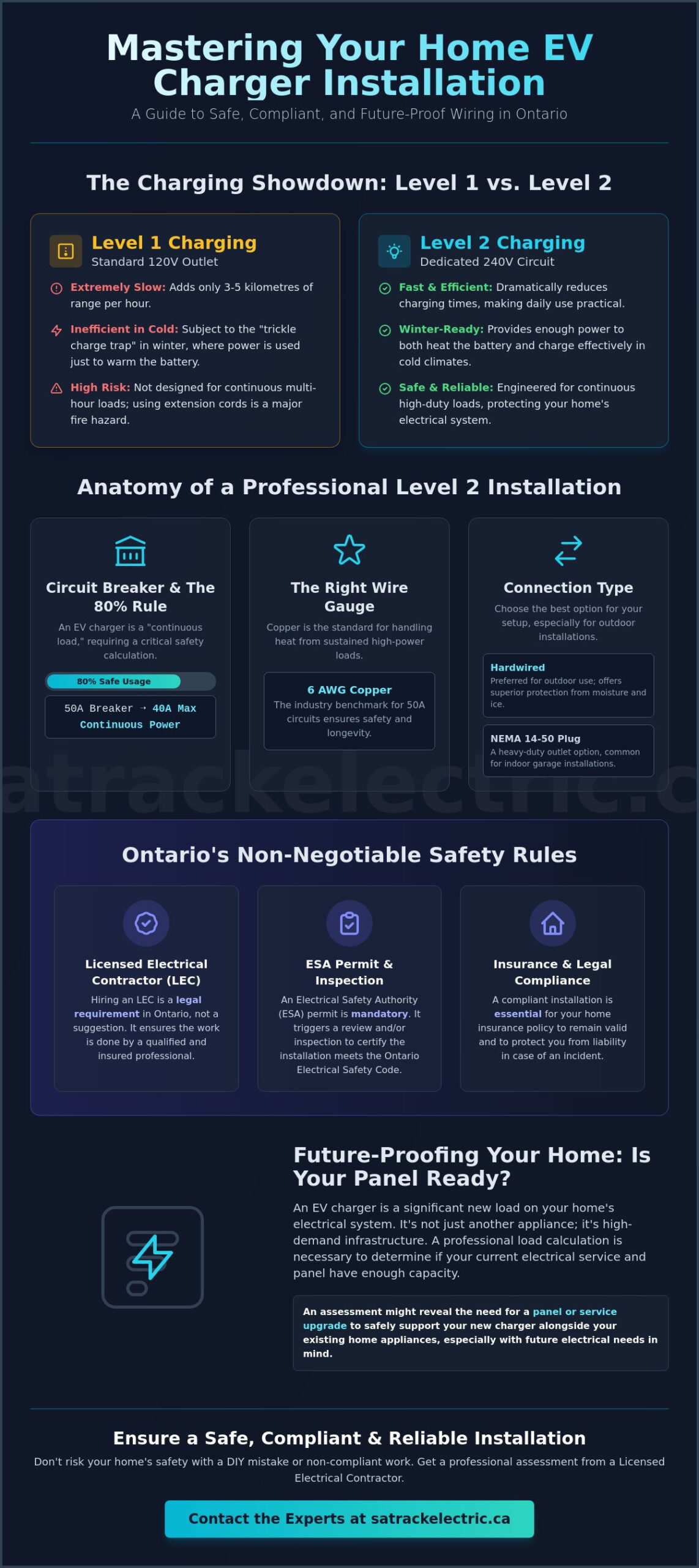
Most homeowners start their journey into electric mobility by using the Level 1 charging cord that came with their vehicle. While it’s convenient because it plugs into a standard 120V household outlet, this method is rarely sufficient for the needs of modern EVs. A standard outlet is designed for intermittent loads, like a coffee maker or a vacuum. In contrast, charging an electric vehicle is a continuous, high-duty cycle operation that can last for 12 hours or more. This creates significant thermal stress on your home’s electrical system, as the wires remain at their maximum rated capacity for extended periods.
Professional EV charger wiring for a Level 2 system addresses these safety and efficiency concerns by utilizing a dedicated 240V circuit. This is the same voltage used by heavy appliances like clothes dryers or ovens, but with a critical difference in how the power is delivered. Because an EV charger runs at full tilt for hours, the wiring must be sized to handle the heat without degrading the insulation or risking a connection failure. You can find more foundational information on EV charging station basics to see how these levels differ in their technical architecture.
Ontario’s climate adds another layer of complexity to these requirements. Cold temperatures increase electrical resistance, and in the depths of a Belleville winter, your vehicle’s battery management system must use energy just to keep the battery warm enough to accept a charge. On a Level 1 connection, you might find that most of the incoming power is consumed by the battery heater, leaving very little to actually increase your driving range. A robust Level 2 installation provides the “overhead” needed to charge the battery efficiently even when the mercury drops well below zero.
Why Level 1 Charging Struggles in the Quinte Region
When temperatures hit -20°C in the Quinte region, Level 1 charging often falls into the “trickle charge trap.” At this voltage, a vehicle might only gain three to five kilometres of range per hour. If you have a long commute from Trenton or Brighton, a standard outlet simply cannot keep up with your daily consumption. Furthermore, using standard extension cords to bridge the gap between your house and your driveway is a major fire hazard. These cords aren’t rated for continuous high-amperage use and can easily overheat under the snow.
The Anatomy of a Level 2 Circuit
The core of professional EV charger wiring involves installing a double-pole breaker in your electrical panel to provide 240V of power. We typically install 40A, 50A, or 60A circuits depending on your vehicle’s capabilities and your home’s available capacity. You must also choose between a hardwired connection or a NEMA 14-50 plug-in style. Hardwired installations are often preferred for outdoor setups in our region because they offer better protection against moisture and ice, ensuring a reliable connection regardless of the weather.
Technical Requirements: Wire Gauge, Breakers, and Conduit
The primary safety standard governing EV charger wiring is the 80% rule. Because an electric vehicle pulls power for many hours, it is classified as a continuous load. This means you cannot run a circuit at its maximum capacity indefinitely. For example, a 50A circuit is designed to provide only 40A of continuous power. Exceeding this limit leads to heat buildup, which can damage the breaker or melt wire insulation. Understanding these technical requirements for EV chargers is essential for a safe home setup.
Selecting the correct wire gauge is the next critical step in the installation process. While 8 AWG copper might suffice for smaller loads, 6 AWG copper is the industry benchmark for 50A circuits. Copper is the preferred material because it handles thermal stress more effectively than aluminum. In an Ontario residential context, we often use NMD90 (commonly called Romex) for interior runs through wall studs. However, when wiring is exposed on a garage wall, it must be protected by conduit. Choosing the right materials ensures the system remains stable under the heavy demand of daily charging cycles.
Selecting the Correct Wire for Continuous Loads
Wire choice depends largely on the installation environment. For runs through conduit, we utilize THHN or THWN-2 conductors, which are individual wires designed for high-temperature environments. If your charging station is located in a detached garage or a far corner of a property in Picton, we must account for voltage drop. Long distances can lead to power loss and reduced charging speeds, requiring a thicker wire gauge to maintain efficiency. Ensuring your residential electrical installation is sized correctly prevents these performance issues and protects your equipment.
Conduit and Protection Standards
Mechanical protection is a legal requirement in Ontario. Exposed EV charger wiring in a garage must be housed in EMT (Electrical Metallic Tubing) or PVC conduit to prevent physical damage. For outdoor pedestals, proper grounding and bonding are non-negotiable safety features. We use weatherproof boxes and liquid-tight connectors to shield the system from Quinte West’s snow and rain. Additionally, the 2024 Ontario Electrical Safety Code requires GFCI protection for most residential charging receptacles located in damp or outdoor areas to prevent shock hazards and ensure user safety.
Ontario Regulatory Landscape: ESA Permits and LEC Requirements
In Ontario, electrical safety is governed by a strict legal framework that ensures all installations meet rigorous standards. The 2024 Ontario Electrical Safety Code, which came into effect on May 1, 2025, is the current binding regulation for all EV charger wiring projects. This code exists to prevent electrical fires and equipment failure by mandating specific installation methods. Compliance is monitored by the Electrical Safety Authority (ESA), the provincial body responsible for public electrical safety. Ignoring these regulations doesn’t just put your home at risk; it carries significant legal and financial consequences.
Securing an ESA permit, officially known as a notification of work, is a mandatory step that must be completed before any installation begins. This permit creates a formal record of the project and triggers a professional inspection once the work is finished. For homeowners in the Quinte region, this documentation is essential for two primary reasons: insurance and resale. Most Canadian home insurance providers require a Certificate of Acceptance from the ESA to maintain coverage for electrical additions. Without it, you may face denied claims in the event of a fire. Additionally, savvy homebuyers now look for this certificate during the due diligence phase to ensure the property is safe and code-compliant.
The ESA has recently increased its enforcement efforts, conducting inspection blitzes to identify unpermitted work. A recent enforcement campaign identified over 400 violations across the province, highlighting the prevalence of unsafe, unlicensed installations. Engaging in “tailgating,” where an unlicensed individual performs the work under someone else’s credentials, is a major liability. Following the Ontario government guidelines for EV charger installation is the only way to guarantee your project meets provincial safety laws.
Hiring a Licensed Electrical Contractor (LEC)
By law in Ontario, only a Licensed Electrical Contractor (LEC) is authorized to perform residential electrical work for hire. It is important to distinguish between a general electrician and an LEC. While an individual may be a certified electrician, they must work for a company with a valid ECRA/ESA licence number to legally pull permits. Hiring a licensed insured electrician Ontario residents can trust ensures that the business carries the necessary liability insurance and WSIB coverage. You should always ask to see an LEC’s seven-digit licence number before signing any contract.
The ESA Inspection Process
Once your EV charger wiring is complete, the ESA inspector will review the installation to ensure it matches the submitted notification of work. Common reasons for inspection failure include improper grounding, using the wrong wire gauge for the breaker size, or failing to provide mechanical protection for exposed cables. If the work passes, the ESA issues a Certificate of Acceptance. This document is your proof of compliance and should be kept with your home records. It confirms that the installation was performed by a qualified professional and meets the highest safety standards in the province.
Future-Proofing Your Home: Capacity Planning and Panel Upgrades
Adding an EV charger isn’t as simple as finding an empty slot in your breaker box. Before beginning any EV charger wiring project, a professional must perform a load calculation based on the Ontario Electrical Safety Code. This calculation determines if your existing service can handle the sustained draw of a vehicle alongside your other appliances. Many older homes in Belleville operate on a 100-amp service. While this was adequate twenty years ago, it often struggles with the electrification needs of a modern household.
If the math reveals your home is near its limit, a 200-amp service upgrade becomes a necessity rather than a luxury. This transition ensures your home remains stable when the car is charging, the air conditioner is running, and you’re using the stove simultaneously. Beyond immediate needs, we recommend planning for a multi-EV household and exploring how renewable energy resources from MarGav Solar can complement your electrical setup. Running larger conduit or extra lines during the initial installation can save thousands of dollars in future labour costs as electric vehicle adoption continues to rise across Ontario.
Is Your Electrical Panel Too Small?
An overloaded panel often provides subtle warning signs before a major failure occurs. You might notice flickering lights when a large appliance starts or experience frequent tripped breakers. A dedicated circuit for your vehicle is essential to prevent these issues and maintain home safety. If your current system is at capacity, you can learn more about electrical panel upgrade Belleville services to ensure your property is ready for the future of mobility.
Smart Load Management Solutions
For homes where a full service upgrade isn’t immediately feasible, smart load management offers a viable alternative. Devices like a Demand Charge Controller (DCC) monitor your home’s total power consumption in real-time. If the home’s usage gets too high, the DCC temporarily pauses the EV charger to prevent a main breaker trip. This technology is particularly useful when integrating charging with other high-draw installations like hot tub wiring Belleville residents often enjoy. If you’re unsure about your home’s capacity, you should contact a licensed professional to determine the most efficient path forward for your specific needs.
The Satrack Advantage: Professional EV Wiring in the Quinte Region
Selecting a partner for your EV charger wiring project requires a balance of technical expertise and local accountability. We don’t just pull wires. Our team follows a methodical workflow that ensures every junction is secure and every conduit run is perfectly aligned. This disciplined approach is rooted in our commitment to safety and long-term reliability. We understand that a home charging station is a significant investment, and our goal is to provide a seamless experience that prioritizes your peace of mind from the initial assessment to the final ESA inspection.
Our reputation as a dependable local authority is built on years of delivering thorough results for both residential and commercial clients. We take pride in our workmanship, ensuring that every installation reflects our high standards for competence and integrity. By choosing a local specialist, you gain a partner who is deeply invested in the safety of the community. We treat every project with a sense of professional assurance, moving at a steady pace to ensure no detail is overlooked during the complex process of upgrading your home’s infrastructure.
Serving Belleville, Trenton, and Beyond
Our deep roots in the Quinte community mean we possess a detailed understanding of the specific requirements for various municipalities. We maintain professional relationships with local utility providers, including Elexicon and Hydro One, to ensure that every EV charger wiring installation aligns with regional grid standards. Whether you are located in the heart of Belleville or the rural outskirts of Brighton, our team arrives prepared with the tools and knowledge necessary for your specific environment. We focus on creating clean, organized installations that not only meet the 2024 Ontario Electrical Safety Code but also enhance the functionality of your garage or driveway.
Book Your EV Readiness Assessment
The first step toward a safe and efficient charging setup is a comprehensive electrical audit. During this assessment, we perform a detailed load calculation to determine how a new charger will interact with your existing service. We examine your panel capacity, identify the most efficient route for conduit runs, and provide clear, professional guidance on whether a service upgrade is necessary. This transparent communication ensures there are no surprises during the installation phase. We invite you to Contact Satrack Electric to secure your home’s electrical future and ensure your property is fully prepared for the next generation of electric mobility. Our methodical process guarantees a smooth, hassle-free experience that protects your vehicle and your home for years to come.
Preparing Your Property for the Electric Transition
Transitioning to an electric vehicle is a significant step toward a more sustainable lifestyle, but the foundation of that transition lies in your home’s infrastructure. Successful EV charger wiring depends on meticulous planning, from selecting the correct copper gauge to performing a rigorous load calculation. Adhering to the 2024 Ontario Electrical Safety Code and securing a mandatory ESA permit are not just legal hurdles; they are essential safeguards for your property and your family’s safety.
Satrack Electric brings professional assurance to every project we undertake. As a Licensed Electrical Contractor (LEC) serving Belleville, Trenton, and Quinte West, we specialize in complex panel upgrades and the installation of dedicated circuits designed for high-duty cycles. We take pride in delivering organized, code-compliant results that offer long-term reliability. You can Request a Professional EV Wiring Quote from Satrack Electric to begin your home’s upgrade with confidence. We look forward to helping you build a safe, efficient, and future-ready environment.
Frequently Asked Questions
Can I wire an EV charger myself in Ontario?
While Ontario law allows homeowners to perform electrical work on their own primary residence, it is highly discouraged for high-voltage systems like EV chargers. You are still legally required to obtain an ESA permit and pass a professional inspection. Most residents choose to hire a Licensed Electrical Contractor to ensure the installation meets the 2024 Ontario Electrical Safety Code and maintains their home insurance coverage.
What is the best wire gauge for a 50-amp EV charger?
We recommend using 6 AWG copper wire for a 50-amp circuit to ensure safe and efficient power delivery. While some configurations might technically allow for 8 AWG on shorter runs, 6 AWG handles the thermal stress of continuous charging much more effectively. Using copper conductors instead of aluminium provides superior heat resistance, which is vital for a circuit that runs at high capacity for several hours.
Do I need an ESA permit for a plug-in EV charger?
Yes, you must obtain an ESA permit for the installation of a new 240V outlet intended for a plug-in charger. The Electrical Safety Authority requires a notification of work for any new circuit or modification to your home’s electrical system. This process ensures the outlet and the associated EV charger wiring are installed correctly and can safely support the heavy load required by the vehicle.
How much does it cost to wire an EV charger in a garage?
The total cost for wiring a charger varies depending on the complexity of your home’s layout and the distance between your electrical panel and the charging location. Factors such as the need for a service upgrade, the length of conduit runs, and any required trenching will influence the final price. We suggest booking a professional site assessment to receive a detailed estimate based on your property’s specific technical requirements.
Will an EV charger work with my 100-amp electrical panel?
A 100-amp panel can sometimes support an EV charger, but it depends on your home’s existing electrical load. We must perform a professional load calculation to see how much capacity remains after accounting for high-draw appliances like your stove and air conditioner. If your panel is near its limit, we may recommend a service upgrade or a smart load management device to prevent the main breaker from tripping.
What is the difference between a hardwired charger and a NEMA 14-50 outlet?
A hardwired charger is permanently connected to your home’s electrical system, whereas a NEMA 14-50 is a heavy-duty outlet that allows you to plug the unit in. Hardwired installations are often the preferred choice for outdoor setups in the Quinte region because they offer better protection against snow and ice. They also typically support higher amperage, allowing for faster charging speeds than most plug-in models.
How long does a professional EV charger installation take?
A standard EV charger wiring project typically takes between three to six hours to complete. This timeframe includes mounting the charging station, installing the dedicated breaker, and running the protected conduit. If your project requires more extensive work, such as a panel upgrade or running lines to a detached garage, the installation may take a full day to ensure every component is thoroughly tested and code-compliant.
Does cold weather affect the wiring of my EV charger?
Cold weather impacts charging efficiency and the physical flexibility of materials during the installation process. In Belleville’s winter temperatures, your vehicle’s battery heater will draw significant power, which makes a robust Level 2 circuit essential for consistent performance. We use high-quality wire insulation and weatherproof connectors that are specifically rated to withstand the freeze-thaw cycles common in Ontario without degrading over time.