
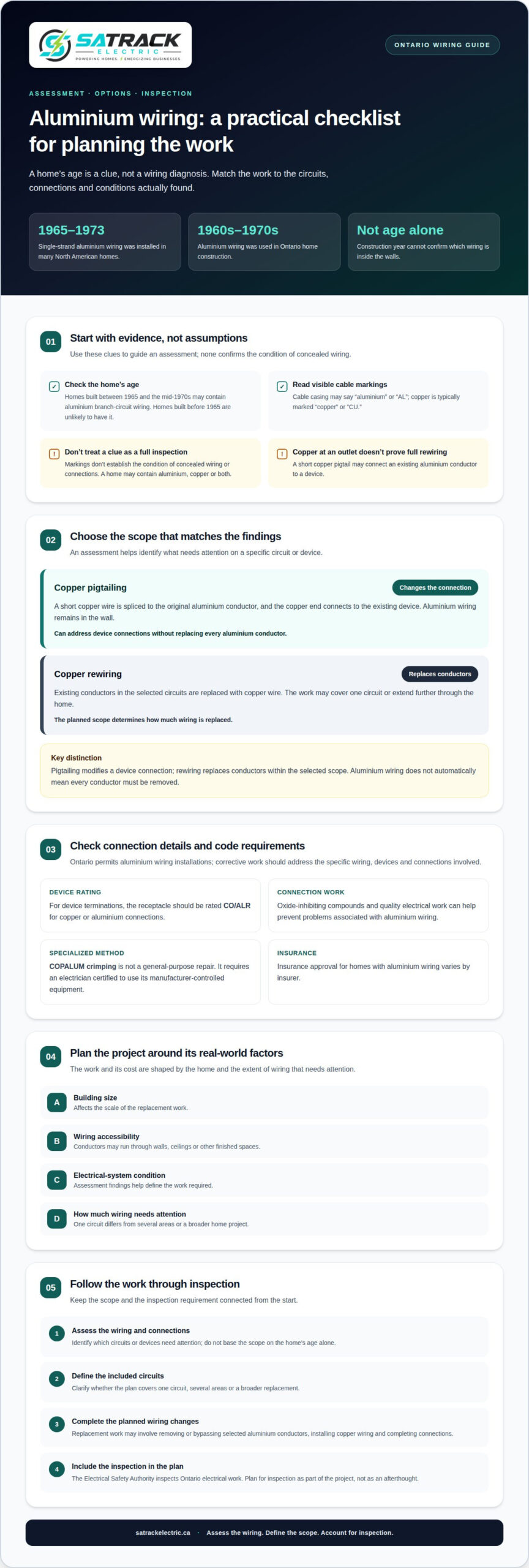
Aluminium wiring was used in Ontario construction during the 1960s and 1970s, and residential cables installed between 1965 and the mid-1970s may contain it. A home’s age is a useful first clue, but it doesn’t confirm what wiring is inside its walls. Aluminium wiring replacement isn’t always the only option: copper pigtailing may address device connections without removing every aluminium conductor.
The concern isn’t simply that aluminium wiring is present. Heating and cooling, oxidation and movement at connections can contribute to loose or deteriorating connections over time. The Ontario Electrical Safety Code permits aluminium wiring installations, while insurance approval varies by insurer.
This guide explains when aluminium wiring was used in Ontario, why connections can fail, and how electrical codes and insurance may affect your next steps. It also covers the main factors that shape replacement costs, including building size, wiring accessibility, electrical system condition and how much wiring needs attention.
Key Takeaways
- Learn why the age of a home can suggest when aluminium wiring may have been installed, but can’t confirm what is inside the walls.
- Understand how copper pigtailing can address device connections while leaving existing aluminium wiring in place.
- See the connection-failure risks behind a U.S. Consumer Product Safety Commission finding about older aluminium-wired homes.
- Identify how building size, wiring access, electrical-system condition and project scope influence replacement work and cost.
- Follow the stages of a replacement project, from assessing the wiring to completing and inspecting the electrical work.
When was aluminium wiring used in Ontario?
Aluminium wiring was used in Ontario home construction during the 1960s and 1970s. Residential electrical cables installed between 1965 and the mid-1970s may contain aluminium branch-circuit wiring. Homes built before 1965 are unlikely to have it. These dates help narrow down what a home might contain, but the construction year alone can’t identify its wiring.
Single-strand aluminium wiring was installed in many North American homes between 1965 and 1973. That period falls within the broader window when Ontario homes were wired with aluminium. A house built during those years may have aluminium wiring, copper wiring, or both, particularly if electrical work has changed the original installation. The year of construction is a useful starting point, not a complete wiring record.
Visible cable markings can provide another clue. Aluminium wiring may be marked “aluminium” or “AL” on its casing, while copper wiring is typically marked “copper” or “CU.” These markings identify the conductor material, but they don’t establish the condition of concealed wiring or connections. Seeing copper at an outlet also doesn’t prove that every circuit has been rewired; a short copper pigtail may connect an existing aluminium conductor to a device.
Copper pigtailing offers an alternative to replacing every aluminium conductor. The process splices a short length of copper wire to the original aluminium wire, then connects the copper end to the existing electrical device. This changes the connection at the device while leaving the aluminium wiring in the wall. It can address device connections without full rewiring, but it doesn’t mean the home’s branch-circuit wiring is entirely copper.
Full copper rewiring takes a different approach: existing conductors in the selected circuits are replaced with copper wire. The scope may cover specific circuits or extend further through the home, depending on the planned work. For example, a homeowner may consider rewiring one circuit rather than replacing wiring throughout the house. The distinction matters: pigtailing modifies connections, while rewiring replaces conductors.
Homeowners don’t necessarily need to remove all aluminium wiring. Copper pigtailing is one alternative, while copper rewiring replaces wiring within the selected scope. The right comparison starts with identifying which circuits contain aluminium and what work is intended. A home built between 1965 and the mid-1970s deserves closer attention to its wiring history, but its age alone doesn’t determine whether pigtailing or rewiring is appropriate.
Electrical upgrades to current building standards and safety codes
In Ontario, the Electrical Safety Code permits aluminium wiring installations. An upgrade should address the specific wiring, devices and connections involved.
Electrical Assessments and Corrective Work
An electrical assessment examines wiring and connections to identify the work needed on a specific circuit or device. The appropriate correction depends on the assessment findings, not simply the home’s age. For example, an electrician may identify a device connection that needs attention without recommending replacement of every conductor. Those findings help define the project scope.
For device terminations, the receptacle should be rated CO/ALR for copper or aluminium connections. This marking indicates that the device is intended for those conductor materials. Oxide-inhibiting compounds and quality electrical work can also help prevent problems associated with aluminium wiring. These measures address connection details; they don’t turn existing aluminium conductors into copper wiring.
The method matters, too. Copper pigtailing joins a short copper wire to an existing aluminium conductor, so the device connects to the copper end. The splice and connector must suit the materials and the work. COPALUM crimping is a specialized option, not a general-purpose repair. It requires an electrician certified to use its manufacturer-controlled equipment.
Replacement Process and Timeline
Replacement involves defining which circuits are included, removing or bypassing the selected aluminium conductors, installing copper wiring and completing the connections. The scope affects the work: replacing wiring in one circuit differs from rewiring several areas of a home. Access also shapes the process, since conductors may run through walls, ceilings or other finished spaces. These details influence the project sequence and duration.
Ontario electrical work is inspected by the Electrical Safety Authority. This inspection is part of the local safety framework for electrical work, including upgrades that involve wiring changes. An assessment and a clear description of the planned work help establish what needs to be completed before inspection. Include inspection requirements in the project plan rather than leaving them until after the electrical work is finished.
Choose a qualified electrician for assessment and corrective work involving aluminium connections. This is especially important for specialized methods: a COPALUM crimp must be completed by an electrician certified to use the equipment. For a home upgrade, electrical upgrade support can help connect the assessment, corrective work and replacement scope.
Heating and cooling cycles and connection failure
Electrical loads heat wire connections, which cool when the loads stop. Repeated temperature changes can weaken aluminium wiring connections over time.
Overheating and Fire Risks
A loose connection can reduce the contact area, increasing resistance and heat at an outlet. As the connection heats and cools, movement can make the fit less secure. A damaged or deteriorating connection may then overheat further, creating a fire hazard. The risk is concentrated at connection points, such as outlets and switches, rather than explained by the wire’s presence alone.
A Franklin Research Institute survey for the U.S. Consumer Product Safety Commission found that homes built before 1972 and wired with aluminium were 55 times more likely to have one or more outlet wire connections reach fire-hazard conditions than homes wired with copper. The finding concerns homes in the survey, not a prediction that every Ontario home with aluminium wiring will have a fire. It does show why the condition of outlet connections matters.
Aluminium expands three times as much as copper. Where a conductor is held by a terminal, repeated expansion and contraction can contribute to a loose connection. For example, a kitchen outlet serving an appliance with a larger load may heat while current flows, then cool when the appliance stops. Repeated cycles put stress on the connection.
Oxidation and Connection Failure
Oxidation occurs when exposed aluminium reacts with oxygen, forming a layer on the conductor’s surface. At a connection, gaps can expose more wire to oxygen. Oxidation can impede electrical flow and contribute to heat, creating a cycle: a poor connection allows exposure, oxidation worsens contact, and added resistance can increase heating.
Heating and cooling can also make connection points brittle over time. As a connection loosens, gaps may widen, exposing more aluminium and increasing the chance of further oxidation. These changes can compound: movement affects contact, oxidation affects current flow, and heat adds stress to the connection. That’s why connection condition is central to evaluating aluminium wiring.
Replacement costs and project factors
The cost of aluminium wiring replacement depends on the project scope and the building’s conditions. Work on a few affected circuits involves different wiring and access needs from a whole-house project.
Four factors shape an estimate: building size, wiring accessibility, the electrical system’s condition and how much wiring needs replacement. A compact area with accessible wiring can require different work from a larger home with conductors concealed behind finished walls. Existing damage or other electrical work can also affect the scope. An estimate should reflect the actual circuits and work involved, not just the home’s age.
Project size matters, but outlet count alone doesn’t describe the full job. Replacing conductors may require access through walls or ceilings, and restoring those areas can be part of the project considerations. Replacing wiring on a limited circuit differs from work throughout the house, even if both projects include several outlets. The electrical system’s condition can also change what corrective work belongs in the scope.
Whole-House Replacement Costs
Whole-house replacement means replacing aluminium wiring across the home, rather than addressing selected circuits or connections. The cost reflects the building’s size, wiring access and amount of electrical work required. For example, a home with hard-to-reach wiring presents a different scope from one where conductors are more accessible. “Whole-house” describes the coverage, but doesn’t make every project identical.
Before comparing estimates, distinguish whole-home work from a targeted project. An estimate should make clear whether it covers all wiring or only specific circuits, and whether associated electrical work is included. This gives homeowners a practical way to understand what each proposed scope addresses and avoids comparing a limited repair with full rewiring as though they were equivalent.
Remediation Costs
Remediation addresses aluminium-wiring concerns without necessarily replacing every conductor. Depending on the work required, it may focus on connections, while replacement removes and renews wiring within the agreed scope. These approaches involve different amounts of labour and access, so their costs can differ. The right approach depends on the wiring condition and the corrective work identified for the home.
Before settling on a scope, clarify which circuits and outlets are included, whether the work is remediation or replacement, and how access affects the job. Work on several outlets on selected circuits isn’t the same as rewiring the entire house. The price depends on the case and is provided after a quote request. Building size, access, system condition and replacement scope shape the estimate.
How long does aluminium wiring replacement take, and what does the process involve?
There’s no single timeline for aluminium wiring replacement. The work depends on how many circuits are included, where the wiring runs, how accessible it is and the electrical system’s condition. Replacing wiring in a limited area differs from work throughout a home. Finished walls, ceilings and other obstacles can affect access and the work sequence.
The process starts by defining the project scope. An electrician assesses the affected wiring and identifies which circuits need replacement. The plan distinguishes conductors being replaced from wiring that remains, and clarifies which outlets or other electrical points are included. For example, a project focused on selected kitchen circuits has a different scope from one covering several areas of a house.
Next, the wiring route and access points shape the work plan. Conductors may run through walls, ceilings or accessible spaces such as a basement. The route affects how existing wiring can be reached and how new conductors will be installed. If access requires opening finished surfaces, that can add work beyond the electrical installation itself. The project scope should account for these practical conditions.
During installation, the selected aluminium conductors are replaced with copper wiring, and the affected electrical connections are completed. The electrician coordinates the work circuit by circuit, following the defined scope. In a partial project, this means replacing conductors on the included circuits rather than treating every wire in the house as part of the job. A clear scope helps distinguish replacement from connection remediation.
After installation, the electrical work is reviewed and the applicable inspection process is addressed. In Ontario, the Electrical Safety Authority inspects electrical work. Inspection is a distinct project stage, so include it in the schedule alongside installation. The work may also involve coordinating access to outlets and other areas where wiring runs, particularly in finished rooms or along concealed routes.
To understand the likely schedule, focus on the project’s actual drivers: circuit count, wiring route, access, system condition and inspection. A small, accessible scope and a whole-home project aren’t equivalent, even if both involve copper conductors. The stages are assessment, scope definition, access planning, installation and inspection; the amount of work at each stage determines the overall timing.
If your electrical project also includes a hot tub or spa, discuss hot tub and spa wiring as part of planning the work.
Satrack Electric: Hot tub and spa wiring
Satrack Electric provides hot tub and spa wiring for residential and commercial properties in Belleville, Trenton, Picton, Brighton, Quinte West, Greater Napanee, Cobourg and surrounding communities. If you’re planning a spa installation while addressing other electrical work, keep each project’s wiring requirements clear. Hot tub wiring is separate from replacing or remediating existing household wiring, so consider each scope on its own.
Satrack Electric also provides residential and commercial electrical services, including electrical repairs, in Belleville, Trenton, Picton, Brighton, Quinte West, Greater Napanee, Cobourg and surrounding communities. These services can help homeowners and businesses address broader electrical needs alongside a hot tub or spa wiring project. Contact Satrack Electric to discuss your spa installation, electrical repair or other project requirements.
Plan a clear next step for your home
Choosing aluminium wiring replacement is also an opportunity to define what matters most in your home. Consider how the project fits with planned renovations, which areas need attention first and how wiring access may affect your household. Sharing these priorities helps frame a practical discussion about the project scope.
A useful conversation can focus on your concerns, the areas involved and how electrical work may fit alongside other property plans, including broader clean energy goals. For homeowners interested in how residential solar and storage solutions are structured, maknenergy.com.au provides insight into modern solar panel and battery setups. This gives the assessment a clear purpose and keeps decisions centred on your needs, rather than assumptions based only on the home’s age.
For support with your electrical project, contact Satrack Electric. A clear starting point can make the next decision feel more manageable.
Frequently Asked Questions
What are the cost implications of different remediation approaches?
Connection remediation and conductor replacement involve different scopes, so their costs differ. Pigtailing addresses selected device connections, while wiring replacement covers the conductors within the agreed project area. Work involving several outlets on one circuit isn’t equivalent to work throughout a home. An estimate should identify the approach, affected circuits, access requirements and any corrective work needed, so you can understand what the proposed scope includes.
What are the risks of aluminium wiring in Canadian homes?
The main concern is deterioration at connections, where heat, movement and oxidation can contribute to poor electrical contact. For instance, a loose outlet connection can heat under load, while damaged wiring or connectors may show burn marks. Breakers tripping under appliance loads are another reason to have the affected circuit assessed. These signs don’t prove aluminium wiring is the cause, but they warrant attention from a qualified electrician.
Does aluminium wiring need to be replaced, or can it be made safe?
Aluminium wiring doesn’t automatically need complete removal. Options include correcting device connections or replacing selected conductors, depending on the wiring’s condition and project scope. For example, if the concern is limited to particular outlets, work can focus on those connections rather than every circuit. An electrical assessment helps identify which areas need corrective work and whether targeted remediation or broader rewiring best addresses the condition found.
What are the options for aluminium wiring remediation: full rewiring, pigtailing, or approved connectors?
Full rewiring replaces conductors within the project scope; pigtailing joins a short copper wire to existing aluminium at a device. Receptacles used for these terminations should be rated CO/ALR. COPALUM crimping is another specialized connection method, using manufacturer-controlled equipment operated by an electrician certified for it. These approaches aren’t interchangeable: the right one depends on the connection, wiring condition and extent of work required.
How much does aluminium wiring replacement cost in Canada?
The cost depends on the property and replacement scope, so there isn’t one figure that applies to every Canadian home. A project limited to selected circuits differs from whole-house rewiring. The price depends on the case and is provided after a quote request. Building size, wiring accessibility, electrical-system condition and how much wiring needs replacement all shape the estimate. Clarify whether the proposed work covers specific circuits or the entire home.
What factors affect the cost of replacing aluminium wiring in a house?
Building size, wiring access, electrical-system condition and the amount of wiring being replaced all affect project cost. For example, conductors concealed behind finished walls can require different access work than wiring reached through an unfinished area. The number of circuits included matters too: a defined project for selected rooms differs from a whole-house scope. A detailed estimate should state which areas and related electrical work are included.
What does the Canadian Electrical Code require for aluminium wiring repairs and replacement?
For an Ontario home, the Ontario Electrical Safety Code permits aluminium wiring installations. Receptacles used with aluminium or copper terminations should be rated CO/ALR. Repairs must account for the conductor material and the device or connector used at each termination. Applicable code requirements depend on the jurisdiction and work involved, so an Ontario rule shouldn’t be assumed to apply to every province or municipality.
Do Canadian provinces or municipalities require permits and inspections for aluminium wiring work?
In Ontario, the Electrical Safety Authority inspects electrical work. Inspection and permitting are separate considerations, and local regulations and project scope shape the required process. Before work begins, the project plan should identify the electrical work involved and account for applicable inspection steps. Ontario requirements shouldn’t be treated as rules for every municipality or province; governing electrical requirements depend on the property’s location.