
Could your home’s outdated electrical panel be the only thing standing between you and a cancelled insurance policy? Many homeowners in the Quinte region feel a sense of urgency when an insurance provider flags a 60-amp service or an old fuse box as a significant liability. It’s frustrating to face these requirements without a clear understanding of the panel upgrade cost Ontario contractors charge or the regulatory hurdles involved. We understand that you want a safe, code-compliant home that meets modern standards without any unwelcome financial surprises during the process.
This guide provides a professional overview of the primary factors influencing your investment, from the 1.9 per cent ESA fee increase effective April 2026 to the new 12 kW Plan Review threshold. You’ll learn how the 29th edition of the Ontario Electrical Safety Code affects your project and what’s required to ensure your home is ready for high-demand technology like electric vehicles and heat pumps. By the end of this article, you’ll have the technical knowledge and budgeting confidence needed to organize a successful transition to a 100-amp or 200-amp service while maintaining full compliance with provincial safety regulations and insurance standards.
Key Takeaways
- Understand how labour rates and material choices in the Quinte region directly impact your final invoice.
- Learn why the panel upgrade cost Ontario homeowners pay is influenced by 2026 ESA fee structures and safety code updates.
- Identify the specific documentation and permit requirements needed to ensure your electrical work is fully compliant and insurance-approved.
- Discover how modernizing your system supports high-demand additions like electric vehicle chargers and energy-efficient heat pumps.
- Recognize the importance of hiring a licensed contractor to handle the technical complexities and mandatory safety inspections of a service upgrade.
Understanding the Basics of Electrical Panel Upgrade Costs
Starting an electrical project requires a clear understanding of the project’s scope and regulatory environment. Your home’s distribution board is the central hub of its safety system, managing the flow of electricity to every room. In Ontario, every modification to this system is strictly regulated by the Electrical Safety Authority (ESA). Compliance isn’t optional; it’s a legal requirement that ensures your property remains safe and your insurance coverage stays valid. Many homeowners discover that their existing 60-amp service or aging fuse box is no longer acceptable to modern insurance underwriters. This realization often triggers an inquiry into the panel upgrade cost Ontario residents should budget for when modernizing their home’s infrastructure.
The ESA enforces the Ontario Electrical Safety Code to prevent electrical fires and shock hazards. As of May 2025, the 29th edition of this code is in effect, introducing stricter requirements for grounding and circuit protection. Insurance companies frequently mandate these upgrades before they will renew a policy or finalize a home sale. They view outdated equipment as a high-risk liability. Upgrading your system isn’t just about convenience; it’s a necessary step to protect your investment and maintain the long-term viability of your property.
Panel Swap vs. Service Upgrade
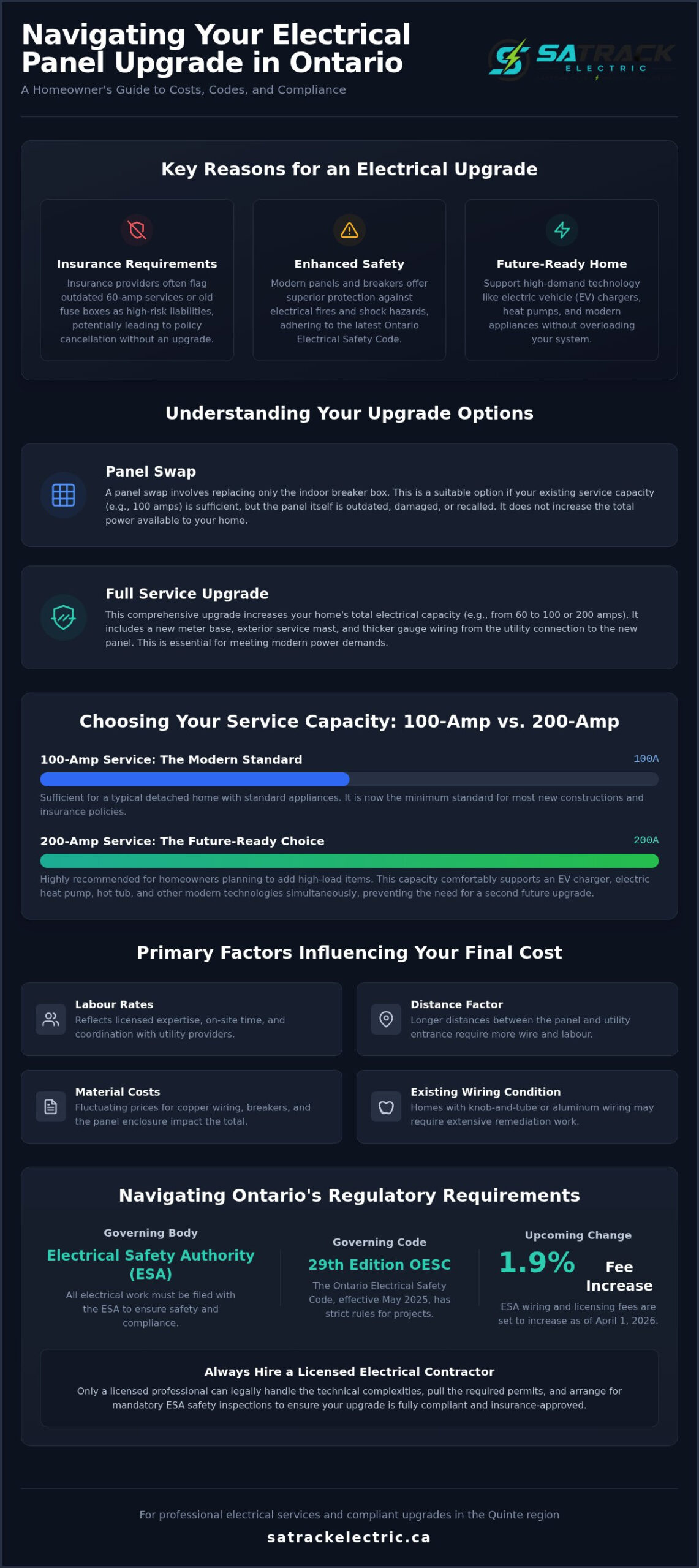
A common point of confusion is whether a project requires a simple panel swap or a comprehensive service upgrade. A panel swap involves replacing the indoor breaker box while keeping the existing exterior wires and service entrance. This is often possible if your current service capacity is sufficient but the hardware is damaged, obsolete, or recalled. However, if you’re increasing your capacity, you’ll likely require a full service upgrade. This process includes installing a new meter base, a sturdier exterior service mast, and thicker gauge wiring from the utility connection. The complexity of this meter-to-panel connection is a primary driver in the total panel upgrade cost Ontario contractors must factor into their detailed estimates.
The 100-Amp vs. 200-Amp Decision
Modern living demands significantly more power than homes built just a few decades ago. While 100-amp service was once the standard for a typical detached home, 200-amp is rapidly becoming the preferred choice for future-proofing in 2026. This shift is largely driven by the widespread adoption of electric vehicle chargers and high-efficiency electric heat pumps. If you plan to stay in your home long-term, moving to 200-amp now prevents the need for a second, more expensive upgrade later. It’s essential to evaluate your current load and anticipate future additions. A licensed professional will perform a load calculation to determine if your system can handle these modern demands safely and efficiently.
Primary Factors That Influence Your Final Invoice
Calculating the panel upgrade cost Ontario residents face requires a detailed look at variables beyond the hardware itself. While the physical panel is a fixed component, the labour and surrounding infrastructure often dictate the final total. In the Quinte West and Belleville areas, labour rates reflect the expertise required to navigate local utility standards and the latest safety protocols. Licensed professionals must account for the time spent on site, including the mandatory coordination with utility providers for power disconnects and reconnects.
Material costs also play a significant role. The price of copper wiring, high-quality breakers, and the panel enclosure itself can fluctuate based on market conditions. Additionally, the physical layout of your home affects the bottom line. The “distance factor” refers to how far your panel sits from the exterior utility service entrance. Longer runs require more heavy-gauge copper wire and additional labour to route through finished or cramped spaces. All professional work must be filed with the Electrical Safety Authority (ESA), which increased its wiring and licensing fees by 1.9 per cent as of April 1, 2026. If you are unsure about your home’s current capacity, booking a professional inspection for residential electrical services can provide much-needed clarity.
The Age and Condition of Existing Wiring
Older homes in Ontario often present hidden challenges that extend the project timeline. If your property still utilizes knob-and-tube or aluminum wiring, these legacy systems must be addressed to meet the 29th edition of the Ontario Electrical Safety Code. Modern grounding and bonding requirements are much stricter than they were decades ago. Bringing a system up to code often involves more than just a panel swap; it requires remediating previous “handyman” modifications that may have compromised the system’s integrity over the years.
Hardware Quality and Breaker Types
The type of breakers required by the 2024 OESC significantly impacts material costs. Modern codes now mandate Arc-Fault Circuit Interrupter (AFCI) protection for most residential circuits to prevent electrical fires. These specialized breakers are more expensive than standard thermal breakers but offer superior safety. Many homeowners also choose to install whole-home surge protection during an upgrade. This protects expensive electronics and appliances from external power spikes, providing a layer of security that standard panels lack. Choosing reputable brands ensures that replacement parts remain available for decades to come.
Navigating Ontario Regulatory Requirements and ESA Permits
Hiring an unlicensed electrician might seem like a way to reduce the initial panel upgrade cost Ontario homeowners encounter, but it creates severe legal and safety liabilities. In Ontario, all electrical work must be performed by a Licensed Electrical Contractor (LEC). An unlicensed “side-job” worker cannot pull the necessary permits or provide the required documentation for your insurance company. This lack of oversight puts your property at risk and could lead to a voided insurance policy.
The process begins with filing a notification with the Electrical Safety Authority (ESA) before work commences. Once the installation is complete, an ESA inspector reviews the work to ensure it adheres to the 29th edition of the Ontario Electrical Safety Code. This rigorous oversight protects your family from fire hazards and ensures the longevity of your home’s infrastructure. Safety is the priority. Following these steps ensures your system meets the highest provincial standards.
The Cost of Compliance: Permit Fees
ESA permit fees are structured based on the specific scope of the project. For a standard residential upgrade, these fees typically range from $100 to $300. While this adds a small amount to the total panel upgrade cost Ontario residents budget for, the value of the resulting “Certificate of Acceptance” is immense. This document serves as your official proof for insurance providers and future home buyers that the work is safe and code-compliant. Satrack Electric manages the entire filing process. We ensure all documentation is accurate and submitted on time to prevent unnecessary delays.
Utility Disconnect and Reconnect Logistics
A panel upgrade requires a coordinated “power out” window. Local utility companies like Hydro One or Elexicon Energy must disconnect the service from the grid so our team can work safely. We schedule these windows meticulously to minimize the time your home is without electricity. Utilities often charge their own service fees for these alterations. These costs are separate from the contractor’s labour or material fees. A methodical workflow ensures the transition happens smoothly. Power is restored as soon as the inspector provides the final authorization.
Why Quinte Region Homeowners Are Upgrading in 2026
The Quinte region is experiencing a significant shift in residential energy consumption. In Belleville and Trenton, the surge in electric vehicle (EV) ownership has transformed a service upgrade from a luxury into a necessity. Most older homes were built with 100-amp services that simply cannot support the simultaneous load of a Level 2 EV charger, a modern kitchen, and laundry facilities. When calculating the panel upgrade cost Ontario residents must consider, it’s vital to view this as a foundational step toward a fully electrified home. Modern appliances demand more than legacy systems can provide.
Beyond transportation, many residents in Picton and Prince Edward County are transitioning from legacy oil or gas heating to high-efficiency electric heat pumps. These systems offer impressive climate control but require a stable, high-capacity electrical backbone. During these upgrades, many homeowners also choose to prepare their infrastructure for backup generator installation. This foresight ensures that your home remains functional during the severe weather events that occasionally affect our region. If you’re planning multiple home improvements, consulting a professional for electrical upgrades can help you sequence these projects efficiently.
Future-Proofing for EVs and Smart Homes
A 200-amp upgrade is the gold standard for modernizing a property. It provides the necessary capacity for Level 2 home charging, which can draw significant current for several hours at a time. This capacity also allows for the seamless integration of smart home energy monitors. These devices provide real-time data on your consumption, helping you manage costs as utility rates evolve. A larger panel ensures you have enough physical circuit spaces for future basement renovations or kitchen expansions without needing a secondary sub-panel later.
Addressing Insurance Red Flags
Ontario insurers are increasingly stringent regarding outdated electrical hardware. Many providers now refuse to renew policies for homes with 60-amp services or active fuse boxes. They view these systems as fire hazards that are ill-equipped for modern appliance loads. Investing in a professional electrical panel upgrade removes these red flags and often leads to lower annual premiums. It provides documented proof that your home meets the 2024 Ontario Electrical Safety Code, offering both financial savings and peace of mind regarding your property’s safety.
Investing in Safety with Satrack Electric
Choosing a partner for your home’s electrical infrastructure requires a focus on long-term stability and technical safety. Satrack Electric provides a sense of professional assurance through every stage of the process, ensuring that your property meets the highest provincial standards. As a licensed and insured contractor, we prioritize competence over quick fixes. We understand that the panel upgrade cost Ontario residents invest in represents a commitment to their family’s safety and their property’s future value. Our team serves the entire Quinte region, including Belleville, Trenton, and Napanee, with a steady demeanour that instills confidence in every client.
Hiring a licensed professional is the only safe choice for panel work. An unlicensed worker cannot legally pull the required ESA permits or provide the documentation your insurance company demands. We take our responsibilities seriously, maintaining a formal and grounded approach to every installation. By handling all the regulatory paperwork and coordinating directly with utility providers, we remove the stress and confusion often associated with major electrical projects. You can trust that our work is performed by seasoned experts who value integrity and thorough results above all else.
Our Methodical Workflow
Our approach to every project is disciplined and organized. We begin with a comprehensive site assessment to identify any existing code violations or specific challenges within your home’s wiring. This planning phase allows us to provide a clear and accurate scope of work. During the installation, we follow a methodical workflow designed to minimize disruption to your daily routine. We coordinate the power disconnect and reconnect windows with precision, ensuring that the transition to your new system is as smooth as possible. Once the hardware is in place, we facilitate the final ESA certification, providing you with the official proof of compliance required for your records.
Total Capability for Residential and Commercial Needs
While many of our projects involve residential homes, we also possess the total capability required for complex commercial service upgrades. These larger projects demand a high level of technical expertise and a deep understanding of industrial safety regulations. Whether you’re upgrading a small home in Picton or a commercial facility in Belleville, our standards remain unwavering. Long-term safety also requires consistent attention. We recommend scheduling routine electrical maintenance to ensure your new panel and its associated circuits remain in peak condition. We invite you to contact us for a professional consultation to discuss your specific needs and receive a detailed assessment of your system’s current capacity.
Secure Your Home’s Electrical Future
Upgrading your electrical system is a strategic investment that addresses immediate safety concerns while preparing your home for the next generation of energy needs. It’s important to recognize that the panel upgrade cost Ontario residents encounter reflects a commitment to provincial safety standards and long-term property value. Whether you’re remediating insurance red flags or preparing for a heat pump installation, the priority remains unwavering reliability and total code compliance. A modernized system provides the capacity required for modern living without compromising on safety.
As a Licensed Electrical Contractor serving the Quinte region, Satrack Electric provides the technical expertise and professional assurance required for these complex installations. We manage every aspect of the project, including mandatory ESA paperwork and utility coordination, to ensure your workmanship is fully guaranteed. Request a professional quote for your Ontario panel upgrade to begin the process of modernizing your home. We look forward to partnering with you to create a safer, more efficient electrical environment for your family.
Frequently Asked Questions
How much does a typical 200-amp panel upgrade cost in Ontario?
The total investment for a 200-amp upgrade depends on your home’s current infrastructure and its distance from the utility connection. Factors such as the 1.9 per cent ESA fee increase in 2026 and the cost of specialized AFCI breakers influence the final total. Because every property has unique grounding and wiring requirements, the panel upgrade cost Ontario homeowners pay is best determined through a professional site assessment that accounts for all material and labour variables.
How long does the power stay off during an electrical panel upgrade?
A standard panel upgrade typically requires a power interruption lasting between four and eight hours. This window allows our team to safely remove obsolete hardware and install new equipment while the service is disconnected from the grid. We coordinate the “power out” window with local utilities like Hydro One or Elexicon Energy to ensure the transition is as efficient as possible. Power is restored once the installation meets the inspector’s safety requirements.
Do I need a permit from the ESA to change my electrical panel?
Yes, filing a notification with the Electrical Safety Authority (ESA) is a legal requirement for any panel replacement in Ontario. This process ensures that your project is reviewed by an inspector and complies with the 29th edition of the Ontario Electrical Safety Code. After a successful inspection, you receive a Certificate of Acceptance. This document serves as vital proof for your insurance provider that the work meets provincial safety standards.
Can I upgrade my own electrical panel if I am the homeowner?
While Ontario regulations allow homeowners to perform certain work on their own residence, a service upgrade involves high-voltage utility connections and complex safety protocols. Most insurance companies and utility providers require that a Licensed Electrical Contractor perform this specific work to ensure it passes the mandatory ESA inspection. Hiring a professional guarantees that the installation is code-compliant and safely integrated with the municipal power grid without risking your property’s insurance eligibility.
Will a panel upgrade increase the resale value of my home in Ontario?
An electrical upgrade significantly improves a property’s marketability and value by removing common “red flags” found during home inspections. Modern buyers actively seek homes with 200-amp service that are ready for electric vehicle chargers and energy-efficient heat pumps. A new panel, backed by a Certificate of Acceptance, provides documented proof that the home’s infrastructure is safe and modern. This investment often results in smoother real estate transactions and potentially lower annual insurance premiums.
What is the difference between a fuse box and a circuit breaker panel?
Fuse boxes use internal filaments that melt to stop electrical flow during an overload, requiring physical replacement after every trip. In contrast, modern breaker panels use resettable switches that provide more reliable protection for the high-demand loads of 2026. Breakers also support advanced safety technology like Arc-Fault Circuit Interrupter (AFCI) protection. Most Ontario insurers now mandate the transition to breakers because they are better equipped to handle contemporary household electricity demands safely.
How do I know if my current electrical panel is too small for my home?
If you experience frequent breaker trips, flickering lights when appliances start, or have no physical room for new circuits, your panel is likely at capacity. Many older homes in the Quinte region still operate on 60-amp or 100-amp services that aren’t designed for modern electrification. A professional load calculation is the most accurate way to determine if your current system can safely support new additions like a hot tub or a Level 2 EV charger.
Does my insurance company require me to upgrade from 60-amp to 100-amp?
Many Ontario insurance underwriters now view 60-amp services as a significant fire risk and may threaten to cancel coverage or increase premiums. They typically require a minimum of 100-amp service with a circuit breaker panel to maintain a standard policy. This shift is due to the fact that 60-amp systems often lead to overloaded circuits in modern households. Upgrading ensures your home meets current safety expectations and remains fully insurable under standard residential terms.