
Could your home’s electrical service support an EV charger without an upgrade? It depends on more than the vehicle: your panel capacity, charger requirements and installation location all shape the plan. If you’re considering EV charger installation Belleville, it’s sensible to want clear answers before work begins.
A safe, practical installation starts with an assessment of your property and charging needs. The right equipment and location should suit your vehicle and home, and the installation must follow applicable safety requirements. Understanding these steps can help you prepare and avoid surprises.
This guide explains what an electrician assesses, how charger compatibility and placement affect the plan, and what to expect during installation. Satrack Electric is a licensed and insured electrical contractor serving Belleville and nearby communities. The team provides EV charger installations for homes and businesses, planning the work around the property, the equipment and how you intend to charge.
Key Takeaways
- EV charger installation Belleville begins with a site assessment to understand your electrical capacity, vehicle needs and preferred charger location.
- The charger unit, your vehicle’s onboard charger and the home circuit each affect charging capability.
- Compare hardwired and receptacle-based setups, along with indoor and outdoor placement considerations.
- The typical installation sequence includes discussing your requirements, planning circuit routing and testing the completed work.
- Gather your vehicle and charger details before arranging an assessment with Satrack Electric, a licensed and insured local electrical contractor.
EV charger installation in Belleville: what the project involves
A safe installation is a planned electrical project, not simply a matter of mounting a charging unit beside a parking space. For EV charger installation Belleville homeowners and businesses need, the work typically involves assessing the property, planning the electrical connection and equipment location, completing the electrical work, then testing the finished setup.
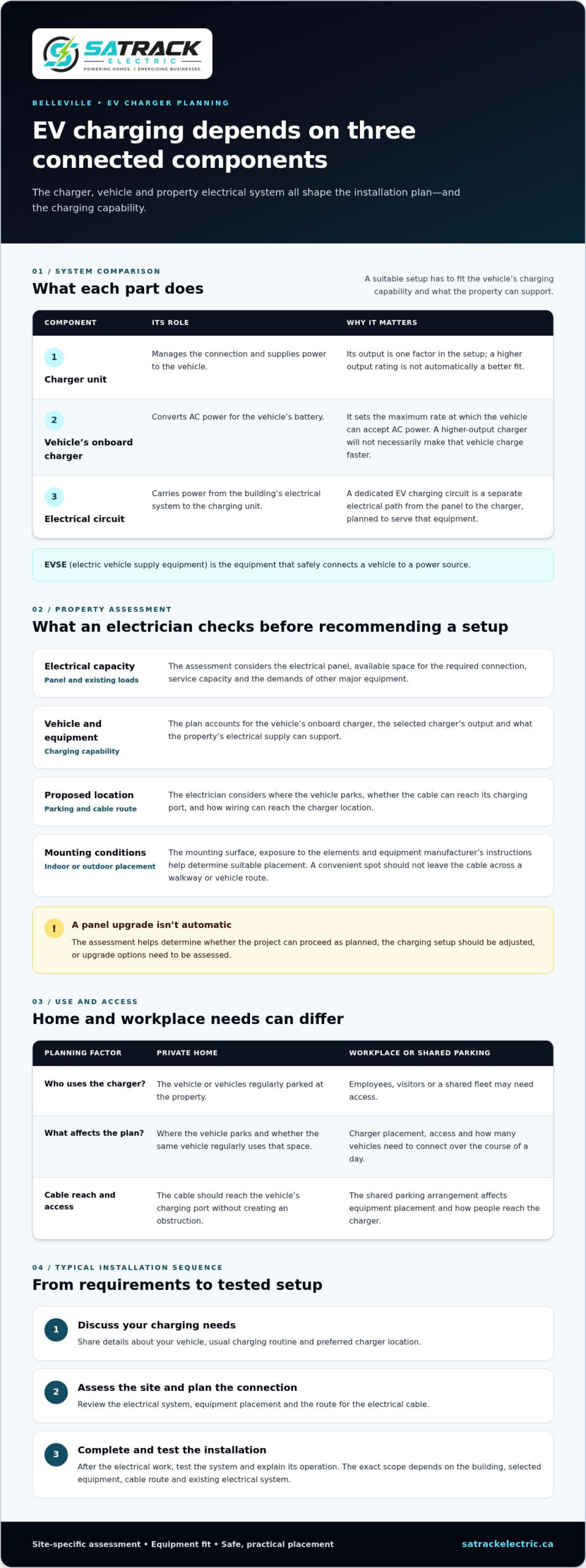
Three components work together: the charger unit, which manages the connection and supplies power to the vehicle; the vehicle’s onboard charger, which converts AC power for the battery; and the electrical circuit, which carries power from the building’s electrical system to the charging unit. The term electric vehicle supply equipment (EVSE) is also used for the equipment that safely connects a vehicle to a power source.
Equipment choice should reflect the vehicle’s charging capability, your usual charging routine, where the vehicle is parked and what the property’s electrical supply can support. A suitable plan for a detached home may differ from one for a shared parking area or workplace. This guide covers residential and commercial properties in Belleville and nearby communities, where each building and installation site has its own requirements.
What does an EV charger installation include?
The process starts with a discussion about your vehicle, charging needs and preferred location. An electrician then assesses the site and plans the connection, including equipment placement and the route for the electrical cable. After installation, the system is tested and its operation explained. The exact scope depends on the building, selected equipment, cable route and existing electrical system.
A dedicated EV charging circuit is a separate electrical path from the panel to the charger, planned to serve that charging equipment. The site assessment helps determine how that connection can be arranged safely and practically.
Who needs a home or workplace charging setup?
A private home setup serves the vehicle or vehicles regularly parked at that property. At a workplace, charging may need to accommodate employees, visitors or a shared fleet. Those uses can call for different decisions about charger placement, access and how many vehicles need to connect over the course of a day.
Start by considering who will use the parking space and whether it remains available to the same vehicle or is shared. Parking access affects where equipment can be mounted and whether the cable can reach the vehicle comfortably without creating an obstruction. These details help shape an installation plan for a home, business or shared parking area.
Can your Belleville property support an EV charger?
An existing electrical system may be able to support a charger as planned, or the installation may need a different approach. For EV charger installation Belleville property owners should start with a site-specific assessment, not a general rule based on a home’s age or panel label. An electrician considers the electrical system as a whole before recommending a practical setup.
What does an electrical capacity assessment check?
The assessment looks at the electrical panel, available space for the required connection, service capacity and the demands of other major equipment. It also considers where the charger is proposed and how wiring could reach that location. Existing loads matter: a system already serving several large electrical appliances may need a different plan from one with more available capacity.
This review helps determine whether the project can proceed as planned, whether the charging setup should be adjusted, or whether electrical upgrade options need to be assessed. A panel upgrade isn’t automatic. If capacity constraints are identified, the Belleville electrical panel upgrade guide explains how an upgrade may relate to a property’s electrical needs.
How do vehicle, charger and property requirements fit together?
The charger’s maximum output is only one part of the decision. A vehicle’s onboard charger sets the maximum rate at which it can accept AC power, so choosing equipment with a higher output won’t necessarily make that vehicle charge faster. The property’s electrical supply must also be able to support the selected setup. The installation plan accounts for all three.
Location affects day-to-day use as well as the electrical work. The electrician considers how the vehicle parks, whether the cable can reach its charging port, and whether the unit will be indoors or outdoors. The mounting surface, exposure to the elements and the equipment manufacturer’s instructions also help determine suitable placement. A convenient spot should allow access without leaving the cable across a walkway or vehicle route.
Related home electrical work may also inform the project plan. Satrack Electric provides residential electrical services in Belleville, including electrical installations and upgrades. If you’re planning a charger, review Satrack Electric’s local electrical services as a practical next step toward an assessment.
Compare EV charger installation choices for your Belleville property
For EV charger installation Belleville homeowners should compare how a charger will connect to the electrical system and where it will be used. The right arrangement depends on the equipment instructions, vehicle capability, assessed electrical capacity and conditions at the property. A higher output rating isn’t automatically a better fit if the vehicle or electrical supply can’t make use of it.
Hardwired or receptacle-based: what changes during installation?
A hardwired unit connects directly to its planned electrical supply. A receptacle-based setup uses a suitable outlet and a compatible charger connection. Each approach affects the circuit and installation details, so suitability depends on the site and equipment rather than convenience alone. The permitted setup must also follow the manufacturer’s instructions and current Ontario requirements. See the EV charger outlet versus hardwired guide for a closer look at these connection methods.
| Installation choice | What to consider |
|---|---|
| Hardwired | The connection is made directly to the electrical supply. The plan accounts for the unit’s mounting location, circuit route and equipment requirements. |
| Receptacle-based | The setup relies on a compatible receptacle and charger connection. The electrician assesses whether the outlet arrangement suits the equipment and the property. |
Where should the charger be placed?
Choose a location based on how the vehicle actually parks. The charging cable should reach the vehicle’s port without creating a tripping hazard or crossing a regular walking or driving path. The mounting surface needs to suit the equipment, and the unit should be positioned to reduce the risk of routine impact from vehicles, doors or stored items.
Indoor placement can offer shelter, while an outdoor location may better suit a driveway or parking space. Outdoor equipment and its installation must follow the manufacturer’s instructions and applicable requirements, including directions for exposure and mounting. The electrician also considers whether the unit is accessible and whether the cable can be handled safely in the available space.
The route from the electrical panel matters, too. A direct route may allow a simpler installation plan; obstacles or a longer route can affect how wiring is run and what work is needed. The assessment brings these details together with the charger’s output and the vehicle’s AC charging limit, helping determine a setup suited to the property rather than defaulting to the highest rating.
What happens during EV charger installation in Belleville?
A clear process helps you understand what’s being planned and why. The site assessment determines the installation plan by matching the charger location and wiring route to the property’s electrical system. The work varies by building and equipment, so there’s no universal timeline or one-size-fits-all installation.
- Discuss your requirements. Share your vehicle details, charging routine and intended parking location so the installation can be planned around how you’ll use it.
- Assess the site. The electrician reviews the electrical panel and service, proposed charger location, parking arrangement and possible wiring routes.
- Plan the work. Equipment placement, circuit routing and any additional electrical work are considered together. Applicable Electrical Safety Authority (ESA) processes and current Ontario Electrical Safety Code requirements should be verified for the project before work begins.
- Complete the installation. The charger is mounted and connected according to the site plan, equipment instructions and applicable requirements. Any required protective measures are included in the electrical work.
- Test and explain operation. The completed setup is checked, and the electrician explains the equipment’s basic operation so you know how to connect and charge your vehicle.
What should you prepare before the site assessment?
Gather the vehicle’s charging information and the charger’s documentation, if you’ve selected equipment. Note where vehicles usually park, where you’d prefer the charger to be mounted, and any limits on access to the parking area. It’s also helpful to identify the electrical panel’s location and mention other major electrical loads or upgrades. These details help the electrician tailor the assessment, but they don’t determine the result in advance.
How are installation and final checks handled?
Installation coordinates the charger’s mounting position with the electrical connection and the route from the panel. The electrician completes the planned wiring and connection, then tests the setup and reviews basic use with you. Applicable ESA notification or inspection processes, along with the current code details for the specific work, should be confirmed for the project. This keeps the work grounded in the requirements that apply to the property and installation.
For EV charger installation Belleville homeowners can work with Satrack Electric, a licensed and insured electrical contractor serving residential and commercial customers locally. Arrange an EV charger installation assessment to discuss your vehicle, parking setup and property.
Arrange EV charger installation with Satrack Electric in Belleville
Once you’ve identified how and where you want to charge, the next step is to arrange an electrical assessment. Satrack Electric provides EV charger installations for residential and commercial properties in Belleville and nearby communities, including Trenton, Picton, Brighton, Quinte West, Greater Napanee and Cobourg. As a licensed and insured electrical contractor, the team can assess the property and plan the electrical work around your vehicle, equipment and site conditions.
Before arranging EV charger installation Belleville property owners can gather a few details to help make the initial discussion productive. You don’t need to determine your home’s electrical capacity yourself. Share what you know, and the assessment can establish what the property requires.
What information helps plan an installation?
Have these details ready if available:
- Property location: The home or business address and where the vehicle is usually parked.
- Vehicle details: The make and model, along with any charging information provided with the vehicle.
- Charger information: The equipment you intend to use and its installation documentation, if you’ve selected a unit.
- Parking arrangement: Whether parking is private or shared, and how the vehicle is positioned.
- Preferred location: Where you’d like the charger mounted and any access limitations around that spot.
- Known electrical concerns: Mention panel or service issues, planned upgrades, or major electrical loads you’re aware of. There’s no need to diagnose capacity.
These details help shape the site assessment. Satrack Electric tailors the electrical work to the property and the installation requirements, including the equipment location and connection plan.
Why use a local licensed and insured electrical contractor?
EV charging equipment needs an electrical connection planned for the specific building and use. A licensed and insured electrical contractor can assess the site, coordinate the installation work and account for applicable safety requirements. Satrack Electric serves homeowners and businesses in Belleville and nearby communities, including Trenton, Picton, Brighton, Quinte West, Greater Napanee and Cobourg, providing a local route from assessment through installation.
Share your vehicle and charger details, describe your parking setup, and arrange an assessment to discuss the next steps for your property. Arrange an EV charger installation assessment with Satrack Electric.
Plan a charger installation that fits your property
A suitable EV charger setup starts with the building, not just the equipment. An electrician’s assessment helps determine whether the existing electrical system can support the planned connection and whether the proposed charger suits your vehicle’s charging capability. Placement and cable routing matter, too, since the unit needs to work with your parking arrangement and be practical to use.
For EV charger installation Belleville homeowners and businesses can take the next step by gathering their vehicle and charger details, noting their preferred parking location, and arranging an electrical assessment. This gives the electrician useful context for planning work around the property rather than relying on assumptions.
Satrack Electric is a licensed and insured electrical contractor providing EV charger installations in Belleville and nearby communities, including Trenton, Picton, Brighton, Quinte West, Greater Napanee and Cobourg. The team can plan a site-specific installation for your home or business, with safety and practical use guiding the work. Arrange an EV charger installation assessment and move forward with a clearer plan for charging at your property.
Frequently Asked Questions
Do I need a permit or ESA inspection for an EV charger installation in Ontario?
Yes, an EV charger installation in Ontario requires an electrical permit, called a Notification of Work, to be filed with the Electrical Safety Authority (ESA) before work begins. The installation must comply with current electrical safety requirements. Inspection steps depend on the work and applicable ESA processes, so they should be confirmed for the project. A Licensed Electrical Contractor can explain the process and coordinate the required notification.
Can my existing electrical panel support an EV charger?
It may, but an electrician needs to assess the property before determining what it can support. The review considers panel space, service capacity, existing electrical loads and the proposed charger’s requirements. For example, other major equipment in the home may affect the available capacity. Depending on the findings, the installation may proceed as planned, use an adjusted charging setup, or require assessment of upgrade options.
Is a hardwired EV charger better than a receptacle-based installation?
Neither connection method is automatically best for every property. A hardwired charger connects directly to its electrical supply, while a receptacle-based setup uses a compatible outlet and charger connection. The suitable option depends on the equipment instructions, site conditions and current Ontario requirements. An electrician can assess the circuit plan and location so the connection method fits the vehicle, intended use and electrical system.
How long does EV charger installation take in Belleville?
There isn’t one reliable installation duration for every property. The time required depends on the site assessment, the route between the electrical panel and charger location, the existing electrical system and whether additional work is needed. A straightforward cable route may involve different work from one with obstacles or capacity constraints. For EV charger installation Belleville homeowners should arrange an assessment to establish a project-specific plan, rather than rely on a generic timeline.
Can an EV charger be installed outdoors in Ontario?
Yes, an EV charger can be installed outdoors if the equipment and installation are suitable for the location. The plan should account for exposure, mounting surface, cable reach, parking access and protection from routine impacts. The equipment manufacturer’s instructions and applicable electrical requirements guide placement and installation. An electrician can assess the proposed outdoor location and plan a connection that works with the property and how the vehicle is parked.
Does an electrician need to assess my home before installing an EV charger?
An electrical assessment is the practical way to determine how a charger can be installed safely at your home. The electrician reviews the panel and service, other major electrical loads, the charger’s requirements and the proposed parking location. This helps identify whether the planned setup is suitable or whether changes need to be considered. Share your vehicle and charger information, but leave electrical capacity decisions to the assessment.
Can Satrack Electric install an EV charger at a commercial property?
Yes. Satrack Electric provides commercial electrical services and EV charger installations for commercial properties. The installation plan can account for the building’s electrical system, equipment location, parking access and intended users. Satrack Electric is a licensed and insured electrical contractor serving Belleville and nearby communities, including Trenton, Picton, Brighton, Quinte West, Greater Napanee and Cobourg. A site assessment helps define the work for the specific property.