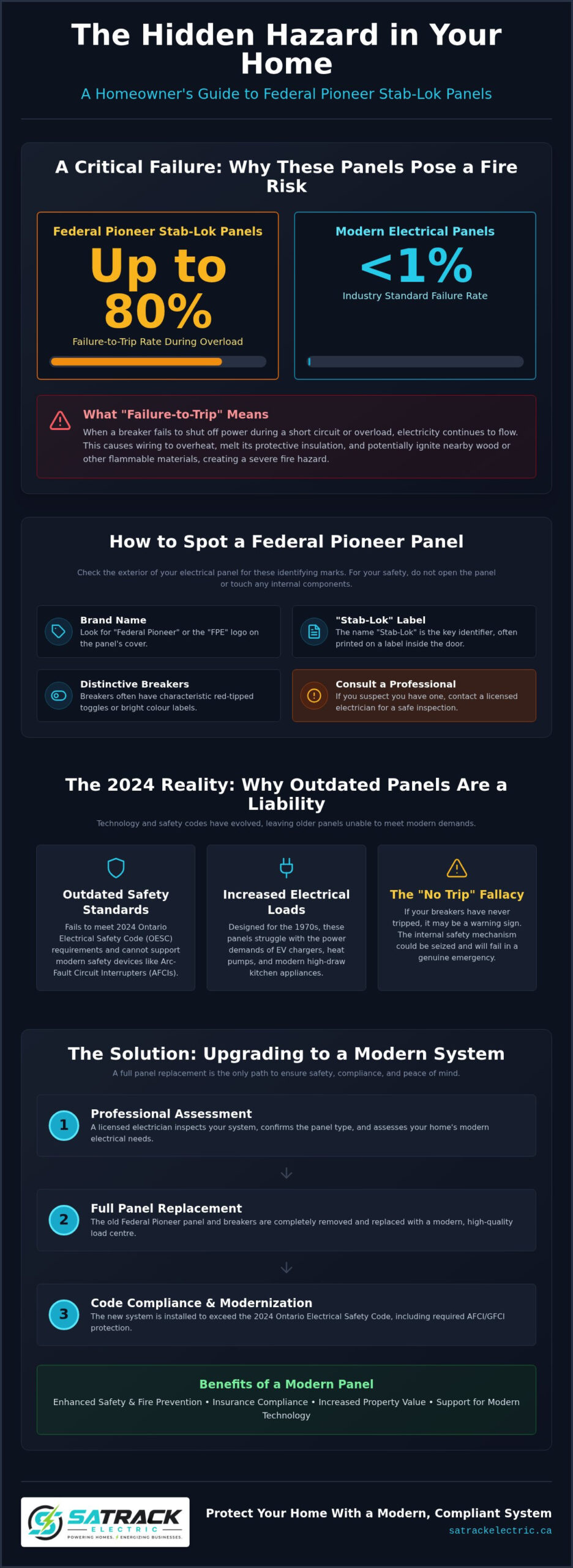
Independent testing has shown that up to 80% of breakers in Federal Pioneer Stab-Lok Panels can fail to trip during a short circuit or power overload. This is a significant departure from the industry standard failure rate of less than 1% for modern equipment. If you live in Belleville or the Quinte region, you may have encountered conflicting advice about whether these panels are truly a hazard or simply a topic for aggressive sales tactics. It’s common to feel frustrated by the confusion between Canadian and American recalls, especially when your home insurance renewal depends on getting a clear answer.
You deserve an objective look at the technical risks and a practical path toward protecting your property. This guide explains how to identify your panel, why the 2024 Ontario Electrical Safety Code has updated its standards, and what a professional upgrade looks like for an Ontario homeowner. We will walk through the specific safety flaws recognized by experts and provide a roadmap for modernizing your system. By the end, you will have the information needed to move from uncertainty toward a safe, reliable, and fully compliant electrical system.
Key Takeaways
- Learn how to identify your electrical panel using specific visual cues like red toggles and blue or orange labels without touching internal components.
- Understand why Federal Pioneer Stab-Lok Panels pose a specific fire risk due to a design that may fail to trip during a power overload or short circuit.
- Discover how these panels impact your ability to secure or renew home insurance in Ontario and your legal obligations during a real estate transaction.
- Recognize why current safety standards and insurance providers prioritize a complete panel upgrade over simply replacing individual breakers.
- Establish a clear path toward modernizing your electrical system to ensure full compliance with the 2024 Ontario Electrical Safety Code.
What are Federal Pioneer Stab-Lok Panels?
Federal Pioneer Stab-Lok Panels were once the gold standard for residential construction across Ontario. Between the 1960s and the 1990s, these systems were installed in thousands of homes because they were cost-effective and easy to assemble during the province’s mid-century housing boom. The “Stab-Lok” name refers specifically to the design of the circuit breaker connection. Unlike modern breakers that often use more secure fastening methods, these breakers “stab” directly into the bus bar. This design allowed for a compact panel that could fit many circuits into a small space, which was a significant selling point for builders at the time.
Electrical standards aren’t static. They evolve as we gather more data on fire prevention and equipment failure. While a Federal Pioneer system was perfectly legal when your home was built, the 2024 Ontario Electrical Safety Code (OESC) now reflects a much higher standard for circuit protection. Modern homes consume significantly more power than they did forty years ago. Equipment designed in the 1970s often struggles to manage the demands of electric vehicle chargers, high-end kitchen appliances, and sensitive home electronics that are now common in every household.
The Distinction Between Federal Pacific and Federal Pioneer
Homeowners often feel confused when searching for information about their electrical system online. Most search results highlight Federal Pacific Electric (FPE), a US brand that faced significant legal challenges and a massive recall. Federal Pioneer was the Canadian brand name for the same technology. While Canada didn’t issue a blanket recall for every panel, the underlying design flaws are shared between the two brands. There was a specific voluntary replacement program for 15-amp, single-pole NC015 and NC015CP breakers manufactured between August 1, 1996, and June 11, 1997, which the Electrical Safety Authority (ESA) last revised in December 2017. Even without a total recall, the shared design architecture remains a point of concern for safety experts.
Why They Were Popular in Ontario Construction
During the mid-century housing booms in Belleville and Quinte West, speed and efficiency were top priorities for developers. Federal Pioneer Stab-Lok Panels offered a compact design that allowed for more circuits in a smaller footprint. Electricians of the era appreciated the “stab-in” design because it reduced the labour time required to populate a panel. Over time, “Stab-Lok” became a common trade term in the Quinte region, synonymous with standard residential builds. Although these panels met the safety requirements of their era, they lack the advanced protection required today. The 2024 OESC now emphasizes Arc-Fault Circuit Interrupter (AFCI) technology, a safety feature that these older panels simply cannot support in their original configuration.
The Safety Risks: Why Stab-Lok Breakers May Fail to Trip
The primary function of a circuit breaker is to act as a safety valve. When a circuit draws too much power, the breaker should trip and cut the flow of electricity. However, Federal Pioneer Stab-Lok Panels are known for a specific, dangerous failure: the breakers often remain in the “on” position despite a massive overload or short circuit. This “non-tripping” event is the most significant hazard associated with the brand. When the breaker fails to cut power, the electrical wires themselves become the weakest link in the system. They begin to overheat, melt their insulation, and can eventually ignite surrounding structural materials.
Many homeowners believe their panel is safe because they’ve lived in the house for decades without a single incident. In the context of Stab-Lok technology, this is actually a major red flag. If you’ve never had a breaker trip despite using modern, high-draw appliances, it may indicate that the safety mechanism is seized. You don’t want to discover a failure only when a genuine emergency occurs. Scheduling routine electrical maintenance is the most reliable way to identify these hidden hazards before they escalate.
Understanding the Failure-to-Trip Mechanism
The internal switching mechanism in these breakers is prone to “jamming.” This is a mechanical seizure where the internal components fail to move even when the thermal sensor detects dangerous heat levels. Interestingly, a breaker might still feel functional when you manually toggle the switch. This creates a false sense of security. The manual operation of the handle doesn’t always reflect the state of the internal automatic trip. Over time, repeated manual cycling can actually increase internal wear, making a mechanical jam more likely during a real electrical fault.
The Risk of Arcing and Overheating
Beyond internal breaker failure, the physical connection to the panel’s bus bar is a known vulnerability. The “stab” design relies on a tension connection that can loosen over a 30 to 40 year life cycle. When this connection becomes loose, electricity begins to “arc” or jump across the gap. Arcing generates intense localized heat. You may notice specific warning signs during a visual check:
- Discolouration or scorch marks on the breaker casing.
- A distinct, pungent ozone smell near the panel.
- Buzzing or crackling sounds when high-draw appliances are running.
- Breakers that feel unusually warm to the touch.
These physical symptoms indicate that the panel has exceeded its reliable service life. Independent testing has shown that some Stab-Lok breakers fail at rates as high as 80%, which is staggering compared to the industry standard failure rate of less than 1% for modern equipment. If any of these signs are present, the system requires immediate professional attention to ensure the safety of your home.
Insurance and Real Estate: Practical Realities for Ontario Homeowners
Owning a home equipped with Federal Pioneer Stab-Lok Panels is no longer just a technical concern; it’s a significant financial and legal factor in the Ontario housing market. As of August 2026, the landscape for homeowners has shifted due to stricter disclosure laws and evolving insurance standards. Under the Trust in Real Estate Services Act (TRESA), which took effect on December 1, 2023, sellers in the Quinte region are legally obligated to disclose material latent defects. Because the fire risks associated with these panels are well-documented, they often fall under this disclosure requirement. A legacy panel can quickly become a hurdle during a sale, leading to lower offers or deals that fall through during the inspection period.
For many residents in Belleville and Quinte West, the most immediate impact is felt during insurance renewals. Insurers have moved away from simply charging higher premiums for older electrical systems. Many now issue mandatory replacement clauses or refuse to provide new policies altogether until the system is modernized. Proactively scheduling an electrical panel upgrade in Belleville is a practical way to protect your property value and ensure your home remains insurable under standard market rates.
Securing Home Insurance in 2026
The risk assessment models used by Canadian insurers have become increasingly sophisticated. In 2026, a home with a legacy Stab-Lok system is often flagged as a high-risk asset. If your provider issues a notice of non-renewal, you may be forced into the “high-risk” insurance market, where premiums are significantly higher. While some providers might accept a Certificate of Inspection from a licensed electrician as a temporary measure, the trend is moving toward requiring full hardware replacement. This ensures the home meets the safety standards of the 2024 Ontario Electrical Safety Code, which insurers now use as a benchmark for reliability.
Modern Electrical Demands and Load Capacity
The 60-amp or 100-amp capacities common in older Federal Pioneer systems weren’t designed for the electrification of 2026. Modern households now integrate electric vehicle (EV) chargers, high-efficiency heat pumps, and sophisticated home automation. The 2024 OESC introduced specific load calculation rules to account for these heavy draws. An aging panel often lacks the physical space for new breakers and the internal capacity to handle these concurrent loads safely. If you’re adding a hot tub or upgrading your HVAC system, consulting with residential electrical services in Belleville is essential to determine if your current service can support your lifestyle without risking a dangerous failure.
Identification and Inspection: How to Spot a Federal Pioneer Panel
Identifying Federal Pioneer Stab-Lok Panels is usually a straightforward process that doesn’t require any tools or technical expertise. You should start by examining the exterior and interior of the panel door. Most units feature a clear manufacturer’s label with the “Federal Pioneer” logo or the “Stab-Lok” trademark prominently displayed. If the branding has faded or the label is missing, you can look for the distinct colour-coded breakers that defined this product line for decades in the Ontario market.
The most recognizable visual cue is the bright red “on” toggle switch. While modern circuit breakers are typically solid black or grey, Federal Pioneer utilized a high-visibility red for the handle. You should also look for orange or blue labels on the face of the breakers. These labels were used to indicate specific amperage ratings or model series, such as the NC series breakers involved in previous voluntary replacement programs. If you see this combination of red toggles and colourful labels, you are likely looking at a legacy Stab-Lok system.
Safety is the highest priority during this identification process. You should never attempt to remove the metal “dead-front” cover to inspect the internal wiring or bus bars yourself. Removing this panel exposes live electrical components and creates a significant risk of accidental contact or arcing. If you suspect your home uses this equipment, the safest course of action is to request a professional electrical panel upgrade consultation to confirm the system’s condition without putting yourself at risk.
Visual Markers of a Stab-Lok System
Beyond the colours, the physical shape of the breaker handles is unique to the brand. They often feature an “E” or “F” shaped profile when viewed from the side. You can also check the panel schedule, which is usually a handwritten or printed list taped to the inside of the door. This document often includes the installation date or the name of the original electrical contractor. If your home was built or renovated between 1960 and 1990 and the schedule mentions Federal Pioneer, the equipment is likely original and has exceeded its expected 30-year reliable service life.
Professional Safety Inspections
A licensed electrician performs a much deeper analysis than a homeowner’s visual check. While you can spot a brand name, a professional audit involves checking for loose tension at the “stab” connection and identifying early signs of internal heat damage. They may also review your system against the electrical repairs in Belleville safety checklist to ensure your home meets modern standards. A visual inspection alone cannot detect a seized internal trip mechanism. Only a professional evaluation can determine if the breakers will actually function during a genuine electrical fault or if they have become a “silent” hazard.
Upgrading Your Electrical Panel: The Path to Safety
When homeowners discover the risks associated with Federal Pioneer Stab-Lok Panels, the first instinct is often to look for a quick fix. You might consider simply replacing a single breaker that seems loose or discoloured. However, professional standards in Ontario suggest that this is a counterproductive strategy. A panel upgrade is not just about replacing hardware; it is about modernizing your home’s entire electrical foundation to meet the rigorous safety requirements of the 2024 Ontario Electrical Safety Code (OESC).
Modern panels provide several advantages that legacy systems cannot match. They are designed to support Arc-Fault Circuit Interrupter (AFCI) technology, which the ESA notes can reduce residential electrical fires by up to 71%. Additionally, a new installation provides integrated surge protection and the physical space needed for future expansions, such as electric vehicle chargers or heat pumps. Choosing a licensed electrician in Belleville ensures that your new system is sized correctly for your specific load requirements and installed to current provincial standards.
Why Replacement Breakers Are Only a Temporary Fix
Sourcing certified, new-production breakers for an aging Federal Pioneer system is increasingly difficult and expensive. Even if you find a replacement, it cannot address the underlying issue: the bus bar. Over decades, the “stab” connection points on the bus bar can lose their tension or suffer from microscopic pitting caused by arcing. Installing a new breaker onto a degraded bus bar is like putting a new tire on a bent rim. The connection will remain poor, heat will continue to build, and the risk of failure persists. From a financial perspective, the cost of several service calls and expensive legacy parts often approaches the price of a full, permanent upgrade.
What to Expect During a Panel Upgrade
A professional panel swap is a highly coordinated event that minimizes disruption to your daily routine. The process begins with securing an ESA permit, which is a legal requirement for insurance compliance and safety verification. On the day of the installation, your electrician coordinates with the local utility provider, such as Elexicon or Hydro One, to safely disconnect the power at the meter. This allows for a complete removal of the old equipment and a clean installation of the new panel and breakers.
Satrack Electric manages this transition with a methodical workflow that prioritizes safety and precision. Once the new hardware is in place, we perform a thorough circuit identification and testing process to ensure every connection is secure. The final step is the ESA inspection, where a provincial inspector verifies that the work meets all OESC standards. This structured approach ensures that when your power is restored, your home is protected by a reliable, modern system that will serve your family for decades to come.
Securing Your Home’s Electrical Future
Managing the legacy of Federal Pioneer Stab-Lok Panels requires a balance of technical awareness and proactive planning. By identifying these systems early, you can address potential fire risks before they impact your family’s safety or your property’s market value. Transitioning to a modern electrical system isn’t just about meeting the 2024 Ontario Electrical Safety Code. It’s about ensuring your home can safely handle the power demands of modern life, from high-efficiency heat pumps to electric vehicle charging. A professional upgrade provides the peace of mind that comes from knowing your breakers will function exactly as intended during a fault.
Satrack Electric is an ESA Licensed Electrical Contractor, fully insured for both residential and commercial work. We’ve been serving Belleville, Quinte West, and the surrounding municipalities since our inception, providing steady and reliable expertise for complex modernization projects. Protect your home and family by taking the first step toward a safer electrical foundation. Contact Satrack Electric today for a professional panel safety inspection. Investing in your home’s infrastructure today ensures a secure and reliable environment for years to come.
Frequently Asked Questions
Is there an official recall for Federal Pioneer Stab-Lok panels in Canada?
There is no active, province-wide recall for all Federal Pioneer Stab-Lok panels. However, a specific voluntary replacement program exists for 15-amp, single-pole NC015 and NC015CP model breakers manufactured between August 1, 1996, and June 11, 1997. These specific units are identified by their blue handles. While a total recall wasn’t issued for all models, the shared design architecture with the problematic US brand remains a significant safety concern for many licensed electricians.
My panel has worked fine for 30 years; why should I replace it now?
A panel that hasn’t tripped in decades can actually be a sign of a seized safety mechanism rather than a reliable system. These panels are known for a “non-tripping” failure where the breaker stays in the on position during an overload, which can lead to overheating and fire. Most electrical equipment has a reliable service life of 30 to 40 years. Modern homes now draw significantly more power than these systems were designed to handle safely.
Can I just buy replacement breakers for my Federal Pioneer panel?
While you can find replacement breakers, it is not a recommended long-term solution for Federal Pioneer Stab-Lok Panels. A new breaker cannot fix a degraded or pitted bus bar, which is often where arcing and overheating occur. Certified replacement parts are also increasingly expensive and difficult to source. A full panel upgrade is generally more cost-effective and provides a much higher level of safety for your home by meeting current provincial standards.
How much does it cost to replace a Federal Pioneer Stab-Lok panel in Ontario?
The cost to replace an electrical panel in Ontario varies based on the service size and the complexity of the installation. For a standard residential upgrade, homeowners typically see a range that includes the new hardware, labour, and mandatory ESA permit fees. Since every home has different wiring conditions and load requirements, it is best to request a professional on-site evaluation to get an accurate estimate tailored to your property’s specific needs.
Will having a Stab-Lok panel affect my ability to sell my home?
Yes, having this type of panel can complicate a real estate transaction in the Quinte region. Under Ontario’s Trust in Real Estate Services Act (TRESA), sellers must disclose known material latent defects that could make a home unsafe. Many buyers struggle to secure or renew home insurance for properties with these panels. This often leads to demands for replacement as a condition of the sale, so upgrading before listing can prevent significant closing delays.
What is the difference between Federal Pacific and Federal Pioneer?
Federal Pacific Electric (FPE) was the brand name used in the United States, while Federal Pioneer was the brand name for the same technology in Canada. Although they operated under different names, they utilized the same design and shared the same fundamental engineering flaws. The primary difference for homeowners is that the US brand faced a massive recall, whereas the Canadian brand only saw limited, voluntary replacement programs for specific breaker models over the years.
Can a home inspector tell if my Stab-Lok panel is dangerous?
A home inspector can identify the brand of the panel, but they cannot verify if the internal safety mechanisms are functional. Most home inspections are visual and don’t involve the specialized load testing required to detect a seized breaker. Because these panels often fail “silently” without any external signs of damage, a licensed electrician should perform a detailed safety audit to determine the actual condition of the internal bus bars and switching components.