
It’s 3:00 AM, and the persistent, rhythmic chirp of a smoke alarm has just woken the entire household. You’ve already swapped the batteries, yet the noise continues, leaving you frustrated and concerned about your family’s safety. For many Ontario homeowners, this nuisance is a signal that you must realize your life-safety equipment has reached the end of its functional life. While it may seem like a simple maintenance task, a hardwired smoke detector replacement involves handling 120V electrical circuits and ensuring your interconnected system communicates properly across every floor.
You likely want the peace of mind that comes with a quiet home and a system that meets the latest Ontario Fire Code requirements. This guide explains when you must replace your units, why professional installation is the safest route for high-voltage alarms, and how to organize the process across different brands and wiring harnesses. We’ll walk through the 2026 provincial regulations and the steps needed to ensure your home remains fully protected and compliant.
Key Takeaways
- Identify the 10-year expiry rule and learn how to locate the specific manufacture date on your existing units.
- Stay compliant with updated Ontario Fire Code regulations, including the latest requirements for carbon monoxide detectors on every storey.
- Understand how interconnected 120V systems provide superior safety by ensuring all alarms sound simultaneously throughout the home.
- Learn the necessary safety procedures for a hardwired smoke detector replacement to manage risks associated with household electrical circuits.
- Realize the importance of professional installation to ensure your life-safety system is fully compliant with the Ontario Building Code.
Understanding the Lifespan of Hardwired Smoke Alarms
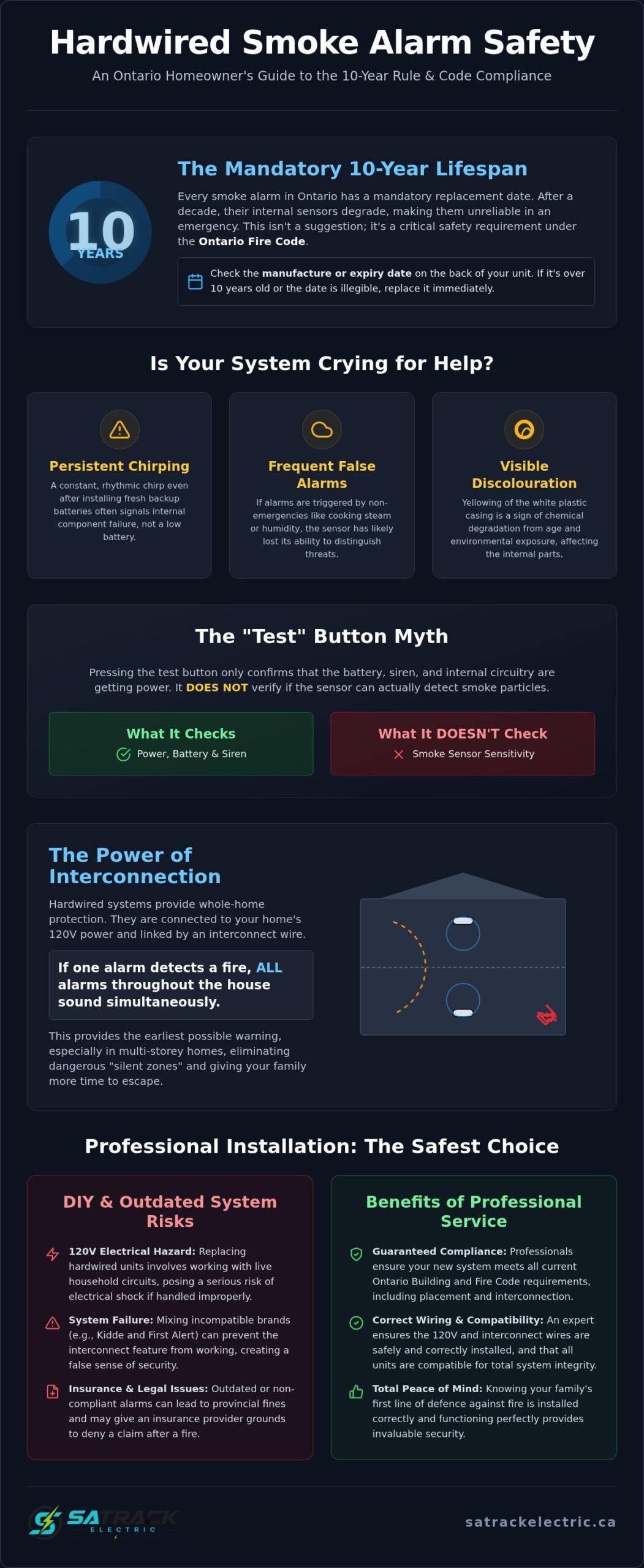
Every smoke alarm in your home has a finite lifespan. While many homeowners believe that simply changing the battery is enough to keep their family safe, the internal sensors actually degrade over time. The Ontario Fire Code requires a full hardwired smoke detector replacement every 10 years, regardless of how well the unit seems to function. This isn’t just a recommendation; it’s a critical safety standard for residential dwellings.
You can find the age of your current device by removing it from the ceiling bracket. Most manufacturers print the manufacture date or a specific expiry date on a label located on the back of the unit. If the date is missing or illegible, it’s safest to assume the unit is expired and requires immediate replacement. Attempting to fix a hardwired system with “battery-only” solutions often fails because the issue is frequently rooted in the aging circuitry or a faulty 120V connection rather than a simple power drain.
Common indicators that your system is reaching the end of its life include:
- Frequent false alarms triggered by steam or cooking without a clear cause.
- A persistent chirping sound that continues even after you’ve installed fresh backup batteries.
- Visible yellowing of the plastic casing, which indicates chemical degradation from age and environmental exposure.
Why Sensors Degrade Over Time
The effectiveness of an alarm depends on its ability to detect particles in the air. Most residential units use ionization or photoelectric technology. Understanding how smoke detectors work helps clarify why they fail; ionization sensors use a small amount of radioactive material that decays, while photoelectric sensors rely on a light source that can dim or become obstructed over a decade of use. Dust, high humidity, and kitchen grease can coat these sensitive internal components, making them less responsive to actual smoke.
Pressing the “test” button only confirms that the battery, siren, and internal circuitry are functional. It doesn’t guarantee that the sensor can still detect smoke particles in the air. This is why a hardwired smoke detector replacement is the only way to ensure the sensor itself is reliable and capable of providing an early warning.
The Consequences of Outdated Detectors
Using expired alarms significantly increases the risk of failure during a fire event. In Ontario, failing to maintain working smoke alarms can lead to provincial fines and legal liability for landlords. Perhaps more importantly, your home insurance provider may deny a claim if it’s discovered that the fire protection system was outdated or non-compliant with the building code. Starting a fresh 10-year cycle provides the professional assurance that your home meets current safety standards.
How Interconnected Hardwired Systems Protect Your Home
Hardwired systems offer a level of safety that independent, battery-operated units cannot match. When you perform a hardwired smoke detector replacement, you aren’t just updating a single device; you’re maintaining a network. In an interconnected system, if a fire starts in the basement, every alarm throughout the house sounds simultaneously. This provides the earliest possible warning to occupants in bedrooms or on upper floors who might otherwise remain unaware of the danger until it’s too late.
These systems rely on a 120V power supply from your home’s electrical panel, which is why they include a backup battery for power outages. However, the most critical component for whole-home safety is the “interconnect” wire. In most Canadian homes, this is a third wire in the electrical box, typically coloured orange or yellow. This wire carries the signal that triggers the entire network. If this connection is loose or improperly wired, your alarms will function only as individual units, leaving dangerous gaps in your protection.
The Benefit of Whole-Home Communication
Multi-storey homes in the Quinte area present unique challenges for fire detection. A fire in a remote area, such as a furnace room or detached garage suite, can grow significantly before smoke reaches a sleeping area. Interconnection eliminates these “silent zones.” By ensuring that every device is part of a unified network, you adhere to the spirit of Ontario’s smoke alarm laws, which prioritize comprehensive coverage. Modern safety expectations in Canada mandate that new builds and major renovations include these interconnected systems for maximum occupant safety.
Compatibility Issues Between Brands
A common mistake homeowners make during a hardwired smoke detector replacement is mixing different brands within the same network. Leading manufacturers like Kidde and First Alert use proprietary communication protocols. While the physical wiring might look the same, the electronic signals sent over the orange interconnect wire are often incompatible. Mixing brands can lead to “phantom” chirping, failure to trigger the rest of the network, or even damage to the units’ internal circuitry.
To maintain a reliable system, it’s best to standardize your home on a single brand and model series. Using mismatched wiring harnesses from old units is also a significant risk, as pin configurations can change between generations. If you’re unsure if your existing wiring supports a new system, consulting a licensed residential electrical service provider can ensure your home remains fully protected and code-compliant. Replacing all units at the same time ensures total compatibility and resets the 10-year clock for your entire household safety system.
Ontario Building Code and Fire Safety Requirements
Since 1975, the Ontario Building Code has mandated that new residential constructions include hardwired smoke alarms. This requirement ensures that life-safety devices don’t rely solely on batteries, which can be removed or forgotten. For many residents in the Quinte area living in homes built after this date, a hardwired smoke detector replacement is a recurring legal obligation that must be addressed every ten years to stay compliant with provincial standards.
Effective January 1, 2026, Ontario Regulation 87/25 introduced stricter requirements for carbon monoxide (CO) protection. Homes with fuel-burning appliances, fireplaces, or attached garages must now have CO alarms installed on every storey. This expands on previous rules that only required them adjacent to sleeping areas. Integrating these into your hardwired system is the most efficient way to meet these updated standards while ensuring your family is protected from the “silent killer.”
Smoke and CO Combo Units
To simplify compliance, many homeowners opt for 2-in-1 combination units. These devices handle both smoke and carbon monoxide detection through a single mounting bracket and wiring harness. When you realize that the law now requires protection on every floor, these combo units become a practical choice. They reduce the number of devices on your ceiling while ensuring you meet NFPA smoke alarm recommendations for comprehensive home coverage. Placement is equally critical; the code requires alarms on every level, including the basement, and specifically outside of all sleeping areas to ensure maximum audibility.
Liability and Insurance Considerations
Performing electrical work without a license or failing to follow the Ontario Fire Code can have serious financial consequences. Home insurance providers often require proof that life-safety systems were installed according to local regulations. If a fire occurs and investigators find that the alarms were expired or improperly wired, your claim could be denied. This can leave you personally liable for property damage or injuries.
Hiring a licensed electrical contractor for your hardwired smoke detector replacement provides a paper trail of professional competence. An official invoice serves as a record of compliance during a home sale or a municipal fire inspection. It confirms that the work meets the standards set by the Electrical Safety Authority (ESA) and the Ontario Building Code, protecting both your family and your property investment. Professional installation ensures that the 120V circuits are handled safely and that the interconnection between units is verified for total home safety.
Step-by-Step Guide to Replacing a Hardwired Smoke Detector
Replacing a hardwired smoke alarm is more complex than a standard battery-powered unit. Because these devices are tied directly into your home’s 120V electrical system, safety is the primary concern. A hardwired smoke detector replacement requires a methodical approach to ensure the new unit is properly powered and communicating with the rest of the network. Following a structured process helps avoid electrical shocks and ensures the system functions as intended during an emergency.
Tools and Preparation
Before you begin, gather a sturdy ladder, a Phillips-head screwdriver, and a reliable non-contact voltage tester. You must never work on a live circuit. Locate your electrical panel and shut off the specific breaker labelled for smoke detectors. Once the power is off, use your voltage tester at the ceiling unit to verify that no electricity is flowing. This is also a good time to inspect the condition of the electrical box in the ceiling. Ensure it’s securely fastened and free of debris or signs of overheating.
Wiring and Mounting
Remove the old detector by twisting it off the mounting bracket. You’ll see a plastic plug connecting the unit to the house wiring. If you’re switching brands, the legacy plug likely won’t match your new device. You’ll need to remove the old harness and wire in the new one provided with the alarm. Match the black (hot) wire to black, white (neutral) to white, and the orange or yellow (interconnect) wire to its counterpart. Use proper wire nuts to create secure, insulated connections. After the harness is ready, screw the new mounting plate into the ceiling box and snap the detector into place.
The Final System Test
Restore power at the electrical panel and look for the green “Power On” LED on the unit. This confirms the 120V supply is active. To verify the interconnection, you must perform a system test. Press and hold the test button on one unit for at least five seconds; this duration is necessary to send the signal through the interconnect wire to the other alarms in the house. If correctly installed, every alarm in your home should sound within a few seconds of each other. If some units remain silent, there’s likely a fault in the communication wire or a compatibility issue between models.
If you encounter mismatched wiring or feel uncomfortable working with your home’s electrical panel, it’s best to consult a professional. You can book an electrical installation service to ensure your life-safety system is installed correctly and meets all Ontario building standards.
Why Professional Replacement is the Safest Choice in Quinte West
Working with residential electricity involves inherent risks that go beyond a standard DIY project. A hardwired smoke detector replacement isn’t a simple battery swap; it requires direct contact with 120V household circuits. An error in wiring can lead to electrical fires or shocks, compromising the very safety the device is meant to provide. Satrack Electric provides professional assurance for homeowners in Belleville and Trenton, ensuring every unit is correctly integrated into your home’s electrical infrastructure.
Our team performs comprehensive safety checks that go beyond a simple hardware swap. We verify the integrity of the ceiling boxes, check the age of the wiring, and ensure that the interconnected signal is strong enough to reach every floor. This methodical approach guarantees that your life-safety system is truly code-compliant and reliable. We prioritize your family’s peace of mind by confirming that every component of the system functions exactly as the manufacturer intended.
Expertise in Local Ontario Homes
Many properties in Picton, Napanee, and the surrounding Quinte area feature older electrical systems that may not align with modern standards. Navigating the unique challenges of legacy wiring requires a seasoned expert who understands how to safely transition to current technology. We specialize in updating outdated systems to meet the rigorous 2026 Ontario Fire Code requirements. By choosing a licensed professional, you receive a thorough Electrical Repairs in Belleville assessment that identifies potential hazards before they become emergencies.
Booking Your Professional Installation
Satrack Electric focuses on making the maintenance of your home’s safety systems a hassle-free experience. We understand that your time is valuable, so we offer efficient scheduling for residents in Quinte West, Brighton, and Cobourg. Many clients choose to group a hardwired smoke detector replacement with other essential residential electrical services, such as panel upgrades or light fixture installations. This organized approach ensures your entire home remains safe and functional without the need for multiple service calls.
Our commitment to community-focused professionalism means we take pride in delivering thorough results that provide long-term peace of mind. Contact us today to organize a professional installation and ensure your home meets the latest provincial safety standards. We’re here to serve as your dependable local authority for all your residential electrical needs.
Protecting Your Home for the Next Decade
Maintaining a safe home requires more than just testing your alarms; it involves staying current with the 10-year replacement cycle and evolving provincial standards. By prioritizing a hardwired smoke detector replacement, you ensure that your household remains compliant with the 2026 Ontario Fire Code updates and that every floor has reliable, interconnected protection. These systems are the first line of defence against fire and carbon monoxide, providing the early warning necessary to protect your family and your property investment.
As a licensed and insured electrical contractor, Satrack Electric brings expert knowledge of Ontario fire codes to every project. We serve Belleville, Trenton, and the surrounding Quinte area with a commitment to thorough workmanship and customer peace of mind. Ensure your home is safe; book your professional smoke detector replacement with Satrack Electric today. Taking this proactive step now ensures your life-safety systems remain dependable and functional for years to come.
Frequently Asked Questions
Do I need an electrician to replace a hardwired smoke detector in Ontario?
You should hire a licensed electrician for a hardwired smoke detector replacement to ensure safety and compliance with the Ontario Electrical Safety Code. Handling 120V household wiring carries risks of shock or fire if improperly connected. A professional verifies that the mounting bracket and wiring harness are installed correctly. This professional record is often essential for home insurance verification and municipal fire inspections in the Quinte area.
How often should I replace my hardwired smoke detectors?
You must replace your hardwired smoke detectors every 10 years from the date of manufacture. The sensors inside these units degrade over time, making them less sensitive to smoke particles regardless of whether they pass a battery test. You can find the manufacture date on a label located on the back of the unit. Staying within this 10-year cycle is a core requirement of the Ontario Fire Code.
Why is my hardwired smoke detector chirping even after I changed the battery?
A persistent chirp usually indicates that the unit has reached its 10-year expiry date or that there is a fault in the 120V power supply. If the battery is fresh, the sensor itself may be failing or clogged with dust and grease. In some cases, a loose interconnect wire can cause intermittent chirping across the entire network. If cleaning the unit doesn’t resolve the noise, it’s time for a full replacement.
Can I mix different brands of hardwired smoke detectors?
You should avoid mixing different brands within an interconnected system. Manufacturers like Kidde and First Alert use specific communication protocols that are often incompatible with one another. Mixing brands can lead to failure in triggering the whole-home alarm or cause constant false alarms. To ensure your family’s safety, standardize your home on a single brand and model series during your hardwired smoke detector replacement.
What is the orange wire on my smoke detector for?
The orange wire, sometimes yellow, is the interconnect signal wire that allows all alarms in your home to communicate. When one unit detects smoke, it sends a signal through this wire to trigger every other alarm in the network simultaneously. This feature is critical for providing an early warning in multi-storey homes. Ensuring this wire is securely connected with proper wire nuts is essential for a code-compliant installation.
Are hardwired smoke detectors better than battery-operated ones?
Hardwired detectors are generally considered superior because they rely on your home’s permanent electrical system and include a battery backup for power outages. Their primary advantage is the ability to be interconnected, ensuring that an alarm in the basement is heard in upstairs bedrooms. While the 2024 Ontario Building Code permits wireless interconnection in specific secondary suites, hardwired systems remain the gold standard for long-term reliability and safety.
Will my hardwired smoke detector work during a power outage?
Your hardwired smoke detector will continue to function during a power outage provided it has a working battery backup. Most modern units use a 9V battery or a sealed 10-year lithium battery to maintain protection when the 120V supply is interrupted. It’s important to test these batteries regularly or choose sealed models to ensure your home remains protected during local grid failures or severe weather events in Ontario.
Does the Ontario Fire Code require a smoke detector in every bedroom?
The Ontario Fire Code requires working smoke alarms on every storey of a home and outside all sleeping areas. While the fire code doesn’t strictly mandate them inside every bedroom for older homes, the Ontario Building Code requires them inside bedrooms for newer constructions. For maximum safety, fire professionals recommend installing alarms in every bedroom to ensure occupants are alerted as quickly as possible if a fire starts behind a closed door.