
What if the electrical system that has powered your Belleville home for decades isn’t necessarily “broken,” but simply wasn’t designed for the way we live in 2026? If you’re living in one of our community’s beautiful heritage properties, you’ve likely asked yourself: Is knob-and-tube wiring safe? It’s a question that carries significant weight, especially when you’re facing conflicting advice from home inspectors and contractors or struggling to secure a reasonable insurance policy.
You probably feel a sense of unease every time you plug in a high-power appliance or receive a renewal notice from your insurance provider. This concern is valid, as these vintage systems often struggle to meet the demands of contemporary technology and modern insulation standards. In this article, we’ll explain the specific safety risks associated with aging insulation and the lack of grounding. You’ll discover the latest 2024 Ontario Electrical Safety Code requirements and learn why many insurers now require upgrades before granting coverage. By the end, you’ll have a clear understanding of your system’s status and a plan to arrange a professional assessment to protect your property.
Key Takeaways
- Learn how the absence of a grounding conductor in vintage systems increases the risk of electrical shock and potential property damage.
- Address the central question, “Is knob-and-tube wiring safe?”, by evaluating the impact of brittle insulation and modern power demands on older homes.
- Understand the requirements of Ontario insurance providers who often mandate full system replacement to maintain or obtain coverage.
- Gain practical steps for identifying ceramic knobs and tubes in unfinished areas of your home to determine if an upgrade is necessary.
- Discover the professional process for modernization, from the initial assessment to obtaining the required Electrical Safety Authority permits.
Understanding Knob-and-Tube Wiring in Ontario Homes
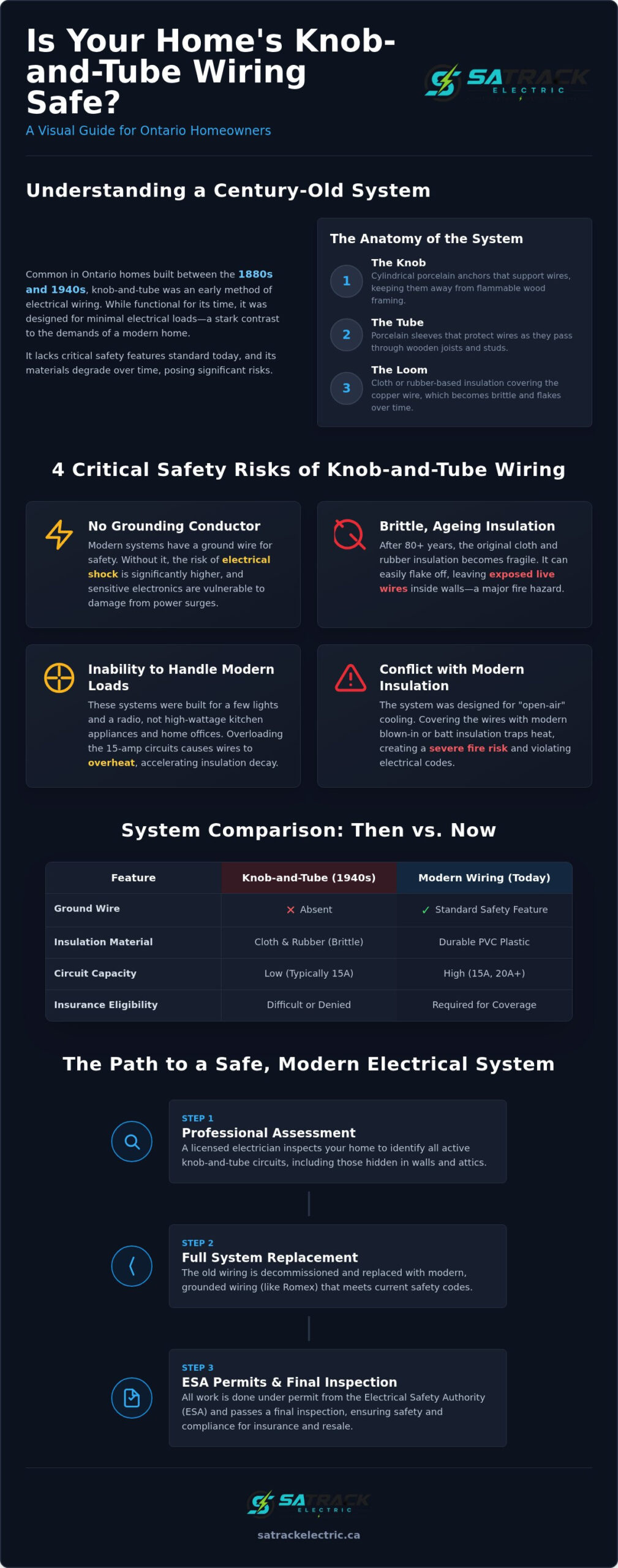
Knob-and-tube wiring was the standard method for electrical distribution in North America for several decades. In Ontario, this system was commonly installed in residential properties between the 1880s and the 1940s. It consists of two separate copper wires: one hot and one neutral. These wires run parallel through the home’s structure, supported by porcelain ceramic knobs and protected by ceramic tubes where they pass through wooden joists or studs. While the craftsmanship of that era was often excellent, the system was designed for a different age of energy consumption.
When evaluating whether is knob-and-tube wiring safe, it’s helpful to understand its original design. The system relied on “open-air” cooling, meaning the wires were spaced apart to allow heat to dissipate naturally. During the early 20th century, electrical loads were minimal, typically limited to a few light bulbs and basic appliances. However, this design lacks a grounding conductor. A ground wire is a critical safety feature in modern systems that provides a safe path for electricity during a fault; without it, the risk of electrical shock and damage to sensitive electronics increases significantly.
Where is Knob-and-Tube Commonly Found?
In the Quinte region, these systems are frequently encountered in the heritage neighbourhoods of Belleville, Picton, and Trenton. Because these homes have stood for nearly a century, the wiring is often hidden behind original lath and plaster walls or buried under attic floorboards. Homeowners sometimes find “mixed” systems. This occurs when previous renovations replaced visible sections of wiring with modern Romex, while leaving active knob-and-tube circuits concealed within the walls. This makes tracing the electrical system difficult for anyone but a licensed professional, as it’s not always clear which circuits are still energized.
The Anatomy of the System
To identify this system, look for three distinct components that characterize its construction:
- The Knob: These are cylindrical porcelain anchors that keep the wires taut and away from the wooden framing of the house.
- The Tube: These are porcelain sleeves inserted into holes drilled through floor joists or wall studs. They ensure the wire never makes direct contact with the wood.
- The Loom: This is the flexible, cloth-based or rubberized insulation that covers the copper wire. Over time, this material can become brittle and flake away. This degradation is a primary factor when asking is knob-and-tube wiring safe? for your specific property, as exposed copper is a serious fire hazard.
Why Modern Safety Standards View Knob-and-Tube as a Risk
In its original state, this wiring method was a functional solution for early 20th-century needs, but time and modern usage have changed the answer to the question: is knob-and-tube wiring safe? The most immediate issue is age-related degradation. The cloth and rubberized insulation used a century ago was never intended to last this long. Today, this material often becomes extremely brittle. If you touch it, the insulation may flake off entirely, leaving bare copper wires exposed inside your walls, which significantly increases the risk of arcing and fire.
Beyond the physical breakdown of the materials, modern electrical loads pose a significant challenge. These systems were typically designed for 15-amp circuits. While this was sufficient for a few lamps and a radio, it’s inadequate for modern kitchens equipped with high-wattage appliances or home offices running multiple computers. Overloading these circuits causes the wires to heat up, which accelerates the breakdown of the already fragile insulation. When homeowners ask our team, is knob-and-tube wiring safe?, we often point to these load issues as a primary factor in system failure.
We also frequently encounter improper modifications in older properties. Over the decades, various owners may have attempted “handyman” splices to add new outlets or fixtures. These amateur connections often lack proper junction boxes and can lead to dangerous overheating at the points where old wiring meets new. To ensure your home meets current standards, it’s wise to consider residential electrical services for a thorough system review and professional assessment.
The Danger of Blown-in Insulation
One of the most misunderstood risks involves energy efficiency upgrades in heritage homes. Knob-and-tube wiring relies on “open-air” cooling to dissipate the heat generated by electrical current. When homeowners add modern cellulose or fibreglass insulation to their attics or walls, they inadvertently trap this heat against the wires. This thermal trapping is a major fire hazard that can lead to smoldering within the structure. Covering knob-and-tube wiring with thermal insulation is a direct violation of the Ontario Electrical Safety Code.
No Grounding and Sensitive Electronics
The lack of a grounding conductor is another critical safety gap. Modern electronics and appliances are designed to use a three-prong plug, where the third prong provides a safe path for fault current. Without this ground, surge protectors cannot function correctly, leaving your expensive home office equipment or home theatre systems vulnerable to damage from voltage spikes. Additionally, the lack of grounding increases the risk of electrical shock in “wet” areas like bathrooms and kitchens, where water can easily create a path for electricity to reach the user.
Insurance and Real Estate Implications in Ontario
In Ontario, the presence of knob-and-tube wiring is no longer just a technical concern; it is a significant financial hurdle. Most major insurance providers in the province now refuse to issue new policies for homes with active vintage wiring. If you’re purchasing a heritage property in Belleville, you’ll likely find that securing a standard homeowner’s policy is nearly impossible until the system is modernized. For existing homeowners, the discovery of these circuits during a routine inspection or renewal can lead to immediate policy cancellations or substantial premium increases.
While the Electrical Safety Authority (ESA) regulates the standards for these systems, a simple “pass” on a safety inspection rarely satisfies an underwriter’s requirements. When insurers ask, is knob-and-tube wiring safe?, they are looking at risk management rather than just code compliance. even if a system appears functional, few licensed contractors are willing to sign off on the long-term safety of century-old cloth insulation. This creates a gap where a home might be legally “safe” to occupy but remains uninsurable in the private market.
From a real estate perspective, active knob-and-tube is a major red flag that can derail a sale. Savvy buyers and their agents recognize that the cost of replacement will fall on them, often leading to aggressive price reductions or requests for the seller to complete the work before closing. Ignoring the issue often results in failed deals once the buyer’s bank or insurance company reviews the home inspection report.
Securing Insurance for Older Homes
If you find an insurer willing to provide coverage, they’ll typically include a binding condition. This often requires you to hire a licensed insured electrician Ontario to replace all active knob-and-tube components within 30 to 60 days of the closing date. It’s important to distinguish between “active” wiring and “abandoned” wiring. If old porcelain knobs remain in your attic but are no longer energized, a professional can certify the system as modernized, which satisfies most insurance requirements.
Selling a Home with Knob-and-Tube
Transparency is the most effective strategy when listing a heritage home. Because modern home inspectors are trained to identify these systems immediately, attempting to hide the wiring only damages your credibility during negotiations. By opting for a professional assessment and targeted electrical repairs Belleville before you list, you can provide prospective buyers with a clear quote for the work or complete the upgrades yourself to protect your equity. Addressing the question, is knob-and-tube wiring safe?, with a documented plan instils confidence in buyers and ensures a smoother transaction.
How to Identify Knob-and-Tube Wiring Yourself
Identifying the presence of vintage wiring is the first step in determining the status of your home’s electrical system. While much of the infrastructure is hidden behind plaster, several visual cues remain accessible to the observant homeowner. When considering the question, is knob-and-tube wiring safe?, you must first confirm if the system is active. Start your search in the basement by examining the exposed floor joists. Look for white ceramic spools, known as knobs, which anchor the wires, and porcelain tubes that guide them through the wood. If you see these components with two distinct wires running parallel, you’ve identified a knob-and-tube system.
The attic is another common location for these installations. You may find wires running across the tops of joists, often supported by porcelain knobs. Inside the living areas, original push-button light switches are a strong indicator that the underlying system remains from the early 20th century. Additionally, examine your service panel. While a modern breaker panel is a good sign, the presence of an old fuse box makes it highly likely that the original wiring is still in use throughout the structure.
The “Mixed System” Trap
One of the most frequent challenges we encounter is the “mixed system.” Seeing modern Romex wiring at your electrical panel doesn’t guarantee that your entire home has been updated. It’s common for previous contractors to “junction” new wire into old circuits hidden deep within the walls. A thorough electrical panel upgrade Belleville often reveals these hidden connections, as the process involves tracing every circuit back to its source. This hidden integration is a primary reason why a professional assessment is necessary to truly understand your home’s safety.
Warning Signs of Failing Wiring
Even if you cannot see the physical components, your home may provide audible or sensory clues. Flickering lights or frequently blown fuses are signs that the system is struggling with modern electrical loads. More serious indicators include a distinct burning smell near outlets or switches, which suggests arcing or overheating. If any of your outlets feel warm to the touch or show signs of discolouration, the wiring is likely failing. In these cases, the answer to is knob-and-tube wiring safe? is a definitive “no” until a professional intervention occurs.
If you’ve identified any of these indicators in your property, the next step is a formal safety review. You can contact our licensed team to schedule a comprehensive inspection of your residential electrical system.
Steps to Replace and Modernize Your Electrical System
Modernizing a heritage property requires a disciplined approach to ensure both safety and compliance with current regulations. If you’ve determined that the answer to is knob-and-tube wiring safe? for your specific home is a clear “no,” the path forward involves a structured replacement plan. This process is not merely about pulling new wire; it’s about engineering a system that can handle the electrical demands of 2026 and beyond. A successful modernization follows four essential steps:
- Step 1: Professional Assessment. A licensed electrical contractor must map all active circuits to identify exactly where the vintage wiring remains energized.
- Step 2: ESA Permits. Every major rewiring project in Ontario requires a permit from the Electrical Safety Authority. This ensures the work is recorded and scheduled for official inspection.
- Step 3: Systematic Replacement. We replace the old two-wire system with modern, grounded copper wiring throughout the entire structure.
- Step 4: Final Inspection. Once the work is complete, an ESA inspector verifies the installation. You’ll receive a Certificate of Acceptance, which is vital for your insurance provider.
The Replacement Process
One of the primary concerns for homeowners in Belleville is the potential for damage to original plaster walls. Our team uses a technique called “fishing,” where we utilize strategic access points to navigate new wires through existing wall cavities. This methodical approach minimizes the need for large openings in your walls, which helps preserve the architectural character of your home. During this transition, a panel upgrade is almost always necessary to accommodate the new grounded circuits and modern safety breakers. This is also an ideal time to consider a generator installation Belleville, as the infrastructure will already be open for the necessary transfers and upgrades.
Why Choose Satrack Electric for Your Upgrade?
We understand the unique challenges of heritage home wiring in the Quinte region. Our team provides professional assurance by ensuring every project is in full compliance with the 2024 Ontario Electrical Safety Code. We prioritize clear communication, so you understand the status of your project at every stage. When you ask, is knob-and-tube wiring safe?, our goal is to provide a solution that allows you to answer “yes” with total confidence. We take pride in delivering thorough results that protect your property’s value and your family’s peace of mind through skilled workmanship and adherence to the highest safety standards.
Protecting Your Belleville Heritage Home
Maintaining the integrity of an older home requires a balance between preserving history and ensuring modern safety standards. We’ve explored how aging insulation and the lack of grounding create significant risks for contemporary electronics and insurance eligibility. When homeowners ask, is knob-and-tube wiring safe?, the answer depends on the system’s current condition and its ability to handle modern electrical loads without overheating. Upgrading to a grounded copper system isn’t just a code requirement; it’s an investment in your property’s longevity and your family’s security.
As a Licensed Electrical Contractor serving Belleville and the Quinte region for years, Satrack Electric provides the expertise needed to modernize vintage systems with ESA compliant workmanship. We prioritize thorough assessments to give you a clear understanding of your home’s needs. Contact Satrack Electric today for a professional wiring assessment to begin the process of securing your home’s electrical future. Taking this proactive step ensures your property remains a safe and stable environment for years to come.
Frequently Asked Questions
Is knob-and-tube wiring illegal in Ontario?
It is not illegal to have existing knob-and-tube wiring in your Ontario home, but the 2024 Ontario Electrical Safety Code no longer permits it for new installations. While you aren’t legally required to remove it simply because it exists, any modifications to your electrical system must comply with current standards. This often necessitates a full upgrade to ensure the entire circuit meets modern regulations and provides the reliability needed for modern appliances.
Can I get home insurance with knob-and-tube wiring?
Securing insurance for a home with active knob-and-tube wiring is increasingly difficult in the current Ontario market. Most major providers require a full replacement within 30 to 60 days of a property purchase as a condition of coverage. While some niche insurers might offer policies, they often come with significantly higher premiums and limited liability. Most homeowners find that upgrading the system is the only way to obtain standard, affordable residential insurance.
How much does it cost to replace knob-and-tube wiring in a standard home?
The cost to modernize a home’s electrical system varies based on the size of the property and the complexity of the installation. Factors such as the number of circuits, the accessibility of the wiring behind plaster walls, and the need for a concurrent electrical panel upgrade all influence the final investment. Because every heritage home in the Quinte region is unique, a professional assessment is the only way to receive an accurate and professional project estimate.
Can I just replace the visible knob-and-tube in the attic?
Replacing only the visible portions of the system in your attic or basement is insufficient for safety or insurance purposes. This often creates a “mixed system” where modern wires are spliced into old, hidden circuits. To truly address the question, is knob-and-tube wiring safe?, the entire circuit must be replaced from the service panel to the final outlet. Partial replacements leave the most vulnerable sections of brittle insulation concealed within your walls.
Does knob-and-tube wiring have a ground wire?
No, knob-and-tube is a two-wire system that lacks a dedicated grounding conductor. Modern electrical systems use a third wire, the ground, to provide a safe path for electricity in the event of a fault. Without this feature, there is a higher risk of electrical shock and damage to sensitive electronic equipment. This fundamental design difference is why modern safety codes require grounded copper wiring for all new residential installations and upgrades.
How long does it take to rewire an older home?
A full home rewiring project typically takes between one and two weeks to complete, depending on the home’s layout and accessibility. The process involves mapping existing circuits, fishing new wires through walls, and installing modern outlets and switches. Our methodical approach focuses on minimizing disruption to your daily routine while ensuring full compliance with the 2024 Ontario Electrical Safety Code. We coordinate with the ESA to ensure the transition is seamless.
Is it safe to use a surge protector with knob-and-tube wiring?
Surge protectors cannot function as intended when connected to knob-and-tube wiring because they lack a path to ground. These devices rely on a grounding wire to divert excess voltage away from your electronics. Since vintage systems lack this ground, the surge protector has nowhere to send the surplus energy, leaving your computers and appliances vulnerable to voltage spikes. To protect modern technology, you must first upgrade to a grounded system that supports surge protection.
What happens if I ignore the knob-and-tube wiring in my walls?
Ignoring aging wiring increases the risk of electrical fires as the cloth insulation continues to degrade and flake away over time. The exposed copper can eventually arc against wooden framing or attic insulation, creating a significant hazard. Additionally, unaddressed knob-and-tube wiring can lead to the denial of insurance claims or the inability to sell your property in the future. When asking is knob-and-tube wiring safe?, consider the long-term risks of inaction.