
Imagine a heavy storm rolling through the Quinte region while you’re away from home. The power flickers and dies, silencing your sump pump as the water level in the basin begins to rise. For many homeowners, this scenario is a recurring source of anxiety that disrupts their peace of mind. You likely already realize that relying on portable units or luck isn’t a sustainable strategy for protecting your property and your family’s comfort.
A professional standby generator installation in Ontario transforms this uncertainty into a reliable, automated response. This guide outlines how to secure your home with a system that meets all current safety codes, including the 2026 ESA permit requirements and the updated 12 kW plan review thresholds. You’ll discover how a correctly sized unit provides a seamless power solution that activates the moment the grid fails. We will cover everything from navigating the 29th edition of the Ontario Electrical Safety Code to understanding the essential role of licensed contractors in ensuring your home remains safe and functional during the most demanding weather. By the end of this guide, you’ll have the clarity needed to organize a permanent backup solution with confidence.
Key Takeaways
- Understand how changing weather patterns in the Quinte region necessitate a permanent backup system to protect critical home infrastructure like sump pumps and furnaces.
- Identify the functional advantages of automatic systems over portable units, specifically the role of the Automatic Transfer Switch in providing a hands-free power transition.
- Learn the legal requirements for compliance with the 29th edition of the Ontario Electrical Safety Code and the mandatory nature of ESA permits for all permanent installations.
- Discover the methodical approach to calculating your home’s essential load to ensure your standby generator installation Ontario is correctly sized and properly fuelled.
- Review the professional site assessment process used to evaluate electrical panels and placement options for a safe, code-compliant integration.
Why Standby Generator Installation is Essential for Ontario Properties
Ontario homeowners face a new reality where severe weather events are becoming more frequent and intense. In the Quinte region, power outages are no longer minor inconveniences; they represent significant risks to your home’s structural integrity. A professional standby generator installation Ontario ensures that your property remains powered during the most volatile conditions. Unlike portable units that require manual setup in the dark, a standby system provides a permanent, automated response.
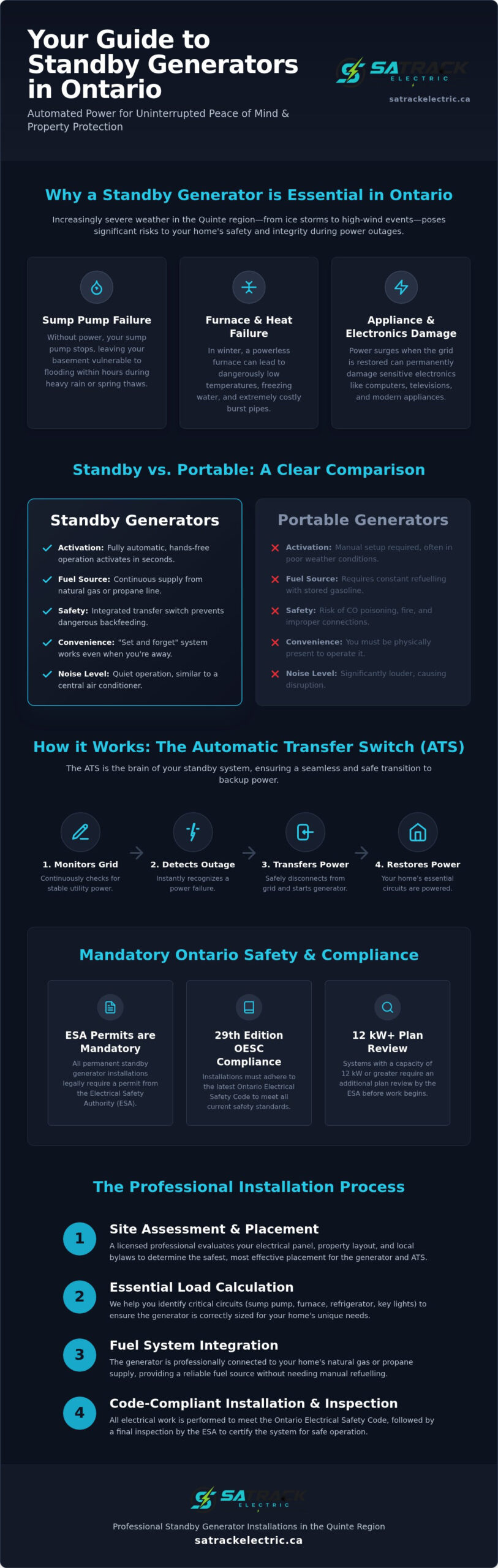
Understanding the difference between basic backup power and a dedicated standby system is critical for long-term planning. For a technical overview of how these units function, you can research What is a Standby Generator? and its role in modern electrical infrastructure. The primary advantage is the Automatic Transfer Switch (ATS). This component detects a grid failure and restores power in seconds, protecting essential home systems like sump pumps and furnaces even when you’re away.
Resilience Against Ontario’s Changing Climate
Belleville and Quinte West have seen an increase in high-wind events and ice storms that can leave the grid compromised for days. When the power fails during a spring thaw or a winter freeze, the consequences are immediate. Without a working sump pump, basements can flood within hours. Without a furnace, pipes are at risk of bursting. Standby systems also protect sensitive electronics from the damaging surges that often occur when the grid is restored. These “set and forget” installations have become the standard for homeowners who prioritize safety and property preservation.
Protecting Commercial Continuity in the Quinte Region
For local business owners in Trenton and Napanee, an outage is a direct threat to the bottom line. The cost of downtime in retail or small-scale manufacturing can be devastating. Satrack Electric provides commercial-grade solutions that keep safety systems, security alarms, and refrigeration units operational. Maintaining continuity isn’t just about convenience; it’s about fulfilling your responsibilities to your customers and staff. Our approach focuses on high-capacity reliability to ensure your business doesn’t skip a beat when the local grid fails.
Beyond immediate safety, these systems offer long-term financial benefits. Many insurance providers recognize the reduced risk of water damage and pipe bursts, which can lead to more favourable premiums. A professionally managed standby generator installation Ontario also increases property value. Prospective buyers in our region increasingly look for homes with built-in climate resilience, viewing a permanent generator as a high-value asset rather than a simple appliance.
Standby vs. Portable Generators: Comparing Power Solutions
Choosing between a portable unit and a permanent system is a matter of both convenience and safety. Portable generators require you to be physically present to haul the unit outside, connect cables, and manage fuel storage during a storm. In contrast, a standby generator installation Ontario provides a fully integrated solution that operates without human intervention. This automation is particularly Essential for Ontario Properties when severe weather makes it unsafe or impossible to venture outdoors to set up equipment.
Fuel reliability is another major differentiator. Portable units rely on gasoline, which degrades over time and requires constant refilling during a crisis. Standby systems connect directly to your natural gas or liquid propane line. This provides a continuous fuel supply without the need for flammable storage containers on your property. Modern units also feature sound-dampening enclosures that keep noise levels comparable to a central air conditioner, allowing them to sit discreetly on a concrete or gravel pad.
The Role of the Automatic Transfer Switch (ATS)
The ATS is the brain of your backup power system. It constantly monitors the utility line for a voltage drop or total failure. When an outage occurs, it instantly disconnects your home from the grid and engages the generator. This disconnection is a vital safety requirement to prevent “backfeeding.” Backfeeding occurs when power flows from your home back into the utility lines, which can be lethal for technicians trying to restore service. Because of these risks, professional standby generator wiring Ontario is a mandatory requirement for any permanent installation.
Maintenance and Longevity
Permanent standby units are engineered for decades of service. While a portable engine may only last for a few hundred hours of operation, a standby unit uses high-grade components designed for extended run times. These systems also perform “self-exercising” cycles. Once a week, the generator runs for a short duration to lubricate the engine and test the battery. This ensures the unit is ready to perform the moment the grid fails. If you’re considering an upgrade to your home’s resilience, speaking with a licensed electrical contractor can help you determine the best placement for your specific lot and power needs.
Routine professional inspections are the final piece of the reliability puzzle. An expert can verify that the transfer switch is responsive and the fuel lines are secure. This methodical approach to maintenance guarantees that your investment remains a “set and forget” solution for years to come.
Navigating Ontario Electrical Safety Authority (ESA) Requirements
In Ontario, electrical safety is governed by strict regulations that protect both the property owner and the public grid. Every permanent standby generator installation Ontario must comply with the 2024 Ontario Electrical Safety Code, which is the 29th edition of the province’s safety standards. This code includes specific updates regarding energy storage and outdoor equipment that became mandatory on May 1, 2025. One recent change to be aware of is the Electrical Safety Authority (ESA) Plan Review threshold; as of July 6, 2026, this threshold increased from 10 kW to 12 kW. This means larger residential units may require a more detailed technical review before work begins.
Obtaining an ESA permit is not a suggestion; it’s a legal requirement for any permanent wiring. This permit creates an official record of the work and triggers a safety inspection by an ESA inspector. For a detailed look at the safety logic behind these rules, you can review the official ESA requirements for generator installation. These standards ensure that your system is grounded correctly and that the transfer switch functions without endangering utility workers.
The Importance of Licensing and Insurance
Hiring a Licensed Electrical Contractor (LEC) is the only legal way to have a generator installed in Ontario. You can verify a contractor’s credentials through the ESA’s find-a-contractor portal to ensure they’re authorized to perform the work. Attempting a DIY installation or hiring an unlicensed “handyman” carries severe risks beyond simple safety hazards. Most Ontario home insurance policies contain clauses that void coverage for fire or water damage if the underlying cause was unpermitted electrical work. Satrack Electric operates as a fully licensed and insured contractor, providing the professional documentation your insurer requires.
Permits and Documentation
When you partner with a professional, the contractor is responsible for filing the permit and coordinating the inspection. In the Belleville and Trenton areas, inspection timelines vary based on local demand, but having a professional manage the schedule prevents project delays. Once the inspector approves the installation, you’ll receive a Certificate of Acceptance. You should keep this document in your permanent home records. It serves as proof of compliance during future property sales and provides peace of mind that your backup power system meets every provincial safety standard.
Sizing and Fuel Planning for Your Ontario Installation
Sizing a standby generator is a methodical process that begins with identifying your “Essential Load.” This refers to the critical systems that must remain operational to prevent property damage or health risks. In the Quinte region, this typically includes sump pumps, well pumps, refrigeration, and your furnace or air conditioning. A professionally managed standby generator installation Ontario ensures your unit is sized to handle the starting wattage of these motors without tripping breakers or stalling the engine.
Site preparation is equally important and requires coordination between electrical and gas contractors. Permanent units must be installed on a level concrete pad or a stabilized gravel base to prevent shifting. Ontario safety regulations dictate strict placement rules; for example, the unit must be at least 1.5 metres from any window or door and 3 metres from any air intake. These clearances are vital for preventing carbon monoxide from entering your home or facility during operation.
Determining Your Power Requirements
Residential standby units generally range from 10kW to 22kW. A 10kW unit is often sufficient for basic lighting, refrigeration, and a sump pump. However, if you wish to run a central air conditioner or an electric water heater, you will likely need a 20kW or 22kW system. In some cases, an electrical panel upgrade Belleville is required to accommodate the transfer switch and the additional circuits. Commercial sizing for retail or light industrial facilities involves even more complex calculations to support safety systems, heavy machinery, and emergency lighting.
Fuel Logistics and Safety
Choosing between natural gas and liquid propane depends largely on your property’s infrastructure. Natural gas is convenient for urban lots because it provides an endless fuel supply. However, you must often coordinate with your local utility for a meter upgrade to ensure the generator receives adequate gas pressure. Rural properties in areas like Napanee or northern Quinte West often rely on liquid propane. This requires a dedicated storage tank on the lot, which must be placed according to provincial safety distances from property lines and ignition sources.
Proper ventilation is the final technical hurdle. The exhaust system must be clear of obstructions to ensure the engine runs efficiently and safely. If you are unsure which fuel source or unit size fits your property, contact us to schedule a professional site assessment. This initial step is the most reliable way to ensure your backup system is both code-compliant and capable of meeting your specific power demands.
The Satrack Electric Professional Installation Process
A successful standby generator installation Ontario relies on a disciplined, step-by-step methodology. We begin with a comprehensive site assessment to evaluate your existing electrical panel, the proximity of gas lines, and the physical terrain of your property. This evaluation ensures that the chosen unit fits your needs while strictly adhering to the 2024 Ontario Electrical Safety Code. We prioritize finding a placement that meets all clearance requirements while maintaining the aesthetic integrity of your outdoor space.
Transparency is a core value in our workflow. Before any work begins, we provide a detailed proposal that outlines the scope of the project. This includes a clear breakdown of labour and materials, helping you understand the cost to hire an electrician in Belleville for complex installations. Once approved, our team manages the technical integration of the Automatic Transfer Switch (ATS) and the sub-panel wiring with precision. We conclude every project with a rigorous testing phase and a thorough customer walkthrough to verify that you feel confident operating your new system.
A Local Approach to Reliability
Satrack Electric is deeply rooted in the Quinte region, serving communities from Brighton and Trenton to Belleville and Greater Napanee. This local presence is a distinct advantage for our clients. We understand the specific municipal bylaws regarding noise and placement, as well as the unique challenges posed by our regional weather patterns. Our safety-first demeanour reflects our commitment to protecting our neighbours. We don’t rush the process; instead, we move with a methodical efficiency that ensures every connection is secure and every permit is closed correctly.
Post-Installation Support
Your relationship with Satrack Electric doesn’t end when the generator is first powered on. We offer comprehensive electrical repairs and maintenance in Belleville to keep your system in peak condition. Many modern units now include mobile app monitoring, allowing you to check the status of your system or view exercise reports directly from your phone. This added layer of oversight provides constant reassurance that your home is protected even when you’re away.
Securing your property against the next major grid failure starts with a professional consultation. Contact us today to discuss your requirements and take the first step toward a reliable, automated power solution for your home or business.
Secure Your Home’s Future with Reliable Backup Power
Protecting your property from the increasing frequency of severe storms in the Quinte region requires a proactive and methodical approach. By choosing a permanent system over portable alternatives, you ensure that critical infrastructure like sump pumps and furnaces remain operational during the most challenging weather events. Every successful standby generator installation Ontario homeowners invest in must prioritize safety, adhering to the latest 2026 ESA regulations and the 29th edition of the Ontario Electrical Safety Code.
As a Licensed Electrical Contractor (LEC) fully insured for both residential and commercial work, Satrack Electric provides the expertise needed for a seamless integration. We serve Belleville, Trenton, and the surrounding areas with a commitment to high standards and local reliability. You don’t have to navigate complex permit requirements or fuel logistics alone when a seasoned partner is available to manage the process from the initial site assessment to the final inspection.
Request a Professional Generator Installation Quote from Satrack Electric today to secure your peace of mind and protect your home’s essential systems for years to come.
Frequently Asked Questions
Do I really need a permit for a standby generator installation in Ontario?
Yes, obtaining an ESA permit is a mandatory legal requirement for every permanent standby generator installation Ontario property owners undertake. This process ensures the wiring meets the 29th edition of the Ontario Electrical Safety Code. A Licensed Electrical Contractor (LEC) like Satrack Electric handles the filing and coordinates with inspectors. Without a permit and a subsequent Certificate of Acceptance, your home insurance coverage may be compromised in the event of an electrical failure or fire.
How much does a professional standby generator installation cost in the Quinte area?
The total investment for a professional installation depends on several variables including the generator’s power capacity, the complexity of the transfer switch integration, and the distance to your fuel source. While unit prices vary by size, you must also account for site preparation, gas line coordination, and ESA permit fees. We provide transparent, comprehensive quotes following a site assessment to ensure the system meets your specific power demands and local safety standards.
Can a standby generator run my entire house, including the air conditioner?
A correctly sized standby generator can certainly power your entire home, including high-demand appliances like central air conditioners. Achieving this requires a detailed load calculation to ensure the unit handles the initial surge wattage when the A/C compressor engages. For many properties in the Quinte region, a 20kW or 22kW unit is the standard choice for whole-home continuity, though smaller units can be configured to prioritize only your most essential circuits.
What is the best fuel source for a generator in rural Ontario: propane or natural gas?
The ideal fuel source depends primarily on your property’s location and existing infrastructure. Natural gas is the most convenient choice for urban homes in Belleville or Trenton because it offers an unlimited supply. For rural properties in Greater Napanee or Prince Edward County where natural gas isn’t available, liquid propane is the reliable alternative. Propane requires an on-site storage tank, which must be installed according to specific provincial safety distances from property lines and buildings.
How far must a generator be placed from my home according to Ontario codes?
Ontario safety codes dictate that a standby generator must be positioned at least 1.5 metres from any window, door, or wall opening. Additionally, the unit must be at least 3 metres away from any building air intake to prevent carbon monoxide from entering your living space. These distances are critical for the safety of your household. Our team evaluates these clearances during the initial site assessment to find a location that is both code-compliant and functional.
Does a standby generator require regular maintenance like a car engine?
Regular maintenance is essential for ensuring your system remains ready for a sudden grid failure. Much like a vehicle, these units require periodic oil and filter changes, battery health checks, and spark plug inspections. Most modern standby systems are programmed to perform a weekly self-exercise cycle to lubricate engine components and test the starter. We recommend a professional inspection at least once a year to verify that all electrical connections and fuel lines remain secure.
Will a standby generator increase my property value in Belleville?
A professionally installed standby generator is considered a high-value asset that can increase the resale value of your property. In the Belleville and Quinte West areas, where severe weather can lead to extended outages, prospective buyers often prioritize homes with built-in climate resilience. Having a permanent, code-compliant backup system provides a competitive advantage in the real estate market and demonstrates that the property has been maintained to a high professional standard.
What happens if my generator fails to start during a power outage?
If a generator fails to engage, it is often due to a depleted starter battery or a lack of fuel pressure. Professional maintenance is the best way to prevent these issues before an outage occurs. If your system does not start automatically, you should check the status indicator on the unit or your mobile monitoring app for error codes. For persistent issues, contacting a licensed contractor for an electrical repair ensures the system is restored to full operational safety.