
Your home’s electrical panel was likely designed for a world that didn’t include electric vehicles, high-speed heat pumps, and a dozen smart devices in every room. It’s a reality that many Ontario homeowners face as their aging infrastructure struggles to keep pace with modern life. You’ve probably felt that flash of concern when a breaker trips during dinner or noticed a slight flicker in the hallway lights. These aren’t just minor inconveniences; they are often the primary signs electrical panel needs upgrade to prevent serious safety hazards.
We understand that navigating electrical codes and capacity requirements can feel overwhelming. You want to know if your home is safe and if your current setup meets the 2024 Ontario Electrical Safety Code standards for insurance purposes. This article provides a clear, professional checklist to help you evaluate your system’s health. You’ll learn how to distinguish between a simple repair and a necessary modernization, ensuring your property remains protected and fully powered for years to come.
Key Takeaways
- Identify the physical warning signs electrical panel needs upgrade, such as breakers that are warm to the touch or lights that flicker when major appliances engage.
- Learn why modern home additions like Level 2 EV chargers often necessitate an increase in electrical capacity to maintain system stability and safety.
- Understand the critical relationship between your electrical panel and home insurance requirements to ensure your property remains fully covered and compliant.
- Recognize the importance of Electrical Safety Authority (ESA) permits and professional oversight to ensure your home meets the 2024 Ontario Electrical Safety Code.
- Discover a methodical approach to panel modernization that minimizes downtime while handling all necessary coordination with local utilities and regulatory bodies.
Understanding Your Home’s Electrical Heart: What is a Service Panel?
Every watt of power used in your home passes through a single, grey metal box usually tucked away in the basement or utility room. This unit, technically known as a service panel or distribution board, acts as the central hub for all electricity entering your property. It is the primary safety gatekeeper between the municipal grid and your family. Without this critical component, electricity would flow unchecked, creating an immediate fire risk to your structure and electronics.
The panel manages two vital tasks. First, it divides the incoming power from the utility company into separate branch circuits that feed your kitchen, laundry room, and bedrooms. Second, it monitors the current on those circuits. If a fault occurs or a circuit becomes overloaded, the panel’s safety mechanisms trip to cut power instantly. Modern panels are designed to handle significantly higher baseloads than those installed even 15 years ago, reflecting our increased reliance on high-draw technology and smart home infrastructure.
Recognizing the age and limitations of this equipment is essential for property maintenance. If you notice that your breakers trip frequently or your lights dim when the air conditioner starts, these are often the first signs electrical panel needs upgrade to ensure your system can handle modern demands safely.
The Evolution of Electrical Capacity in Ontario
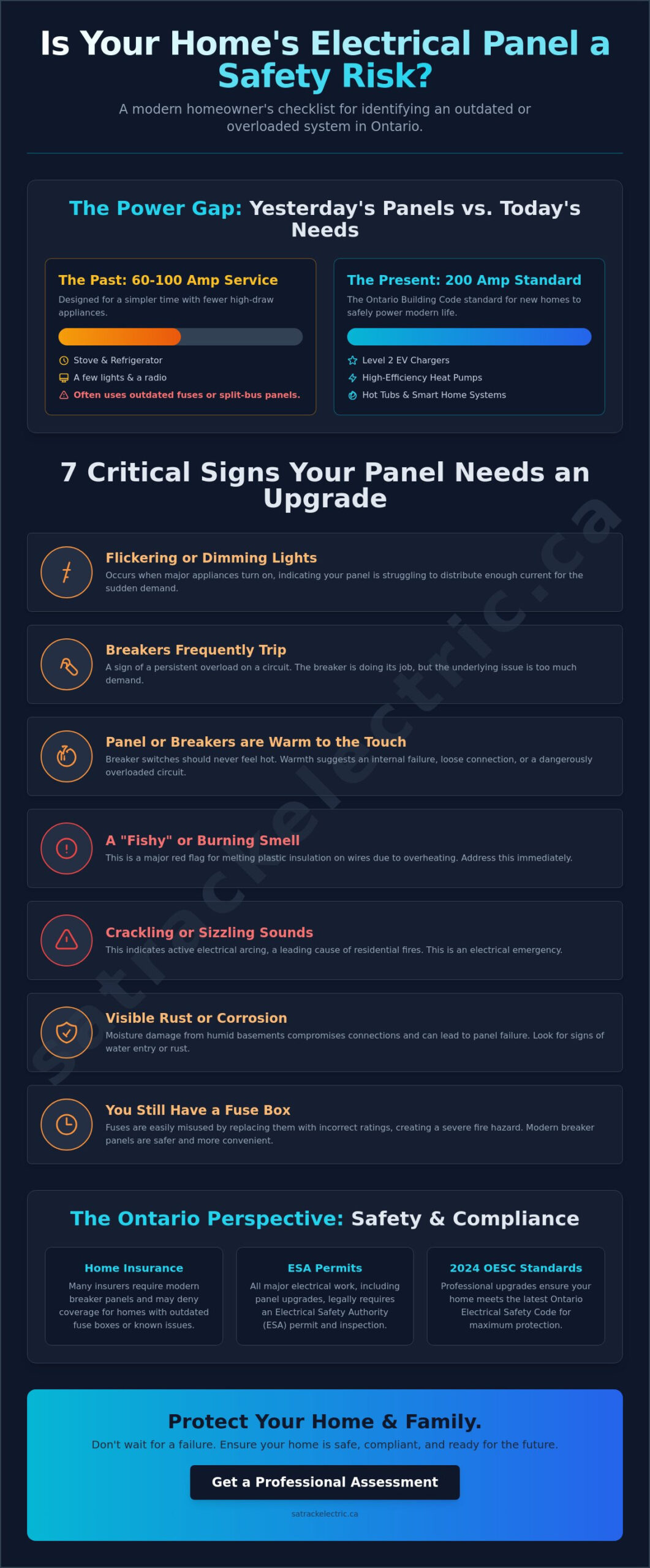
Historically, 60-amp or 100-amp services provided sufficient power for a standard Canadian household. These systems were built for a time when a few lights, a radio, and a stove were the primary loads. Today, the Ontario Building Code recognizes 200-amp service as the standard for new home constructions. This shift is necessary to support modern demands like electric vehicle chargers, hot tubs, and heat pumps. In many Belleville homes, older split-bus panels remain in use. These panels lack a single main disconnect and are now considered a significant safety risk because they often fail to trip during a sustained overload.
Breakers vs. Fuses: Why the Distinction Matters
While both devices perform the same basic function, their operation differs greatly. A circuit breaker is a mechanical switch that flips when it detects a problem; it can be reset once the issue is resolved. A fuse, however, contains a metal filament that melts to break the circuit. Fuses are technically reliable, but they are often misused. Homeowners sometimes replace a blown fuse with a higher-rated one to stop it from blowing again, which bypasses the safety system entirely. If you still have a fuse-based system, reading our Fuse Box Replacement in Ontario: The Complete 2026 Homeowner’s Guide will help you understand the modernization process and the safety benefits of moving to a breaker system.
The 7 Critical Signs Electrical Panel Needs Upgrade: A Visual Checklist
Detecting a faulty electrical system often starts with simple observation. While some issues remain hidden behind the drywall, the most common signs electrical panel needs upgrade often manifest in plain sight. One of the most frequent indicators is flickering or dimming lights that occur when a major appliance, such as your refrigerator or air conditioner, cycles on. This phenomenon happens because your panel is struggling to distribute enough current to satisfy the sudden demand, causing a temporary voltage drop across the circuit.
Beyond visual cues, your senses of smell and touch are vital diagnostic tools. Breaker switches should never feel hot. If a switch is warm to the touch, it suggests an internal failure or an overloaded connection. Similarly, a distinct “fishy” or ozone-like burning smell near the panel area is a red flag for melting plastic insulation or arcing wires. It is critical to understand that any crackling or sizzling sound emanating from the box constitutes an electrical emergency. These sounds indicate active arcing, which is a leading cause of residential fires. For more detailed identification of hazards, you can consult this official electrical safety guide to better understand common household risks.
Physical Deterioration and Environmental Factors
Many Ontario basements suffer from high humidity levels, which can lead to significant panel corrosion over time. You should look for visible rust or a white, powdery oxidation on the metal components. These signs of moisture ingress often lead to “arcing,” where electricity jumps between connections, creating intense heat. During a visual inspection, check for scorch marks or melted insulation on the wires inside the enclosure. You might also spot “double-tapped” breakers, where two wires are forced into a single terminal. This is a clear sign of an amateur installation that lacks the proper capacity for your home’s needs. If you notice these physical defects, it is wise to schedule professional electrical maintenance to assess the damage accurately.
The “Frequent Trip” Warning
A circuit breaker is a safety device designed to trip when it detects a dangerous load. If a specific breaker trips once a month or more, it is not just a nuisance; it is a symptom of a larger capacity issue. Many homeowners fall into the trap of “reset fatigue,” where they repeatedly flip the switch back on without investigating the cause. This habit is dangerous. Ignoring a tripping breaker can lead to “reset failure,” where the mechanism eventually seizes or fails to trip when a real fire risk occurs. Additionally, the inconsistent power flow caused by frequent tripping can permanently damage sensitive electronics, including your computers, smart TVs, and home automation systems.
Performance Gaps: Is Your Panel Too Small for 2026 Demands?
Your electrical panel might appear physically sound, but its internal capacity often tells a different story. As we move through 2026, the volume of electricity required by a standard household has shifted significantly. One of the most telling signs electrical panel needs upgrade is what we call the “extension cord trap.” If you find yourself relying on multiple power strips and extension cords because your walls lack enough outlets, it’s a clear indicator that your current system cannot support the additional circuits required for modern convenience. Overloading a single circuit with multiple strips creates a localized heat build-up that your older breakers may not detect until it’s too late.
The widespread shift toward electrification in Ontario has introduced high-load devices that older 100-amp panels simply weren’t designed to handle. A Level 2 EV charging station, for example, requires a dedicated 40 to 60-amp circuit to operate safely and efficiently. When you combine this with the transition to electric heat pumps, which demand a massive amperage draw during cold Quinte winters, a 100-amp service quickly reaches its functional limit. If you’re concerned that you may have an electrical panel too small for Ontario’s modern energy demands, understanding the specific load requirements of your appliances is the critical first step. Even lifestyle additions like a hot tub or a home sauna can be the tipping point that pushes an aging system into a state of constant, dangerous overload. When planning these upgrades, many homeowners also look to online resources like Living Chic for high-quality garden furniture and decor to complete their outdoor living spaces.
Modern Appliance Surges and Smart Home Tech
It’s a common misconception that high-efficiency appliances reduce the immediate strain on your panel. While they use less total energy, many modern motors and compressors actually have higher startup surges than older models. When several of these units cycle on simultaneously, they can overwhelm an aging breaker. Additionally, the cumulative effect of smart home devices creates a higher “always-on” baseline power draw. These phantom loads keep your system under constant stress, reducing the lifespan of your breakers and increasing the likelihood of a failure when you need power the most.
Planning for Future-Proofing
Upgrading to a 200-amp service is a strategic investment in your property’s resale value. In the Quinte region, prospective buyers increasingly prioritize homes that are already EV-ready and capable of supporting modern infrastructure without immediate renovation costs. A larger panel also provides the necessary framework for installing a home backup generator, ensuring your family remains protected during utility outages. For local entrepreneurs facing similar capacity issues at their place of business, our guide on Commercial Electrical Upgrades in Belleville offers specialized insights for professional environments.
The Ontario Perspective: Insurance, ESA, and Legal Requirements
In the Ontario housing market, your electrical system is a major factor in property insurability. Many insurance providers now mandate a transition from fuse boxes to circuit breaker panels before they will issue or renew a homeowner’s policy. This isn’t just about modern convenience; it’s a risk management strategy. If you are experiencing common signs electrical panel needs upgrade, such as flickering lights or breakers that trip under normal loads, your insurer may view your property as a high-risk asset. Failing to address these issues can lead to significantly higher premiums or even a complete denial of coverage.
Beyond insurance, there are strict legal requirements enforced by the Electrical Safety Authority (ESA). Every panel upgrade in Ontario requires a permit and a subsequent inspection to ensure compliance with the 2024 Ontario Electrical Safety Code (OESC). It’s vital to understand that only a Licensed Electrical Contractor (LEC) can legally pull an ESA permit in Ontario. Attempting a DIY installation or hiring an unlicensed “handyman” to perform this work can void your fire insurance. In the event of a claim, insurers often check for an ESA Certificate of Acceptance; without it, you may be held personally liable for damages.
The Real Cost of Keeping an Outdated System
Keeping an outdated system carries hidden financial burdens that extend beyond simple repair bills. An old panel often reduces your property’s appraisal value and leads to elevated insurance costs. Electrical fires remain a leading cause of preventable home damage across Canada, often stemming from components that were never designed for 2026 energy loads. During a professional inspection, we often identify specific hazardous brands like Federal Pacific Electric or Zinsco. These panels are notorious for failing to trip during a surge, which creates a direct fire path within your walls. Recognizing the early signs electrical panel needs upgrade can prevent these dangerous scenarios before they escalate. If you suspect your home contains these components, scheduling a professional electrical panel upgrade is the most effective way to secure your investment.
Selling Your Home in Belleville or Trenton?
If you are planning to sell a home in Belleville or Trenton, your electrical panel will be under intense scrutiny. Local home inspectors routinely flag outdated panels as high-priority repair items during the due diligence phase. This often leads to last-minute price negotiations or significant delays in the closing process. By proactively upgrading your system, you provide potential buyers with the peace of mind that comes with a modern, safe, and ESA-certified installation. An ESA Certificate of Acceptance serves as a powerful document during a sale, proving that your home’s electrical heart meets the highest provincial safety standards. Business owners in the area facing similar scrutiny during property transactions can find additional guidance in our 2026 professional reference guide for commercial electrical upgrades in Belleville.
Professional Electrical Panel Upgrades in Belleville: The Satrack Process
Identifying the signs electrical panel needs upgrade is the first step toward a safer home, but the execution of that upgrade requires precise coordination. At Satrack Electric, we provide a methodical approach to both residential and commercial panel upgrades, ensuring that the transition to a modern system causes minimal disruption to your daily routine. We take full responsibility for the administrative burden. This includes managing applications with local utilities and scheduling the mandatory inspections with the Electrical Safety Authority (ESA) so you don’t have to manage the paperwork yourself.
Our team consists of licensed, insured electricians who are committed to high standards of Canadian workmanship. We prioritize safety and cleanliness on every job site. You can expect clear, professional communication from the moment you receive your initial quote until the final inspection is approved. We treat your property with the same respect we would our own, ensuring that the final installation is not only functional but also neatly organized and compliant with all provincial regulations.
What to Expect During Your Upgrade Day
A standard residential panel swap generally follows a predictable timeline, typically requiring between 4 and 8 hours to complete. During this window, we coordinate the power shut-off with your local utility provider, whether it is Elexicon or Hydro One. Once the new hardware is installed, we enter a thorough testing phase. We verify that every circuit is correctly balanced and clearly labelled, providing you with a transparent map of your home’s electrical distribution. This methodical final check ensures that your new system is ready to handle modern 2026 energy demands without hesitation.
Invest in Your Safety with Satrack Electric
Our local reputation in Brighton, Picton, and Quinte West is built on years of reliable service and integrity. We use only high-quality, code-compliant materials specifically chosen to withstand the rigours of Ontario winters. When you choose a local expert, you gain the benefit of ongoing support and a warranty backed by a business rooted in your community. Don’t wait for a system failure to address your home’s needs. Schedule your professional electrical panel assessment today with Satrack Electric and ensure your property remains a safe, modern environment for your family.
Secure Your Home’s Electrical Infrastructure
Maintaining a safe and efficient home starts with understanding the functional limitations of your electrical system. Physical signs electrical panel needs upgrade, such as persistent flickering or breakers that are warm to the touch, are clear signals that your home is under significant stress. Modernization ensures your property is ready for 2026 technology demands like Level 2 EV charging and high-efficiency heat pumps while keeping you compliant with Ontario insurance requirements and safety standards.
As a Licensed Electrical Contractor (LEC #7012345), Satrack Electric is fully insured for residential and commercial work. We’ve served the Belleville, Trenton, and Quinte West communities for years, prioritizing safety and professional integrity in every installation. Our team handles every detail of the ESA permit process and utility coordination to provide a seamless, hassle-free experience for your family. Book Your Professional Panel Inspection with Satrack Electric today to ensure your electrical system is reliable, legal, and ready for the future. Your peace of mind is our primary goal.
Frequently Asked Questions
Is it worth upgrading from a 100-amp to a 200-amp panel?
Yes, upgrading to a 200-amp panel is a sound investment for any modern household. This capacity has become the standard for new Ontario homes because it safely supports high-draw equipment like Level 2 EV chargers, heat pumps, and electric water heaters. Beyond immediate performance, it significantly enhances your property’s resale value and ensures your electrical system won’t become a bottleneck during future home renovations or additions.
How much does an electrical panel upgrade cost in Ontario for 2026?
The total investment for a panel upgrade varies based on several factors, including the existing service size and the complexity of the rewiring required. Costs typically cover high-quality materials, professional labour, and mandatory Electrical Safety Authority (ESA) permit fees. While specific rates depend on your home’s unique layout, a professional assessment is necessary to provide an accurate quote that reflects current market conditions and regulatory requirements in Ontario.
Can I upgrade my own electrical panel if I am handy with tools?
No, homeowners should not attempt to upgrade their own electrical panels. In Ontario, all electrical panel work must be performed by a Licensed Electrical Contractor (LEC) to ensure it meets the 2024 Ontario Electrical Safety Code. Only an LEC can legally pull the required ESA permit and coordinate the necessary power disconnect with your utility provider. Attempting this work yourself poses severe safety risks and can void your home insurance policy.
How long does a typical electrical panel replacement take?
A standard residential panel replacement usually takes between 4 and 8 hours to complete. This timeline includes the time required for the local utility to disconnect the power, the physical installation of the new hardware, and the final testing of all circuits. While your power will be off during this window, we coordinate closely with local utilities to ensure the transition is as efficient as possible.
Will insurance cover the cost of a panel upgrade if it is old?
Insurance companies generally do not cover the cost of a panel upgrade, as they view it as a proactive maintenance or improvement expense. However, upgrading your system is often a prerequisite for obtaining or renewing a policy, especially if you have an outdated fuse box. While you pay for the installation, the modernization can lead to lower premiums and prevents the risk of a claim denial following an electrical fire.
What happens if I don’t upgrade my electrical panel when it shows signs of wear?
Ignoring signs electrical panel needs upgrade significantly increases the risk of electrical fires and permanent damage to sensitive electronics. Overloaded panels can lead to arcing, where electricity jumps between connections and generates intense heat. Additionally, you may face legal liability or insurance complications if a fire occurs in a system with known defects. Proactive replacement is the most reliable way to protect your family and your property investment.
Do I need a permit for an electrical panel upgrade in Belleville?
Yes, an ESA permit is legally mandatory for any electrical panel upgrade performed in Belleville or anywhere else in Ontario. This permit ensures that a provincial inspector reviews the work to confirm it adheres to strict safety standards. Once the inspection is successful, you receive a Certificate of Acceptance, which serves as vital documentation for your insurance provider and future home buyers.
What is the difference between a sub-panel and a main panel upgrade?
A main panel upgrade involves replacing the primary service entrance to increase the total amperage coming into your home. In contrast, a sub-panel is a smaller distribution box installed to provide more circuit space in a specific area, like a garage or basement. A sub-panel does not increase your home’s total power capacity; it simply redistributes the power already provided by your main panel. If your total load is too high, a main upgrade is required.