
Could your home’s electrical system be the one thing standing between you and the modern upgrades you want to install? Many people across the province are discovering that their existing service cannot keep up with the power demands of electric vehicle chargers, heat pumps, and induction ranges. If you’re researching an electrical panel too small Ontario homeowners frequently find that older 100-amp systems cannot safely handle the load of modern equipment, leading to frequent breaker trips and safety concerns.
It’s understandable to feel hesitant about the complexity of a service upgrade, especially when safety and budget are your primary concerns. You want to ensure your family’s protected from electrical fires without undergoing unnecessary work or hiring uncertified contractors who don’t follow the latest regulations.
This guide will help you identify the specific signs of an undersized panel and explain the professional steps to modernize your system according to the 2024 Ontario Electrical Safety Code. We’ll look at how to perform a proper load calculation, the impact of new AFCI protection requirements, and how to determine if a 200-amp service is necessary for your 2026 renovation plans.
Key Takeaways
- Distinguish between physical circuit space and total electrical capacity to determine if your electrical panel too small Ontario homeowners often find their systems are outdated.
- Learn why modern high-demand appliances, such as Level 2 EV chargers and heat pumps, typically require a 200-amp service to operate safely.
- Identify the safety hazards and insurance challenges associated with maintaining legacy 60-amp services or fuse-based panels.
- Understand the professional upgrade process, including the necessity of accurate load calculations and mandatory Electrical Safety Authority (ESA) permits.
Understanding Your Electrical Panel: Is It Physically or Electrically Too Small?
An electrical panel too small Ontario homes often struggle with is one that simply wasn’t designed for the power demands of the 2020s. In many older properties, the system functions perfectly for lights and basic electronics, but it fails the moment you try to modernize. Identifying your current capacity is the first step. Locate the main breaker, which is the largest switch in your distribution board (electrical panel). It’s usually stamped with a number like 60, 100, or 200. This figure represents the total amperage your home can draw from the utility provider at any given time.
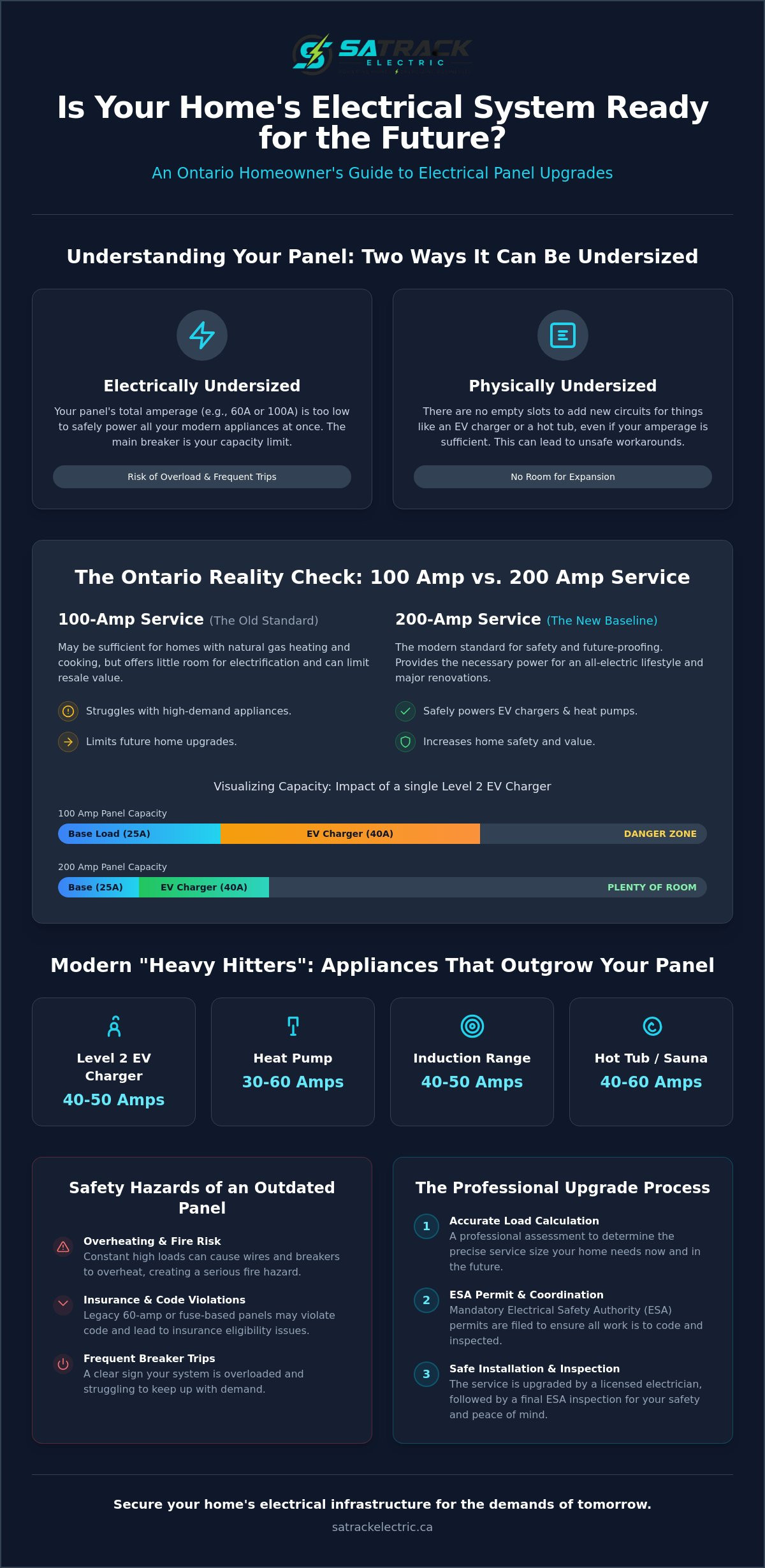
A panel can be undersized in two distinct ways. It can be electrically undersized, meaning you lack the amperage to run appliances simultaneously. Alternatively, it can be physically undersized, meaning there are no empty slots left on the bus bar to install a new circuit. Many homeowners try to bypass this by using tandem breakers, which allow two circuits to fit into the space of one. While these are legal in specific configurations, they often act as a temporary band-aid. They don’t increase your total power; they just crowd the existing space and can lead to excessive heat buildup within the enclosure.
Amperage vs. Circuit Capacity
You might have a 100-amp service that seems adequate, yet you find yourself unable to add a hot tub or a basement apartment. This happens when the physical capacity of the bus bar is reached. The bus bar is the internal metal rail that distributes power to each individual breaker. When a panel is physically crowded, you may see “double-tapping,” where two wires are forced into a single terminal. This is a significant safety violation. If you notice tangled wiring or a lack of open knockouts, your panel is physically at its limit regardless of its amperage rating.
The “Future-Proof” Standard for 2026
As we move through 2026, the 100-amp standard is becoming a relic of the past. Ontario’s shift toward electrification means that a single heavy-draw appliance, like a Level 2 EV charger, can consume nearly half of a 100-amp panel’s total capacity. For most families, a 200-amp service is now the baseline for reliability. It provides the necessary headroom to add modern conveniences without compromising safety or performance. If you’re unsure if your system is reaching its limit, reviewing the signs your electrical panel needs an upgrade can help you decide if it’s time to consult a licensed professional.
100 Amp vs. 200 Amp: The Ontario Reality Check
Many Ontario homeowners ask if their 100-amp service is still sufficient for a modern lifestyle. While 100 amps was the gold standard for decades, the rapid electrification of residential properties has changed the math. If you find your electrical panel too small Ontario regulations and insurance requirements often point toward a necessary capacity increase. Determining your true needs requires looking beyond the number of switches in the box and evaluating your total simultaneous power draw.
When 100 Amps is Still Enough
A 100-amp panel may still serve a home that relies on natural gas for heating, water heating, and cooking. If your high-draw appliances are limited to a dryer and a stove, you might not need an immediate upgrade. However, safety remains paramount. Scheduling a regular electrical maintenance check ensures that your existing 100-amp system isn’t under hidden stress from loose connections or aging components. Keep in mind that while it works today, a 100-amp service can limit your home’s resale value, as many buyers now view 200-amp capacity as a prerequisite for future-proofing.
The Move to 200 Amps
In the Quinte region, 200-amp service has become the default for major renovations and new builds. This shift is driven by “heavy hitters” like electric heat pumps and Level 2 EV chargers. A single Level 2 charger can require a dedicated 40 to 50-amp circuit. On a 100-amp panel, this leaves very little headroom for other essential systems. Upgrading to 200 amps provides a significant safety margin, reducing the risk of overheating at the main lugs during peak usage. It’s often more cost-effective to upgrade during a planned renovation than to wait for an emergency failure or a rejected insurance application.
Deciding between a sub-panel and a full service upgrade depends entirely on your total load. A sub-panel adds physical circuit slots but does not increase the total power coming into your home. If your total demand exceeds 80 percent of your main breaker’s rating, a sub-panel won’t solve the underlying issue. If you suspect your electrical panel too small Ontario professionals can conduct a formal load calculation to provide a definitive answer. This process uses specific formulas from the 2024 Ontario Electrical Safety Code to determine your home’s peak demand accurately. For those planning a significant project, understanding the complete electrical panel upgrade process Ontario homeowners must navigate ensures your home remains safe and compliant for years to come.
Modern “Heavy Hitters”: Appliances That Outgrow Your Panel
Modern lifestyle upgrades often demand more power than legacy systems can provide. While your home might have functioned well for years, the introduction of a single high-draw appliance can suddenly make an electrical panel too small Ontario homeowners realize. These “heavy hitters” don’t just use more electricity; they require dedicated circuit space and consistent amperage that older 60-amp or 100-amp panels were never designed to handle. Understanding the specific requirements of these devices is essential before you commit to a purchase or renovation.
EV Charging and Your Panel Capacity
Installing a Level 2 electric vehicle charger is the most common reason for a service upgrade in 2026. A standard Level 2 charger typically requires a dedicated 40-amp to 50-amp, 240-volt circuit. On a 100-amp panel, this single charger can consume half of your home’s total available power. Some homeowners attempt to use “dryer splitters” to share an existing 30-amp circuit, but this is rarely a convenient or recommended long-term solution. It often leads to nuisance tripping and doesn’t provide the charging speed most drivers require. While smart load management systems can help balance the draw, they are often used to supplement a 200-amp service rather than to make an undersized 100-amp panel work. As you modernize your home for an EV, ensuring your vehicle is also well-maintained is vital; for those in the capital region, Auto Glass Ottawa offers professional glass services to keep your car in top condition.
Outdoor Luxury and Indoor Comfort
Adding a pool or a spa significantly changes your home’s electrical profile. Because water and electricity are a dangerous combination, the 2024 Ontario Electrical Safety Code mandates strict requirements for hot tub wiring, including dedicated GFCI protection. These units can draw upwards of 50 amps on their own. Similarly, Ontario’s shift toward green energy has led many to install electric heat pumps or hybrid HVAC systems. While efficient, these systems have high peak demands during extreme temperatures. If you’re also considering an electric tankless water heater, be aware that these units are often “deal-breakers” for 100-amp panels, sometimes requiring 60 to 120 amps just for the heater itself.
Beyond indoor appliances, luxury outdoor additions like sunrooms or motorized screens also factor into your total electrical load; for professional guidance on these installations, click here to learn more about Muskokify.
Legal basement suites and secondary apartments also trigger mandatory panel assessments. Building codes require that these units have sufficient power for independent cooking, heating, and laundry facilities. This cumulative load almost always necessitates an upgrade to a 200-amp or even a 400-amp service to ensure both units can operate safely without flickering lights or frequent breaker trips. When planning these additions, a professional load calculation is the only reliable way to confirm if you are operating within the safe limits of your current distribution board.
Ignoring an undersized system introduces more than just the nuisance of a tripped breaker. When you operate an electrical panel too small Ontario homes often experience thermal stress that remains hidden behind the drywall. Continuous overloading causes the main bus bars to reach temperatures they weren’t designed to withstand. Over time, this heat degrades wire insulation and can lead to arcing or electrical fires. This isn’t a hypothetical risk. The Electrical Safety Authority (ESA) has noted that advanced protection like AFCI can reduce residential distribution fires by up to 71 percent, but these safety features can’t be properly installed in an outdated or overcrowded panel.
Safety and Insurance Standards
For many property owners, the first encounter with these risks happens during an insurance renewal. Most Ontario insurers now view 60-amp services or legacy fuse systems as high-risk. In many cases, a fuse box replacement is a non-negotiable requirement for maintaining coverage. Beyond the amperage, specific older brands like Federal Pacific or Zinsco are known for failure rates that exceed modern safety standards. Upgrading to a modern breaker system provides a clear, labelled interface and the peace of mind that your home meets current provincial safety codes. Business owners facing similar aging infrastructure challenges can find detailed guidance in the commercial electrical upgrades Belleville professional reference guide, which addresses the unique demands of commercial facilities under the 2024 Ontario Electrical Safety Code.
Impact on Daily Life
Living with an undersized panel often turns daily chores into a game of “musical appliances.” You might find you can’t run the microwave while the toaster is active, or you notice the lights dim when the air conditioner cycles on. This “voltage sag” is a clear sign your service is struggling. These fluctuations don’t just cause flickering. They can damage sensitive electronics like smart TVs, computers, and high-end kitchen appliances by forcing their internal power supplies to work harder.
The financial impact also extends to your home’s equity. During a home inspection, an undersized panel is a major red flag. Buyers in 2026 expect a home to be ready for an EV charger or a heat pump. If your panel is at capacity, it becomes a significant negotiation point that often results in a price reduction or a demand for the seller to fund the upgrade before closing. Proactively investing in an electrical panel upgrade protects your property value and ensures your home’s infrastructure supports your long-term renovation goals.
Upgrading Your Service in Ontario: The Satrack Electric Process
The process of resolving an electrical panel too small Ontario homeowners often struggle with begins with a professional load calculation. This is a precise mathematical assessment required by the 2024 Ontario Electrical Safety Code, not a simple estimate. We evaluate your home’s total square footage and the specific amperage requirements of your current and future appliances. This step ensures that your new service provides enough headroom to handle your modern lifestyle without the risk of overloading the main bus bars. Homeowners who want a detailed breakdown of every stage can review the full electrical panel upgrade process Ontario regulations require, including how to manage the ESA permit timeline and utility coordination.
Once we determine the required capacity, our team manages the coordination with the Electrical Safety Authority (ESA) and your local utility provider. Whether you’re served by Hydro One or Elexicon, we handle the technical communication and paperwork. We file the necessary notification of work and schedule the power disconnect and reconnect with the utility. Managing these logistics is essential. Unpermitted electrical work can void your home insurance policy and lead to significant provincial fines.
On the day of the upgrade, you can expect a methodical and organized workflow. Our team arrives prepared with all necessary materials to ensure the power outage is as brief as possible. We remove the outdated equipment and install the new service, making sure every connection is secure and meets professional standards. This isn’t just a simple swap. It’s a comprehensive modernization of the entry point of power into your home, ensuring your distribution board is ready for the next several decades.
Working with a Licensed Ontario Contractor
Hiring a licensed and insured team is the only way to guarantee your upgrade meets the 2024 OESC standards. After the installation is complete, an ESA inspector visits the property to verify that the work complies with all safety regulations. This final step provides you with a Certificate of Acceptance, which is your legal proof of a safe installation. We take pride in delivering results that stand up to the strictest scrutiny in Belleville, Trenton, and Napanee. Property owners managing facilities in the region can also explore our commercial electrical upgrades in Belleville to understand how the same rigorous standards apply to business and industrial environments.
Next Steps for Your Home
Preparing for a future with increased electrical reliance is a proactive step toward home safety and property value. If you suspect your current system is reaching its limit, a professional assessment is the only reliable way to confirm your needs. We provide clear, direct guidance on the state of your infrastructure so you can plan your renovations with confidence. Contact Satrack Electric for a professional panel assessment today.
Securing Your Home’s Electrical Infrastructure
Modernizing your home’s electrical system is a practical investment in both safety and future capability. The demand for power in 2026 is significantly higher than in decades past. Whether you’re adding a Level 2 EV charger or preparing for a heat pump installation, ensuring your distribution board can handle the load is essential. When researching an electrical panel too small Ontario property owners usually find that upgrading to 200 amps is the most reliable path forward to support a modern lifestyle.
A professional upgrade involves more than just swapping a box; it requires a detailed load calculation and strict adherence to the latest provincial regulations. As a Licensed and Insured Electrical Contractor, we prioritize expertise in OESC compliance to provide results that protect your family and your property value. We take pride in serving residents throughout Belleville, Trenton, and the surrounding Quinte regions with dependable, high-quality service.
Your home’s electrical system should support your goals rather than restrict them. We look forward to helping you create a safe and efficient environment for your next renovation project.
Frequently Asked Questions
Can I just add a sub-panel if my main panel is full?
You can add a sub-panel to create more physical circuit slots, but this does not increase the total amperage available to your home. A sub-panel is an excellent solution if you have plenty of power capacity but no room to physically plug in new breakers. If your main service is already struggling to meet your home’s total demand, adding a sub-panel won’t prevent the main breaker from tripping.
How much does it cost to upgrade an electrical panel in Ontario?
The total investment for a panel upgrade depends on several variables, including the condition of your existing meter base and the fees charged by your local utility provider. Costs are influenced by the required Electrical Safety Authority (ESA) permits and the specific material needs of your property. Every home is unique; therefore, a professional site assessment is necessary to provide an accurate estimate for your specific project requirements.
Do I need to upgrade to 200 amps for an EV charger?
Upgrading to 200 amps is often necessary because a Level 2 EV charger can consume nearly half of a standard 100-amp service. While some homes with gas heating might manage on 100 amps, the cumulative load of modern appliances usually makes 200 amps the safer choice. A licensed professional will perform a load calculation to determine if your current panel can support the additional 40 to 50 amps required for the charger.
How long does a panel upgrade take to complete?
Most residential panel upgrades are completed within six to eight hours. Our team coordinates with the local utility provider to manage the power disconnect and reconnect on the same day. While the power will be off during the installation, we work efficiently to minimize the disruption to your household. We ensure the new system is fully operational and tested before the end of the workday.
Will insurance companies cover a house with a 100 amp panel?
Most Ontario insurers accept 100-amp breaker panels, but they often flag 60-amp services or legacy fuse boxes as high-risk. When an insurer identifies an electrical panel too small Ontario homeowners may be asked to modernize the system to maintain their coverage. It’s common for insurers to request a Certificate of Acceptance from the ESA to prove the installation meets modern safety standards during a home purchase or policy renewal.
What is the difference between a service upgrade and a panel upgrade?
A panel upgrade replaces the indoor breaker box, while a service upgrade increases the total amperage coming from the utility. A service upgrade involves replacing the exterior mast, the meter base, and the main service wires in addition to the indoor panel. You might choose a panel upgrade to gain more circuit slots, but you need a service upgrade if you want to increase your home’s total electrical capacity.
Do I need a permit to change my electrical panel in Ontario?
Yes, any change to your electrical panel requires a permit from the Electrical Safety Authority (ESA). This notification of work is a legal requirement that ensures your upgrade is inspected and verified for safety. Licensed Electrical Contractors handle the permit process on your behalf, providing you with a Certificate of Acceptance once the inspector confirms the work complies with the Ontario Electrical Safety Code.
How do I know if my panel is overloaded if it isn’t tripping breakers?
Physical symptoms like flickering lights or buzzing sounds often indicate an overloaded system before a breaker actually trips. You should also check if the panel cover or individual breakers feel warm to the touch, which suggests excessive heat buildup. If you notice a faint burning smell or see discolouration on the breakers, your system is likely under significant stress and requires an immediate professional assessment to prevent a fire.