
Skipping a licensed permit for your electrical work does more than risk a fine; it can effectively void your home insurance policy in the event of a fire. As modern homes transition toward full electrification with heat pumps and EV chargers, the demand on your electrical system has never been higher. It’s understandable if you feel some anxiety about the coordination required between the Electrical Safety Authority (ESA) and local utilities like Hydro One or Elexicon. You want the job done right, but the administrative hurdles often feel overwhelming.
This reference clarifies the electrical panel upgrade process Ontario homeowners must navigate in 2026. We provide the professional assurance you need to modernize your service while strictly adhering to the latest Ontario Electrical Safety Code. You’ll learn exactly how to manage the timeline of your upgrade, what to expect during the mandatory power disconnect, and how to utilize the Canada Greener Homes Loan for your project. This guide moves step-by-step through the permit phase, the physical installation, and the final ESA inspection to ensure your property value and safety are protected.
Key Insights
- Identify signs of an aging system and evaluate if your current service supports modern electrical demands.
- Compare 100-amp and 200-amp panels to ensure your property has the headroom required for future-proofing.
- Navigate the electrical panel upgrade process Ontario homeowners must follow, including utility coordination and ESA permit requirements.
- Review the 2026 ESA fee increases and administrative standards to plan your project budget with accuracy.
- Recognize why partnering with a Licensed Electrical Contractor is essential to maintain safety and protect your home insurance coverage.
Recognizing When Your Ontario Property Requires a Service Panel Upgrade
The distribution board, commonly known as the electrical panel, acts as the central hub for your home’s power. In many older Ontario residences, these systems were installed when household electrical needs were significantly lower. Today, a legacy system often struggles to manage the simultaneous load of modern technology. Identifying whether your current setup is sufficient is the first step in the electrical panel upgrade process Ontario homeowners should prioritize to maintain safety and functionality.
Warning Signs of an Undersized Electrical System
Physical symptoms of an overloaded system are often subtle before they become hazardous. You might notice your lights dim or flicker when the refrigerator compressor kicks in or when you start a vacuum cleaner. This indicates that your appliances are competing for a limited supply of current. More serious indicators include a panel that feels warm to the touch or a faint, persistent scent of ozone or burning plastic near the unit. If you encounter these issues, consult a comprehensive list of signs your electrical panel needs an upgrade to determine if your system is failing.
Modern Demands: EV Chargers, Heat Pumps, and Hot Tubs
The shift toward home electrification has changed the baseline for residential power requirements. A standard 100-amp panel was once the benchmark for a single-family home. However, many current renovations and appliance upgrades exceed this capacity. Installing a Level 2 electric vehicle charger or a high-efficiency heat pump can push an older system beyond its safe operating limits. You may find that your legacy 100-amp panel is too small for modern Ontario homes, especially if you’re planning additions like hot tub wiring in Belleville or the surrounding Quinte region.
Beyond convenience, there are significant insurance implications to consider. Many Canadian insurers are increasingly hesitant to provide coverage for homes equipped with fuse boxes or certain brands of outdated breakers known for failure. A persistent pattern of tripped breakers isn’t just a nuisance; it’s a clear signal from your system that it can no longer safely distribute the required load. When a breaker trips, it’s a safety mechanism preventing wires from overheating. Frequent trips mean your system is at capacity. Initiating the electrical panel upgrade process Ontario regulations mandate ensures your home remains compliant with 2026 safety codes and stays fully insurable. This proactive approach protects your property value and provides peace of mind for your family.
Understanding the Technical Requirements: 100-Amp vs. 200-Amp Service
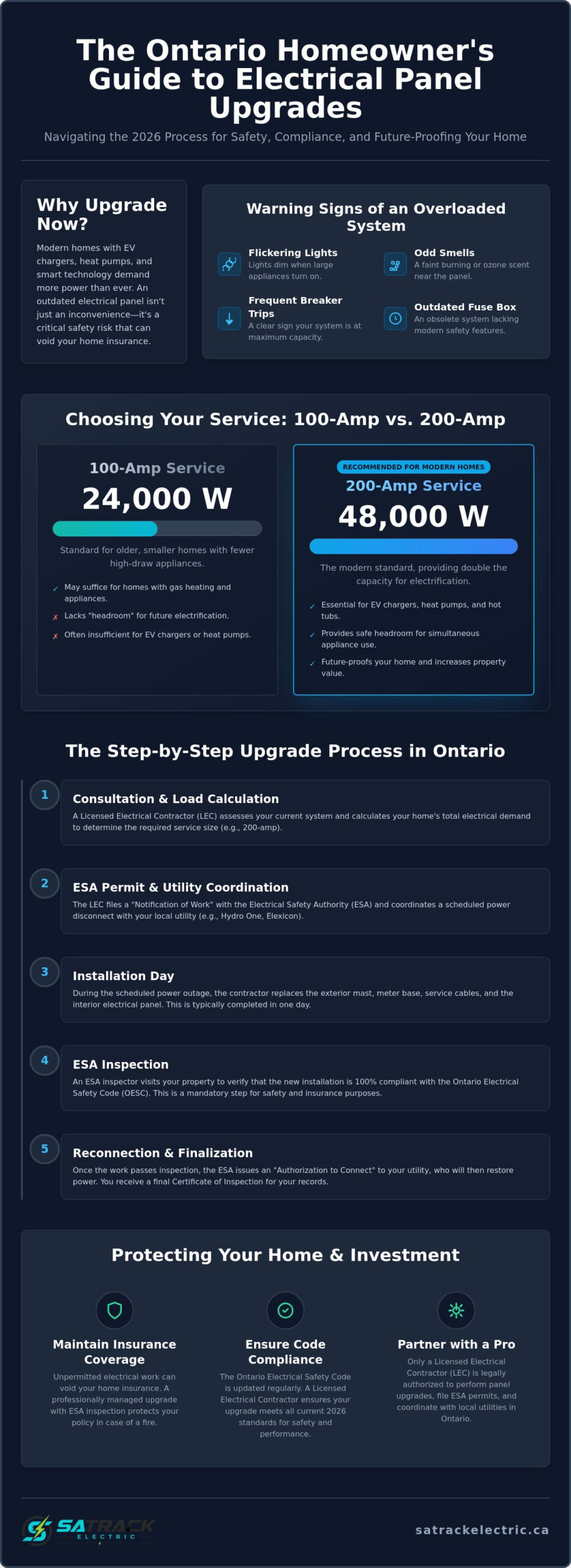
The technical foundation of the electrical panel upgrade process Ontario homeowners undergo often centres on service capacity. Amperage measures the volume of electricity flowing into your home at any given time. While a 100-amp panel was the standard for decades, the 2026 Ontario Electrical Safety Code (OESC) reflects the increasing demand for higher capacity. A 100-amp service provides approximately 24,000 watts of power, which may suffice for smaller homes with gas appliances. However, a 200-amp service doubles that capacity to 48,000 watts, providing the “headroom” necessary for modern electrification.
Headroom is the margin between your peak electrical usage and the maximum capacity of your panel. Maintaining sufficient headroom prevents the system from running near its limit, which reduces heat build-up and extends the lifespan of your components. A full service upgrade involves more than just swapping the interior box. It typically requires replacing the exterior mast (the pipe carrying wires from the utility line), the meter base, and the heavy-gauge service entrance cables. Ensuring these components meet the standards of the Electrical Safety Authority (ESA) is a mandatory requirement for any professional installation.
Is 200-Amp Service Necessary for Your Home?
Deciding between a 100-amp and 200-amp upgrade requires a formal load calculation. Our technicians evaluate the square footage of your property alongside high-draw appliances like electric ranges, dryers, and central air conditioning units. If you plan to add an electric vehicle charger or a cold-climate heat pump, a 200-amp service is almost always necessary. Beyond immediate utility, a 200-amp panel significantly improves property resale value in the Ontario market. Prospective buyers in 2026 prioritize homes that are already equipped for green energy transitions, a trend noted by GTA market experts at Pinnacle Realty. If your existing 100-amp service is in good physical condition but lacks space for new circuits, a simple panel replacement might work, but it won’t increase your total power volume.
The Role of the Main Breaker and Branch Circuits
The main breaker is the primary safety switch for your entire home. It’s designed to shut off all power instantly if it detects a massive surge or a fault that exceeds the panel’s rating. Below the main breaker, the panel organizes power into branch circuits. Each circuit is protected by an individual breaker that monitors specific areas, such as the kitchen or laundry room. Modern breakers offer superior protection compared to legacy fuse box systems, as they can be easily reset and provide more precise detection of dangerous arc faults. For a thorough evaluation of your home’s current capacity, you can schedule a professional load assessment with our team to determine the best path forward for your property.
Factors Influencing the Investment of an Electrical Panel Upgrade in Ontario
Investing in a service upgrade involves more than just the purchase of a new breaker box. The electrical panel upgrade process Ontario homeowners experience is influenced by several variables, ranging from the physical location of the equipment to the specific requirements of local utility providers. If your panel is located in a finished basement, the labour required to access and reroute wiring will be higher than a panel situated in an open garage or utility room. These logistical factors, combined with the current cost of high-gauge copper wiring and premium components, form the baseline of your project’s value.
Administrative and Regulatory Costs
A significant portion of the project investment is dedicated to mandatory regulatory compliance. As of April 1, 2026, the Electrical Safety Authority (ESA) implemented a 1.9% increase across all wiring and licensing fees. For a standard 200-amp service upgrade, the ESA permit fee is currently $253. This permit is a legal requirement in Ontario. It ensures that a provincial inspector reviews the work to verify it meets the 2026 Ontario Electrical Safety Code. Without this permit and the subsequent Certificate of Acceptance, your home insurance provider may refuse to honour claims related to electrical fires.
Homeowners must also account for utility-specific charges. Providers like Hydro One or Elexicon typically charge a reconnection fee, which often ranges between $150 and $300. This covers the cost of a utility crew physically disconnecting the power from the grid so the contractor can work safely, and then restoring it once the inspection is complete. We manage these schedules directly with the utility to minimize your downtime. You should be wary of “under-the-table” quotes that suggest skipping these steps. Such offers lack the professional assurance and legal protections that come with a licensed installation.
Material Quality and Workmanship Standards
The durability of your new system depends heavily on the quality of the materials selected. While basic panels are available, we prioritize high-durability options with copper bus bars. These offer superior conductivity and corrosion resistance compared to cheaper aluminum alternatives. These components, alongside potential requirements for a new meter base or service entrance cable, ensure the system can handle the rigorous demands of modern appliances for decades.
Choosing a Licensed Electrical Contractor (LEC) provides the peace of mind that your investment is protected by comprehensive liability insurance. The long-term ROI of a professional installation is found in the reliability of the system and the preservation of your home’s market value. A properly executed electrical panel upgrade process Ontario standards require is a calculated investment in the safety and future-readiness of your property. For homeowners in the Quinte area, our detailed electrical panel upgrade Belleville buying guide outlines the specific ESA permit structures, contractor selection criteria, and capacity considerations relevant to your region.
The Step-by-Step Electrical Panel Upgrade Process: From Permit to Power
A successful transition to a modern service requires precise synchronization between the homeowner, the contractor, and provincial authorities. The electrical panel upgrade process Ontario residents follow is not a single-day event but a multi-stage operation. It begins with a comprehensive load calculation to ensure the new panel meets your current and future energy needs. This technical assessment forms the basis for the project scope and is required before any administrative work begins.
Phase 1: Planning and Administrative Preparation
Once the technical requirements are established, your contractor initiates the permitting phase. A Licensed Electrical Contractor (LEC) must file a permit with the Electrical Safety Authority (ESA) before work starts. For larger scale projects, such as commercial electrical upgrades, a “Notice of Project” may also be required to comply with provincial regulations. During this time, we coordinate directly with your local utility, such as Hydro One or Elexicon, to secure a “disconnect/reconnect” appointment. This is a specific window of time where the utility crew removes the power from the grid to allow for a safe installation.
Homeowners should prepare for a scheduled power outage on the day of the upgrade. This window typically lasts between 4 and 8 hours. We recommend keeping refrigerator and freezer doors closed to maintain internal temperatures and ensuring that sensitive electronic equipment is unplugged or protected by surge suppressors before the power-down occurs. If you are ready to begin the administrative phase of your project, you can contact our team to initiate your ESA permit application.
Phase 2: The Physical Upgrade and ESA Inspection
On the day of installation, our team begins by removing the existing panel and any outdated service entrance equipment. The new enclosure is mounted, and the main service cables are landed. Each branch circuit is then carefully migrated to the new breakers, ensuring proper wire termination and balance across the bus bars. This phase is methodical and focuses on the integrity of every connection to prevent future points of failure.
The final step is the mandatory ESA inspection. An inspector visits the site to verify that the grounding, bonding, and circuit organization meet the 2026 Ontario Electrical Safety Code. Once the work passes, the inspector issues a Certificate of Acceptance. This document is vital; it serves as your official proof that the installation is safe and compliant. You must retain this certificate for your records, as insurance companies often require it to maintain your home coverage. This structured approach ensures that your power is restored with the full assurance of provincial safety standards.
Why Professional Installation by Satrack Electric Ensures Long-Term Safety
Choosing a partner for your home’s electrical infrastructure is a decision that impacts your safety for decades. Satrack Electric operates as a Licensed Electrical Contractor (LEC) in Ontario, a designation that guarantees we carry the necessary insurance and provincial qualifications to perform high-stakes work. While the electrical panel upgrade process Ontario mandates can seem bureaucratic, our team handles the technical and administrative weight. We don’t just swap components; we implement a system designed for longevity and clarity. This professional assurance allows you to focus on your home’s modernization while we manage the complexities of code compliance.
Our approach is defined by what we call the “Satrack Standard.” This involves a methodical organization of the internal distribution board, where every wire is landed with precision and every circuit is clearly labeled. A clean, organized panel isn’t just about aesthetics; it’s about safety. It allows for easier future maintenance and ensures that heat is dissipated correctly across the bus bars. We prioritize integrity in our workmanship, refusing to cut corners on grounding or bonding. These are the most critical safety elements of your system, and they require a seasoned expert to execute properly.
The Advantage of a Local Licensed Electrical Contractor
Working with a business deeply rooted in the Quinte region offers distinct benefits over national franchises. We possess specific local knowledge regarding the utility standards of Hydro One and Elexicon in Belleville, Trenton, and the surrounding Quinte West areas. This regional expertise ensures that your service mast and meter base installations meet the exact height and placement requirements of your specific utility provider on the first attempt. Our accountability to the community drives us to maintain high standards, as our reputation is built on the trust of our neighbours. Faster response times and a thorough understanding of regional housing challenges make a local LEC the most reliable choice for your project.
Your Next Steps: Securing a Professional Assessment
Modernizing your home’s power should never be a rushed decision. A methodical on-site evaluation is the only way to determine the precise needs of your property. Our technicians conduct a thorough load calculation and physical inspection of your existing wiring before recommending a path forward. We encourage homeowners to prioritize safety and code compliance over the speed of a “budget” quote that might overlook essential ESA requirements. By investing in a professional assessment, you secure the peace of mind that your home is ready for the electrical demands of 2026 and beyond. This proactive step protects your family, your property value, and your insurance eligibility.
Schedule your professional electrical panel assessment with Satrack Electric today.
Securing Your Home’s Electrical Future
Modernizing your home’s electrical infrastructure is a significant step toward ensuring safety and long-term property value. By transitioning to a 200-amp service, you provide the capacity needed for modern high-demand appliances while strictly adhering to the 2026 Ontario Electrical Safety Code. The electrical panel upgrade process Ontario homeowners navigate requires a methodical approach that balances technical precision with regulatory compliance. From securing mandatory ESA permits to coordinating with local utilities, every stage must be handled with professional care to protect your home insurance and peace of mind.
As an ESA Licensed Electrical Contractor, Satrack Electric provides the expertise required to manage these transitions seamlessly. We’re fully insured for both residential and commercial projects, serving the Belleville, Trenton, and Quinte West areas with a commitment to integrity and workmanship. Don’t leave your property’s safety to chance or unverified quotes. Take the next step toward a more reliable and future-ready home today.
Request a Professional Panel Upgrade Consultation
Frequently Asked Questions
Do I need a permit to upgrade my electrical panel in Ontario?
Yes, you absolutely need a permit from the Electrical Safety Authority (ESA) for this work. It’s a legal requirement in Ontario that ensures the installation meets the 2026 Ontario Electrical Safety Code. Your contractor typically files this on your behalf. This permit is the only way to receive a Certificate of Acceptance, which is necessary for your home insurance provider to maintain your coverage.
How long does a typical 100-amp to 200-amp upgrade take?
A standard 100-amp to 200-amp upgrade usually takes one full working day to complete. The physical installation of the enclosure and landing the circuits typically requires about 8 to 10 hours of labour. This timeline depends on the complexity of your home’s existing wiring and the location of the unit. We coordinate with your utility provider to ensure power is restored as quickly as possible.
Can I legally upgrade my own electrical panel as a homeowner in Ontario?
While Ontario law allows homeowners to perform electrical work in their own primary residence with an ESA permit, it’s not advisable for service panels. Most local utilities in the Quinte region will only coordinate the mandatory disconnect and reconnect with a Licensed Electrical Contractor. The high voltage involved in the electrical panel upgrade process Ontario standards demand makes professional installation the only safe choice for your family.
Will my power be out during the electrical panel upgrade process?
Your power will be disconnected for a significant portion of the installation day. You should expect an outage lasting between 4 and 8 hours while the utility provider isolates your home from the grid. We recommend preparing by charging mobile devices and keeping your refrigerator closed. Once the ESA inspector provides the authorization, the utility crew will restore your power immediately.
What is the difference between an electrician and a Licensed Electrical Contractor (LEC)?
An electrician is an individual who has completed their trade apprenticeship and holds a Certificate of Qualification. A Licensed Electrical Contractor (LEC) is a business that’s authorized by the ESA to offer electrical services to the public. Only an LEC can legally pull permits, carries mandatory liability insurance, and is registered with the Workplace Safety and Insurance Board (WSIB).
Does a panel upgrade increase the resale value of my Ontario home?
What happens if my electrical panel fails an ESA inspection?
If an installation fails an ESA inspection, the inspector will issue a deficiency notice outlining the specific code violations. The contractor is then responsible for correcting these issues before requesting a follow-up inspection. This is why hiring an LEC is critical; they’re accountable for ensuring the electrical panel upgrade process Ontario requires is completed to exact provincial standards before the job is closed.
How often should an electrical panel be inspected or replaced?
You should have your electrical panel professionally inspected every 10 years to check for loose connections or signs of thermal damage. Most panels have a functional lifespan of 25 to 40 years. However, you should consider a replacement sooner if you notice flickering lights, warm breakers, or if you’re planning a major home renovation that increases your total electrical load.