
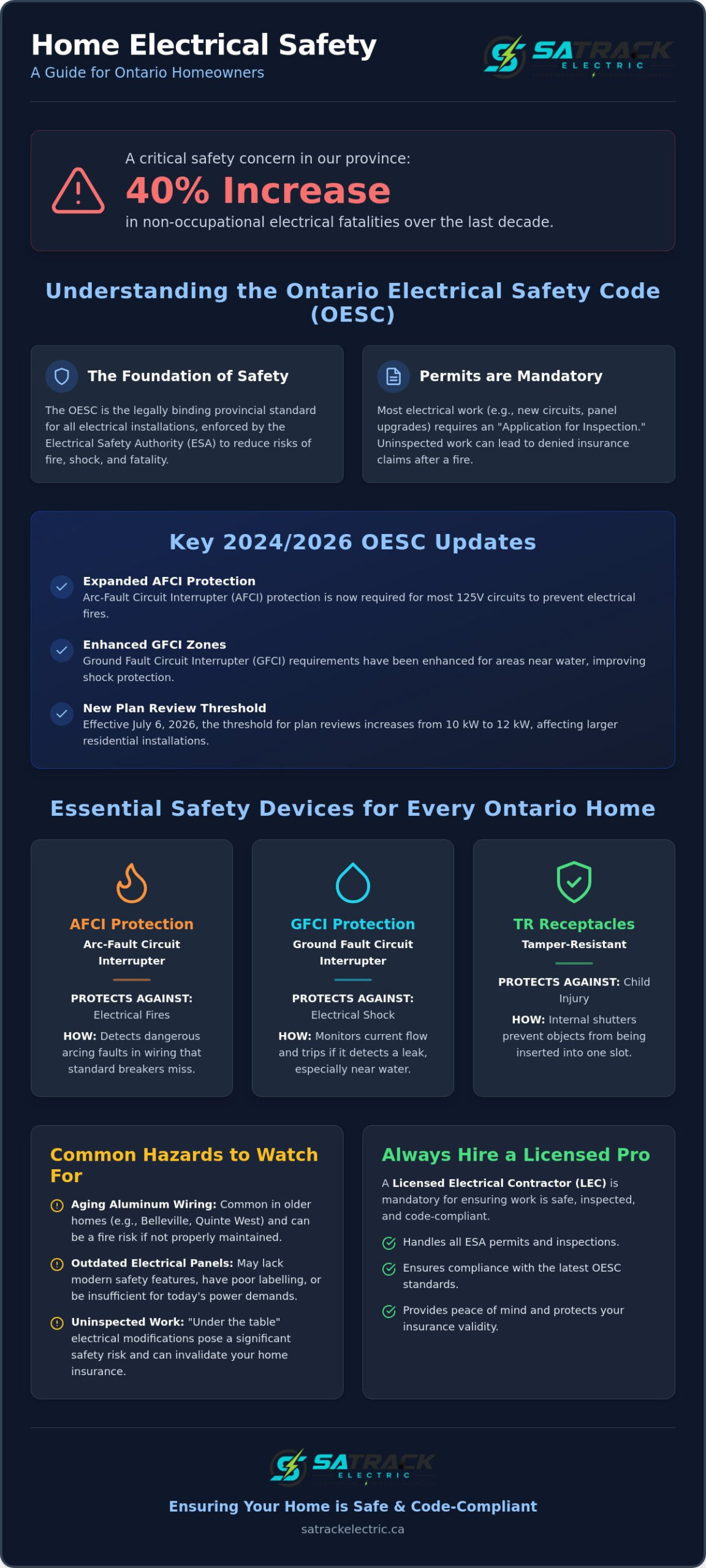
Did you realize that non-occupational electrical fatalities in our province have increased by 40% over the last decade? While workplace safety standards continue to improve, the risks within our own houses are rising, making home electrical safety Ontario a critical priority for every family. Whether you’re navigating the 2024 Ontario Electrical Safety Code updates or facing insurance demands regarding older aluminum wiring, the technical requirements often feel complex and daunting.
It’s natural to feel concerned when regulations shift or when you’re unsure if your electrical panel meets modern standards. Maintaining a safe environment requires a methodical approach to both maintenance and code compliance. This guide simplifies the latest ESA standards into a practical, room-by-room checklist tailored for 2026. We’ll walk through essential AFCI and GFCI protection, explain the July 2026 plan review threshold changes, and provide the clarity you need to manage your home’s electrical system with professional confidence.
Key Takeaways
- Navigate the latest 2024 Ontario Electrical Safety Code updates to ensure your property remains compliant with current provincial standards.
- Differentiate between GFCI and AFCI protection to effectively safeguard your household against both electrical shocks and fire hazards.
- Identify and address regional challenges such as aging aluminum wiring commonly found in historic Belleville and Quinte West neighbourhoods.
- Implement a methodical room-by-room checklist designed to help you maintain home electrical safety Ontario and identify risks in high-use areas.
- Learn how to verify a Licensed Electrical Contractor’s credentials to ensure all upgrades are performed legally and safely by a qualified professional.
Understanding the Ontario Electrical Safety Code (OESC)
The Ontario Electrical Safety Code (OESC) is the provincial standard for all electrical installations to ensure public safety. It is a legally binding document that governs how electrical work is performed across the province. This code is updated periodically to incorporate advancements in technology and lessons learned from electrical incident data. The current 29th Edition, which is based on the Canadian Electrical Code, officially came into effect on May 1, 2025. The Electrical Safety Authority (ESA) acts as the administrative body responsible for enforcing these regulations. Their primary mandate is to reduce electrical fire, shock, and fatality risks in Ontario residences.
Prioritizing home electrical safety Ontario means recognizing that the code is not a static set of rules. It evolves to address emerging risks, such as the increased demand for Electric Vehicle Supply Equipment (EVSE) and sophisticated home automation systems. By adhering to the OESC, homeowners ensure that their electrical infrastructure can handle modern power loads without compromising the integrity of the structure or the safety of its occupants. This methodical approach to regulation provides a consistent safety benchmark for every licensed professional in the province.
Permits and Inspections: When are they mandatory?
Most electrical work in Ontario requires a permit, technically known as an “Application for Inspection.” Projects such as installing new circuits, performing an electrical panel upgrade, or adding light fixtures must be reported to the ESA. Engaging in “under the table” work is a significant risk for homeowners. If an electrical fire occurs, insurance providers often deny claims if they discover that the underlying work was not inspected and certified. The process is designed to be thorough. A Licensed Electrical Contractor (LEC) files the permit, performs the installation, and coordinates with an ESA inspector to verify that the work meets provincial standards.
The 2026 Standards: What has changed?
The 2024 OESC introduced several updates that homeowners must be aware of throughout 2026. A significant administrative change is the Director’s Order increasing the Plan Review threshold from 10 kW to 12 kW, effective July 6, 2026. This affects how larger residential installations are processed. On a technical level, the code now requires expanded Arc-Fault Circuit Interrupter (AFCI) protection for most 125V circuits and enhanced Ground Fault Circuit Interrupter (GFCI) zones. While the code is not retroactive for existing wiring, insurance companies frequently demand these modern safety upgrades before renewing policies on older homes. This shift reflects a growing emphasis on preventing fires caused by aging infrastructure and outdated circuit protection.
Essential Safety Devices Every Ontario Home Needs
Modern home electrical safety Ontario relies on a combination of sophisticated devices designed to detect faults before they cause harm. While older homes often relied solely on standard fuses or breakers, the current 2024 OESC mandates specific technologies to mitigate distinct risks. The Electrical Safety Authority (ESA) emphasizes that these devices are not optional additions but foundational requirements for a secure living environment. A methodical approach to safety starts with understanding how these components interact to protect your property.
Tamper-resistant (TR) receptacles are another essential standard for modern households. These outlets feature internal shutters that only open when equal pressure is applied to both slots simultaneously. This simple mechanical safety measure prevents children from inserting objects into the live contacts. If your home still has older, non-TR outlets, a professional electrical upgrade can provide peace of mind by bringing your receptacles up to modern safety standards.
Your electrical panel serves as the central hub for all these safety devices. A modern, well-organized panel ensures that breakers trip correctly during an overload and allows for easy identification of circuits during maintenance. If your panel is outdated or lacks clear labelling, it can hinder your ability to respond quickly during an electrical issue. Keeping this centre of your home’s power in top condition is a primary responsibility for any diligent homeowner.
GFCI vs. AFCI: Knowing the difference
Ground Fault Circuit Interrupters (GFCIs) are mandatory near water sources, such as kitchens, bathrooms, and outdoor areas. They trip when they detect a current leak, protecting you from potentially fatal shocks. Conversely, Arc Fault Circuit Interrupters (AFCIs) are designed to detect dangerous electrical arcs caused by damaged wires or loose connections. These arcs are a leading cause of residential fires. The 2024 OESC has expanded AFCI requirements to cover almost all 125V circuits in living areas. You should test these devices monthly using their built-in “test” buttons to ensure they function correctly.
Smoke and Carbon Monoxide Alarms
Ontario law requires functional smoke alarms on every level of the residence and outside all sleeping areas. Carbon monoxide alarms are also mandatory near sleeping areas for homes with fuel-burning appliances or attached garages. Hard-wired alarms with battery backups are the preferred standard for reliability. When these units are interconnected, an alert in any room will trigger every alarm throughout the house, providing critical extra seconds for a safe evacuation. Regularly replacing batteries and checking expiry dates ensures these systems remain ready to protect your family.
Common Electrical Hazards in Belleville and Quinte Area Homes
Belleville and the surrounding Quinte region feature a diverse mix of housing, ranging from historic Victorian estates to mid-century bungalows. While these homes offer significant character, they often hide aging electrical systems that don’t meet modern safety expectations. Maintaining home electrical safety Ontario requires a specific understanding of how these older components fail over time. For instance, knob and tube wiring, common in Belleville’s older neighbourhoods, is frequently flagged by insurance companies. These systems lack a grounding wire and use porcelain “knobs” and “tubes” to run wires through joists. Over time, the cloth insulation becomes brittle and flakes away, leaving live wires exposed to attic insulation or wood framing.
Another frequent issue involves overloaded circuits. Many homes in Quinte West were originally built with 60-amp or 100-amp services. These were sufficient for a few light bulbs and a radio, but they struggle to support today’s high-draw appliances like air fryers, portable air conditioners, and home theatre systems. When a circuit is consistently pushed to its limit, it generates heat that can degrade wire insulation, eventually leading to a fire. It’s a gradual process that often goes unnoticed until a breaker fails to trip or a burning smell develops behind a wall.
Aluminum Wiring: A Quinte Region Reality
In homes built between the mid-1960s and late 1970s, aluminum wiring was a standard alternative to copper. The primary risk with aluminum is its tendency to expand and contract more than copper when under load. This movement can loosen connections at switches and outlets, creating high-resistance points that generate heat. To manage this safely, homeowners often choose between “pigtailing,” which involves connecting copper leads to the aluminum ends using specialized connectors, or a comprehensive aluminum wiring replacement Belleville. Both methods require precision to ensure the connections remain stable and fire-safe over the long term.
Seasonal Hazards in Ontario’s Climate
Our local climate presents unique challenges for electrical infrastructure. Proximity to the Bay of Quinte often leads to high humidity in basements, which can accelerate the corrosion of electrical panels and connections. During winter, ice dams on roofs can pull on the electrical mast, the pipe that brings power from the utility line into your home. If this mast is bent or pulled away from the house, it creates a significant shock hazard. The Electrical Safety Authority (ESA) recommends regular visual inspections of these exterior components after major storms. Given the frequency of severe weather in our region, many residents find that a professional generator installation Belleville is an essential part of their safety strategy, ensuring that critical systems like sump pumps and heating remain active during prolonged outages.
Your Room-by-Room Home Electrical Safety Checklist
Applying provincial regulations to your daily living space requires a systematic approach. A room-by-room inspection allows you to identify hazards that may not be obvious at a glance. By integrating these checks into your seasonal maintenance, you significantly enhance home electrical safety Ontario and ensure your property remains a secure environment for your family. This methodical walkthrough helps bridge the gap between complex code requirements and the practical reality of managing a modern household.
In bedrooms and living areas, focus on cord management and circuit loads. Avoid running extension cords under rugs or furniture, as this traps heat and leads to insulation breakdown. With the 2024 OESC expanding AFCI requirements, check that your bedroom circuits are updated to detect dangerous arcing. In the garage and basement, use only GFCI-protected outlets for power tools. Ensure your sump pump has a dedicated, reliable circuit to prevent flooding during heavy Quinte storms. Finally, inspect exterior outlets for “in-use” weatherproof covers that protect the connection even when a cord is plugged in, which is vital for landscape lighting or seasonal displays.
Kitchen and Bathroom Safety Priorities
The kitchen is often the most electrically demanding room in the house. Ensure high-load appliances like kettles and air fryers aren’t sharing a single circuit, which can lead to frequent trips. Check all outlets within 1.5 metres of a sink; these must have functional GFCI protection to prevent shocks. In the bathroom, listen to your exhaust fan for unusual grinding noises. A laboured motor can overheat and ignite accumulated dust, posing a serious fire risk. Inspect all faceplates for discolouration or warmth. If an outlet feels hot to the touch, it often indicates a deteriorating connection that requires immediate attention.
The Utility Room and Panel Check
The electrical panel is the centre of your home’s power distribution. Open the panel door and look for signs of “double tapping,” where two wires are incorrectly secured under a single terminal screw. This creates a loose connection and is a common fire hazard found in older homes. If you notice flickering lights or buzzing sounds coming from the breakers, professional electrical repairs Belleville are necessary to prevent a system failure. Verifying that your panel is correctly labelled and free of debris is a simple yet effective step in maintaining a safe system.
If your walkthrough reveals outdated outlets or a crowded electrical panel, don’t leave your safety to chance. You can book a residential safety assessment to ensure every room in your home meets the current Ontario Electrical Safety Code.
Why Hiring a Licensed Electrical Contractor (LEC) is Mandatory
In Ontario, the law is clear regarding who can perform electrical work for hire. While many homeowners assume that any skilled “handyman” or general contractor can manage wiring tasks, provincial regulations state that only a Licensed Electrical Contractor (LEC) is legally permitted to do so. An LEC is a business that is licensed by the Electrical Safety Authority (ESA) and employs at least one designated Master Electrician. This distinction is vital for home electrical safety Ontario because it ensures that the person performing the work is not only qualified but also carries the necessary liability insurance and WSIB coverage to protect you and your property.
Verifying a contractor’s credentials is a simple but essential step. Every legal pro will display a seven-digit ECRA/ESA licence number on their vehicles, business cards, and official estimates. This number confirms that the business is registered and accountable to provincial safety standards. If a contractor cannot provide this number, they are likely operating illegally. Hiring an unlicensed individual puts your family at risk and may lead to significant complications with your home insurance provider. Most Ontario policies contain clauses that void coverage for fire or damage resulting from electrical work performed without a permit and an ESA Certificate of Inspection.
The Risks of Unlicensed Electrical Work
The financial penalties for performing electrical work without a permit in Ontario can be severe, but the physical dangers are even more concerning. Unlicensed individuals often overlook critical technical details such as proper grounding and bonding. These errors are invisible to the untrained eye but can lead to electrified surfaces or catastrophic equipment failure. Satrack Electric eliminates these risks by strictly adhering to the highest electrician Belleville Ontario standards. Every project we manage includes the necessary permit filings and a final inspection to confirm that all installations meet the current 2024 Ontario Electrical Safety Code.
Protecting Your Investment and Your Family
Professional documentation is a valuable asset for any homeowner. When you eventually decide to sell your property, a history of ESA Certificates of Inspection provides potential buyers with tangible proof that the electrical system is safe and code-compliant. This transparency often increases a home’s resale value and speeds up the closing process. Beyond financial gains, the long-term reliability of a system installed by a licensed expert provides a level of security that DIY or unlicensed work simply cannot match. If you are uncertain about the current state of your wiring or need to verify previous work, you should Contact Satrack Electric for a professional safety inspection to ensure your home remains a safe haven for your family.
Secure Your Home’s Future with Professional Oversight
Maintaining home electrical safety Ontario is a continuous commitment. It extends far beyond a simple checklist. By understanding the current 2024 OESC requirements and performing regular room-by-room inspections, you take an active role in preventing fire and shock hazards. However, identifying a potential issue is only the first step. Ensuring that your home’s infrastructure remains reliable requires the expertise of a professional who understands the specific challenges of our local Quinte neighbourhoods, from historic wiring to modern climate demands.
As fully insured local professionals and a Licensed Electrical Contractor (ECRA/ESA), Satrack Electric provides the technical competence required for total code compliance. We prioritize your peace of mind by delivering thorough results that protect both your family and your property investment. Don’t leave your safety to chance or unlicensed work. It’s a risk that isn’t worth taking.
Book Your Professional Home Safety Inspection with Satrack Electric today to ensure your electrical system is ready for the years ahead. We look forward to serving as your trusted partner in maintaining a safe and efficient home.
Frequently Asked Questions
Do I really need a permit for small electrical jobs in Ontario?
Yes, most electrical work in our province requires a permit from the Electrical Safety Authority. This includes common tasks such as installing new outlets, adding light fixtures, or performing an electrical panel upgrade. Filing a permit ensures that an inspector verifies the work, which is a critical step in maintaining home electrical safety Ontario. Without this documentation, you may face difficulties with insurance claims or future home sales.
How can I tell if my home has dangerous aluminum wiring?
You can identify aluminum wiring by inspecting the lettering printed on the outer jacket of the cables in your basement, attic, or electrical panel. Look for the word “ALUMINUM” or the abbreviation “ALUM.” This type of wiring was a standard choice in homes built between 1965 and 1979. If you notice flickering lights or faceplates that feel warm to the touch, your aluminum connections may be deteriorating and require professional attention.
Is it legal to do my own electrical work in my Ontario home?
It’s legal for a homeowner to perform work on their own primary residence, provided they obtain an ESA permit and pass a final inspection. You must follow the exact same Ontario Electrical Safety Code standards as a professional. However, you cannot perform electrical work for friends or family. Many residents find that the technical complexity and potential insurance risks make hiring a Licensed Electrical Contractor a more secure and reliable option.
Whether you are navigating the complexities of electrical compliance or other Ontario-wide requirements like driver licensing, expert assistance can save you time. If you’re preparing to get on the road, you can learn more about Book Your Road Test to help you schedule your Ontario road test efficiently.
What should I do if my circuit breaker keeps tripping?
You should immediately unplug any high-draw appliances from that specific circuit to reduce the electrical load. A tripping breaker is a safety mechanism designed to prevent wires from overheating and causing a fire. If the breaker continues to trip after you’ve removed the devices, it likely indicates a short circuit or a faulty breaker. Do not attempt to force the breaker to stay in the “on” position, as this bypasses a vital safety feature.
How often should I have a professional electrical safety inspection?
We recommend a professional safety assessment every three to five years for homes that are more than 25 years old. It’s also prudent to schedule an inspection before you purchase a new property or immediately following a major renovation. These regular checks help identify hidden hazards, such as loose connections or overloaded circuits, before they lead to equipment failure or safety risks. Just as you prioritize the maintenance of your home’s vital systems, caring for your physical health is equally important; for those who need support with mobility or recovery, Fruitland Physiotherapy offers expert clinical services to keep you moving safely.
Why does my home insurance company require a 100-amp service upgrade?
Insurers require a minimum 100-amp service to ensure your home’s infrastructure can safely handle the power demands of modern appliances and electronics. Older 60-amp services were not designed for the simultaneous use of air conditioners, electric dryers, and kitchen appliances. Upgrading your service reduces the likelihood of overloads and electrical fires, which makes your property a lower risk for the insurance provider to cover.
What is the difference between an electrician and an LEC in Ontario?
An electrician is an individual who has the trade certification to perform electrical work. A Licensed Electrical Contractor (LEC) is a business that is officially licensed by the ESA to operate in the province. Only an LEC is legally authorized to pull permits and offer electrical services to the public. You should always verify a contractor’s seven-digit ECRA/ESA licence number to ensure they are a legal and insured professional.
Are hard-wired smoke detectors mandatory in older Ontario homes?
Hard-wired, interconnected smoke detectors are mandatory for all new constructions and major residential renovations in Ontario. While older homes that haven’t been renovated may still use battery-operated units, the Ontario Fire Code requires functional alarms on every level and near sleeping areas. Upgrading to hard-wired units significantly improves home electrical safety Ontario by ensuring that if one alarm detects smoke, every alarm throughout the house sounds simultaneously.