
A 100-amp panel doesn’t automatically rule out Level 2 EV charging. Assessing EV charger and electrical panel capacity means looking beyond the panel’s rating: a 100-amp electrical service can often support a charger, depending on the home’s overall electrical demand. A load evaluation helps determine whether the existing system has capacity or needs load management or an upgrade.
It’s understandable to focus on the amperage shown on the panel, but the charger is only one part of your home’s electrical load. Equipment running at the same time also affects what the system can safely support.
This Belleville guide explains how panel capacity relates to Level 1 and Level 2 charging, what a load assessment considers, and when load management or a panel upgrade may be appropriate. You’ll have a clearer basis for planning an EV charger installation that fits your home’s electrical system.
Key Takeaways
- Start by identifying your electrical service rating, then consider the demands of major appliances as well as EV charging.
- Level 1 and Level 2 chargers have different power needs; a Level 2 charger uses a dedicated 240-volt circuit.
- A 100-amp service may support Level 2 charging, but the home’s overall electrical demand affects the decision.
- Load management can help fit charging within available capacity, while a load evaluation clarifies whether an upgrade is needed.
- Compare charger requirements with your panel’s capacity before planning an installation or panel upgrade.
What is my home’s electrical capacity?
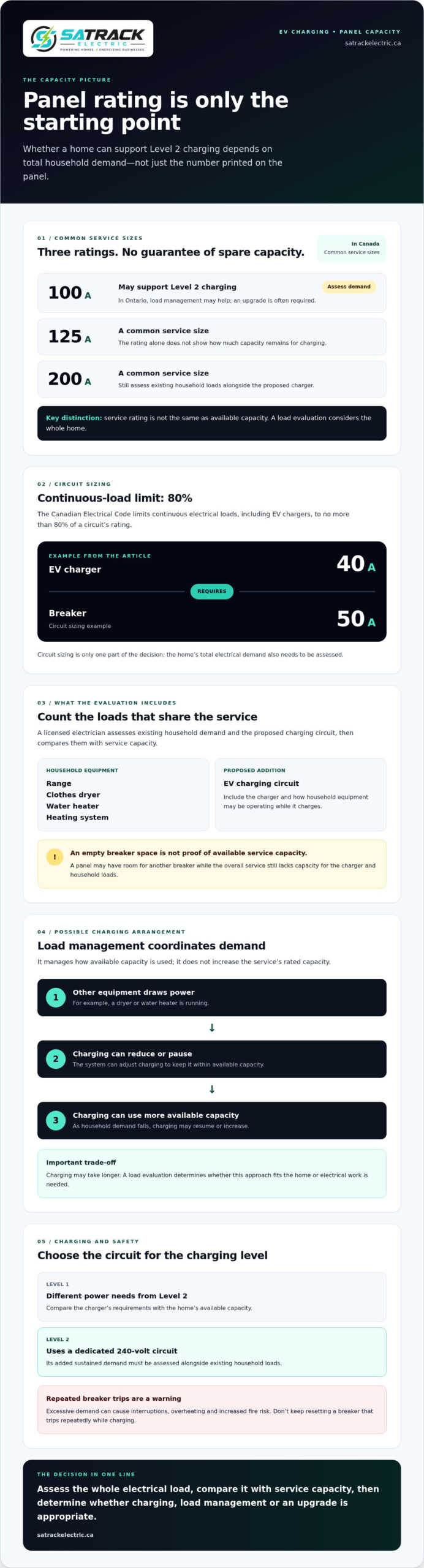
Your home’s electrical capacity is the electrical service and panel capacity available to supply its circuits. In Canada, common service sizes include 100-amp, 125-amp and 200-amp, but the panel rating alone doesn’t show how much capacity remains for charging.
Household Loads and Panel Capacity
A household’s electrical load is the combined demand from its appliances and connected equipment. This matters because an EV charger adds sustained demand, and the electrical service must support it alongside existing uses.
Consider equipment such as an electric range, clothes dryer, water heater and heating system. If several operate while an EV charges, they draw from the same service, even when they use separate breakers. Homes built more than 20 years ago commonly have 100-amp panels, so age can be a useful prompt to examine capacity, not a complete assessment.
Continuous loads require particular care. The Canadian Electrical Code limits continuous electrical loads, including EV chargers, to no more than 80% of a circuit’s rating. For example, a 40-amp EV charger requires a 50-amp breaker under the stated continuous-load sizing example. The circuit calculation is only one part of determining whether the home can support the charger.
Calculating Household Electrical Load
An electrical load calculation estimates demand on a home’s electrical service, including existing household loads and a proposed EV charger. It assesses the whole system, rather than relying only on the number printed on the panel.
How do electricians calculate whether an electrical panel can support an EV charger? They assess the home’s electrical load, including existing appliances and the proposed charger, then compare that demand with the service capacity. A licensed electrician must perform a load evaluation to assess whether a home can support an EV charging station.
What is an electrical load calculation for EV charger installation in Canada? It’s an assessment of the existing electrical demand and the charger’s added demand against the home’s available service capacity. The electrician considers how household equipment affects the total, rather than assuming a 100-amp or 200-amp rating guarantees spare capacity.
For a useful household calculation, include major appliances and the planned charging circuit. A range, dryer and water heater are examples of loads to consider. The result helps determine whether the service has room for the new demand or needs a different charging arrangement or electrical work.
Risks of an Overloaded Panel
An overloaded panel or circuit is being asked to supply more electrical demand than it can safely handle. This matters because an EV charger may operate for extended periods while other household appliances are in use.
What are the safety risks of installing an EV charger on an overloaded electrical panel? A circuit breaker may trip and interrupt power. Persistent excessive demand can also cause overheating and increase fire risk. A breaker that trips repeatedly is a warning, not a reason to keep resetting it while charging.
Don’t treat an empty breaker space as proof of available capacity. A panel may have room for another breaker while the overall service still lacks capacity for the charger and household loads. A formal load evaluation considers both the proposed circuit and demand across the home.
Make the assessment specific to the equipment in your household. For example, an electric dryer and water heater affect available capacity differently than a home without those appliances. This helps determine whether the service can support charging as planned or requires another solution.
Can a Load Management System Prevent a Panel Upgrade?
Electrical load management coordinates EV charging with other household demand, helping use available service capacity. In Ontario, a 100-amp service may support Level 2 charging with load management, although an upgrade is often required.
Load Management as an Upgrade Alternative
For example, a system can reduce or pause charging as other household equipment increases demand, then allow charging to resume as demand falls. This coordinates the charger with the home’s electrical use instead of treating charging as an unrestricted additional load.
Load management doesn’t increase the service’s rated capacity. It manages how available capacity is used, so the assessment still needs to account for the home’s electrical demand and the charger’s requirements. The load evaluation helps determine whether the system can support this approach or needs upgrades.
For a home with 100-amp service, load management may make Level 2 charging possible without an immediate panel upgrade. That is not a blanket rule for every 100-amp home: existing demand and the proposed charging setup affect the result. An upgrade is often required, so management is an alternative to assess, not an automatic substitute.
Smart Charging and Household Demand
Smart charging and load management devices coordinate charging with changing household demand. They matter because a charger’s available power can be managed around equipment such as a range, dryer or water heater.
A device may monitor the electrical system and adjust charging when other loads are active. For instance, if a dryer and water heater are drawing power, the charger can operate at a reduced level. When those loads stop, charging can use more of the capacity available to it.
This approach can help a household avoid running the charger at full output during periods of higher demand. Charging may also take longer, depending on how much capacity the system makes available. Consider whether that charging pattern suits your household’s routine and vehicle use.
Compare the charger’s required circuit, household demand and expected charging schedule before choosing management equipment. A device must be suitable for the electrical system and installed as part of a sound plan, not used to bypass a capacity assessment. Where the assessment shows an upgrade is the appropriate solution, consider residential electrical upgrades as the next step.
How Much Power Does an EV Charger Require?
Charger level determines the voltage, amperage and charging rate a home needs to accommodate. In Canada, Level 1 uses a standard 120-volt outlet, while Level 2 requires a dedicated 240-volt circuit.
Charger Levels, Voltage, and Amperage
Level 1 and Level 2 chargers use different voltages and draw different amounts of current, affecting charging speed and circuit needs. This distinction helps you compare everyday charging requirements with the electrical capacity available at home.
A Level 1 charger typically draws 12 to 16 amps and uses approximately 1.4 to 1.9 kilowatts. It can add about 6 to 8 kilometres of driving range per hour. That may suit a household with modest daily driving and enough time to charge between trips.
A residential Level 2 charger operates at 240 volts and typically draws 30 to 60 amps. Its power output commonly ranges from approximately 7.2 to 19.2 kilowatts, adding about 30 to 80 kilometres of driving range per hour. Actual range added depends on the vehicle and charging conditions, so compare charger output with your driving routine.
Level 2 Circuit Requirements
A Level 2 home charger needs a dedicated 240-volt circuit sized for the charger’s amperage. That matters because the circuit and breaker must be selected to match the charger’s electrical requirements, not simply the panel’s available spaces.
For example, the stated sizing examples pair a 24-amp charger with a 30-amp breaker for approximately 5.8 kilowatts. A 32-amp charger paired with a 40-amp breaker produces approximately 7.7 kilowatts. These pairings show how circuit capacity relates to charger output.
Other examples include a 16-amp charger on a 20-amp breaker, producing approximately 3.8 kilowatts, and a 48-amp charger on a 60-amp breaker, producing approximately 11.5 kilowatts. A 240-volt, 40-amp Level 2 charger produces approximately 9.6 kilowatts under ideal conditions. Circuit sizing must also account for continuous charging and the home’s overall electrical demand.
Choosing a Level 2 Charger Amperage
Choosing a charger amperage means matching the vehicle’s charging capability and preferred charging time with the home’s electrical capacity. A higher-amperage unit may charge faster, but it requires a suitable circuit and enough capacity in the electrical system.
What amperage and circuit size are common for home EV chargers in Canada? Residential Level 2 chargers commonly require 30 to 60 amps on a dedicated 240-volt circuit; many require 40 to 60 amps. The required breaker depends on the charger’s specifications and the applicable continuous-load sizing.
A 32-amp charger with a 40-amp breaker is one sizing example, while a 48-amp charger with a 60-amp breaker is another. For a 40-amp charger, the continuous-load example calls for a 50-amp breaker. These examples are not interchangeable: the selected charger, breaker and available household capacity all matter.
When a panel upgrade may be needed
A panel upgrade may be needed when the home’s existing service cannot support the EV charger alongside other electrical demands. The panel’s amperage, household load, charger circuit requirements and any load management all affect the decision.
A 100-amp service can often support Level 2 charging, depending on the home’s overall electrical demand. However, a 100-amp panel may struggle to supply modern appliances and an EV charger at the same time. If the load evaluation shows insufficient capacity, adding a charger without addressing the constraint isn’t an appropriate plan.
A 200-amp service can make capacity planning easier, but the number alone doesn’t prove that every home has room for every charger. Existing circuits and equipment still draw power. For example, a home with electric heating, an electric range and a dryer presents different demands from one with fewer major electrical loads.
Plan an upgrade based on a formal assessment, not an assumption about panel age or breaker spaces. A licensed electrician evaluates the home’s electrical demand and proposed charger. Load management may avoid an immediate upgrade if it keeps charging within available capacity. If the service cannot support the planned installation, a panel upgrade may be required.
In Ontario, EV charger installations involving electrical wiring require an Electrical Safety Authority permit. Panel upgrades and charger installations also require permits and inspections through the Electrical Safety Authority. These steps apply to the electrical work, not just the charger unit, so installation planning should include the home’s wiring and service equipment.
Panel upgrade and installation costs vary with the work involved. The price depends on the home and project, and is given after a quote request; factors include the required service capacity, panel location, wiring changes and the scope of installation. A 200-amp upgrade may involve more than replacing panel hardware if the existing electrical service or installation needs related work.
When considering an upgrade, distinguish the charger installation from changes to the home’s electrical service. The installation adds a dedicated charging circuit; a panel upgrade addresses limited capacity in the existing system. A home with adequate capacity may need only the charger circuit, while higher demand may call for load management or service work before charging can be added.
Use the load evaluation to compare the charger’s requirements with current and planned household equipment. If it identifies inadequate capacity, consider whether load management can address the demand or an electrical panel upgrade is the suitable next step. The goal is safe operation alongside the household’s other electrical needs.
Electrical panel amperage and EV charger capacity
A panel’s amperage is a starting point, not a complete answer about charger capacity. A 100-amp service can often support Level 2 charging, depending on the home’s overall electrical demand. A practical review of EV charger and electrical panel capacity compares the charger with the other loads the service must supply.
How much electrical panel capacity does a Level 2 EV charger need in Canada? There isn’t one service size that suits every home: Level 2 chargers typically use a dedicated 240-volt circuit drawing 30 to 60 amps. A load assessment compares the charger and household demand with the home’s available capacity.
For a 100-amp service, the charger’s selected amperage and the home’s existing loads both matter. A 32-amp Level 2 charger can suit many homeowners with a 100-amp panel, but the panel rating alone doesn’t establish capacity. Electric heating, a range, a dryer and a water heater all contribute to the household load.
A 200-amp panel can make it easier to install a 48-amp Level 2 charger. That doesn’t make every 200-amp home automatically suitable: the overall electrical demand and circuit arrangement still matter. A home with several major appliances can have a different capacity picture from one with fewer large electrical loads.
Think of amperage as the size of the home’s electrical supply, and the charger as one demand on that supply. The charger also needs a correctly sized dedicated circuit. For example, a 40-amp charger uses a 50-amp breaker in the continuous-load sizing example. That circuit pairing addresses charger wiring, while the service assessment addresses the home’s combined demand.
A licensed electrician’s load evaluation connects these figures by considering the proposed charger, existing appliances and service capacity together. It can show whether the planned charger fits, load management is appropriate, or an electrical upgrade is needed. An open breaker space alone doesn’t establish that the service can support an EV charger.
For example, understanding EV charger and electrical panel capacity means recognizing that two homes with the same service rating can have different available capacity. A home with 100-amp service, electric heating and a dryer has different demand from one with fewer high-demand appliances. The charger installation should reflect that difference, rather than relying on the panel label alone.
If you’re planning charging at home, arrange an electrical load assessment before selecting the charger. Plan an electrical panel upgrade when the assessment identifies a need for additional service capacity.
Satrack Electric: Commercial Electrical Services
Satrack Electric provides residential and commercial electrical services, including installations and repairs. For homeowners planning an EV charger, its residential electrical work is a natural next step after assessing the home’s capacity. A suitable installation accounts for the charger, electrical system and household demand.
Contact Satrack Electric to discuss your electrical project.
Plan Your EV Charging Project with Confidence
Satrack Electric provides residential and commercial electrical services, including electrical repairs. If you’re ready to discuss an EV charging project or related electrical work, contact Satrack Electric for advice. A conversation can help you move from general information toward a plan suited to your property and intended use.
Good preparation makes the next decision easier. Set out your charging priorities and questions, then move the project forward one considered step at a time.
Frequently Asked Questions
Can Your Electrical Panel Support an EV Charger in Belleville?
It may, depending on the panel’s capacity, the charger’s requirements and the home’s other electrical loads. A 200-amp service is generally compatible with Level 2 charging when a dedicated circuit is available; a 100-amp service may also support it, depending on household demand. For a Belleville home, consider major electrical equipment such as heating, cooking and laundry appliances as part of the overall assessment.
How much does an electrical panel upgrade cost?
The cost depends on the project and is provided after a quote request. Factors include the required service capacity, panel location, existing wiring and whether related electrical work is needed. A panel replacement can involve a different scope from work requiring changes to the service or panel location. A project-specific assessment helps define the work before a quote is prepared.
What Size EV Charger Should You Choose?
Can a 100-amp or 200-amp panel support a Level 2 EV charger?
Either service size may support Level 2 charging, but the home’s total electrical demand determines whether capacity is available. A 100-amp service can often support a Level 2 charger, while 200-amp service can make higher-amperage charging easier. For example, a home with electric heating and a dryer places different demands on its service than one without those loads.
What are the options if an electrical panel lacks capacity for an EV charger?
Options include using load management to coordinate charging with household demand or upgrading the electrical service. Load management may reduce or pause charging while other equipment draws power. A panel or service upgrade may be appropriate when household demand leaves insufficient capacity for the planned charger. The assessment, charging needs and existing electrical equipment determine the suitable approach.
How much does an EV charger panel upgrade or load management system cost in Canada?
The cost depends on the project and is provided after a quote request. Factors include the charger and circuit requirements, the home’s service capacity, panel location, wiring changes and whether load management or an upgrade is needed. Comparing options requires considering the property and proposed installation together, since the scope of electrical work varies from one home to another.
What Canadian Electrical Code rules apply to residential EV charger circuits?
Continuous electrical loads, including EV chargers, are limited to 80% of a circuit’s rating. For example, a 40-amp charger requires a 50-amp breaker in the stated continuous-load sizing example. A Level 2 charger also needs a dedicated 240-volt circuit. In Ontario, a dedicated circuit and formal load assessment are required for a Level 2 EV charger installation.
Do Canadian provinces or municipalities require permits and inspections for EV charger installation?
Requirements depend on the jurisdiction, so don’t assume a rule in one province applies across Canada. In Ontario, EV charger installations involving electrical wiring require an Electrical Safety Authority permit. Panel upgrades and charger installations also require permits and inspections through the Authority. These requirements apply in Belleville and nearby communities, including Trenton, Picton, Brighton, Quinte West, Greater Napanee and Cobourg.