
Your hot tub retailer’s “easy” electrical estimate is almost certainly missing the most expensive part of your installation. While the spa itself is a major investment, the infrastructure required to power it safely involves more than just a simple connection. You’ve likely spent weeks choosing the right model, only to feel blindsided by technical talk of 240V circuits and panel capacities. It’s frustrating to face unexpected quotes when you’re simply looking for a safe way to relax. We understand that budgeting for the cost of hot tub wiring Ontario requires clear, honest information about what the job actually entails.
You want the peace of mind that your installation meets the strict standards of the 2026 Ontario Electrical Safety Code without overpaying for unnecessary work. This guide provides a transparent look at the primary cost drivers, from mandatory ESA permit fees to the expanded AFCI and GFCI protection requirements. We’ll help you determine if your home needs a panel upgrade and explain why professional compliance is the only way to ensure your spa is functional and safe for years to come.
Key Takeaways
- Identify the typical investment required for 2026 installations and why these specialized circuits carry a higher price tag than standard home wiring.
- Learn how distance and wire path complexity from your electrical panel directly impact the total cost of hot tub wiring Ontario.
- Understand the mandatory ESA permit process and how adherence to the 2026 Ontario Electrical Safety Code protects your home and insurance validity.
- Recognize the signs that your current electrical service may require a panel upgrade to accommodate the high-amperage demands of a new spa.
- Discover the critical risks of using unlicensed contractors for high-voltage outdoor work and why local expertise is essential for long-term safety.
Understanding the Average Cost of Hot Tub Wiring in Ontario (2026)
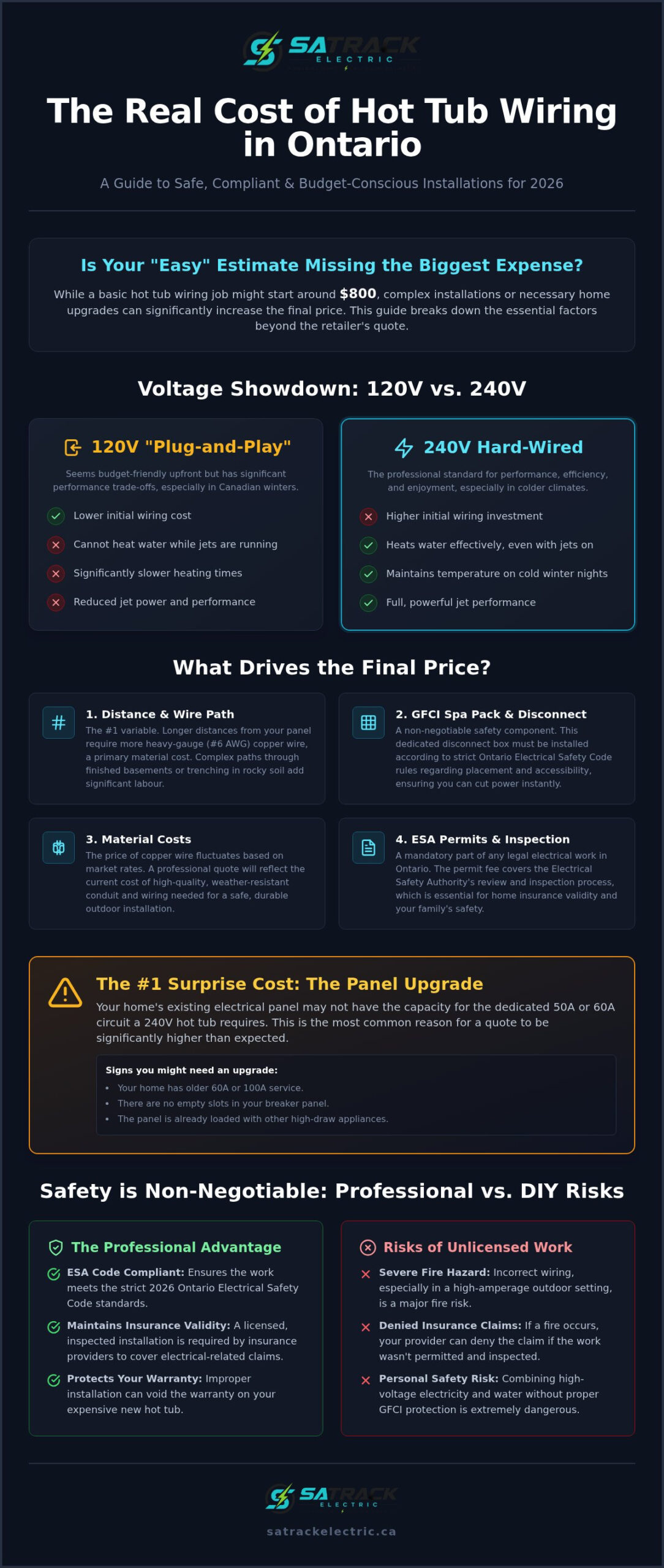
Planning for a spa installation in 2026 requires more than just picking a model from a showroom. The cost of hot tub wiring Ontario has shifted recently due to inflation and the adoption of the 28th edition of the Ontario Electrical Safety Code. While a basic installation might start around $800, complex runs or homes requiring infrastructure updates can see those figures climb significantly. This isn’t a standard residential circuit; it’s a high-demand, high-voltage installation that must withstand outdoor exposure and proximity to water.
Most homeowners encounter two distinct pricing paths based on the equipment they choose. Retailers often promote the simplicity of “plug-and-play” models, but these rarely offer the performance most families expect in a Canadian climate. A professional estimate should provide an “all-in” perspective that accounts for the breaker, the conduit, the wire, and the mandatory permit fees. This prevents the frustration of hidden extras appearing on your final bill.
120V vs. 240V: How Voltage Dictates Your Budget
Choosing a 120V model might seem like a budget-friendly move because it often uses a standard outlet. However, these units struggle to heat water while the jets are running. In contrast, 240V models are hard-wired and require a dedicated 50A or 60A circuit. This necessitates heavy-gauge copper wiring, which is a primary driver of the cost of hot tub wiring Ontario. While the initial investment for a 240V setup is higher, you’ll gain the ability to maintain water temperature during a cold January night in Belleville. The trade-off for lower upfront wiring costs is almost always slower heating times and reduced jet power.
The “Hidden” Value of Professional Installation
A professional quote reflects a balance between high-quality materials and specialized labour. Licensed contractors ensure your system aligns with the Canadian Electrical Code, which serves as the foundation for our provincial safety standards. Attempting a DIY installation or hiring an uncertified worker can lead to severe consequences. You don’t want to risk a denied claim, as insurance providers in Ontario often reject coverage for electrical fires if the work wasn’t performed by a licensed contractor and inspected by the ESA. Professional certification is a strict requirement for maintaining your home insurance compliance and protecting your equipment warranty.
Primary Factors That Influence Your Electrical Estimate
Every property presents a unique set of challenges, which is why a one-size-fits-all estimate for a spa installation is rarely accurate. The cost of hot tub wiring Ontario depends heavily on the physical layout of your home and the specific electrical demands of your chosen model. While the spa itself is the centrepiece, the infrastructure supporting it involves specialized materials and precise labour. The market price of materials also influences the final cost of hot tub wiring Ontario, as copper rates can fluctuate throughout the year.
The Impact of Distance and Trenching
Distance remains the most significant variable in any professional estimate. A hot tub positioned fifty feet from the main panel requires considerably more material and labour than one placed just outside the foundation wall. Because these units draw high amperage, we typically use #6 AWG copper wire. This material is heavy and follows commodity pricing. If the run is exceptionally long, a larger gauge might be necessary to prevent voltage drop. This calculation is vital to ensure your spa motors receive consistent power and don’t burn out prematurely.
Trenching adds another layer of complexity to the project. Digging a trench to the required depth involves significant physical effort, especially if the soil is rocky or if we must navigate around established landscaping. Running wire through a finished basement or a tight crawlspace presents different challenges, often requiring two technicians to fish the line through floor joists. Obstacles like poured concrete patios or wrap-around decks can increase the time required for the installation, as they often necessitate more complex routing or specialized protective conduit.
The Spa Pack and Disconnect Box
A dedicated GFCI disconnect, frequently referred to as a spa pack, is a non-negotiable safety component. This box acts as a local shut-off point, allowing you to cut power to the unit instantly if an issue arises. It must be installed according to specific Ontario Electrical Safety Code requirements, which dictate its placement relative to the water. Following these rules ensures the installation is safe for everyone using the spa.
The “sight-line” requirement is a critical rule in Ontario. The disconnect must be within sight of the tub so a service technician can see that the power is off while they work. However, it must also be placed at a safe distance to prevent a person from reaching the switch while still in the water. We use high-quality, outdoor-rated hardware designed to withstand our local seasonal temperature swings. If you’re unsure about the best path for your wiring, consulting with a licensed residential electrician can clarify your options and help you avoid common placement errors.
ESA Permits and Ontario Electrical Safety Code Requirements
The Electrical Safety Authority (ESA) oversees all electrical work in the province to ensure it adheres to the Ontario Electrical Safety Code. For any new spa installation, filing a notification of work is a legal requirement, not a suggestion. As of the 2026 fee schedule, the ESA charges $168 for a hard-wired hot tub installation, a cost that includes two site visits by an inspector. This administrative step is a critical component of the total cost of hot tub wiring Ontario, providing an independent verification that your contractor’s work is safe and compliant.
Hiring a Licensed Electrical Contractor (LEC) is the only legal way to have this work performed in your home by a third party. Every legitimate contractor must display their ECRA/ESA licence number on their vehicles and official paperwork. This designation ensures the professional is fully insured and qualified to handle high-voltage outdoor circuits. Using an unlicensed worker not only puts your safety at risk but can also lead to significant fines and the requirement to tear out and redo the work at your own expense.
The ESA Inspection Process in the Quinte Region
Satrack Electric manages the entire permit and notification process for our clients in Belleville, Trenton, and the surrounding Quinte area. We coordinate the timing of the rough-in and final inspections to keep your project moving forward without delays. The rough-in inspection occurs while the wiring is still visible, such as in an open trench or before basement ceilings are closed. The final inspection confirms the spa is properly bonded and the GFCI protection functions correctly. It’s vital to realize that when selling an Ontario home, you must provide an ESA Certificate of Acceptance to demonstrate that all electrical installations meet provincial safety standards.
Code Compliance: GFCI Protection and Grounding
The 28th Edition of the Ontario Electrical Safety Code, which came into effect in 2026, mandates strict Ground Fault Circuit Interrupter (GFCI) protection for all spa equipment. These devices monitor the flow of electricity and trip the circuit in milliseconds if they detect a leak to ground. This technology is the primary defence against lethal shocks in wet environments. Proper grounding and bonding of metal objects near the spa, such as metal handrails or fences, are also required to eliminate potential differences in electrical charge.
While labour rates vary based on Electrician wages in Canada, the investment in a code-compliant installation is a necessary part of the cost of hot tub wiring Ontario. A safe installation is not just about functionality; it’s about adhering to the rigorous safety protocols that define professional workmanship in our province. This methodical approach ensures your spa is ready for use without the looming anxiety of electrical failure or safety hazards.
The Panel Upgrade: Addressing the #1 Surprise Cost
Many homeowners are surprised to find that the most significant part of the cost of hot tub wiring Ontario isn’t the wire itself, but the source of power. A high-performance 240V spa typically requires a dedicated 50A or 60A double-pole breaker. This is a substantial demand on your home’s electrical system, often consuming a large portion of the available capacity. If your current panel is already supporting an electric range, clothes dryer, and air conditioner, there may not be enough “headroom” to safely add a hot tub without risking frequent tripped breakers or overheating components.
Determining whether you need an upgrade involves more than just looking for an empty slot in your breaker box. A licensed electrician must perform a formal load calculation. This process evaluates the total square footage of your home against the combined amperage of all fixed appliances. If the calculation shows that your total demand exceeds the rating of your main service, you’ll need to consider an electrical panel upgrade Belleville homeowners often prioritize to ensure long-term safety and code compliance.
Signs Your Panel is at Capacity
There are several physical warning signs that your electrical system is struggling to keep up with your home’s needs. If you notice flickering lights when a heavy appliance kicks on, or if your breakers feel warm to the touch, your panel is likely operating near its limit. For those living in older homes, the presence of a fuse box is an immediate signal that an upgrade is necessary. Modern 240V spas are not compatible with old fuse technology, and insurers in Ontario generally require a transition to a modern breaker panel before they will cover a property with a new hot tub installation.
Budgeting for a Service Upgrade
While an upgrade represents an additional investment, it provides benefits that extend far beyond your new spa. Transitioning from a 100A to a 200A service increases the overall value and safety of your property. It also future-proofs your home for other high-demand technologies, such as electric vehicle chargers or heat pump systems. By addressing the panel capacity now, you ensure that your electrical infrastructure is robust enough to handle your current lifestyle and future additions. If you are concerned about your current capacity, you can request a professional panel assessment to determine the best path forward for your installation.
Hiring a Professional for Hot Tub Wiring in Belleville
Choosing the right contractor is the final step in ensuring your spa installation is safe and code-compliant. While it’s tempting to hire an unlicensed “trunk-slammer” to reduce the initial cost of hot tub wiring Ontario, the long-term risks are substantial. High-voltage outdoor wiring requires specialized knowledge of grounding and moisture protection that general handymen often lack. Most importantly, an unlicensed worker cannot legally pull an ESA permit, leaving you without the official Certificate of Acceptance required by provincial law.
Insurance companies in Ontario are increasingly diligent about verifying electrical compliance. If an electrical fire or equipment failure occurs and the investigation reveals uncertified wiring, your provider may deny the claim entirely. This leaves you responsible for all damages and potential liability. Satrack Electric eliminates this risk by providing transparent, itemized quotes for homeowners in Picton, Brighton, and Quinte West, ensuring every aspect of the job is documented and insured.
What to Look for in a Hot Tub Wiring Quote
A professional estimate should be easy to understand and free of vague lump-sum figures. It’s essential that your quote includes the ESA permit fees, all necessary materials, and the final inspection visit. You should always verify that your contractor holds a valid ECRA/ESA licence and carries sufficient liability insurance. Local expertise in hot tub wiring Belleville is particularly valuable, as a local professional understands regional material availability and common soil conditions for trenching in the Quinte area.
Preparing Your Property for Installation
You can help the installation process move efficiently by preparing your property before the electrician arrives. Ensure the path from the electrical panel to the spa location is clear of debris or stored items. If your project involves trenching, mark any existing underground sprinklers or private utility lines. The hot tub pad must be level and fully cured before the final hookup occurs. Coordination is key; we recommend scheduling the electrical work to align with your spa delivery so you can begin using your investment as soon as possible.
Before your appointment, use this final checklist:
- Confirm the spa’s specific amperage requirements (50A vs. 60A).
- Ensure the electrician has clear access to your main electrical panel.
- Verify that the hot tub is in its final, permanent position.
- Keep your spa’s owner’s manual and wiring diagram on hand for the technician.
Ready to soak? Contact Satrack Electric for a professional hot tub wiring quote in Ontario. We provide the technical expertise and administrative support needed to manage the cost of hot tub wiring Ontario while prioritizing your family’s safety.
Securing Your Spa Investment with Professional Expertise
Investing in a home spa should be a source of relaxation, not a cause for electrical concern. By understanding the primary factors that influence the cost of hot tub wiring Ontario, you can move forward with a budget that reflects both quality materials and mandatory safety standards. It’s vital to remember that an ESA permit and a professional load calculation are more than just formalities. These steps are essential safeguards that protect your home’s insurance validity and ensure the long-term safety of your family.
Satrack Electric is an ECRA/ESA Licensed Contractor dedicated to providing thorough and reliable service. We’re fully insured for residential work and take pride in serving the communities of Belleville, Quinte West, and Prince Edward County. Our methodical approach ensures your installation meets the latest 2026 safety codes from the very first site visit, providing you with total peace of mind as you prepare to enjoy your new spa.
Get a Professional Hot Tub Wiring Quote from Satrack Electric
We look forward to helping you complete your backyard oasis with a safe, efficient, and fully certified installation.
Frequently Asked Questions
Do I really need a permit for hot tub wiring in Ontario?
Yes, obtaining an electrical permit, officially known as a notification of work, is a legal requirement for all hot tub installations in the province. This process ensures that your project is recorded with the Electrical Safety Authority and undergoes the necessary inspections to verify code compliance. It’s a critical step that protects your safety and ensures your home insurance remains valid in the event of a claim.
How much does the average ESA permit cost for a spa installation?
In 2026, the mandatory ESA permit fee for a hard-wired hot tub or spa is $168. This fee is set by the Electrical Safety Authority and covers the administrative processing along with two separate site visits by an inspector. These visits typically include a rough-in inspection of the wiring and a final inspection once the spa is connected and ready for use.
Can I use my existing outdoor outlet for a hot tub?
You cannot use a standard outdoor outlet for most hot tubs unless you’ve purchased a specific 120V “plug-and-play” model. Even with these smaller units, the outlet must be on a dedicated circuit and equipped with a Ground Fault Circuit Interrupter. Most spas require a 240V hard-wired connection, which means a new, dedicated line must be run from your main electrical panel to a specialized outdoor disconnect box.
What is the difference between 120V and 240V hot tub wiring costs?
The cost of hot tub wiring Ontario is generally lower for 120V models because they require less expensive wire and a standard breaker. However, 240V installations involve heavy-gauge #6 AWG copper wiring and a dedicated spa pack disconnect, which increases the material investment. While the 240V setup costs more upfront, it’s the preferred choice for Ontario’s climate because it allows the spa to heat the water and run the jets simultaneously.
How far can a hot tub be from the electrical panel?
A hot tub can be located at any distance from the electrical panel, but the price of the installation will rise as the distance increases. Longer wire runs require more labour for trenching or fishing through structures and more expensive copper materials. If the run is exceptionally long, an electrician must calculate the voltage drop and may need to use a thicker gauge of wire to ensure the spa operates correctly.
Does my hot tub need its own dedicated circuit?
Yes, every hot tub must be installed on its own dedicated electrical circuit. The Ontario Electrical Safety Code prohibits sharing a spa’s circuit with any other lights, outlets, or appliances. This is because a hot tub draws a significant amount of power; sharing the line would lead to constant breaker trips and could cause the wiring to overheat, creating a fire hazard.
What happens if I wire my hot tub without a licensed electrician?
Wiring a hot tub without a licensed electrical contractor can result in denied insurance claims and the voiding of your spa’s warranty. In Ontario, it’s illegal for anyone other than the homeowner or a licensed contractor to perform electrical work. If an unlicensed “handyman” performs the work, you won’t receive an ESA Certificate of Acceptance, which can lead to fines and requirements to redo the work when you sell your home.
How long does it take to complete the electrical hookup for a new spa?
A standard electrical hookup usually takes one full working day to complete. This timeframe includes installing the new breakers, running the conduit, and mounting the exterior disconnect box. While the physical work is efficient, the total project timeline depends on the scheduling of ESA inspections, as the rough-in must often be viewed before the trench is backfilled or the wiring is hidden.