
Did you know that lighting can account for up to 40 percent of your building’s total energy consumption? For many local business owners, those rising hydro bills and the complexity of the 29th edition of the Ontario Electrical Safety Code feel like a constant weight. It’s frustrating to manage outdated fixtures that dim your team’s productivity while worrying if your facility still meets the latest 2024 Ontario Building Code standards.
Professional commercial lighting installation Ontario is more than just a cosmetic upgrade. It’s a strategic investment in your facility’s safety and long-term financial health. By partnering with a licensed contractor, you can discover how to enhance your workspace, reduce energy costs by up to 75 percent through LED technology, and ensure your business remains in full regulatory compliance. This 2026 guide provides a methodical overview of current Save on Energy incentives, the upcoming phase-out of mercury-containing lamps, and the essential steps to organize a successful lighting retrofit for your commercial property.
Key Takeaways
- Learn how modern LED systems serve as a strategic asset to improve workplace productivity and significantly reduce monthly energy expenditures.
- Understand the latest regulatory requirements and why professional commercial lighting installation Ontario is necessary to ensure full compliance with the updated Electrical Safety Code.
- Identify available financial incentives and rebate programs managed by the IESO to help offset the initial costs of your lighting upgrades.
- Discover a methodical installation process designed to minimize business disruption while maintaining high standards of workmanship and safety.
- Evaluate the benefits of partnering with a licensed local contractor in the Quinte region to manage your facility’s ongoing electrical maintenance and upgrades.
The Strategic Importance of Professional Commercial Lighting
A professional commercial lighting installation Ontario project is a specialized electrical service designed to meet the unique demands of business environments. It encompasses the planning, placement, and wiring of high-performance fixtures in warehouses, offices, and retail spaces. While many owners once viewed lighting as a simple utility expense, it has transitioned into a strategic asset that directly influences productivity, safety, and brand image. For a comprehensive overview of lighting technologies, one can see how the evolution from traditional bulbs to modern systems has reshaped facility management.
Proper illumination is essential for employee health and task accuracy. Inadequate light levels can lead to eye strain, headaches, and fatigue, which naturally slow down operations and increase the likelihood of clerical or manual errors. By contrast, a well-designed system supports circadian rhythms and ensures that workers can perform detailed tasks with precision. This shift toward high-quality light creates a more professional atmosphere that reinforces your brand’s commitment to quality for both staff and visiting clients.
Enhancing Workplace Safety and Security
Adequate lighting is a critical factor in reducing workplace accidents and associated liability. In industrial settings, shadows and dark spots can hide hazards, leading to slips, trips, or equipment mishaps. Clear, uniform light ensures that safety signage and floor markings are visible at all times. Exterior lighting plays an equally vital role by deterring vandalism and providing a safe environment for staff members who arrive or depart after dark. Security lighting is defined as a preventative measure designed to illuminate high-risk areas of Ontario commercial properties to discourage unauthorized access and improve surveillance clarity.
Driving Energy Efficiency and Operational ROI
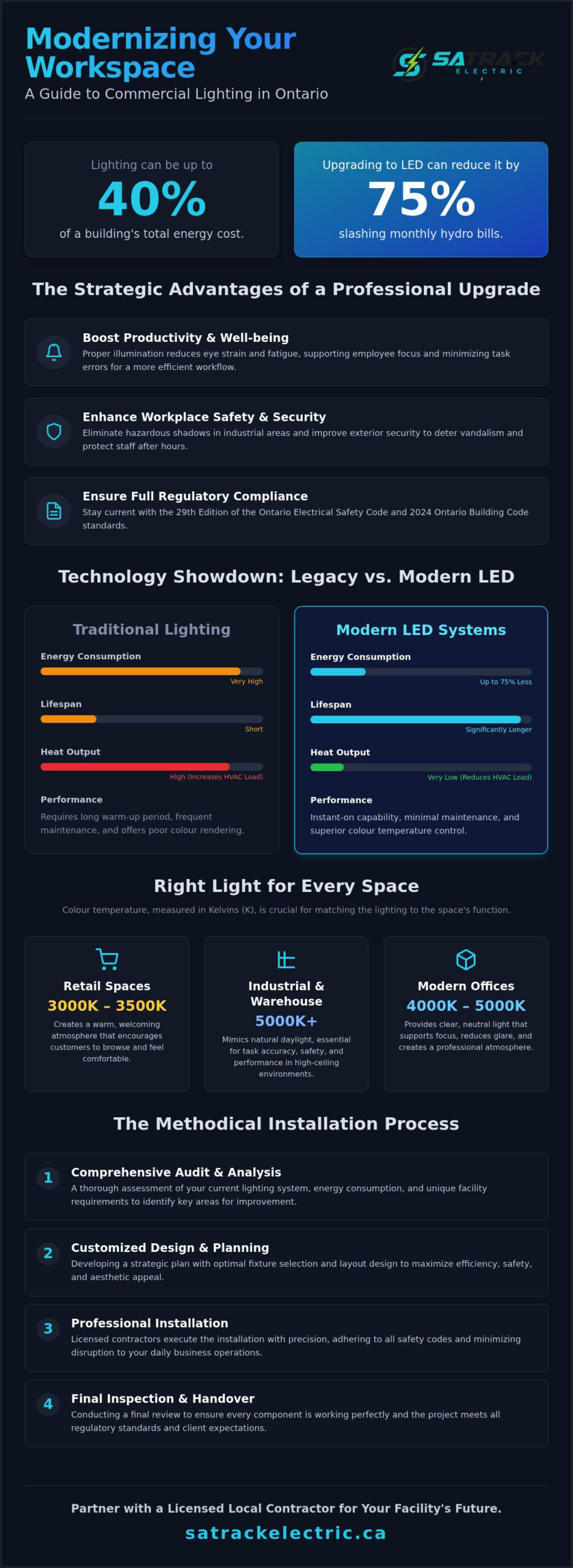
Modern electrical upgrades offer significant long-term financial benefits in the Ontario market. When comparing lifecycle costs, traditional metal halide systems require frequent maintenance and consume vast amounts of power. Modern LED systems last significantly longer and use up to 75 percent less energy. This efficiency has a direct impact on monthly hydro bills for large-scale facilities in the Quinte region, where electricity rates can fluctuate. Additionally, LEDs produce far less heat than older technologies. This reduced heat output lowers the load on your HVAC system, resulting in secondary savings on cooling costs during the summer months. Investing in a professional commercial lighting installation Ontario ensures these technical advantages are fully realized through proper circuit balancing and code-compliant wiring.
Types of Commercial Lighting Systems for Ontario Facilities
Selecting the correct fixtures for a commercial property involves more than just picking a bright bulb. It requires a methodical evaluation of the space’s function and the specific requirements outlined in Ontario’s Building Code. A professional commercial lighting installation Ontario project typically categorizes systems into interior and exterior applications, each with distinct technical standards for performance and durability. Modern systems now move beyond simple illumination by integrating smart controls and occupancy sensors that automatically adjust output based on real-time usage.
Colour temperature, measured in Kelvins (K), is another primary consideration for facility managers. For instance, retail spaces often use 3000K to 3500K to create a warm, welcoming atmosphere that encourages browsing. Conversely, industrial facilities require 5000K or higher to mimic daylight, which is essential for detailed task accuracy and safety. Architectural lighting integrates these technical choices with aesthetic design, using accent lights and recessed fixtures to define office layouts or highlight specific merchandise in a showroom.
Industrial High-Bay and Warehouse Lighting
Manufacturing plants in Trenton and surrounding areas require fixtures that can perform in high-ceiling environments, often exceeding 20 feet. High-bay LEDs are the industry standard for these zones because they provide powerful, focused light from significant heights. These fixtures must meet rigorous durability standards to withstand dust accumulation and temperature fluctuations common in unconditioned warehouses. Unlike older metal halide bulbs that require a long warm-up period, modern LED technology provides instant-on capabilities. This ensures your team has full brightness the moment a shift begins, eliminating unproductive wait times.
Office and Retail LED Flat Panels
Modern office environments benefit from glare-free recessed LED troffers and flat panels. These systems provide uniform light distribution that reduces screen glare and eye strain, which are common complaints in poorly lit workspaces. Retailers use specialized lighting to influence customer behaviour, directing attention to specific products through high colour rendering index (CRI) fixtures that make colours appear more vibrant. Many businesses now opt for tunable white lighting. This technology allows staff to adjust the colour temperature throughout the day to support natural circadian rhythms and improve overall comfort.
Outdoor and Parking Lot Illumination
Exterior lighting must balance security with energy conservation. Decorative pole-top fixtures and wall packs are essential for maintaining uniform light distribution across parking lots. This uniformity is vital to eliminate dark spots where accidents or security breaches might occur. Integrating motion sensors allows these systems to operate at a reduced power level when the lot is empty, then ramp up to full intensity when activity is detected. If you’re unsure which system fits your facility, a specialist can help you choose the right light fixtures installation for your specific needs.
Navigating Ontario Regulations and Incentive Programs
Managing a successful commercial lighting installation Ontario project requires a firm grasp of provincial safety standards and financial incentive structures. The Electrical Safety Authority (ESA) acts as the primary regulator, overseeing all electrical work in the province to ensure it adheres to the Ontario Electrical Safety Code (OESC). It’s vital to obtain the correct electrical permits before any wiring begins. This formal process documents the project and triggers the necessary inspections that verify the installation is safe for public and employee use. Partnering with a licensed and insured contractor is a non-negotiable requirement for local businesses. This status protects the property owner from liability and ensures the technician possesses the specialized training required to handle commercial-grade voltages and complex control systems.
Compliance with the Ontario Electrical Safety Code
The 29th edition of the OESC, which has been in effect since May 1, 2025, dictates specific requirements for commercial emergency and exit lighting. These systems must remain functional during power outages to guide occupants safely toward exits. Professional installation ensures these fixtures are wired to dedicated circuits and meet the illumination levels required by law. Once the work is completed and reviewed, the ESA issues a Certificate of Inspection. This document is frequently required by insurance providers to maintain your policy’s validity. If a facility lacks this certification, an insurance claim related to an electrical fire or accident could be denied, leaving the business owner financially vulnerable.
Maximizing Government Rebates and Incentives
The 2026 landscape for energy efficiency offers several avenues to recover a portion of your installation costs. The Independent Electricity System Operator (IESO) manages the Save on Energy portfolio, which includes the Save on Energy Instant Discounts Program for point-of-sale savings on eligible LED fixtures. Small businesses with 50 or fewer employees may also qualify for up to $3,000 in incentives through the Small Business Program. Furthermore, new “Regional Adders” introduced in 2026 can significantly increase standard incentives in high-demand zones across Ontario. A licensed contractor assists in this process by identifying DLC-certified products and providing the technical documentation needed for a successful application. This methodical approach ensures your facility meets the strict criteria for high-efficiency equipment while maximizing your total return on investment.
The Commercial Installation Process: From Audit to Inspection
Executing a commercial lighting installation Ontario project requires a disciplined, step-by-step workflow to ensure the results are safe and long-lasting. A methodical approach is essential to minimize business downtime and prevent unexpected technical hurdles during the build. This process begins with data collection and ends with a formal verification from provincial authorities. By coordinating closely with facility managers and other trades, a licensed contractor ensures that the transition to modern lighting is seamless and does not interrupt daily operations.
Step 1: The On-Site Lighting Audit
The first stage of any professional upgrade is a comprehensive on-site audit. This involves evaluating existing foot-candle levels to determine if current light output meets the specific needs of your staff and tasks. During this phase, technicians identify areas of significant energy waste, such as fixtures that remain on in unoccupied zones or outdated ballasts that draw excessive power. It’s also the ideal time to assess your facility’s current electrical panel capacity. If your existing infrastructure cannot support new smart controls or increased loads, you may need to consider commercial electrical upgrades Belleville before proceeding with the installation.
Step 2: Design and Product Specification
Once the audit is complete, the focus shifts to creating a lighting layout that balances aesthetic goals with functional requirements. This design phase involves selecting fixtures that offer the best reliability relative to their upfront cost. Every technical specification must align with the Ontario Electrical Safety Code to ensure the facility remains fully compliant and safe for public use. A well-planned design accounts for the placement of occupancy sensors and dimming zones, ensuring that the new system operates at peak efficiency from the moment it’s energized.
Step 3: Professional Execution and ESA Inspection
The physical installation begins with the safe removal and disposal of old equipment. This is particularly important for mercury-containing bulbs or ballasts, which require specialized handling to meet environmental regulations. After the new fixtures and sensors are precisely installed, the system undergoes final testing and commissioning. This ensures that smart controls and emergency backups are functioning as intended. The final step is facilitating a walkthrough with an inspector from the Electrical Safety Authority (ESA) to close the permit. This formal inspection provides the final assurance that your commercial lighting installation Ontario meets all provincial standards. If you’re ready to improve your facility’s efficiency, you can book a professional lighting audit to establish your baseline today.
Choosing a Reliable Commercial Contractor in Eastern Ontario
Choosing the right partner for your commercial lighting installation Ontario project is a decision that impacts your facility’s safety and operational costs for years. It’s not merely about finding someone to hang fixtures; it’s about establishing a relationship with a professional who understands the nuances of your specific industry. A dependable contractor provides more than technical skill. They offer the professional assurance that every wire, sensor, and ballast meets provincial standards. This level of reliability is essential for maintaining a safe environment for both your employees and the public.
Evaluating a contractor’s portfolio is a necessary step in this process. Look for experience in environments similar to yours, whether that is a high-traffic retail storefront or a heavy manufacturing plant. Reliable commercial references can speak to a contractor’s ability to stay on schedule and manage complex projects without disrupting daily business activities. This level of vetting ensures that your chosen partner has the capacity to handle the specific voltages and control systems your facility requires. Comprehensive insurance and licensing are non-negotiable, as they protect your business from liability and ensure all work is performed by qualified individuals.
Local Service for Belleville, Trenton, and Quinte West
Partnering with a local contractor offers distinct advantages, particularly regarding response times and regional knowledge. A firm rooted in the Quinte region understands the common building types found in Belleville and Trenton, from heritage structures to modern industrial parks. This familiarity allows for more accurate planning and faster problem-solving during the installation phase. They know the local building codes and have established relationships with regional inspectors, which often leads to a smoother project flow.
Proximity is also vital for long-term support. Choosing a local expert ensures they are readily available for ongoing commercial electrical maintenance, helping you avoid prolonged outages if a component needs attention. By hiring Ontario-based licensed professionals, you’re also supporting the local economy and ensuring that the individuals working on your property are fully accountable to provincial regulatory bodies.
The Satrack Commitment to Quality and Safety
At Satrack Electric, our “licensed and insured” status is more than a credential. It’s a core brand pillar that provides our clients with total peace of mind. We understand that commercial projects involve significant investments and strict safety requirements. Our team maintains a steady, methodical pace on every job site. We don’t believe in rushing through a checklist. Instead, we prioritize thorough results and precise workmanship to ensure your system remains reliable for its entire lifecycle.
This disciplined approach mirrors a well-organized workflow, moving from initial planning to final ESA inspection with clarity and efficiency. We take pride in being a stable partner for businesses throughout Eastern Ontario, delivering results that prioritize your staff’s safety and your facility’s efficiency. If you’re ready to upgrade your workspace with a professional commercial lighting installation Ontario, contact Satrack Electric for a professional commercial lighting consultation to discuss your specific needs.
Securing Your Facility’s Future with Professional Lighting
Investing in a professional commercial lighting installation Ontario project is a decisive step toward improving your facility’s operational efficiency and safety. By transitioning from legacy systems to modern LED technology, you address rising hydro costs while creating a workspace that supports employee health and task accuracy. Navigating the latest Ontario Electrical Safety Code requirements and securing available financial incentives requires a methodical approach that only a qualified expert can provide.
Satrack Electric is a licensed and insured Ontario contractor specialized in commercial upgrades and maintenance. We take pride in serving the business communities of Belleville, Trenton, and Quinte West with a focus on reliability and thorough results. Our team ensures that your project moves from the initial audit to the final ESA inspection with minimal disruption to your daily operations. If you’re ready to modernize your facility, Request a Professional Commercial Lighting Consultation today. We look forward to helping you build a brighter, more compliant future for your business.
Frequently Asked Questions
Do I need a permit for commercial lighting installation in Ontario?
Yes, you generally require a permit for any commercial lighting installation in Ontario. All commercial electrical work must be reported to the Electrical Safety Authority through a process called a notification of work. This ensures the installation is inspected and meets the 29th edition of the Ontario Electrical Safety Code. Failing to obtain a permit can lead to safety hazards and may void your business insurance if an electrical incident occurs.
How much can my business save by switching to LED lighting?
Businesses can typically reduce their lighting-related energy consumption by up to 75 percent by switching to modern LED systems. Since lighting often accounts for 20 to 40 percent of a facility’s total electricity bill, these savings are substantial. Modern fixtures also have a much longer lifespan than traditional bulbs. This reduces your long-term maintenance costs and the frequency of fixture replacements in high-ceiling environments like warehouses or manufacturing plants in Belleville.
What is the Electrical Safety Authority (ESA) and why does it matter?
The Electrical Safety Authority is the administrative body responsible for enforcing electrical safety regulations across the province. It matters because they ensure that all electrical work is performed safely and according to the law. Working with a licensed contractor who coordinates with the ESA protects your business from liability. It also guarantees you receive a Certificate of Inspection, which is a vital document for proving regulatory compliance to inspectors and insurers.
How long does a typical commercial lighting retrofit take?
The timeline for a commercial lighting retrofit varies based on the facility’s square footage and the complexity of the new system. A small retail space might be completed in a few days, while a large industrial warehouse in Trenton could take several weeks. A methodical contractor will provide a detailed schedule during the audit phase. This allows you to plan operations around the installation and ensures the project reaches completion without unnecessary delays.
Are there still rebates available for LED lighting in Ontario in 2026?
Yes, several significant rebate programs remain active through the Independent Electricity System Operator’s Save on Energy initiative. In 2026, businesses can access the Instant Discounts Program for point-of-sale savings or the Small Business Program for up to $3,000 in incentives. New Regional Adders have also been introduced this year. These can double standard incentives in specific high-demand zones, making it an ideal time to organize a facility-wide upgrade in the Quinte region.
What is the difference between commercial and residential lighting installation?
Commercial installations involve higher voltages, more complex circuitry, and stricter regulatory standards than residential projects. For example, business properties must adhere to specific requirements for emergency exit lighting and fire-rated fixtures that aren’t typically found in homes. The scale of the equipment is also different. Large-scale facilities require specialized high-bay fixtures and integrated smart controls that manage lighting across thousands of square feet to maximize energy efficiency and safety.
How do I know if my existing electrical panel can handle new lighting?
A professional electrical audit is the only reliable way to determine if your current panel can handle a new system. While LED fixtures generally draw less power than older technologies, the addition of networked smart controls or expanded exterior lighting may require an upgrade. Technicians examine your panel’s total amperage and available circuit space. If your infrastructure is outdated, they may recommend an electrical panel upgrade to ensure your new system operates safely.
Can commercial lighting installation be done without disrupting my business?
Professional contractors use a methodical approach to minimize business downtime during a commercial lighting installation Ontario project. Work can often be scheduled in phases or during off-peak hours to ensure your staff remains productive. By coordinating closely with facility managers, a licensed team can isolate specific zones for work while the rest of the building remains functional. This careful planning ensures that your transition to high-efficiency lighting is a smooth, hassle-free experience for your entire organization.