
An electrical system can appear to work normally while still having issues worth discussing. Electrical Safety Inspections can help Belleville homeowners understand the condition of older or heavily used wiring, panels, outlets, and other components. A finding doesn’t automatically mean major repairs are needed, but it should be explained clearly and considered in context.
It’s reasonable to want clarity before deciding what to do. A general safety assessment and an Electrical Safety Authority (ESA) inspection of electrical work serve different purposes. An ESA inspection checks applicable work for compliance with the Ontario Electrical Safety Code. Knowing which type of assessment you need can help you ask informed questions and avoid mistaking observations for a requirement to upgrade everything.
This article explains what an electrician may assess in a home or commercial property, how findings can be documented and prioritized, and what follow-up may be appropriate. You’ll also learn what to ask a qualified local electrical contractor, so you can make practical decisions based on the condition of the system and the work involved.
Key Takeaways
- Electrical Safety Inspections vary according to the property, the concerns raised, and the agreed scope. Confirm what will and won’t be assessed before work begins.
- Ask how the assessment will proceed, which areas need to be accessible, and how the electrician will explain observations and limitations.
- Residential and commercial properties have different uses and electrical demands. Make sure the assessment reflects the property and any planned changes.
- If concerns are identified, request plain-language explanations and ask which items need prompt attention, further assessment, or planned work.
- When choosing a Quinte-region contractor, confirm licensing, insurance, scope, and how follow-up will be communicated. Satrack Electric is a licensed and insured Ontario electrical contractor. Contact the company to confirm whether it offers the inspection service you need.
Electrical safety inspections: what they are and when to consider one
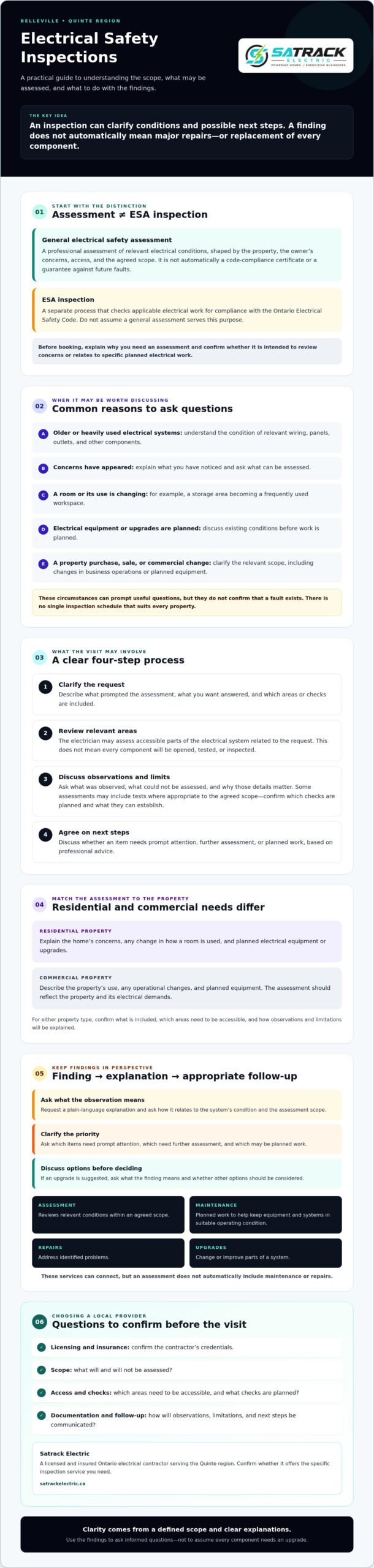
An electrical safety inspection is a professional assessment of relevant electrical conditions at a property, based on the property, the owner’s concerns, and the agreed scope of work. It can help clarify what may need attention, but it isn’t automatically a code-compliance certificate or a guarantee against future faults. What’s assessed depends on access, the purpose of the inspection, and the areas included in the request.
Some assessments may involve tests as well as a visual review, where appropriate to the agreed scope. For background on what electrical safety tests involve, including examples such as insulation resistance and earth continuity testing, consult this general overview. Don’t assume every inspection includes these tests. Ask the contractor which checks are planned and what they can establish.
When might a property owner consider an inspection?
There’s no single schedule that suits every property. An owner might consider an assessment if a home is older, electrical concerns have appeared, or a room’s use is changing. For example, turning a storage area into a frequently used workspace or planning to add electrical equipment may prompt questions about the existing system. These circumstances don’t confirm a fault, but they can help you decide what to ask a qualified professional.
An assessment may also be worth discussing during a purchase or sale, or before planning electrical upgrades. Explain the reason for the request so the contractor can focus on relevant conditions and tell you what may be outside the scope. For a commercial property, a change in operations or planned equipment may also be a reason to discuss the electrical system before work is planned.
Inspection, maintenance, and code compliance are not interchangeable
An inspection is an assessment. Maintenance involves planned work to help keep electrical equipment and systems in suitable operating condition. Repairs address identified problems, while upgrades change or improve parts of a system. These services may connect, but an assessment doesn’t automatically include maintenance or repairs, and findings don’t mean every component needs replacement.
Formal compliance processes have a separate purpose and may apply to particular electrical work. Don’t assume a general assessment confirms that all work at a property meets applicable requirements. Before booking, describe why you’re seeking an inspection and confirm its scope, what documentation will be provided, and whether it is intended to assess concerns or relate to specific planned work.
If an assessment points to a possible upgrade, ask what the finding means and whether other options should be considered. Businesses planning changes can also review a commercial electrical upgrades guide as part of their planning. Satrack Electric provides commercial electrical services, repairs, maintenance, and upgrades in the Quinte region. Contact the company to confirm whether it offers the specific inspection service you need.
What happens during an electrical safety inspection?
Confirm the inspection’s purpose and scope before the visit. Electrical Safety Inspections aren’t one-size-fits-all. What can be assessed depends on the property, access to relevant areas, the concerns raised, and the work agreed with the contractor. A general assessment also shouldn’t be confused with a formal inspection connected to specific electrical work. For Ontario requirements or information about permits, consult the Electrical Safety Authority (ESA).
The visit may follow a clear sequence:
- Clarify the request. Explain what prompted the assessment and what questions you want answered. Confirm which areas and types of checks are included.
- Review relevant areas. The electrician may assess accessible parts of the electrical system that relate to the request. This doesn’t mean every component will be opened, tested, or inspected.
- Discuss observations. Ask the electrician to explain what was observed, what couldn’t be assessed, and why those details matter.
- Agree on next steps. Discuss whether any item needs prompt attention, further assessment, or planned work, based on the professional’s advice.
How should you prepare for an inspection?
Before the appointment, describe any electrical concerns, known past work, and changes to the property, such as a renovated room or a new use for a space. Gather relevant records or previous reports if they’re available. Make the areas identified with the contractor accessible, but don’t remove covers, open panels, or handle electrical equipment yourself. If access is restricted, mention it in advance so expectations are clear.
For a commercial property, explain how the space is used and whether operations or equipment have changed. That context can help the electrician understand which areas are relevant to the agreed assessment. Confirm the inspection scope before the visit, including any limits caused by access or the purpose of the request.
How are observations explained and recorded?
Ask how the electrician will communicate observations and whether notes or other documentation will be provided. Don’t assume a written report is included. Confirm the deliverables before booking. For each concern, request a plain-language explanation, its practical significance, and any limitations that affect the assessment.
Be specific about priorities. Ask which findings need prompt attention, which may call for further assessment, and which could be addressed through planned work. A recommendation doesn’t automatically mean replacement is necessary. If findings lead to questions about repairs, maintenance, or upgrades, you can discuss appropriate residential or commercial electrical work with Satrack Electric, a licensed and insured Ontario electrical contractor.
Residential and commercial electrical safety inspections: what can differ?
The property’s use helps shape the questions an electrician may ask and the areas that matter to the inspection request. A home assessment may focus on occupant concerns and visible changes, while a business assessment may also need to account for equipment, operating hours, and access arrangements. There’s no universal checklist for every inspection in either setting. Confirm the exact scope with the electrical contractor before work begins.
| Consideration | Residential property | Commercial property |
|---|---|---|
| Context | Occupant concerns, renovations, and planned additions | Equipment use, work areas, and changes to operations |
| Access and timing | Access to the areas related to the request | Access planning and coordination around operating schedules |
| Possible follow-up | Further review of a concern or planned electrical addition | Further discussion about maintenance, repairs, or modernization |
What should homeowners discuss with the electrician?
Describe recurring concerns, such as an outlet or light that behaves inconsistently, without trying to diagnose the cause. Mention renovations, past electrical work you know about, and additions you’re considering. Make a note of any questions about outlets, switches, or other visible electrical changes and discuss them with the electrician. Consider a panel upgrade only if the assessment supports further review, rather than assuming one is needed in advance.
What should businesses and property managers plan for?
Choose a point of contact who can explain how the space is used and coordinate access. Identify relevant equipment and work areas, and tell the contractor about operating constraints that could affect the visit. For example, access to a production area may need to be planned around its schedule. Sharing these details helps clarify what can reasonably be assessed while accounting for site operations.
If questions arise about electrical capacity or modernization, separate the inspection findings from decisions about upgrades. Ask what the observations mean and what further assessment may be needed before planning work. A commercial electrical upgrades guide can help frame those planning questions. Make sure the inspection purpose, access arrangements, and agreed scope are clear before the contractor begins.
What should you do after an electrical inspection identifies concerns?
A finding is a reason to get clear information, not to assume the entire electrical system needs replacement. Ask the electrician to explain each observation in plain language, including what it could mean for the property and whether more assessment is needed. Electrical Safety Inspections are most useful when the results help you understand the issue and decide on practical next steps.
How can you understand and prioritize findings?
For each concern, ask what was observed, where it was found, and what the electrician recommends. If a finding is described as urgent, clarify why and what action is advised. Ask which items need prompt attention, which require further assessment, and which can be considered as planned work. If a recommendation or its timing is unclear, request an explanation before deciding how to proceed.
Don’t open an electrical panel, remove covers, or attempt repairs yourself. If the electrician identifies a concern that may pose an immediate safety risk, follow their guidance on what to do next and who should address it. Keep any notes or documentation provided, and record follow-up questions so they can be answered before work is arranged.
When might a repair or upgrade be the next step?
The appropriate response depends on the specific finding and a professional assessment. Some concerns may call for a repair; others may need further investigation or planned maintenance. An electrical panel upgrade could be one option if an assessment indicates that the panel warrants further review, but it shouldn’t be treated as the default solution. Ask what alternatives are appropriate and what work is actually recommended.
For related next-step guidance, look for an electrical repairs and safety checklist. Before arranging work, confirm its scope and whether any required approvals or inspections apply to the specific project. A finding alone doesn’t establish that every part of a system is unsafe or needs replacement.
If an assessment points to electrical repairs, you can discuss electrical repair options with Satrack Electric. Satrack Electric is a licensed and insured Ontario electrical contractor serving residential and commercial customers in Belleville and other communities across the Quinte region. Contact the contractor to discuss the finding and confirm what work may be appropriate.
Choosing an electrical safety inspection provider in the Quinte region
Start by confirming that a provider’s qualifications and proposed work match your needs. In Ontario, check that the contractor is licensed and insured, then ask whether they provide the specific type of assessment you’re seeking. Electrical Safety Inspections can have different purposes and scopes, so don’t assume a general assessment includes formal compliance documentation or every test you may have in mind.
Before arranging a visit, clarify the following:
- Purpose and scope: Which areas, systems, or concerns are intended to be assessed? What is outside the agreed scope?
- Communication: Will observations and limitations be explained verbally, provided in writing, or shared in another agreed format?
- Follow-up: What happens if the electrician identifies a concern that may need further assessment, repairs, or other work? Ask how additional work would be discussed and arranged.
These questions help set practical expectations. If access to an area is limited, ask whether that affects what the electrician can assess. If you want to understand a specific concern, confirm that the proposed scope addresses it. Also ask how the contractor distinguishes an observation from a recommendation, and whether further assessment would be separate from the initial request.
Confirm local availability and the right next step
Satrack Electric is a licensed and insured Ontario electrical contractor providing residential and commercial electrical services in Belleville, Trenton, Picton, Brighton, Quinte West, Greater Napanee, and Cobourg. Its services include electrical installations, repairs, upgrades, and maintenance. Contact the company to confirm whether it currently offers the specific inspection service you need, what its scope would include, and how findings or limitations would be communicated.
Before contacting a contractor, note the property type, the reason for the assessment, any known concerns, and the questions you want answered. This information can help establish whether the requested service is available and what next steps may be appropriate. Ask about the inspection’s purpose and deliverables before booking, especially if you need documentation for a particular reason.
To discuss your property and inspection request, contact Satrack Electric and confirm availability and scope. If a separate repair, installation, or upgrade is appropriate, clarify that work independently rather than assuming it is included in an assessment.
Make your next electrical decision with confidence
Electrical Safety Inspections are most useful when you understand their purpose, scope, and limitations before the assessment begins. The property and your concerns shape what can be reviewed, so confirm what’s included and how observations will be shared. An assessment isn’t automatically a code-compliance certificate or a guarantee against future faults.
If concerns are identified, ask what was observed, why it matters, and whether the next step is prompt attention, further assessment, or planned work. Findings don’t automatically mean the entire system needs replacement. Clear explanations can help you prioritize work based on professional advice.
Satrack Electric is a licensed and insured Ontario electrical contractor providing residential and commercial electrical services in Belleville, Trenton, Picton, Brighton, Quinte West, Greater Napanee, and Cobourg. Contact the team to discuss your property and confirm whether your electrical inspection needs can be addressed, including the available service scope and next steps. With the right questions and a clear plan, you can move forward thoughtfully.
Frequently Asked Questions
What is included in an electrical safety inspection?
An electrical safety inspection assesses relevant electrical conditions at a property, but the exact scope depends on the request and what the contractor and customer agree to review. It may include a review of accessible components related to a concern, such as wiring, outlets, or the electrical panel. Not every component is necessarily opened or tested. Confirm what areas will be assessed, what the inspection can establish, and how observations will be shared.
How often should a property have an electrical safety inspection?
There isn’t a single inspection interval that applies to every property. Consider an assessment if a home or business is older, you’ve noticed an electrical concern, the space is changing use, or you’re planning electrical work. An inspection may also be worth discussing during a purchase or sale. The property’s condition, history, and intended use can help you and a qualified contractor decide whether an assessment is appropriate.
Is an electrical safety inspection the same as an ESA inspection?
No. A general electrical safety assessment and an Electrical Safety Authority (ESA) inspection have different purposes. An ESA inspection relates to applicable electrical work and checks that work against the Ontario Electrical Safety Code. A general assessment may review concerns within an agreed scope, but it isn’t automatically an ESA inspection, code-compliance certificate, or approval. If electrical work is planned, confirm applicable notification and inspection requirements with the ESA or a licensed electrical contractor.
Can an electrical safety inspection find every electrical problem?
No inspection can promise to identify every existing or future electrical problem. What an electrician can assess depends on the agreed scope, access to relevant areas, and the inspection methods used. Some wiring or components may be concealed or outside the request. Ask what was reviewed, what couldn’t be assessed, and whether further investigation is recommended. Electrical Safety Inspections can help clarify concerns, but they don’t guarantee that faults won’t arise later.
What happens if an electrical inspection finds a safety concern?
Ask the electrician to explain what was observed, where it was found, and why it matters. Clarify whether professional advice calls for prompt attention, further assessment, or planned repairs. A finding doesn’t automatically mean that the entire system needs replacement. Don’t open panels or attempt electrical repairs yourself. If the recommendation or its urgency is unclear, ask for a plain-language explanation and confirm the appropriate next step before arranging work.
Are electrical safety inspections legally required in Ontario?
A routine general safety assessment isn’t required on a fixed schedule for every Ontario property. However, ESA notification and inspection requirements apply to many types of electrical work, beyond simple like-for-like replacements. Requirements depend on the work involved, so don’t assume a general assessment meets them. Before starting a project, confirm the applicable requirements with the Electrical Safety Authority or a licensed electrical contractor. This is general information, not a determination for a specific project.
Does Satrack Electric provide electrical safety inspections in Belleville?
Satrack Electric provides residential and commercial electrical services in Belleville and across the Quinte region, but its availability for standalone electrical safety inspections isn’t confirmed here. Contact the company to ask whether it offers the specific assessment you need and confirm its scope, deliverables, and any limitations. Satrack is a licensed and insured Ontario electrical contractor serving Belleville, Trenton, Picton, Brighton, Quinte West, Greater Napanee, and Cobourg.