
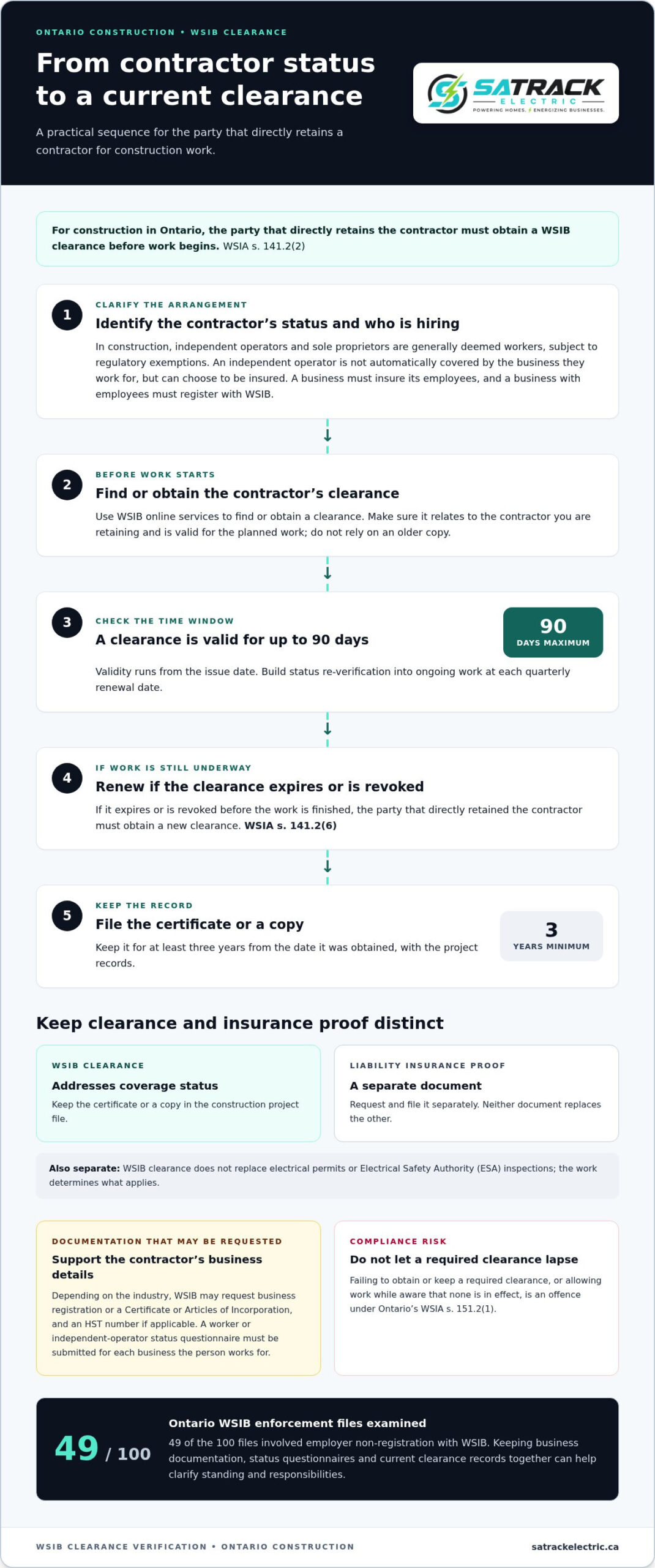
For construction work, a WSIB compliant electrical contractor in Brighton must be considered alongside the hiring party’s responsibilities. In Ontario, the party that directly retains a contractor must obtain a WSIB clearance certificate before work begins under WSIA s. 141.2(2). If the clearance expires or is revoked before the work is finished, that party must obtain a new one under s. 141.2(6).
It’s easy to assume WSIB coverage applies the same way to every contractor, but status matters. In Ontario construction, independent operators and sole proprietors are generally deemed workers under WSIA s. 12.2, subject to regulatory exemptions, while an independent operator isn’t automatically covered by the business they work for.
This article explains how WSIB coverage rules apply to Ontario contractors, how to verify a clearance, and when a hiring organization may be responsible for obtaining or renewing one. It also explains what proof of clearance and liability insurance mean in practice, so you can understand the requirements before electrical work begins in Brighton.
Key Takeaways
- In Ontario construction, independent operators and sole proprietors are generally deemed workers, subject to regulatory exemptions, so contractor status affects WSIB coverage responsibilities.
- If you directly retain a contractor for construction work, obtain a WSIB clearance before work starts and secure a new one if it expires or is revoked before the work is finished.
- Use WSIB online services to find or obtain a clearance, then keep the certificate or a copy for at least three years from the date it was obtained.
- A clearance is valid for up to 90 days from its issue date, so build status re-verification into ongoing contractor work at each quarterly renewal date.
Ontario WSIB coverage requirements for contractors
In Ontario construction, WSIB coverage depends on a worker’s legal status and the hiring arrangement. Electrical permits and Electrical Safety Authority (ESA) inspections are separate requirements: the work determines what applies, and WSIB clearance does not replace them.
Under WSIA s. 12.2, independent operators and sole proprietors carrying on business in construction are deemed workers, subject to regulatory exemptions. An independent operator isn’t automatically covered by the business hiring them, but can choose to be insured. By contrast, a business must insure an employee doing work for that business.
A business with employees must register with WSIB. A hiring party’s responsibilities also depend on whether the work is construction and whether it directly retains the contractor. Clarify the contractor’s status and the work arrangement, since both affect coverage and clearance obligations.
WSIB Clearance Verification
For construction in Ontario, the party directly retaining a contractor must obtain a WSIB clearance before work begins under WSIA s. 141.2(2). Businesses can use WSIB online services to find or obtain a clearance. Check that the certificate relates to the contractor and remains valid for the planned work, rather than relying on an older copy.
A clearance is valid for up to 90 days from its issue date. If it expires or is revoked before the work finishes, the directly retaining party must obtain a new one under WSIA s. 141.2(6). Keep the clearance or a copy for at least three years from the date obtained.
Clearance and Insurance Proof
A WSIB clearance addresses coverage status; proof of liability insurance is a separate document. For a construction project, keep the clearance certificate or a copy in the project file, and request liability insurance documentation separately. Neither document replaces the other.
For ongoing site access, re-verify contractor status every 90 days, at each quarterly renewal date. Failing to obtain or keep a required clearance, or allowing work while aware that none is in effect, is an offence under Ontario’s WSIA s. 151.2(1). A clear record of the clearance and separate insurance proof helps distinguish these obligations.
When confirming a contractor’s business details, Ontario WSIB may request supporting documents, such as business registration or a Certificate or Articles of Incorporation, depending on the industry. It may also request an HST number, if applicable. These documents can help establish the business information in the WSIB file. A worker or independent-operator status questionnaire must be submitted for each business the person works for, so a questionnaire completed for one business does not cover other engagements.
For construction, if an existing certificate expires or is revoked before the work is finished, the party that directly retains a contractor must obtain a new clearance under s. 141.2(6). Registration is another point to check: of 100 Ontario WSIB enforcement files examined, 49 involved employer non-registration with the WSIB. Keeping business documentation, status questionnaires and current clearance records together can make it easier to clarify the contractor’s standing and the hiring party’s obligations.
Which electrical contractors serve Brighton, Ontario?
For electrical work in Brighton, match the contractor’s services to the task and property. If you’re planning a panel upgrade at home, describe that scope clearly. For business maintenance, identify the affected systems and work area. The project address, property type, and requested work help define the right service.
Prepare a short project brief before discussing the work. Include the Brighton address, whether the property is residential or commercial, and the specific task. For example, “repair a light fixture in a home” is a clearer starting point than “electrical help.” For a business, name the room or work area and explain how the issue affects operations.
When considering a WSIB-compliant electrical contractor in Brighton, focus on whether the contractor’s services fit the specific task, not just the general trade. A repair, installation, and upgrade have different scopes. Put the task in writing so you can compare the contractor’s description with your project requirements.
- For a repair: describe the issue and when it occurs, such as a light that flickers when switched on.
- For an installation: identify the equipment and location, such as lighting in a commercial work area.
- For an upgrade: explain what needs to change, such as a panel that no longer suits planned electrical work.
- For maintenance: identify the system or area and the reason it needs attention.
Compare the proposed scope with your brief. Check that it identifies the requested work and the property where it will take place. If an important task is missing, clarify the scope in writing before scheduling. Replacing a fixture, for example, is narrower than adding wiring as part of a renovation.
Location matters, too. A contractor may serve multiple communities, but the specific Brighton address and job still need to fit the project arrangement. Include the address when describing the work, and keep the written scope with your project records. This creates a shared reference if the task changes during planning.
Before comparing a WSIB-compliant electrical contractor in Brighton, organize the project details: address, property type, issue, and desired result. This makes it easier to assess whether the proposed service fits your needs and discuss changes without confusing a repair with a larger installation.
For a home or business project, review electrical work for homes and businesses while defining the work required at your Brighton property.
How can I verify a Brighton electrical contractor’s WSIB clearance certificate?
Use WSIB online services to find or obtain the clearance, rather than relying only on a document forwarded by email. For construction work in Ontario, the party directly retaining a contractor must obtain the clearance before work starts. WSIA s. 141.2(2) sets out that requirement.
Start with the exact contractor or business name associated with the Brighton project. Compare it with the name on the clearance certificate and the agreement or work documents. A mismatch can make it unclear which business the clearance applies to. Resolve the identity before relying on the document for the contractor you retained.
Next, review the certificate’s issue date and validity status. Ontario clearances are valid for up to 90 days from their issue date. A document that was valid when first received may no longer cover work happening later. Use WSIB online services to obtain or locate current clearance information for the relevant contractor.
- Identify the business named in the project agreement or contractor records.
- Use WSIB online services to find or obtain its clearance.
- Compare the business identity and certificate details with the work records.
- Record when you obtained the clearance and keep the certificate or a copy.
- Revisit the status if the work continues toward a renewal date.
Keep the clearance record linked to the project, not in an unlabelled folder. For example, a Brighton business can file it with the contractor agreement and project correspondence. Note when you obtained it so staff can identify the clearance associated with that engagement.
For work that continues, treat a clearance as time-sensitive. Hiring organizations should re-verify contractors with ongoing site access at each quarterly renewal date. If the certificate expires or is revoked before the work is finished, the party directly retaining the contractor must obtain a new clearance under WSIA s. 141.2(6). A previous copy does not replace that step.
Assign responsibility for tracking the clearance to a specific person or project role. They can monitor it alongside work dates and site access, then revisit it at renewal. A reminder in the project record helps keep the clearance in view if electrical work extends beyond its original schedule.
Retain the clearance certificate or a copy for at least three years from the date obtained. Failing to obtain or keep a required clearance, or permitting work while aware that none is in effect, is an offence under Ontario’s WSIA s. 151.2(1). A dated, project-specific record helps show which clearance was obtained and when.
Are Brighton electrical contractors licensed by the Electrical Safety Authority (ESA)?
Check ESA status separately from WSIB clearance. A WSIB certificate addresses WSIB coverage, while ESA records and project documents relate to electrical work. Neither establishes the other. For a Brighton project, compare the contractor’s business name across the records you receive.
Ask for the contractor’s ESA licence details and compare the name with the quote and agreement. If the documents use different business names, clarify which business is responsible for the work. For example, a trade name on a quote should be clearly connected to the contractor named in the project records.
Before work begins, describe the task precisely. Installing a light fixture, making an electrical repair, and upgrading a panel may involve different scopes. Ask what ESA documentation applies to the specific work, including any notification or inspection records. Keep the answer with the project paperwork rather than relying on a general statement about licensing.
- Confirm identity: compare the ESA licence details with the business named in the agreement.
- Match the scope: ensure the documents refer to the Brighton property and planned electrical work.
- Ask about records: clarify which ESA notifications, inspection steps, or documents apply to the task.
- Keep project files: store the response and related documents with the quote and work records.
Project details matter. Replacing a damaged fixture is different from adding circuits during a renovation. Give the contractor the location, requested work, and any known changes to the electrical system. This creates a specific scope to discuss alongside the applicable ESA documentation.
Review the records whenever the scope changes. If a planned repair expands into an installation, update the written description and ask which ESA documents apply to the revised work. Keep the original and updated records together so the project file shows what changed and when.
For an occupied home or business, decide who will retain the documents and how they’ll be associated with the property. A clear file might include the contractor’s licence details, agreed scope, and applicable ESA inspection records. Do not treat a WSIB clearance as a substitute for these separate electrical documents.
The useful question is not simply whether a contractor says they are licensed. For a Brighton electrical project, compare the contractor’s identity, work description, and relevant ESA records. Keep the evidence in the project file so WSIB coverage and electrical documentation remain distinct.
Do Brighton electrical contractors provide WSIB clearance and proof of liability insurance
For a Brighton construction project, keep WSIB clearance and liability insurance proof as separate records. A clearance relates to WSIB status; insurance documentation shows the contractor’s liability coverage. File both with the project agreement and work details, since neither replaces the other.
Ask for the contractor’s current clearance information before construction work starts. Under Ontario’s WSIA s. 141.2(2), the party directly retaining a contractor must obtain a clearance before work begins. Businesses can use WSIB online services to find or obtain one, so a forwarded copy isn’t the only way to access clearance information.
Review the business name against the agreement and the Brighton project records. Then note the clearance issue date and status. A WSIB clearance is valid for up to 90 days from its issue date. If work continues, hiring organizations should re-verify contractors with ongoing site access at each quarterly renewal date.
Request liability insurance documentation separately, and compare the named business with the party performing the electrical work. Keep the document distinct from WSIB records. A contractor’s clearance addresses WSIB status, while insurance proof relates to liability coverage.
- Match identities: compare the business named on the clearance and insurance documents with the agreement.
- Check timing: note the clearance issue date and revisit status at quarterly renewal.
- File separately: store WSIB clearance and liability insurance proof as different project records.
- Track the work: connect both records to the Brighton site and the agreed electrical scope.
Recordkeeping matters after the documents arrive. In Ontario construction, the party directly retaining a contractor must keep the clearance certificate or a copy for at least three years from the date obtained. If the clearance expires or is revoked before the work finishes, that party must obtain a new one under WSIA s. 141.2(6).
Keep the liability insurance document in the project file, but label it separately from the WSIB clearance. This helps a property owner or hiring organization see which record answers each question. For a business renovation, staff can review the WSIB record and separate insurance proof together.
Failing to obtain or keep a required clearance, or permitting work while aware none is in effect, is an offence under Ontario’s WSIA s. 151.2(1). Before the electrical work begins, organize the clearance, insurance proof, agreement, and scope under the Brighton project name. This creates a clear record for the hiring organization throughout the engagement.
Satrack Electric: Commercial Electrical Services
Satrack Electric provides commercial electrical services for businesses planning electrical work, addressing faults, or completing installations. Its services also include residential electrical work, repairs, and installations, so property owners can discuss projects for homes and businesses.
For a commercial project, outline the property, electrical issue, and work required. This helps define the scope before work proceeds. Satrack Electric is a licensed and insured electrical contractor in Ontario, providing services for commercial and residential electrical needs.
For electrical work at your business or home in Brighton, contact Satrack Electric to discuss the project.
Plan your next electrical project with confidence
Prepare a clear project brief as your next step. Note the property type, electrical work needed, and any details that could affect access or coordination. This gives you a practical starting point for discussing the job with a WSIB-compliant electrical contractor in Brighton and keeping project decisions organized.
Satrack Electric provides commercial and residential electrical services, including repairs. Whether you’re planning work for a business or addressing an issue at home, a defined scope keeps the discussion focused on your priorities and the work required.
Prepare the details you already have, then contact Satrack Electric to discuss your electrical project. A thoughtful first conversation can help you move forward with a clear understanding of the next steps.
Frequently Asked Questions
What does WSIB compliance mean for hiring an electrical contractor in Ontario?
WSIB compliance concerns the contractor’s status and coverage under Ontario rules, as well as the hiring party’s applicable construction-clearance duties. For example, a sole proprietor carrying on business in construction may be deemed a worker, while an employee must be insured by their employer. Clarify how the business is classified for the work. Keep WSIB records distinct from ESA documentation and liability insurance, since each addresses a different responsibility.
What electrical services do contractors in Brighton offer?
Electrical services for Brighton homes and businesses can include repairs, installations, upgrades, and maintenance. Satrack Electric also provides electrical panel upgrades, generator installations, hot tub and spa wiring, and light fixture installation. The right service depends on the property and work required. A business may need lighting installation, while a homeowner may be planning a panel upgrade or addressing an electrical fault.
What questions should I ask before hiring an electrical contractor in Brighton?
Describe the project and clarify what the written scope includes. For a lighting job, for example, ask whether it covers fixture installation only or related wiring as well. Find out which ESA documentation applies, who will retain project records, and how scope changes will be documented. For construction work, clarify the WSIB clearance arrangements and request separate liability insurance proof. These details help align the project documents with the planned work.
What risks come with hiring an uninsured or WSIB-noncompliant electrical contractor?
An absent or invalid clearance can create compliance consequences for the party directly retaining a contractor for construction work. Under Ontario’s WSIA s. 151.2(1), failing to obtain or keep a required clearance, or permitting work while aware none is in effect, is an offence. Without separate liability insurance documentation, you also lack clear evidence of the contractor’s liability coverage. Treat coverage records as distinct documents and keep them with the project file.