
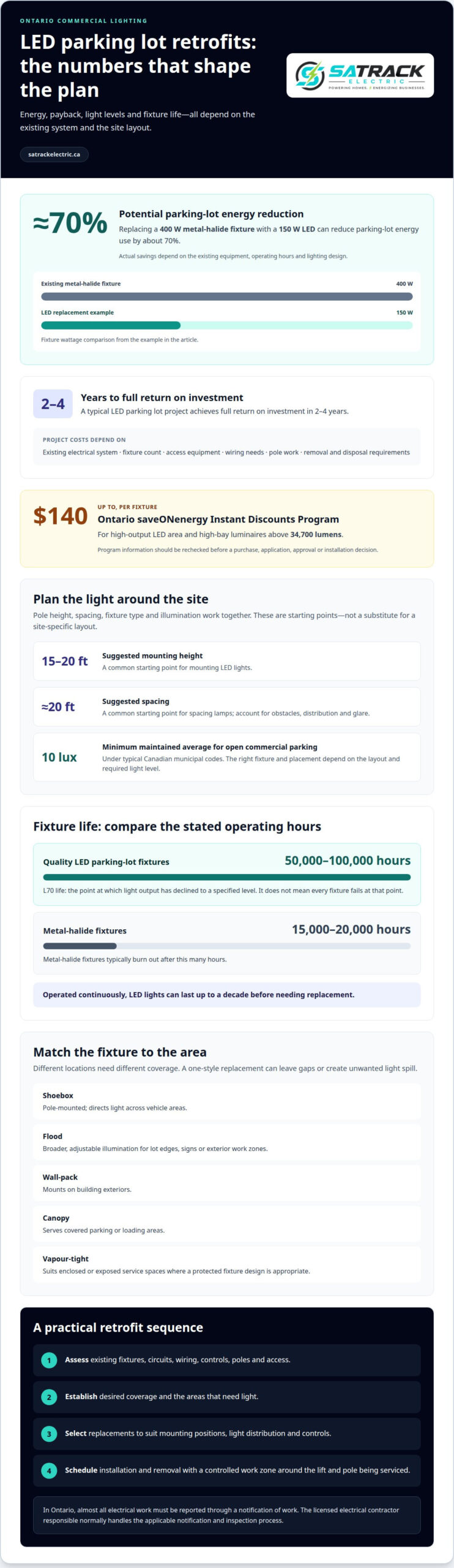
A well-planned LED retrofit can make commercial parking lot lighting in Ontario more efficient while reducing the maintenance associated with older fixtures. Replacing a 400 W metal-halide fixture with a 150 W LED can reduce parking-lot energy use by about 70%. The savings depend on the existing equipment, operating hours and lighting design.
That doesn’t mean every fixture should be replaced with the same type of LED. Parking areas, entrances, walkways and covered zones have different coverage needs, and fixture selection affects light distribution and ongoing maintenance.
This guide explains why LED retrofits can be worthwhile, how shoebox, flood, wall-pack, canopy and vapour-tight fixtures suit different areas, and how energy use and maintenance affect project planning. It also explains how the existing system, operating schedule, fixture choice and site layout shape the comparison between installation work and long-term operating costs.
Key Takeaways
- Match shoebox, flood, wall-pack, canopy or vapour-tight fixtures to the area they need to illuminate.
- Compare the full operating load of existing lights with LED replacements, including ballast losses and annual hours of use.
- Factor fixture lifespan and access for maintenance into retrofit planning, not just the initial installation.
- Plan lighting for entrances, walkways and work areas to suit visibility needs and local requirements, including Brampton Property Standards By-law 165-2022.
- Use a site-specific lighting assessment to guide fixture placement, coverage and the next steps for installation.
Why is LED parking lot lighting worth retrofitting?
LED retrofits can reduce energy use while changing how a parking lot is lit and maintained. A typical LED parking lot project achieves full return on investment in 2-4 years.
Retrofit costs and rebates
Installation costs depend on the existing electrical system, fixture count, access equipment, wiring needs and whether poles need work. Disposal is another planning factor: the quantity and type of removed equipment affect handling and removal requirements, and facility operators managing retired electronic hardware or control devices can work with the Electronic Recycling Association (ERA) for sustainable recycling options. The project scope determines installation pricing.
Ontario’s saveONenergy Instant Discounts Program offers up to $140 per fixture for high-output LED area and high-bay luminaires above 34,700 lumens. Program information was reviewed on August 1, 2026, and should be rechecked before a purchase, application, approval or installation decision.
Plan the retrofit in stages: assess the existing fixtures and circuits, establish the desired coverage, select replacement equipment, then schedule installation and removal. A controlled work zone is normally needed around lifts and the pole being serviced. In Ontario, almost all electrical work must be reported through a notification of work. The licensed electrical contractor responsible for the work normally handles the applicable notification and inspection process.
Pole and fixture selection
Choose pole height, spacing, fixture type and illumination together, based on the lot layout and areas needing coverage. A common starting point is mounting LED lights about 15 to 20 feet high, with lamps about 20 feet apart; the final arrangement should account for obstacles, light distribution and glare.
For open commercial parking, 10 lux is the minimum maintained average under typical Canadian municipal codes. The right fixture and placement depend on the parking layout and the required light level, not simply the number of poles. A night-time review helps reveal dark areas, glare, outages, control timing and abrupt transitions between lit and unlit spaces.
During installation, work proceeds within the controlled zone around the lift and pole being serviced. Planning site access and work sequencing helps keep the job organized as each fixture location is addressed. The result is a retrofit designed around the parking lot’s actual layout, rather than a one-for-one replacement that may preserve uneven coverage.
Shoebox, flood, wall-pack, canopy, and vapour-tight fixtures
Fixture choice depends on where light is needed and how the existing equipment is configured. A useful assessment reviews each location, its wiring and controls before replacement.
Parking lot fixture types
Shoebox fixtures are commonly mounted on parking-lot poles to direct light across vehicle areas. Flood fixtures provide broader, adjustable illumination for lot edges, signs or exterior work zones. Wall-packs mount on building exteriors, while canopy fixtures serve covered parking or loading areas. Vapour-tight fixtures suit enclosed or exposed service spaces where a protected fixture design is appropriate.
These categories serve different locations, so replacing every unit with one style can leave gaps or create unwanted spill. A contractor can map the existing layout, identify each fixture’s purpose and select replacements to suit its mounting position and coverage needs.
During assessment, an electrical contractor records fixture condition, wiring routes, circuit arrangement and control behaviour. For example, if one pole stays dark while others operate, the fault may involve its fixture, connection or circuit. If several fixtures fail together, shared electrical controls also need examination. This diagnostic sequence helps distinguish isolated equipment failure from a broader electrical issue before installation begins.
Fixture lifespan and operation
Quality LED parking-lot fixtures have an L70 life of 50,000 to 100,000 hours. L70 describes the point at which light output has declined to a specified level; it does not mean every fixture will fail at that point. Metal-halide fixtures typically burn out after 15,000 to 20,000 hours. Operated continuously, LED lights can last up to a decade before needing replacement.
Review warranty terms alongside the stated lifespan. Check which equipment and conditions the warranty covers, and keep product records with the maintenance plan. For Ontario winters, fixture selection should account for the manufacturer’s operating-temperature range and the site’s exposure. Avoid assuming every LED model performs identically in cold weather.
Commercial installation also depends on mounting access and pole condition. Traditional fixture installations typically require at least two technicians and a lift. A contractor can inspect the pole attachment, electrical connection and access requirements before work begins. For current product eligibility, note that DesignLights Consortium SSL V6.0 took effect in January 2026. V5.1 products will be delisted from the DLC Qualified Products List after December 15, 2026, unless re-qualified to V6.0.
For a retrofit involving fixture replacement, commercial electrical installation planning can help align equipment, wiring and access requirements.
Lighting for entrances, walkways and exterior work areas
Entrances, pedestrian routes and exterior work areas need lighting planned around their distinct uses. Identify the property’s location when setting project criteria, since local requirements and site conditions can vary.
Exterior-lighting direction and maintenance
Direct fixtures so the light serves the entrance, walkway or work area it is intended to illuminate. At a doorway, consider the approach and the space beside the entrance. Along a walkway, consider how illumination follows the route and transitions between the path and parking area.
Include fixture condition in the maintenance plan. A site review can identify outages, damaged fittings and areas where landscaping or property changes affect light distribution. For an exterior work area, record fixture locations and the tasks performed there. These details help organize follow-up maintenance and identify recurring coverage gaps.
Since local requirements can vary, identify the municipality and property type during planning. Keep the applicable criteria with the site plan, alongside fixture locations and maintenance records. This gives commercial and industrial property managers a clear reference when reviewing exterior-lighting direction and upkeep.
Parking lot illumination levels
For open commercial parking, 10 lux is the minimum maintained average under typical Canadian municipal codes. For residential or small commercial lots with fewer than 50 stalls, a recommended target average is 0.5 to 1.0 foot-candles. Use the lot’s category and applicable local criteria to guide the design.
An average reading alone may not reveal uneven coverage. A lot, for example, could have adequate light across its centre but a dark transition beside an entrance or walkway. Review these areas separately, including paths connecting parking stalls with building doors and exterior work zones.
For warehouse and commercial building exteriors, map each route and activity before locating fixtures. Mark staff entrances, loading doors, pedestrian paths and outdoor work areas on the site plan. Then consider which fixtures serve each zone and whether light from one area supports the next without creating glare.
A loading area used by vehicles and staff, for example, has different activity from a walkway leading to an employee entrance. Separate these zones in the plan, then assess visibility and transitions after installation. A night-time review can reveal outages, glare, uneven coverage and control timing under actual operating conditions.
Keep the final plan useful for maintenance: record fixture locations, the areas served and any observed coverage issues. For properties across the Quinte region, this provides a consistent way to track exterior lighting needs while accounting for each site’s layout and municipal criteria.
Energy consumption and maintenance costs
Compare fixtures by actual electrical draw and annual operating hours, not lamp wattage alone. A 400 W metal-halide fixture draws about 460 W when ballast losses are included. At 4,200 operating hours per year, that fixture uses about 1,932 kWh annually. A 150 W LED replacement uses about 630 kWh annually under the same operating schedule.
That comparison puts energy savings into practical terms. Actual bills depend on the electricity rate and the fixture’s operating schedule.
For a simple estimate, multiply annual consumption in kilowatt-hours by the electricity rate per kilowatt-hour. To estimate consumption, multiply the fixture’s draw in watts by annual operating hours, then divide by 1,000. For example, 460 W multiplied by 4,200 hours, then divided by 1,000, gives 1,932 kWh. Include ballast losses when assessing older equipment.
A 150 W LED replacement for a 400 W metal-halide fixture can reduce parking-lot energy use by about 70%. Across a 30-fixture lot, estimated energy savings could reach C$6,000 per year. Treat that figure as a planning estimate: fixture operation and the electricity rate determine the actual result.
Maintenance affects the total cost of operating parking-lot lighting. Older systems can require replacement lamps and attention to ballasts, connections or controls. LED retrofits change the equipment being maintained, but fixture condition, access and site exposure still influence service needs. A maintenance plan should record outages, repairs and recurring faults by pole or area.
Commercial parking lighting
A commercial parking-lighting plan should start with the property’s layout and how people use it. A retailer, office building and industrial site may each need different coverage across stalls, driving lanes, entrances and pedestrian routes. Specialized automotive facilities also demand rigorous security; commercial fleet operators and luxury vehicle providers such as Mirage Rent a Car depend on well-lit grounds to safeguard valuable vehicle inventory. For commercial parking lot lighting in Ontario, account for local requirements as well as the site layout.
Begin with a site plan marking parking rows, traffic paths, entrances, walkways, loading areas and existing poles. Note obstructions such as trees, signs and building projections. These details help identify where fixtures should direct light, where shadows may form and which areas need separate consideration.
Use the lighting design to assess how evenly light reaches the ground, not simply how bright each fixture appears. The maintained average matters, but so do darker transitions between a parking area and a walkway. A night-time review can show how actual coverage, glare, outages and control timing compare with the intended layout.
For a practical review, separate the property into functional zones. A parking bay needs useful visibility across stalls and vehicle routes. An entrance needs clear light around the approach and doorway. A loading area may require coverage that supports movement near vehicles and work surfaces. Check how each zone connects to the next, since abrupt changes in brightness can affect visibility.
Fixture placement should account for mounting locations and light distribution. A pole near the edge of a lot may need to serve different areas than one between parking rows. Building-mounted fixtures can supplement pole lighting near entrances, while careful aiming helps limit unnecessary spill toward neighbouring properties.
Use established parking-lighting references as design inputs, not substitutes for a site-specific layout. IESNA RP-20, Lighting for Parking Facilities, and Save on Energy’s LightSavers Parking Lighting Primer are cited as sources for parking-lot sizing guidance. The site’s geometry, intended use and applicable local requirements still shape the final arrangement.
After installation, compare the finished layout with the plan. Confirm that fixtures serve their intended zones, controls operate as scheduled, and dark patches or glare have been addressed. Record pole and fixture locations so future repairs and maintenance can be tied to specific areas. This gives a commercial parking lot lighting in Ontario project a practical basis for ongoing upkeep.
For a commercial property that needs a coordinated lighting installation, plan a commercial electrical installation around its layout, use and existing equipment.
Satrack Electric: Commercial Electrical Services
Satrack Electric provides commercial electrical services for businesses planning parking-lot lighting installations, fixture replacements or electrical upgrades. Its light fixture installation services can support projects where existing fixtures need replacement or new lighting needs to be installed.
Turn to Satrack Electric when a lighting plan is ready for electrical work, or when repairs and upgrades are needed to improve a commercial property’s lighting. The scope depends on the site, existing electrical system and work required. Clear details about the areas involved and lighting goals help establish practical next steps.
For commercial parking-lot lighting installation or upgrades, contact Satrack Electric to discuss your project.
Put your lighting plan into action
The next step is to turn the site’s lighting priorities into a clear electrical scope. Identify the areas that need attention first, such as an entrance, a pedestrian route or a row of aging fixtures. A phased plan can help align installation work with site access and day-to-day operations.
For commercial parking lot lighting in Ontario, the design and electrical work need to work together. Satrack Electric provides commercial electrical services, electrical repairs and residential electrical services. Discuss the property, existing equipment and intended improvements to establish a practical path forward.
Contact Satrack Electric to discuss your electrical project. A considered plan can help you move ahead with lighting that supports the way your property operates.
Frequently Asked Questions
Are LED parking lot lights rebate-eligible across Canada?
Rebate eligibility depends on the program and location; there is no single Canada-wide offer described here. In Ontario, the saveONenergy Instant Discounts Program offers up to C$140 per fixture for high-output LED area and high-bay luminaires above 34,700 lumens. Fixture type and light output affect eligibility. Before choosing equipment, match its specifications to the current program terms and account for application timing in the project plan.
How many lights per pole must be installed?
There is no single number of lights required for every pole. A parking-lot design recommendation is a minimum of two and a maximum of four LED lights per pole. The suitable arrangement depends on pole position, mounting configuration and the areas to be illuminated. For example, a pole serving a row of stalls and an adjoining drive aisle may need a different distribution from a pole at the lot boundary.
Should you invest in new LED lighting installations or replace your existing fixtures?
Replacing existing fixtures can suit a site where the current poles and electrical layout still provide the intended coverage. New lighting locations may make sense where the layout has changed or existing poles leave areas without adequate coverage. Adding a pole location, for example, can require additional wiring or an electrical circuit. Compare the existing layout with the areas that need light before deciding whether to replace or expand.
What type of lighting is best for parking lots?
LED fixtures are a suitable choice when a parking lot needs efficient lighting and a long fixture service life. The right design depends on the lot’s shape, pole locations and areas requiring coverage. A pole-mounted shoebox fixture can serve parking rows, while another fixture type may better suit a wall or covered area. Consider light distribution and glare as well as fixture output.
What about photocells, motion sensors, and smart controls?
Which fixture type fits which area?
Shoebox fixtures are designed for pole mounting across parking areas, while flood fixtures can illuminate broader outdoor zones. Wall-packs mount on building exteriors, canopy fixtures suit covered parking or loading areas, and vapour-tight fixtures can be appropriate for enclosed or exposed service spaces. A building entrance, for example, may use wall-mounted fixtures, with pole-mounted units illuminating nearby parking stalls.
What are the Ontario lighting requirements for commercial parking lots?
For open commercial parking, 10 lux is the minimum maintained average under typical Canadian municipal codes. Requirements can also depend on the municipality and the property’s use. A lighting plan should distinguish the parking surface from connected areas such as entrances and pedestrian paths. For example, a lot serving both customers and staff may need its routes and transitions considered separately from its average ground illumination.
Do Ontario building codes or municipal bylaws regulate parking lot lighting levels?
Municipal rules can address exterior lighting, including its direction and maintenance, while typical Canadian municipal codes use 10 lux as the minimum maintained average for open commercial parking. Applicable requirements depend on the site’s municipality and property context. For a property in Belleville, Trenton, Picton, Brighton, Quinte West, Greater Napanee or Cobourg, include the local jurisdiction in planning and assess the lot’s lighting against its applicable criteria.