
What if that frequent nuisance tripping at your circuit breaker is actually a warning sign that your home’s electrical system is struggling to keep up with modern demands? It’s a common frustration for many residents, especially when a microwave or space heater causes the lights to flicker or the power to cut out entirely. You likely recognize that your home should be a place of safety, yet persistent electrical issues can create genuine anxiety about potential fire risks in older properties. A professional dedicated circuit installation in Ontario provides the stability your high-value appliances need while protecting your home’s infrastructure from being overtaxed.
We understand the confusion surrounding Electrical Safety Authority permit requirements and the technical details of the 2024 Ontario Electrical Safety Code. This guide will help you identify which appliances legally require their own circuits and how these installations prevent dangerous arcing and overheating. You’ll learn how to achieve a trip-free electrical system that meets the latest OESC standards, including the expanded requirements for Arc-Fault Circuit Interrupter (AFCI) protection. By the end of this article, you’ll have the clarity needed to ensure your home’s electrical upgrades are both safe and fully compliant with provincial regulations.
Key Takeaways
- Understand why a dedicated circuit installation in Ontario is a critical safety measure that prevents fire hazards by isolating high-power appliances on their own electrical lines.
- Identify specific kitchen and laundry appliances, such as refrigerators and dryers, that require dedicated wiring to operate efficiently and meet provincial codes.
- Discover how dedicated circuits eliminate nuisance breaker tripping and protect sensitive home electronics from damaging voltage drops.
- Learn the importance of load calculations and Electrical Safety Authority (ESA) compliance to ensure your home’s electrical system is legally certified and safe.
- Explore how professional electrical upgrades in the Quinte West region can modernize your home while providing peace of mind through expert workmanship.
What is a Dedicated Circuit and Why Does Your Ontario Home Need One?
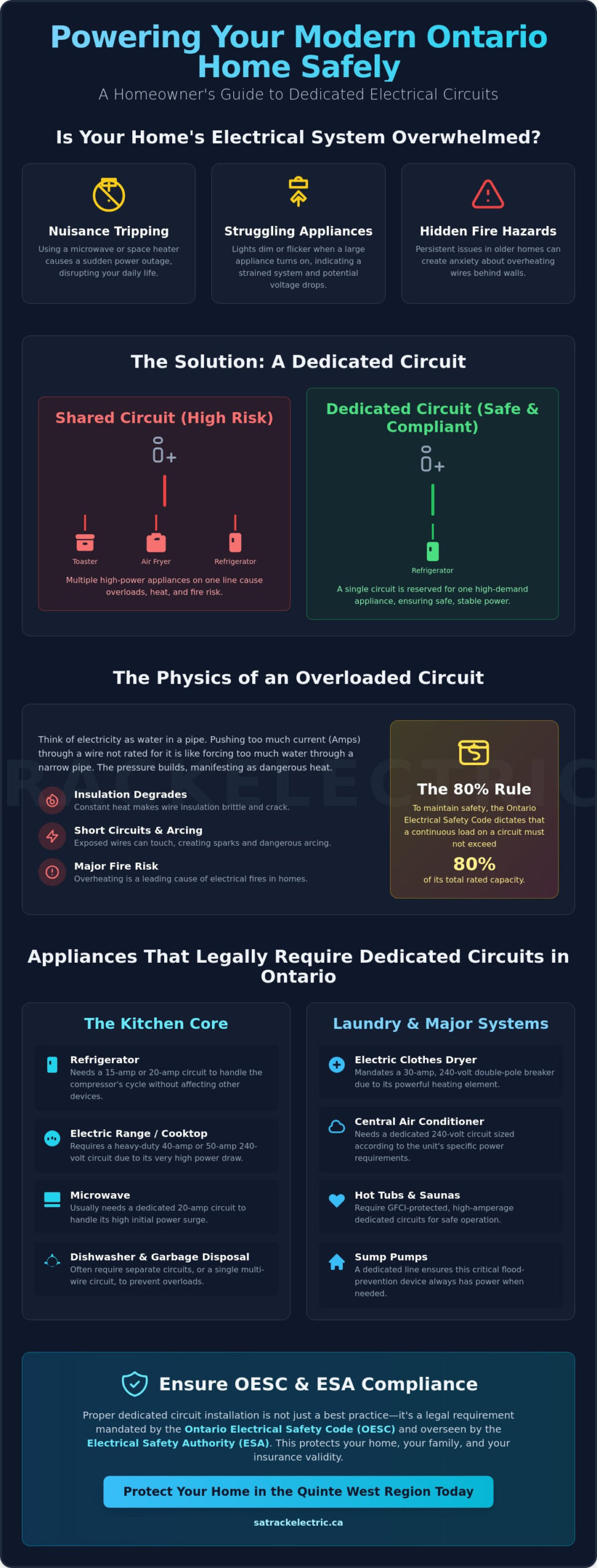
A dedicated circuit is an electrical line reserved for a single appliance or purpose. Unlike a general-purpose circuit that powers multiple outlets in a bedroom or hallway, this line runs directly from your electrical panel to one specific device. This “one-to-one” rule is a fundamental safety practice. If you attempt to share a circuit between a refrigerator and a high-wattage toaster, you risk drawing more current than the wires can safely handle. This creates a significant fire hazard as the copper conductors heat up behind your drywall. Professional dedicated circuit installation in Ontario ensures that your high-demand appliances have the necessary breathing room to operate without interference.
Many homeowners in Belleville and the surrounding Quinte region live in older properties built decades ago. These legacy electrical systems were designed for a time when households had fewer electronics and smaller appliances. Today, a single kitchen might feature a dishwasher, microwave, and air fryer, all running simultaneously. These modern power demands often exceed the original capacity of older wiring. Installing dedicated lines prevents the overheating that occurs when legacy systems are pushed beyond their limits, providing a stable foundation for modern technology.
The Physics of Electrical Overloads
Think of electricity like water flowing through a pipe. Amperage represents the volume of water moving through that pipe. If you try to force too much water through a narrow pipe, the pressure builds. In electrical terms, this pressure manifests as heat. When a circuit is constantly pushed to its limit, the heat begins to degrade the plastic insulation surrounding the copper wires. Over time, this insulation can become brittle and crack, leading to short circuits or electrical fires. To maintain safety, the 80% rule dictates that the continuous load on a circuit should not exceed 80% of its total rated capacity.
Ontario Electrical Safety Code (OESC) Basics
The Electrical Safety Authority (ESA) oversees all electrical work in the province to ensure it complies with the Ontario Electrical Safety Code. A dedicated circuit requires more than just a separate wire; it needs a specific circuit breaker sized correctly for the appliance’s load. For example, an electric dryer requires a 30-amp double-pole breaker, while a standard microwave usually needs a 20-amp single-pole breaker. The OESC mandates these separate lines for high-draw appliances to prevent house-wide power failures and ensure that a fault in one machine doesn’t compromise the rest of your home. A proper dedicated circuit installation in Ontario is a legal requirement for several major household systems that helps maintain your property’s insurance validity and overall safety.
Essential Appliances and Systems Requiring Dedicated Wiring
Modern residential electrical systems must accommodate a wide array of high-draw devices that were not present in homes thirty years ago. While a standard 15-amp circuit is sufficient for lighting or charging a phone, it cannot support the heavy electrical load of major appliances. A professional dedicated circuit installation in Ontario ensures that these critical systems operate independently. This prevents a fault in one area from disabling other essential services in your home. By isolating high-wattage equipment, you protect your sensitive electronics from the electrical noise and surges often generated by large motors.
The Kitchen Core: Beyond the Refrigerator
Kitchens are the most power-hungry rooms in any home. A microwave often requires its own dedicated 20-amp circuit to handle the rapid power surge it demands when heating food. While some homeowners wonder if a dishwasher and garbage disposal can share a line, the OESC has strict rules regarding these configurations. Generally, if the combined load of the two appliances exceeds the circuit rating, they must be separated to ensure ESA Compliance in Ontario. Additionally, countertop outlets must be served by at least two “small appliance” circuits. This allows you to use air fryers and kettles simultaneously without tripping a breaker.
Ontario Essentials: Sump Pumps and HVAC
Ontario’s climate presents unique challenges for residential wiring, making dedicated circuit installation in Ontario a standard requirement for safety and reliability. During the spring thaw or heavy autumn rains, your sump pump is your primary defence against basement flooding. If this pump shares a circuit with a power tool or a space heater, a single trip could lead to thousands of dollars in water damage. Reliability is paramount here. Similarly, central air conditioners and modern heat pumps have high start-up current requirements. These systems need dedicated 240-volt lines to provide the necessary torque for the compressor to start without dimming the lights in the rest of your house.
This requirement for reliable power extends to other essential home infrastructure, such as septic systems that rely on pumps and alarms to prevent backups. For those looking to understand professional standards in this field, you can discover Texas Septic Solutions and their dedicated services for residential and commercial clients.
Specialty items also demand careful planning. Electric vehicle (EV) chargers, hot tubs, and heavy-duty home workshop tools all require specific breaker sizing and wire gauges. For example, an EV charger might draw 40 to 50 amps continuously. This requires a robust, dedicated connection to avoid overheating the wire insulation over several hours of charging. If you are planning a renovation or adding new technology to your home, a professional electrical assessment can determine exactly where new lines are needed to keep your system safe and functional.
The Hidden Risks of Overloaded Shared Circuits
Overloading shared circuits leads to more than just a “dark kitchen” when a breaker trips. It indicates that the electrical infrastructure is operating at its maximum limit, which generates excessive heat. This heat is the primary cause of electrical fires in residential settings. When homeowners rely on “lazy” wiring solutions, such as daisy-chaining multiple power bars to support high-draw devices, they bypass the safety mechanisms designed into their home’s electrical panel. These temporary fixes often lead to a false sense of security while the underlying wiring continues to degrade.
A professional dedicated circuit installation in Ontario addresses these hazards by providing a direct, unshared path for electricity. This is particularly important for the Essential Appliances and Systems Requiring Dedicated Wiring that are known to draw significant amperage. Beyond the physical danger, there are legal and financial implications. If a fire occurs due to non-compliant electrical work, Ontario insurance providers may scrutinize the installation. If they discover that the wiring did not meet the Ontario Electrical Safety Code (OESC), they might deny the claim, leaving the homeowner responsible for the full cost of repairs. Working with a licensed insured electrician Ontario homeowners can verify through the ESA is the most reliable way to ensure your insurance coverage remains valid and your installation meets all provincial requirements.
Protecting Your Technology
Modern home offices in the Quinte area often house thousands of dollars in sensitive equipment. Shared circuits are prone to voltage drops, which occur when a large appliance on the same line starts up. These fluctuations force the power supplies in LED TVs and PCs to work harder, significantly shortening their operational lifespan. Harmonic distortion occurs when non-linear loads on shared neutral wires create electrical interference that can corrupt data or cause equipment to malfunction. Investing in a dedicated circuit installation in Ontario protects these high-value assets from the invisible wear and tear of unstable power.
Warning Signs You Lack Dedicated Lines
Identifying the early indicators of an overtaxed system can prevent a minor issue from becoming a major hazard. If you notice any of the following signs, your home’s wiring may be struggling to manage the current load:
- Flickering or dimming lights when a vacuum, microwave, or hair dryer is turned on.
- Circuit breakers that feel warm to the touch or emit a faint buzzing sound.
- The distinct smell of “hot plastic” or ozone near outlets or the main electrical panel.
- Discolouration or brown scorch marks around the slots of a wall receptacle.
These symptoms suggest that your electrical system is no longer sufficient for your needs. Addressing these issues through professional electrical upgrades is the most reliable way to ensure long-term safety and peace of mind for your family.
The Installation Process and ESA Compliance in Ontario
A professional dedicated circuit installation in Ontario begins with a comprehensive load calculation. This technical assessment determines if your existing electrical panel has the remaining capacity to support a new high-demand line. We analyze the total amperage of your current appliances against the panel’s rating, typically 100 or 200 amps. This step is vital to ensure that adding a new circuit won’t lead to frequent main breaker trips or overheating at the bus bar. Skipping this calculation is a common mistake in DIY projects that can compromise the entire home’s electrical integrity.
The physical installation involves running new NMD90 wire from the panel to the specific location of the appliance. This wire is the standard for residential interior wiring in Canada and must be sized correctly based on the intended load. We then select and install a circuit breaker that matches the required amperage. While a standard outlet uses a 15-amp breaker, heavy-duty equipment demands more:
- 20-Amp Breakers: Standard for modern microwaves and small kitchen appliances.
- 30-Amp Breakers: Required for electric clothes dryers and some water heaters.
- 50-Amp Breakers: Essential for electric ranges and Level 2 EV chargers.
Why a Licensed Electrical Contractor is Required
There’s a significant legal and safety difference between a general handyman and a Master Electrician. In Ontario, only a Licensed Electrical Contractor (LEC) is authorized to perform electrical work for hire and file the necessary paperwork with the Electrical Safety Authority. Choosing an unlicensed individual for a dedicated circuit installation in Ontario creates major liability risks. If an error occurs, your homeowner’s insurance may not cover the damages. You can learn more about verifying credentials by understanding how to hire a licensed insured electrician in Ontario to ensure your project is handled by qualified professionals.
The ESA Permit and Inspection Timeline
Every new dedicated circuit requires a notification of work, often called a permit, filed with the ESA. Satrack Electric manages this entire process for the homeowner, including the minimum $92 notification fee required as of April 1, 2026. Once the installation is complete, an ESA inspector reviews the work to verify compliance with the 2024 Ontario Electrical Safety Code. They check for proper wire gauge, secure support of the cables, correct terminations, and clear labelling at the panel. After the work passes, you receive a Certificate of Inspection. This document is your proof that the installation is safe and meets all provincial standards. If you’re ready to upgrade your home’s power capacity, request a professional installation today to ensure your system is fully compliant.
Professional Dedicated Circuit Installation with Satrack Electric
Satrack Electric provides reliable electrical services across Belleville, Trenton, Picton, and the Quinte West region. We approach every dedicated circuit installation in Ontario with a focus on precision and safety. Our team understands that every property has unique requirements, whether you’re upgrading a modern residential kitchen or installing heavy-duty commercial equipment for a local business. We don’t just meet the minimum requirements of the 2024 Ontario Electrical Safety Code; we strive to exceed them. This commitment ensures that your electrical infrastructure remains robust for years to come.
Our methodical process begins with a thorough evaluation of your existing system. We identify potential bottlenecks and plan for future expansion, ensuring your home can grow with your technological needs. This professional assurance allows you to operate high-value appliances without the constant worry of system failure or fire hazards. We take pride in our reputation as a dependable local authority, delivering thorough results that prioritize customer peace of mind. Our workflow is designed to be efficient and disciplined, mirroring the organized approach we take to every project.
Tailored Solutions for Quinte Area Homes
Homes in the Quinte region often feature a mix of architectural styles and electrical histories. Our technicians are highly experienced in managing the complexities of aluminum wiring and performing seamless fuse-to-breaker conversions. These upgrades are essential for homeowners who want to modernize their properties while maintaining strict safety standards. For those living along our beautiful waterfronts, we offer specialized expertise in hot tub and spa wiring. These installations require precise grounding and GFCI protection to ensure safe operation near water. You can learn more about these requirements by exploring our Professional Hot Tub Wiring Services in Belleville. We ensure every connection is weatherproof and compliant with the latest outdoor safety regulations.
Schedule Your Electrical Safety Assessment
Taking the step to realize a safer home environment starts with a professional consultation. We guide you through a logical flow from the initial site assessment to the final ESA-certified completion. Our goal is to provide a smooth, hassle-free experience that gives you total confidence in your home’s electrical capacity. Our experts are ready to troubleshoot existing issues and provide clear, direct solutions for your electrical upgrades. Don’t wait for a circuit failure to address your power needs. Contact Satrack Electric for your dedicated circuit installation in Ontario and secure the reliability your household deserves. We are committed to maintaining high standards of service for all our domestic and professional clients in the community.
Securing Your Home’s Electrical Future
Protecting your home from the hazards of overloaded circuits is a vital step in maintaining long-term safety and infrastructure integrity. By isolating high-demand appliances, you eliminate the frustration of nuisance tripping and safeguard your sensitive electronics from damaging voltage fluctuations. Adhering to the 2024 Ontario Electrical Safety Code is not just a legal requirement; it’s a fundamental safety measure that ensures your wiring can handle modern power demands without risk of overheating.
A professional dedicated circuit installation in Ontario provides the stability and peace of mind you need to operate your household efficiently. As a Licensed and Insured Ontario Electrical Contractor with extensive expertise in OESC and ESA compliance, Satrack Electric is committed to delivering quality workmanship across Belleville, Trenton, and Picton. We manage the technical load calculations and the mandatory ESA permit process to ensure your project is completed correctly the first time.
Take the first step toward a more reliable and compliant electrical system. Book Your Dedicated Circuit Consultation with Satrack Electric to verify that your home’s wiring meets all provincial safety standards. We look forward to helping you maintain a safe and functional environment for your family.
Frequently Asked Questions
Do I legally need a dedicated circuit for a microwave in Ontario?
Yes, the Ontario Electrical Safety Code generally requires a dedicated circuit for any fixed-in-place microwave. Even for portable countertop models, a dedicated 20-amp line is strongly recommended. These appliances pull significant current, and sharing a circuit with other kitchen devices often leads to frequent breaker tripping and potential overheating of the wire insulation.
How much does it cost to install a dedicated 20-amp circuit in Ontario?
The total cost for this service depends on several technical factors, including the distance between your electrical panel and the appliance. The complexity of the wire run through finished walls and your current panel’s available capacity also influence the final price. If these electrical improvements are part of a larger basement renovation, using a tool like the one provided by BCR Basements can help you estimate the overall project costs. Ultimately, a professional on-site assessment is the most reliable way to receive an accurate estimate for your specific home layout.
Can two appliances share a dedicated circuit if they aren’t used at the same time?
No, a dedicated circuit is designed to serve only one specific appliance or outlet. Sharing a line, even if you don’t intend to run the devices simultaneously, violates the fundamental safety principle of load isolation. OESC regulations mandate separate lines for high-draw equipment to ensure that your dedicated circuit installation in Ontario provides the necessary protection against overloads.
Is an ESA permit required for adding a single new circuit to my panel?
Yes, any new wiring installation in a residence requires a notification of work with the Electrical Safety Authority. This includes adding a single dedicated circuit to an existing electrical panel. Filing this permit ensures that a provincial inspector reviews the work, which is a critical step for maintaining your home insurance validity and ensuring provincial code compliance.
What size breaker do I need for a dedicated dishwasher circuit?
A dedicated dishwasher circuit typically requires a 15-amp or 20-amp breaker. The specific requirement depends on the manufacturer’s nameplate rating for the appliance. Most standard residential dishwashers utilize a 15-amp circuit with 14-gauge NMD90 wire, though some high-performance models may require a 20-amp circuit to operate safely without tripping the breaker during the heat-dry cycle.
Why does my treadmill trip the breaker if nothing else is plugged in?
Treadmills utilize high-torque motors that create a massive power surge during start-up and when the belt meets resistance. If your treadmill is plugged into a general-purpose circuit, this surge often exceeds the breaker’s capacity. Most manufacturers specify that their equipment must be on a dedicated line to prevent nuisance tripping and to protect the sensitive electronic control boards from voltage fluctuations.
Can I use an existing outlet for my new EV charger or hot tub?
No, standard 120-volt household outlets cannot handle the intense power demands of a Level 2 EV charger or a hot tub. These systems require a dedicated circuit installation in Ontario that utilizes 240-volt wiring and specialized breakers. Attempting to use existing general-purpose wiring for these high-load systems is a severe fire hazard and does not meet provincial safety standards.
How do I know if my electrical panel has enough room for a new dedicated circuit?
You can check for physical space by looking for empty breaker slots or removable “knockouts” in your panel cover. However, physical space is only one part of the equation. A Licensed Electrical Contractor must perform a formal load calculation to determine if your panel’s total amperage can support the additional demand. This ensures your main breaker won’t trip when multiple high-power systems run at once.