
In Ontario, hiring “just an electrician” is a legal and financial liability that could void your home insurance policy entirely. Most homeowners realize that faulty wiring is a leading cause of residential fires, yet the process of verifying credentials often feels confusing and stressful. You deserve to know that the person working behind your walls is qualified to meet the rigorous standards of the 2024 Ontario Electrical Safety Code. Securing a licensed insured electrician Ontario residents can depend on is the only way to guarantee that your property remains protected and your insurance claims stay valid.
We recognize that your home is your most significant investment, and maintaining its safety is a top priority. This guide will simplify the hiring process by explaining how to verify an ECRA/ESA licence number and why specific permits are non-negotiable for any electrical project. You’ll learn how to identify legitimate contractors and ensure every installation passes a formal inspection. By following these steps, you can move forward with your home improvements with total confidence in your contractor’s competence and your family’s safety.
Key Takeaways
- Learn how to verify an ECRA/ESA licence number to ensure your contractor is legally authorized to perform electrical work in Ontario.
- Understand why hiring a licensed insured electrician Ontario residents can rely on is essential for maintaining valid home insurance coverage.
- Identify critical red flags during the hiring process, such as contractors who request that you pull the electrical permit yourself.
- Discover how the 2024 Ontario Electrical Safety Code and ESA inspections protect your property from long-term fire and safety hazards.
- Recognize the importance of matching a contractor’s specific professional expertise to the unique requirements of your residential or commercial project.
Understanding the Legal Requirements for Electricians in Ontario
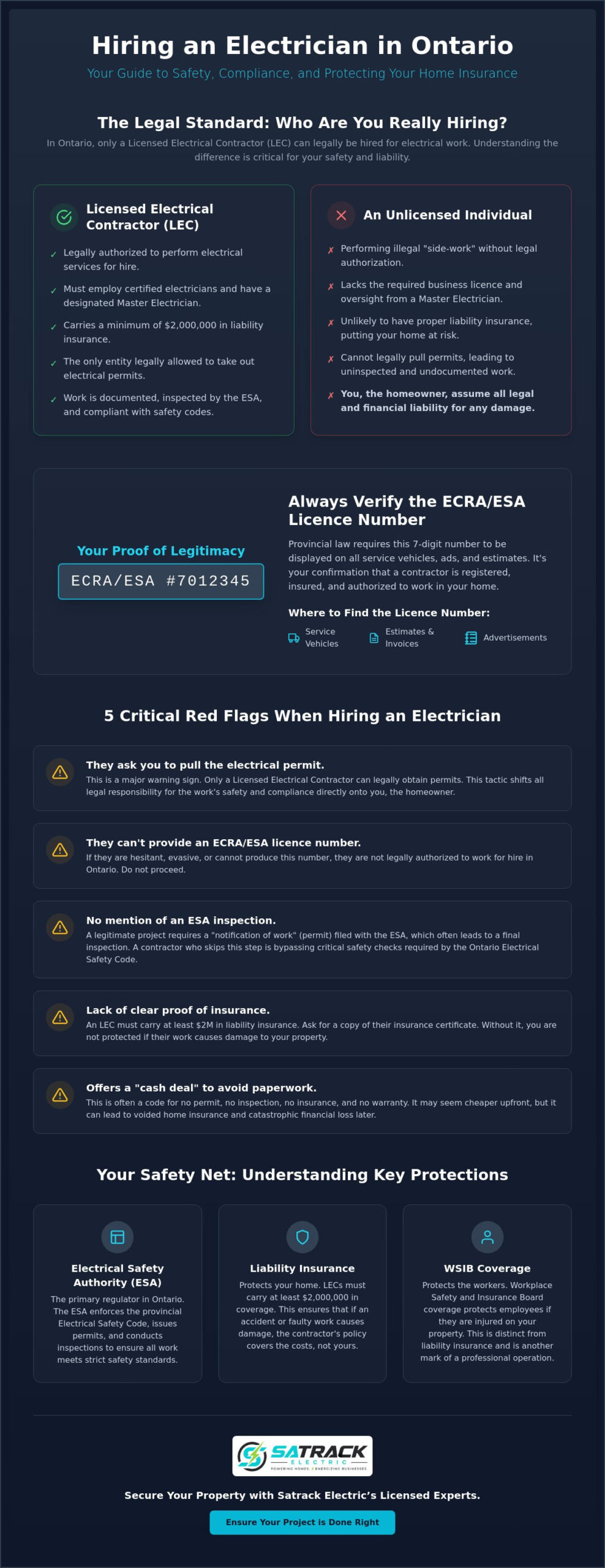
Many homeowners assume that any individual with a toolkit and a basic understanding of wiring is qualified to work on their property. This is a dangerous misconception. In this province, the law is clear: only a Licensed Electrical Contractor (LEC) can legally provide electrical services to the public for hire. While a certified electrician holds the personal qualifications to perform the work, they cannot operate as an independent business unless they also hold an LEC designation. Securing a licensed insured electrician Ontario homeowners can trust involves verifying that the business itself is registered with the proper authorities and carries the necessary protections.
Understanding what is an electrical contractor is the first step in protecting your home. An LEC is a specialized business that employs certified electricians, maintains a master electrician on staff, and carries at least $2,000,000 in liability insurance. This structure ensures that the business assumes full legal and financial responsibility for the safety of the installation. Without this designation, an individual is essentially performing “side-work” that lacks the oversight required by provincial law. This distinction is vital because unpermitted work can lead to significant safety hazards and may even impact the future resale value of your property.
The legal framework in Ontario exists to create a clear barrier between professional services and unregulated labour. By mandating that only LECs can take out permits, the province ensures that every major electrical project is tracked and inspected. This system protects you from the risks of sub-standard workmanship that could result in electrical fires or structural damage. When you hire a professional, you’re not just paying for labour; you’re paying for the peace of mind that comes with a legally compliant installation that adheres to the latest safety standards.
The Role of the Electrical Safety Authority (ESA)
The Electrical Safety Authority (ESA) serves as the primary regulator for all electrical matters in the province. They enforce the 2024 Ontario Electrical Safety Code, which became legally binding on May 1, 2025. Every professional project requires a “notification of work,” or permit. The ESA increased wiring fees by 1.9 percent on April 1, 2026, and the minimum notification fee is currently $92. The ESA is the administrative authority that mandates safety standards across the province.
ECRA/ESA Licence Numbers: What They Mean
You can identify a legitimate contractor by their 7-digit ECRA/ESA licence number. Provincial law requires this number to be visible on all service vehicles, advertisements, and written estimates. This identifier confirms that the business is registered and carries the mandatory $2,000,000 general liability insurance. If a contractor cannot produce this number, they aren’t authorized to work in your home. Relying on an unlicensed individual leaves you personally liable for any property damage.
Why Insurance is Non-Negotiable for Your Property’s Safety
Hiring a licensed insured electrician Ontario property owners can trust is about more than just technical skill. It is a fundamental layer of financial security. If an uninsured individual causes a fire or structural damage, the homeowner is often left responsible for the full cost of repairs. Licensed Electrical Contractors are legally mandated to carry at least $2,000,000 in commercial general liability insurance. This requirement ensures that if an accident occurs, the contractor’s policy covers the damages rather than your own personal savings or home insurance policy.
The risks of hiring “side-job” workers extend beyond property damage. These individuals often lack the necessary credentials to pull permits, which leaves your work unrecorded and uninspected. When you choose a professional, you’re ensuring that the business assumes all legal and financial responsibility for the project. This professional assurance is what separates a legitimate contractor from a liability risk. It’s a standard that protects your home, your family, and your financial future from the consequences of poor workmanship.
Liability Insurance vs. WSIB Coverage
Many people confuse general liability insurance with Workplace Safety and Insurance Board (WSIB) coverage. They serve two distinct purposes. General liability insurance protects your home and assets from damage caused by the contractor’s work. WSIB coverage, however, protects the workers themselves. In Ontario, WSIB is mandatory for most electrical contractors. You should always request a WSIB clearance certificate before any work begins. If an uninsured worker is injured on your property, you could be held legally liable for their medical expenses and long-term disability costs. This risk is simply too high to ignore for the sake of a cheaper quote.
The Impact on Your Homeowner or Business Insurance
Your relationship with your insurance provider depends on your adherence to safety standards. Insurance companies typically view unpermitted or unlicensed electrical work as a breach of contract. If a fire originates from a circuit installed by someone without the proper credentials, your insurer may deny your claim entirely. Following the Legal Requirements for Electricians in Ontario isn’t just a matter of law; it’s a matter of financial survival.
Once a project is complete, you must receive and keep an ESA Certificate of Acceptance. This document serves as definitive proof that the work was inspected and meets the 2024 Ontario Electrical Safety Code. For instance, a dedicated circuit installation Ontario project must be performed by an insured professional to ensure your policy remains in good standing. Older homes with outdated wiring materials present a particular concern for insurers; if your property was built before the 1980s, you may want to explore aluminum wiring replacement Belleville specialists recommend to prevent policy cancellations and reduce fire risk. If you’re ready to start your next project, you can consult with our professionals to ensure every detail of your electrical system is both safe and fully insured.
5 Red Flags to Watch for When Hiring an Electrical Contractor
Hiring a contractor involves more than just comparing quotes. You must remain vigilant for specific warning signs that indicate a lack of professional standing. A legitimate licensed insured electrician Ontario residents hire will always be transparent about their credentials and administrative processes. If a contractor seems evasive or provides vague answers regarding their qualifications, it’s often a sign of underlying regulatory issues. Protecting your home requires a partner who operates with complete transparency and follows provincial laws to the letter.
Watch for these five critical warning signs during your search:
- Asking you to pull the permit: A contractor who asks the homeowner to apply for the ESA permit is often unlicensed. Only a Licensed Electrical Contractor (LEC) can legally pull a permit for work they are performing.
- Missing ECRA/ESA numbers: Every advertisement, vehicle, and estimate must display a 7-digit ECRA/ESA licence number. If this number is absent, the business isn’t registered with the Electrical Safety Authority.
- Cash-only deals: Contractors who insist on “cash-only” payments are usually trying to avoid taxes and a paper trail. This leaves you with no warranty and no proof of work for insurance purposes.
- No physical address: Be cautious of contractors who only provide a mobile phone number and lack a verifiable business address in Ontario. This makes it difficult to hold them accountable if issues arise.
- Hesitation over documentation: A professional will readily provide a written contract and proof that they are fully insured. If they hesitate to show these documents, they likely don’t have them.
Identifying Unlicensed “Handyman” Electricians
While a handyman is often suitable for painting or minor carpentry, they are legally prohibited from performing electrical work for hire in this province. Some homeowners fall into the “friend of a friend” trap, believing they’re getting a deal, but this fails to protect your investment. In Ontario, any individual performing electrical work for hire must be employed by a Licensed Electrical Contractor. Hiring an independent handyman for wiring is not only illegal but also places your property at significant risk of fire and denied insurance claims.
The Dangers of No-Permit Deals
An ESA permit is your only guarantee that the work has been inspected and meets the 2024 Ontario Electrical Safety Code. Skipping the permit might save a small amount upfront, but it complicates the process of selling your home or business later. Buyers and home inspectors will look for the Certificate of Acceptance to verify the safety of the system. Professional firms like Satrack Electric handle all permit filings on behalf of the client, ensuring that every project is fully documented and passes inspection without the homeowner having to manage the administrative burden.
Choosing the Right Professional for Your Specific Electrical Needs
Selecting a licensed insured electrician Ontario property owners can trust requires looking beyond the licence number to find specific project expertise. While the law mandates a baseline of safety, the practical application of the Ontario Electrical Safety Code varies significantly between a residential kitchen renovation and a high-voltage commercial installation. You should prioritize contractors who demonstrate a clear understanding of your specific needs; this might involve integrating smart home technologies or managing complex industrial load requirements. Ask potential contractors about their experience with modern upgrades like EV chargers or smart panels. These installations require specific circuit calculations and load management strategies to prevent overloading your existing service. Before committing to any contractor, it’s also worth reviewing the cost to hire electrician Belleville services typically involve, so you can evaluate quotes with confidence and avoid being overcharged for standard residential work.
Local knowledge is equally valuable in the Quinte region. Contractors familiar with the infrastructure in Belleville and Quinte West understand the specific requirements of local utilities like Elexicon or Hydro One. This expertise is vital for projects that require coordinated power disconnects, such as a main electrical panel upgrade. A professional who understands the local climate also knows how to protect outdoor installations from the temperature fluctuations common in our area. They’ll ensure that exterior conduit and fixtures are rated for our winters, preventing moisture ingress and premature failure of your electrical components.
Residential Specialists: Panels, Hot Tubs, and Generators
Residential projects often involve specialized safety devices. For example, hot tub wiring Belleville homeowners invest in must include Ground Fault Circuit Interrupter (GFCI) protection to prevent electric shock in wet environments. Similarly, installing a backup generator requires a transfer switch to prevent back-feeding electricity into the grid, which poses a severe risk to utility workers. These high-draw appliances demand a contractor who treats safety as a non-negotiable standard. A qualified professional will ensure that your home’s total load capacity is sufficient to handle these additions without compromising the stability of your electrical system. Homes built in the 1960s and 1970s may also require a thorough assessment for aluminum wiring replacement Belleville residents need to address before adding high-draw appliances to an aging electrical system.
Commercial Requirements: Compliance and Maintenance
Commercial properties operate under a more stringent set of regulations. Business owners often require commercial electrical upgrades Belleville facilities need to support new machinery or expanded operations. A licensed contractor ensures these upgrades comply with both the Ontario Fire Code and Occupational Health and Safety (OHS) requirements. Regular maintenance is another critical factor for businesses. Proactive inspections of switchgear and distribution panels can prevent the costly downtime that results from unexpected equipment failure. This methodical approach to maintenance ensures your facility remains productive and safe for employees and customers alike.
If you’re planning a project that requires specialized expertise, you can request a professional assessment from our team to ensure your installation meets every local and provincial standard.
Secure Your Property with Satrack Electric’s Licensed Experts
Satrack Electric operates as a fully licensed and insured contractor dedicated to providing reliable services across the Quinte region. Our team prioritizes a safety-first approach, ensuring every installation or repair adheres strictly to the 2024 Ontario Electrical Safety Code. By choosing a licensed insured electrician Ontario households and businesses can trust, you’re investing in long-term property protection and peace of mind. We recognize the complexities of provincial regulations and take the administrative burden off your shoulders by managing all required ESA permits. Our experts coordinate every necessary inspection on your behalf, ensuring that the work is verified by the proper authorities without causing you unnecessary stress. This end-to-end service ensures that your project is not only technically sound but also fully compliant with provincial laws and insurance requirements.
Serving Belleville, Quinte West, and Surrounding Areas
Our firm is deeply rooted in the communities we serve, providing professional residential and commercial electrical services with a focus on local accountability. We maintain a consistent presence in Belleville, Trenton, Picton, and Brighton, as well as Quinte West, Greater Napanee, and Cobourg. This regional focus allows us to respond efficiently to the needs of our neighbours while maintaining a high standard of community-focused professionalism. Our team is equipped to handle a diverse range of projects, from minor electrical repairs in heritage homes to large-scale electrical installations for growing retail centres. We take pride in being a stable partner for both homeowners and business managers, delivering thorough results that reflect our commitment to the safety of our service area.
Our Commitment to Quality and Code Compliance
Our workflow is designed to be methodical and efficient, starting with a detailed initial consultation to evaluate your specific electrical needs. We specialize in high-impact projects such as electrical panel upgrades, hot tub wiring, and backup generator installations, where precise execution is essential for safety. Every technician on our team values integrity and quality workmanship, ensuring that no detail is overlooked during the installation process. Once the physical work is complete, we facilitate the final ESA inspection to secure your Certificate of Acceptance, which serves as your permanent record of a safe installation. This structured process guarantees that your electrical system is safe, reliable, and fully documented for your insurance provider. Contact Satrack Electric for a professional consultation to discuss your upcoming project with our qualified team and experience a higher standard of electrical service.
Protect Your Home with Verified Professional Expertise
Protecting your property starts with the understanding that professional electrical work is a legal requirement, not a suggestion. Verifying a contractor’s ECRA/ESA licence number and ensuring they carry the mandatory $2,000,000 in liability insurance are the most effective ways to safeguard your investment. These steps ensure your installations meet the 2024 Ontario Electrical Safety Code and keep your home insurance policy in good standing. By choosing a licensed insured electrician Ontario homeowners can rely on, you’re choosing expert service delivered by a team with deep roots in Belleville and Quinte West.
Satrack Electric provides this level of professional assurance to every client. As a fully licensed ECRA/ESA contractor, we maintain comprehensive WSIB and liability insurance to protect both our workers and your property. We handle the technical complexities and the administrative permit process so you don’t have to manage the paperwork yourself. Book your professional electrical consultation with Satrack Electric today to discuss your next residential or commercial project. We’re here to ensure your electrical system remains safe, efficient, and fully compliant for years to come.
Frequently Asked Questions
How do I verify an electrician’s licence in Ontario?
You can verify a licence by visiting the Electrical Safety Authority (ESA) website and using their “Find a Licensed Electrical Contractor” search tool. This database allows you to search by business name or their 7-digit ECRA/ESA licence number to confirm they are authorized to work in the province. It’s a vital step to ensure the business is in good standing before any work begins on your property.
What is the difference between an electrician and an electrical contractor?
An electrician is an individual who has the training and Certificate of Qualification to perform electrical work. An electrical contractor is a licensed business that is authorized to hire electricians and offer services to the public. In Ontario, only a Licensed Electrical Contractor (LEC) can legally pull permits and provide electrical services for hire.
Does a licensed electrician have to pull a permit for every job?
Yes, a notification of work is required for almost all electrical projects, including new installations and major repairs. While simple tasks like replacing a light fixture or a wall plate don’t always require a permit, any work that involves new wiring or changes to your electrical panel must be reported to the ESA for inspection. This process ensures the work meets the 2024 Ontario Electrical Safety Code.
What happens if I hire an unlicensed electrician and there is a fire?
Hiring an unlicensed individual can lead to the total denial of your home insurance claim. If an investigation reveals that a fire was caused by unpermitted work performed by someone without a licence, your insurer may consider it a breach of your policy. You would then be held personally responsible for the full cost of property repairs and any third-party liability claims.
How much liability insurance should an Ontario electrician have?
A licensed insured electrician Ontario property owners hire must carry a minimum of $2,000,000 in commercial general liability insurance. This coverage is a mandatory requirement for maintaining an ECRA/ESA licence. It protects your home or business from financial loss if the contractor accidentally causes damage to your property during the project.
Is WSIB coverage mandatory for electrical contractors in Ontario?
Yes, Workplace Safety and Insurance Board (WSIB) coverage is mandatory for most electrical contractors in the province. This insurance protects you from being held legally liable if a worker is injured while performing a task on your property. You should always ask for a WSIB clearance certificate to confirm the contractor’s account is active and in good standing.
Can I do my own electrical work in my home in Ontario?
Homeowners are legally allowed to perform their own electrical work, but they must still follow the same safety standards as professionals. You’re required to apply for an ESA permit and have the work inspected to ensure it complies with provincial safety codes. However, if you’re not fully confident in your technical skills, hiring a licensed insured electrician Ontario residents trust is the safest option.
What should I look for on a contractor’s business card or vehicle?
You should always look for a 7-digit ECRA/ESA licence number, which must be clearly displayed on all contractor vehicles, advertisements, and business cards. This number is the primary proof that the business is registered with the Electrical Safety Authority and carries the necessary insurance. If this number is missing, the individual is likely not authorized to perform electrical work for hire.