
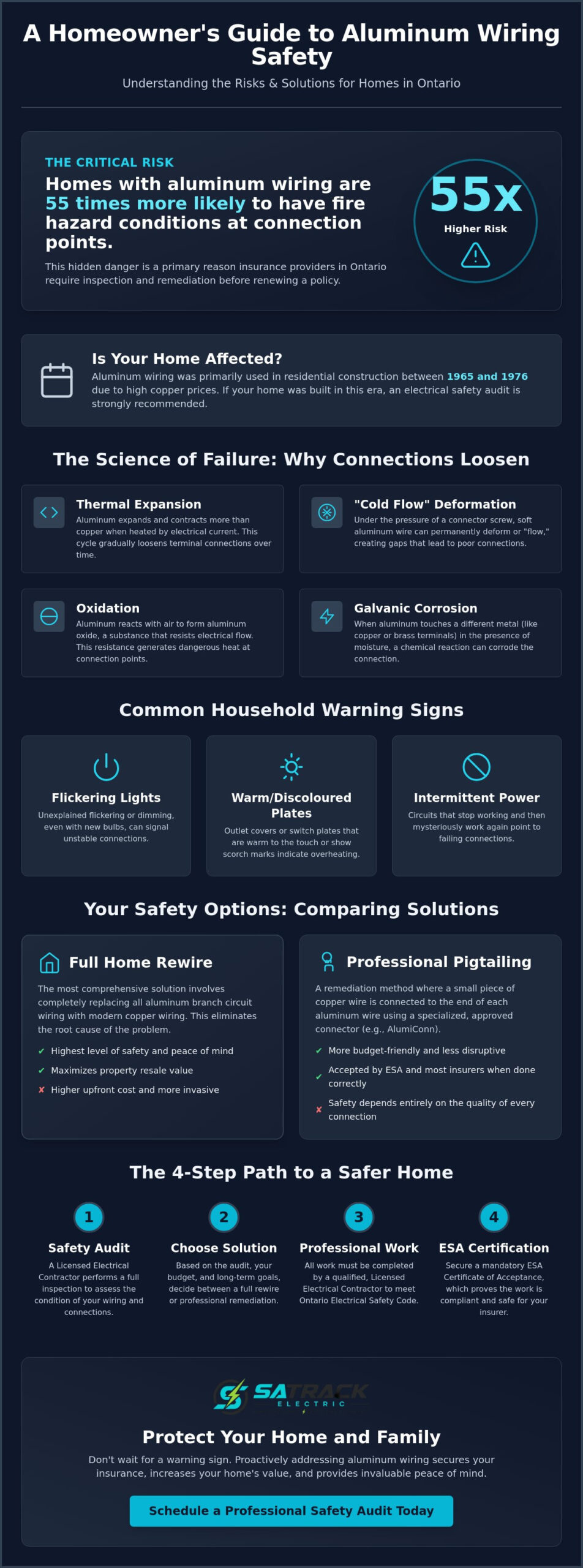
Did you know that homes equipped with aluminum wiring are 55 times more likely to reach fire hazard conditions at their connection points than those with copper? This statistic highlights why many insurance providers in Ontario now require proof of inspection or remediation before renewing a policy. If you’re concerned about the safety of your electrical system, pursuing aluminum wiring replacement Belleville is a proactive way to protect your property and ensure your coverage remains secure.
We recognize the anxiety that comes with potential fire risks and the fear of a costly, invasive home renovation. It’s frustrating to deal with insurance companies that threaten to cancel your protection. This guide will help you understand the most reliable, ESA-compliant methods for making your electrical system safe and durable. We will examine the differences between full rewiring and professional pigtailing, explain how to meet the Ontario Electrical Safety Code, and show you how these upgrades can lower your premiums while providing peace of mind for your family.
Key Takeaways
- Understand why aluminum wiring replacement Belleville is essential for homeowners in properties built between 1965 and 1976 to maintain insurance eligibility.
- Learn about the “cold flow” phenomenon and how thermal expansion leads to loose connections and potential fire hazards over time.
- Discover the differences between a full home rewire and specialized remediation methods like AlumiConn connectors to determine the best fit for your budget.
- Follow a clear step-by-step process for upgrading your system, from the initial safety audit to securing a mandatory ESA Certificate of Acceptance.
- Realize the importance of partnering with a Licensed Electrical Contractor to ensure your home meets the Ontario Electrical Safety Code and protects your family.
Understanding the Risks of Aluminum Wiring in Belleville Homes
Between 1965 and 1976, aluminum wiring was widely adopted as a standard for residential construction across Ontario. This transition wasn’t a choice based on superior performance but rather a response to the economic pressures of the era. The price of copper surged during the Vietnam War, leading builders to seek a more affordable alternative for branch circuit wiring. Understanding the history of aluminum wiring helps clarify why these systems require closer attention today.
The fundamental issue isn’t that aluminum is a poor conductor. In fact, it’s used safely in high-voltage transmission lines today. However, its physical properties differ from copper in ways that can compromise residential connections over time. You can often identify this wiring by checking the wire jackets in your basement or attic for markings like “ALUM,” “AL,” or “ACM.” If your property falls within this age range, considering aluminum wiring replacement Belleville is a logical step for long-term safety.
Common Warning Signs in Your Household
Electrical hazards often manifest through subtle changes in your home’s daily operation. If you notice lights flickering despite having brand-new bulbs, it could indicate a loose connection at a terminal. Another serious red flag involves outlet covers or switch plates that feel warm to the touch or show signs of discolouration. These symptoms suggest that heat is building up at the connection point. You might also experience intermittent power loss to specific rooms without a breaker actually tripping. These aren’t just minor inconveniences; they’re indicators that the wiring is struggling to maintain a stable connection. Understanding when these warning signs require urgent attention is covered in detail in our guide to home electrical repairs in Belleville, which explains how to prioritize and resolve common issues safely.
The Belleville Insurance Landscape
In the local Quinte West market, the presence of aluminum wiring is a significant factor during property transactions and insurance renewals. Major Ontario insurers, such as Aviva or Intact, frequently mandate a comprehensive inspection by a Licensed Electrical Contractor before they will provide or renew coverage. In some cases, they may refuse coverage entirely until remediation or a full aluminum wiring replacement Belleville is completed.
Beyond insurance requirements, your home’s resale value is directly tied to the integrity of its electrical system. Buyers are increasingly aware of the risks and often negotiate for the cost of electrical upgrades during the closing process. Investing in professional replacement or remediation doesn’t just satisfy the Electrical Safety Authority; it can also lead to lower annual insurance premiums. By modernizing your system, you demonstrate to insurers that you’ve mitigated a primary fire risk, which often results in more favourable rates and a smoother selling process in the future.
The Science of Failure: Why Aluminum Wiring Becomes Dangerous
The danger associated with aluminum wiring isn’t a result of the wire failing in the middle of a wall. It’s almost always a failure at the connection points where the wire meets switches, outlets, or the electrical panel. This happens because aluminum has a higher coefficient of thermal expansion than copper. When electricity flows, the wire heats up and expands. When the power is turned off, it cools and contracts. Over thousands of cycles, this constant movement causes the wire to slowly creep out from under terminal screws.
This process is often compounded by “cold flow,” a phenomenon where the wire permanently deforms under the pressure of a connector. Once the metal has deformed, it cannot return to its original shape. This creates a microscopic gap between the wire and the terminal. Aluminum also reacts with oxygen to form aluminum oxide. While copper oxide is conductive, aluminum oxide is a poor conductor that creates high electrical resistance. This resistance generates intense heat, which can eventually ignite surrounding materials. According to CPSC safety recommendations, these conditions significantly increase the risk of fire in older homes. If you suspect your home has these vulnerabilities, scheduling a professional electrical safety audit is a necessary precaution.
Galvanic corrosion adds another layer of risk. When aluminum is improperly joined to copper or brass terminals, moisture in the air can trigger a chemical reaction between the dissimilar metals. This leads to the deterioration of the connection, further increasing resistance and heat. Because of these complex physical and chemical factors, aluminum wiring replacement Belleville is often the most stable long-term solution for homeowners.
The Role of Temperature Fluctuations
Ontario’s seasonal temperature swings accelerate the loosening of wire terminals. Your electrical system doesn’t just react to the weather; it reacts to the load you place on it. High-draw appliances, such as space heaters, kettles, and hair dryers, are the primary catalysts for failure. These devices pull significant current, causing the wires to heat up rapidly. After 50 years of these heating and cooling cycles, many connections in Belleville homes have reached a critical point of instability.
Fire Hazards and Arcing
Loose connections eventually lead to electrical arcing inside your walls. Arcing is a high-temperature luminous discharge across a gap. This heat can reach thousands of degrees, yet it often doesn’t draw enough current to trip a standard circuit breaker. Conventional breakers are designed to detect short circuits or overloads, not the slow-heat failure of an aluminum connection. This is why many homeowners remain unaware of the danger until they smell smoke or see discoloured plastic on an outlet. Professional aluminum wiring replacement Belleville addresses these hidden risks by ensuring every connection is stable and code-compliant.
Replacement vs. Remediation: Comparing Your Options
Homeowners facing the dangers of aluminum wiring must choose between focused remediation and a permanent solution. While the science of failure is clear, the path forward depends on your long-term goals for the property. Several approved methods exist for making these systems safe, but they aren’t all equal in terms of durability or insurance acceptance. Choosing the right approach requires a balance between immediate safety needs and future property value.
One reliable remediation method involves AlumiConn connectors. These are specialized lug-style systems that create a secure mechanical connection between the aluminum house wire and a copper lead. This effectively separates the metals and prevents the thermal issues discussed in previous sections. Another high-tier option is Copalum crimping, which uses a high-pressure tool to create a cold-weld. This method requires specialized certification and equipment. However, homeowners should be wary of the “Marrette” myth. Standard twist-on wire nuts, even those marketed specifically for aluminum, are often seen as a temporary fix rather than a permanent safety standard by many inspectors and insurers.
Pros and Cons of Pigtailing
Pigtailing is the process of connecting a short piece of copper wire to the existing aluminum wire using an approved connector. This allows you to use standard copper-rated switches and outlets safely. It’s a labour-intensive process because every single junction box, switch, and outlet in the home must be addressed individually. While it significantly reduces the risk of fire at the terminals, some insurance providers still view it as a partial measure. You’ll need to confirm with your specific insurer if they will accept pigtailing or if they mandate a complete aluminum wiring replacement Belleville for policy renewal.
The Case for Full Replacement
A full rewire represents the gold standard for residential safety. It eliminates the “mixed metal” risk entirely by removing the aluminum branch circuits and replacing them with modern copper. This is often the most efficient time to consider a professional electrical panel upgrade in Belleville. Combining these projects ensures your entire system is prepared for modern electrical demands and high-draw appliances.
Buyers in 2026 prioritize homes that are move-in ready and free of hidden liabilities. Removing the aluminum wiring entirely eliminates a major obstacle during the home inspection process. While the initial investment is higher than remediation, the long-term ROI is found in lower insurance premiums and increased property value. Opting for a comprehensive aluminum wiring replacement Belleville provides the ultimate peace of mind for your family and secures your investment for years to come.
The Aluminum Wiring Replacement Process: What to Expect
The transition to a copper-based system is a structured process designed to maximize safety while minimizing domestic upheaval. When planning an aluminum wiring replacement Belleville project, the first step is always a comprehensive safety audit. This isn’t a simple visual check. It’s a circuit-by-circuit inspection of your entire home. We identify high-load areas, assess the condition of existing terminals, and map out the most efficient path for new copper lines. This foundation allows for a precise plan that avoids unnecessary work.
Before any tools touch your walls, a permit must be secured from the Electrical Safety Authority (ESA). In Ontario, this is a legal requirement for any significant electrical modification. It ensures that the project is logged with the province and will be subject to professional oversight. Once the permit is in place, the work phase begins. Experienced electricians use specialized techniques to fish new copper wire through existing wall cavities. By utilizing attic spaces, basements, and small access points, we can often replace entire circuits with very little impact on your drywall. The process concludes with a final ESA inspection. A third-party inspector visits your property to verify that every connection meets the current Ontario Electrical Safety Code.
Minimizing Disruption to Your Home
We understand that the idea of a home rewire can feel overwhelming. For a standard 1,500 sq. ft. home in the Belleville area, the replacement process typically spans three to five business days. The timeline can vary based on your home’s layout or the presence of finished basements. To help the project move efficiently, we recommend moving furniture away from walls and clearing paths to your main electrical panel and all wall outlets. This allows our team to work steadily without delays, ensuring your power is restored as quickly as possible.
Documentation and Certification
The most valuable outcome of this process, aside from safety, is the documentation. Upon successful completion, you’ll receive an ESA Certificate of Acceptance. This document is your primary evidence of compliance. You’ll need to provide a copy to your insurance broker to secure your policy and potentially lower your premiums. It’s also a vital asset for your property records. If you decide to sell your home in the future, having a certified record of your aluminum wiring replacement Belleville project will streamline the home inspection process. For more information on choosing the right partner for this work, see our guide on hiring a licensed and insured electrician in Ontario.
If you’re ready to secure your home’s electrical future, request a professional safety audit to get started.
Ensuring Long-Term Safety with Satrack Electric
Choosing a partner for your electrical upgrades requires a focus on professional assurance and unwavering reliability. At Satrack Electric, we prioritize safety and competence in every project we undertake, upholding standards of excellence similar to those seen at Foster Electrical. When dealing with complex systems like aluminum wiring replacement Belleville, working with a Licensed Electrical Contractor (LEC) is non-negotiable. Only an LEC has the legal authority and specialized training required to pull the necessary permits and ensure your home complies with the Ontario Electrical Safety Code.
Our team provides a comprehensive service that manages every detail of the transition. This includes the initial circuit-by-circuit audit, the meticulous installation of new copper wiring, and the coordination of the final ESA certification. We take pride in serving homeowners across Belleville, Trenton, and the broader Quinte region with safety-first electrical solutions. By providing a steady, methodical approach to work, we ensure that your domestic environment remains secure and your insurance requirements are fully met. For a broader understanding of how ESA permit requirements and the 2024 Ontario Electrical Safety Code updates affect your property, our resource on professional home electrical repairs in Belleville provides a detailed overview of current regulatory obligations.
Beyond Wiring: A Holistic Safety Approach
A complete rewire is an ideal time to evaluate the overall health of your electrical system. We often recommend pairing your project with a dedicated circuit installation in Ontario for modern, high-draw appliances. This prevents future overloads and ensures your new copper circuits operate efficiently. As part of our holistic safety approach, many Quinte region homeowners also take this opportunity to explore professional generator installation in Belleville to protect their newly upgraded electrical system against power outages. As part of our safety protocol, we also test your smoke and carbon monoxide detectors to confirm they’re functioning correctly. We verify that your electrical panel can handle the modern loads required by today’s technology, providing a stable foundation for years to come.
Schedule Your Safety Inspection Today
It’s best not to wait for a flickering light or a warm outlet cover to become a serious fire hazard. Taking proactive steps now protects your family and your property investment. Contact Satrack Electric for a methodical, professional evaluation of your home’s wiring. Our experienced practitioners will guide you through the process with clarity and integrity. Book your aluminum wiring inspection with Satrack Electric today to secure your peace of mind and ensure your home is fully compliant with modern safety standards.
Secure Your Home’s Electrical Future
Addressing aluminum wiring is about more than just satisfying a temporary insurance requirement. It’s a critical step in protecting your property from the physical risks of thermal expansion and ensuring your electrical system can handle the high-draw appliances of today. Whether you opt for specialized remediation or a complete aluminum wiring replacement Belleville, the result is a home that meets the Ontario Electrical Safety Code and offers genuine peace of mind for your family.
Satrack Electric operates as a Licensed Electrical Contractor (LEC) with a commitment to providing ESA-compliant workmanship throughout the Quinte region. Our experienced team manages every detail of the process, from the initial circuit-by-circuit audit to the final Certificate of Acceptance. You don’t have to navigate insurance pressures or safety concerns alone. Request a Professional Wiring Audit from Satrack Electric to secure your home’s future. We’re here to provide the steady, reliable service you need for a safer home.
Frequently Asked Questions
Is it illegal to have aluminum wiring in Ontario?
No, it is not illegal to have aluminum wiring in your Ontario home. The Ontario Electrical Safety Code permits its use provided it was installed according to the regulations of the time and utilizes approved devices. However, many homeowners choose to upgrade because modern safety standards and insurance providers often require proof of professional maintenance or remediation to ensure the system remains safe for daily use.
How much does it cost to replace aluminum wiring in a Belleville home?
The cost of replacement varies based on the size of your property, the accessibility of the wiring, and the number of electrical devices in the home. While industry averages exist for the province, every project is unique. We recommend a professional safety audit to determine the specific requirements of your home and provide an accurate scope of work for your electrical upgrade.
Can I just replace the outlets myself if I have aluminum wiring?
You should not attempt to replace outlets yourself if your home has aluminum wiring. Standard outlets and switches are typically rated for copper only; connecting them to aluminum can lead to overheating and fire. Specialized CO/ALR devices or approved connectors are required. In Ontario, this work must be performed by a Licensed Electrical Contractor to ensure it meets the legal safety standards.
Why do insurance companies care about aluminum wiring?
Insurance companies view aluminum wiring as a significant risk factor due to its tendency to develop loose connections over time. Because these failures can occur behind walls without tripping a breaker, they represent a higher fire hazard than copper. Insurers often mandate an ESA inspection or a full aluminum wiring replacement Belleville before they will grant or renew a residential policy.
What is the difference between pigtailing and a full rewire?
Pigtailing is a remediation method where a licensed electrician attaches short copper leads to existing aluminum wires at every connection point. A full aluminum wiring replacement Belleville involves removing the old aluminum branch circuits entirely and installing new copper throughout the building. While pigtailing is a recognized safety measure, a full rewire is the most permanent solution for long-term property value.
How can I tell if my home has aluminum wiring without opening the walls?
You can check for identification marks on the visible wire jackets in unfinished areas of your home, such as the attic, basement, or near the electrical panel. Look for the letters “AL,” “ALUM,” or “ACM” printed directly on the plastic casing. If your home was built between the mid-1960s and late 1970s and you cannot find these marks, a professional electrician can verify the material safely.
Does aluminum wiring replacement require an ESA permit?
Yes, all significant electrical modifications in Ontario require a permit from the Electrical Safety Authority. This process ensures that the work is officially logged and subject to a third-party safety inspection. Once the project passes, you receive a Certificate of Acceptance, which is a vital document for your insurance broker and serves as proof that your home meets provincial safety codes.
Will my drywall be destroyed during a full wiring replacement?
Professional electricians use specialized fishing techniques to pull new copper wire through existing wall cavities, which minimizes the need for demolition. While small access holes are sometimes necessary to navigate corners or studs, they are kept to an absolute minimum. Most homeowners find the process far less invasive than they initially expected, as modern methods prioritize preserving the integrity of your home’s interior.