
Ontario’s Electrical Safety Code requires AFCI protection on almost every 15 A and 20 A residential branch circuit under Rule 26-724. AFCI breaker installation in Belleville starts with identifying which circuits need arc-fault protection and where GFCI protection is required instead.
It’s understandable to want a clear answer before planning AFCI breaker installation in Belleville, especially in an older home where the panel and wiring may reflect an earlier code. AFCIs detect arcing patterns in wiring; GFCIs detect current leaking to ground, so they address different hazards.
This guide explains where each type of protection applies, what can affect installation costs, and how an older Ontario home may be retrofitted. You’ll also learn when renovations, circuit extensions or panel replacements can make AFCI upgrades part of the work, and how a professional installation can address the requirements of your home.
Key Takeaways
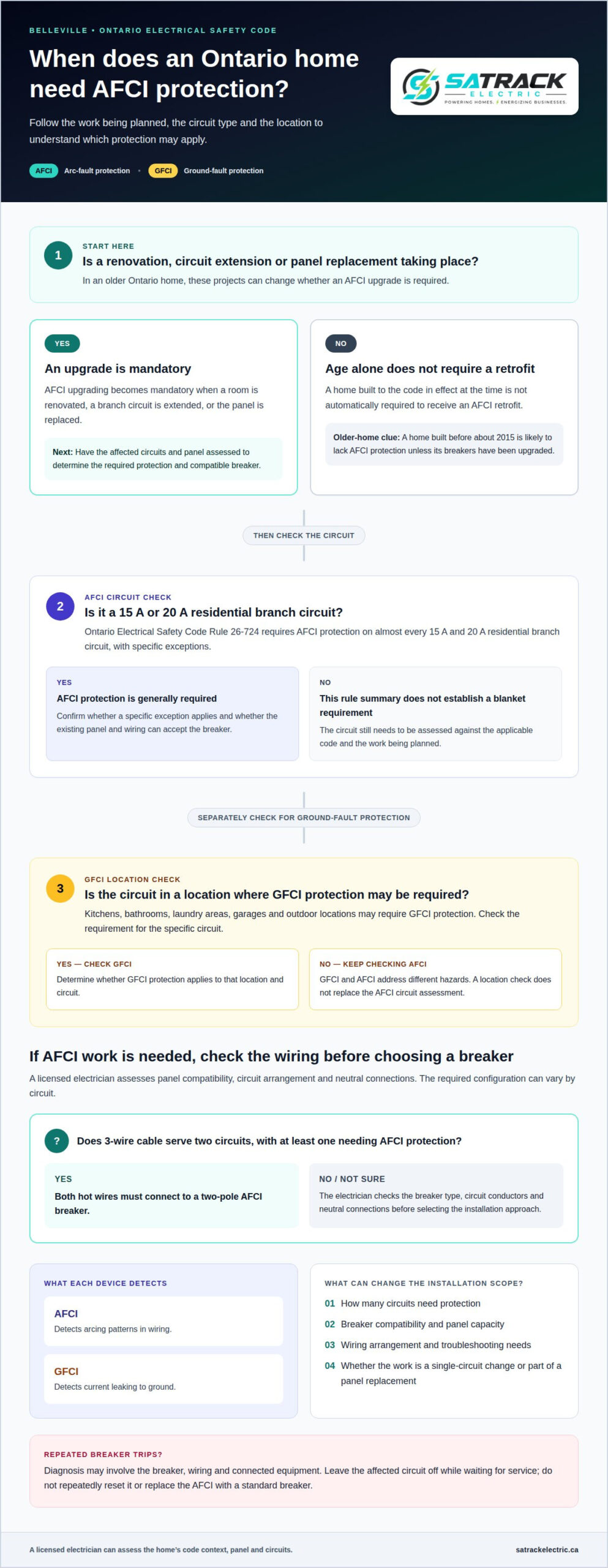
- Ontario Electrical Safety Code Rule 26-724 requires AFCI protection on almost every 15 A and 20 A residential branch circuit, with specific exceptions.
- AFCI protection detects arcing patterns in wiring, while GFCI protection responds to current leaking to ground; kitchens, bathrooms, laundry areas, garages and outdoor locations may require GFCI protection.
- In an older home, whether an AFCI retrofit is needed depends on the code that applied when it was built and whether renovation, circuit-extension or panel-replacement work is taking place.
- Installation costs depend on the scope of the work, including how many circuits need protection and whether the existing panel can accommodate the required breakers.
- Learn how ESA notification and inspection requirements relate to AFCI breaker work before planning an installation.
AFCI installation costs
The cost of AFCI work depends on the circuits involved, the electrical panel and any troubleshooting required. A quote for one 15 A branch circuit differs from work covering several applicable 15 A and 20 A circuits. In Belleville, the first cost decision is the scope: adding protection to a specific circuit or addressing multiple circuits during a larger electrical project.
The price depends on the case and is given after a quote request. Cost factors include the number of circuits, breaker compatibility, panel capacity, wiring arrangement and whether diagnosing a recurring trip adds work. For example, a project involving a panel replacement may have a different scope from an isolated breaker change in an existing panel.
A licensed electrician assesses the panel and circuit before selecting an AFCI breaker. Some circuit arrangements need particular attention: where 3-wire cable serves two circuits and at least one requires AFCI protection, both hot wires must connect to a two-pole AFCI breaker. That configuration can affect the work involved, so the quote should reflect the actual wiring rather than assume every circuit is alike.
Repeated tripping can change the scope. An electrician can assess the breaker, inspect the circuit and connected equipment, and determine whether the trip points to an arc fault or nuisance signals from a motor, vacuum or LED driver. While waiting for service, leave the affected circuit off and avoid repeatedly resetting the breaker or using equipment connected to it.
For diagnosis, the electrician considers when the breaker trips, what was operating, and whether the issue follows a particular device or continues with devices disconnected. This can help distinguish a circuit problem from interference associated with equipment. Don’t replace the AFCI with a standard breaker to stop repeated trips, as that removes the intended protection.
Installing an AFCI breaker without a licensed electrician risks electric shock, incorrect connections and a breaker that fails to provide the intended protection. Panel wiring and shared neutrals require careful assessment, as an incorrect installation can create additional electrical hazards.
- Single-circuit work: The quote reflects the breaker, panel compatibility and circuit wiring.
- Several circuits: The scope depends on which circuits require AFCI protection and their arrangement.
- Recurring trips: Diagnosis may involve the breaker, wiring and connected equipment, not just a replacement.
The project scope depends on more than the breaker itself. An electrician’s assessment identifies the work required for the specific panel and circuits, including whether troubleshooting or a broader upgrade is needed.
AFCI retrofits in older Ontario homes
In Belleville, an older home’s construction date and electrical history help determine whether an AFCI retrofit is needed. A panel assessment can also show whether the existing equipment can support the required protection.
Professional panel compatibility checks
A panel compatibility check assesses whether the existing panel and circuit wiring can accept an AFCI breaker. A licensed electrician examines the panel, breaker type, circuit arrangement and neutral connections before choosing an installation approach. The breaker must match the panel and connect correctly to its circuit. For example, shared circuit wiring may require a different breaker configuration from a single circuit.
Yes. A licensed electrician can assess the panel, identify its breaker type and review how the circuit conductors are arranged. Where 3-wire cable serves two circuits and at least one requires AFCI protection, both hot wires must connect to a two-pole AFCI breaker.
Age provides useful context, but it doesn’t settle the question by itself. An Ontario home built before about 2015 is likely to lack AFCI protection unless its breakers have been upgraded. The electrician can compare the existing installation with the work being planned and identify circuits that need attention.
What to expect during professional breaker installation or replacement
Professional installation involves assessing the circuit, fitting a compatible AFCI breaker and testing it afterward. Correct neutral connections and a functional breaker are central to the protection working as intended. The electrician also considers whether a recurring trip signals a circuit fault or nuisance signals from connected equipment.
For a new AFCI breaker, the factory-attached coiled neutral conductor connects to the neutral bus, while the circuit neutral connects to the breaker’s neutral lug. The circuit-cable neutral is stripped back 3/8 in. to 1/2 in. before termination. These connections are part of the electrician’s panel work, not a homeowner repair task.
After installation, the electrician tests the breaker, including its TEST button, even if it came straight out of the box. Pressing the button should switch the breaker off immediately. If it doesn’t, the breaker may be defective and should be replaced.
Retrofitting doesn’t automatically mean every original circuit must be altered. Ontario homes aren’t legally required to receive an AFCI retrofit if they were built to the code in effect at the time. However, an AFCI upgrade becomes mandatory when a room is renovated, a branch circuit is extended, or the panel is replaced.
ESA inspectors identified more than 1400 defects related to arc-fault protection of receptacles over the preceding year. That finding underscores why an electrician’s assessment should account for both the panel and the specific circuit work, rather than treating a breaker swap as a universal solution.
Ontario Electrical Safety Code AFCI requirements
Ontario Electrical Safety Code requirements depend on the circuit and its location. For a Belleville home, distinguishing AFCI protection from GFCI protection helps clarify which safety measure applies.
Rule 26-724 of the Ontario Electrical Safety Code requires AFCI protection on almost every 15 A and 20 A residential branch circuit. The rule applies to circuits, rather than simply requiring an AFCI breaker in every room. A professional assessment can identify which branch circuits fall within this requirement and account for applicable exceptions. That matters in homes with different wiring arrangements or electrical work completed over time.
One listed AFCI exception concerns receptacles within one metre of the kitchen sink. This is a location-specific exception, not a general exemption for every kitchen receptacle. Both the circuit and receptacle location matter when determining which protection applies. A kitchen may also need GFCI protection, since kitchens are among the locations listed for that protection under the Ontario Electrical Safety Code.
AFCI and GFCI protection address different electrical hazards. An AFCI detects arcing patterns in wiring; a GFCI detects current leaking to ground. The Ontario Electrical Safety Code lists kitchens, bathrooms, laundry areas, garages and outdoor locations where GFCI protection is required. A kitchen circuit may need a location-specific review of both AFCI and GFCI requirements, rather than an assumption that one device replaces the other.
Location alone doesn’t settle every circuit question. A bathroom receptacle is among the locations requiring GFCI protection, while the listed AFCI exception refers to receptacles within one metre of a kitchen sink. These examples show why the receptacle type and position, as well as the branch circuit, should be considered together. A room-wide assumption can miss a requirement tied to a particular receptacle or circuit.
A renovation, circuit extension or panel replacement can affect AFCI requirements. A receptacle moved during kitchen work, for example, may no longer qualify for the one-metre exception. The electrician assesses the planned work and circuit location before determining the required protection. Existing installations and new work may need different assessments.
For Belleville homeowners, a useful review focuses on three details: the residential branch circuit, its amperage and its location. The Ontario Electrical Safety Code’s Rule 26-724 identifies the broad AFCI requirement, while the kitchen-sink exception and GFCI location requirements add important distinctions. Keeping those details clear helps define the scope of electrical work without treating AFCI and GFCI as interchangeable protections.
Which licensed electricians install AFCI breakers in Belleville, Ontario?
Licensed electricians handle AFCI breaker installation as part of residential electrical work. In Belleville and surrounding communities, this means assessing the existing panel, identifying the circuit and completing the breaker installation or replacement. Adding protection to a bedroom circuit differs from addressing circuits during a broader electrical upgrade. The work must match the panel and wiring, rather than simply swapping one breaker for another.
The property and project help define the right scope. A house with one breaker that trips repeatedly needs an assessment focused on that circuit and its connected equipment. A larger home project may involve several circuits or a panel change. Commercial electrical work has different building needs, so the work should suit the property and planned installation.
For an older Belleville home, professional work starts with an assessment of the existing installation. The electrician reviews the panel and circuit arrangement, considers the planned work and identifies compatibility or wiring concerns. If a breaker trips repeatedly, the assessment can consider both the breaker and possible signals from connected devices. This helps distinguish a breaker replacement from the need for further circuit diagnosis.
- Panel assessment: The electrician identifies the panel and relevant breaker before choosing an installation approach.
- Circuit review: The electrician considers wiring arrangements, including circuits that share conductors.
- Installation or replacement: The electrician completes the breaker work and tests the AFCI afterward.
- Trip diagnosis: The electrician assesses whether repeated trips relate to a circuit fault or connected equipment.
These steps matter because the same symptom can have different causes. A breaker that trips when a vacuum runs, for example, may be responding to nuisance signals, while repeated trips can also indicate a genuine arc fault. A professional assessment considers the pattern and circuit instead of assuming the breaker alone needs replacing.
A clear description of the project helps define its scope. Note whether a breaker is being added or replaced, which room or circuit is involved, and whether renovations or panel work are planned. In Belleville, Trenton, Quinte West, Picton, Brighton, Greater Napanee and Cobourg, those details help focus the assessment on the relevant installation, rather than assuming a single-breaker job covers every circuit that may need attention.
Choose the work according to the property and electrical task: a home installation calls for residential electrical expertise, while a business project calls for commercial electrical work. In either setting, the assessment should account for the panel, circuit and intended protection. This defines the installation scope and helps identify when troubleshooting or broader electrical work is also needed.
Does AFCI breaker installation in Belleville require an ESA notification or inspection?
For an Ontario project, ESA notification and inspection should be considered in relation to the full scope of electrical work. The breaker alone doesn’t determine what the project requires. A single AFCI replacement, a branch-circuit extension and a panel replacement are different scopes, so the details matter.
Keep two questions distinct: which circuits need AFCI protection, and what notification or inspection applies to the work. Rule 26-724 of the Ontario Electrical Safety Code addresses AFCI protection on almost every 15 A and 20 A residential branch circuit. It doesn’t, by itself, answer the notification question for every possible installation. Treating those as separate decisions avoids assuming that a protection requirement automatically describes the project’s approval process.
The planned work can change the assessment. An AFCI upgrade becomes mandatory in Ontario when a room is renovated, a branch circuit is extended, or the panel is replaced. During larger residential or commercial remodels—such as projects coordinated by general contractors like Strother Built Construction—breaker replacements and circuit upgrades are integrated into the broader construction timeline rather than treated as isolated tasks. The work description should identify what is being altered, added or replaced.
Before work begins, establish the project details and how notification or inspection will be addressed. Relevant information includes:
- Project scope: State whether the work is a breaker replacement, circuit extension, room renovation or panel replacement.
- Existing installation: Identify the affected circuit and panel, including any recurring breaker trips.
- Protection requirements: Clarify which circuits need AFCI protection and whether another protection type applies.
- Project process: Confirm how ESA notification and inspection fit into the planned electrical work.
These details help distinguish an AFCI requirement from the administrative and inspection questions involved in a particular project. They also provide a clear basis for discussing the work before an electrician starts. If a renovation includes a kitchen receptacle or circuit extension, include the affected location and circuit in that discussion.
For homeowners, consider ESA notification and inspection when defining the complete project, rather than judging only by the breaker being installed. The exact work matters, especially when renovations, circuit extensions or panel replacement are involved. A defined scope keeps AFCI requirements and the project process connected without treating them as the same question.
Discuss AFCI installation requirements as part of planning the electrical work in your Belleville home.
Satrack Electric: Electrical Installations
Satrack Electric provides residential and commercial electrical installations, including AFCI breaker work, in Belleville, Trenton, Quinte West, Picton and surrounding communities. Turn to Satrack when a home circuit needs AFCI protection, a breaker requires replacement, or planned electrical work involves the panel. The work begins with an assessment of the panel and affected circuit, followed by determining the installation scope and next steps.
For a breaker that trips repeatedly, an electrical repair should assess the circuit and connected equipment rather than treating each trip as a simple replacement. Satrack Electric’s Residential Electrical Services support home projects, while its Commercial Electrical Services address electrical work in business settings. The right scope depends on the property and work required.
Contact Satrack Electric to discuss AFCI breaker installation for your property.
Plan the next step for your electrical project
Before arranging AFCI breaker installation in Belleville, make a clear note of the electrical work you’re planning. Include the affected room or circuit, any breaker that has tripped repeatedly, and whether renovations or panel work are part of the project. These details help frame the discussion around your home’s needs and the work involved.
A business property may need a different scope from a residence. A recurring trip may also require attention beyond replacing a breaker. Sharing the symptoms and planned changes gives the electrician useful context for assessing the installation or repair.
Satrack Electric provides residential and commercial electrical services, as well as electrical repairs. The appropriate next step is to discuss the property and the work you need, without assuming every project requires the same approach.
Contact Satrack Electric to discuss your project. A clear starting point can make it easier to plan safe, suitable electrical work.
Frequently Asked Questions
Where do you need to install an AFCI or GFCI protection?
AFCI protection applies to almost every 15 A and 20 A residential branch circuit under Ontario Electrical Safety Code Rule 26-724. GFCI protection is required in locations including kitchens, bathrooms, laundry areas, garages and outdoors. For example, a kitchen circuit may need both protections assessed because the devices address different hazards. Receptacles within one metre of a kitchen sink are listed as an AFCI exception.
Do you have to retrofit AFCI on an older Ontario home?
An older Ontario home doesn’t automatically need an AFCI retrofit if it was built to the code in effect at the time. The answer can change when electrical work is planned: AFCI upgrades become mandatory when a room is renovated, a branch circuit is extended or the panel is replaced. Adding a circuit during a room renovation, for example, can make AFCI requirements part of the project scope.
What is an arc fault breaker (AFCI) and why do I need it?
An AFCI breaker is designed to detect arcing patterns in wiring and provide arc-fault protection. Arcing can indicate a hazardous wiring condition, so this protection is intended to reduce the risk of electrical fires. It applies to residential branch circuits covered by Ontario requirements. An AFCI doesn’t replace GFCI protection, which addresses current leaking to ground rather than arcing.
What is an AFCI breaker and what does it protect against?
An AFCI breaker protects a circuit by detecting arcing patterns in its wiring. If a wiring fault produces an arc pattern, for instance, the AFCI is designed to detect it and interrupt power. This protection concerns the branch circuit, not just the device plugged into a receptacle. A GFCI serves a different purpose by detecting current leaking to ground.
Where are AFCI breakers required under the Ontario Electrical Safety Code?
Rule 26-724 requires AFCI protection on almost every 15 A and 20 A residential branch circuit. One listed exception concerns receptacles one metre from a kitchen sink. A special wiring arrangement also matters: when 3-wire cable serves two circuits and at least one requires AFCI protection, both hot wires must connect to a two-pole AFCI breaker. The circuit configuration helps determine the appropriate installation.
Does the 2024 Ontario Electrical Safety Code require AFCI protection for new or renovated homes?
Ontario’s AFCI requirement is set out in Rule 26-724, which covers almost every 15 A and 20 A residential branch circuit. For renovation work, an AFCI upgrade becomes mandatory when a room is renovated, a branch circuit is extended or the panel is replaced. For a new project, the relevant circuits and work scope determine how the requirement applies; the year alone doesn’t define the installation.
How much does AFCI breaker installation cost in Belleville, Ontario?
Pricing depends on the project and is provided after a quote request. The cost factors include how many circuits need AFCI protection, whether the existing panel can accept compatible breakers, and the circuit wiring arrangement. Troubleshooting a breaker that trips repeatedly may also affect the work involved. A single-circuit replacement and a project involving several circuits or panel work have different scopes.