
Imagine sitting down for dinner in your Belleville home when the kitchen lights flicker and a faint, metallic smell fills the air. It’s a moment of immediate concern that leads most homeowners to wonder if they’re looking at a simple fix or a serious fire hazard. You likely realize that electrical problems are more than just an inconvenience. They represent a safety risk that can feel overwhelming, especially when you consider the strict requirements of the 2024 Ontario Electrical Safety Code (OESC).
We understand the frustration of unexpected power loss and the desire to keep your family safe without facing spiralling repair costs. This guide focuses on professional Electrical Troubleshooting methods to help you identify, diagnose, and safely address common household issues. By following these structured steps, you can gain a clear understanding of your home’s electrical health. We will explore how to restore power and ensure your system remains a reliable centre of comfort that fully meets current ESA standards.
Key Takeaways
- Understand the methodical process of Electrical Troubleshooting to identify faults before they escalate into fire hazards or damage sensitive appliances.
- Learn to distinguish between minor inconveniences and critical warning signs, such as frequent breaker trips or flickering lights caused by loose connections.
- Master a professional diagnostic sequence that begins with thorough information gathering and a safe visual inspection of your home’s electrical components.
- Recognize the specific challenges of residential systems, including the unique requirements for specialized installations like hot tub and spa wiring.
- Establish a clear “Red Line” for DIY repairs to maintain safety and ensure your work remains compliant with Ontario home insurance policies.
What is Electrical Troubleshooting and Why Does it Matter?
What is Electrical Troubleshooting is a methodical, step-by-step process used to identify, locate, and correct faults within an electrical circuit. Instead of replacing components at random, this disciplined approach relies on evidence and testing to find the root cause of a failure. In your Belleville home, this ensures that the underlying issue is resolved rather than just masking the symptoms. It’s the difference between a permanent fix and a recurring headache that could eventually lead to a dangerous situation.
Safety remains the primary reason this process is so vital. Faulty wiring stands as a leading cause of residential fires in Ontario. Beyond immediate physical danger, professional Electrical Troubleshooting protects your investment in expensive appliances and sensitive electronics. It also ensures your property remains compliant with the 2024 Ontario Electrical Safety Code (OESC), which came into effect on May 1, 2025. The Electrical Safety Authority (ESA) oversees these regulations to maintain a high safety standard across the province, and failing to meet them can result in insurance complications or legal liabilities.
A systematic approach beats “guessing and checking” every time. Randomly flipping breakers or swapping out outlets without a plan is inefficient and potentially hazardous. By following a logical sequence, you reduce the time your home spends without power and avoid the hidden costs of unnecessary repairs. This organized workflow is what separates a seasoned professional from an amateur, providing you with the confidence that your home’s electrical system is stable and secure.
The Core Principles of Electrical Logic
To understand why a system fails, you must first understand how it functions. Every circuit relies on a continuous loop consisting of a Source (the panel), a Path (the wiring), a Load (the appliance), and a Return (the neutral wire). Professionals use a “Divide and Conquer” strategy to isolate specific sections of this loop, quickly narrowing down the location of a break. A fault is defined as any deviation from intended circuit behaviour. This logical progression eliminates guesswork and ensures every repair is based on verified data.
Safety First: The Ontario Standard
Before any diagnostic work begins, you must establish strict safety protocols. This includes wearing proper Personal Protective Equipment (PPE) such as safety glasses and using insulated tools and reliable voltage testers. A critical concept is the “Lockout/Tagout” principle, which involves physically securing a breaker in the “off” position so no one accidentally re-energizes the circuit during an inspection. You should recognize that certain “glitches,” like a persistent burning smell or a warm panel cover, are immediate emergencies that require a licensed contractor rather than a DIY attempt.
Common Electrical Warning Signs in Ontario Properties
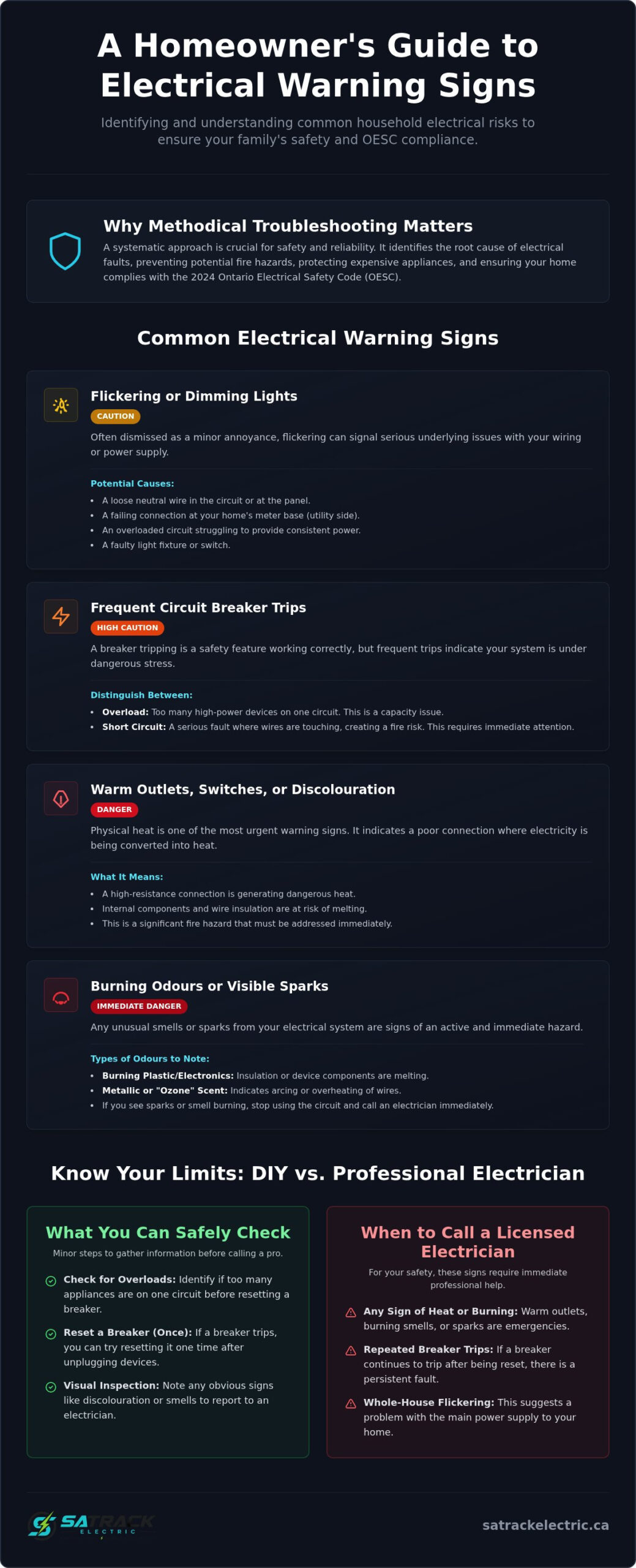
Identifying potential hazards before they escalate is the most effective way to maintain a safe home. Many homeowners overlook minor issues, but recognizing Common Electrical Warning Signs early can prevent costly repairs or dangerous fires. Flickering lights, for instance, are often dismissed as a quirk of an older house. In reality, they frequently signal a loose neutral wire or a problem on the utility side, such as a failing connection at your meter base. If the flickering is localized to one room, it’s likely a circuit issue; if it affects the whole house, it’s a sign that the incoming power supply needs a professional diagnostic check.
Frequent breaker trips are another indicator that your system is under stress. It’s helpful to distinguish between an overloaded circuit, where too many devices are drawing power at once, and a short circuit, which indicates a more serious fault in the wiring. While a tripped breaker is a safety feature designed to protect your home, it shouldn’t be ignored. Repeatedly resetting a breaker without performing Electrical Troubleshooting to find the root cause can lead to permanent damage to your home’s electrical infrastructure.
Physical heat is perhaps the most urgent warning sign. If an outlet or switch feels warm to the touch, it typically points to a high-resistance connection where electricity is struggling to flow. This generates heat that can eventually melt plastic components and wire insulation. If you notice a faint “ozone” scent or a smell similar to burning electronics, you’re likely smelling the early stages of an electrical fire. At this point, you should stop using the circuit immediately and seek professional assistance.
Symptoms vs. Root Causes
A tripped breaker is a symptom, not the problem itself. It acts as a vital safety mechanism that interrupts the flow of electricity when it detects a fault. In the Quinte region, our seasonal weather patterns can directly impact your home’s exterior systems. High humidity and heavy storms often lead to moisture ingress in outdoor fixtures, causing “nuisance trips” that are difficult to pin down without a systematic approach. Understanding these environmental factors is a key part of effective Electrical Troubleshooting in our local climate.
The Danger of Older Wiring Systems
Many properties in Belleville still rely on older electrical standards that aren’t equipped for modern power demands. This is especially true for homes that might require aluminum wiring replacement Belleville. Aluminum connections can become brittle and expand over time, leading to loose joints and potential fire risks. Older fuse boxes also lack the Arc-Fault Circuit Interrupter (AFCI) protection now required by the 2024 OESC for most living areas. If your system is struggling to keep up with modern appliances or an EV charger, a professional electrical maintenance review is a logical next step to ensure your home remains compliant and safe.
The Professional Troubleshooting Process: Step-by-Step
Approaching a circuit failure requires a disciplined sequence of actions. Professionals don’t simply guess where a problem lies; they use a logical framework to narrow down possibilities. The first step involves thorough information gathering. Ask yourself what was happening the moment the failure occurred. Was a heavy appliance like a vacuum running? Did the lights flicker when a specific switch was flipped? These details provide the initial clues needed for effective Electrical Troubleshooting.
Once you’ve gathered the facts, move to a visual inspection. Look for obvious signs of heat damage, such as discoloured outlet covers or charred terminal screws. Check for moisture near outdoor fixtures or in basements. If the visual check doesn’t reveal the culprit, proceed to circuit isolation. This means unplugging every device on the affected circuit. Often, the “electrical fault” isn’t in your walls at all, but rather a short circuit within a faulty toaster or lamp cord. Only after isolating the wiring can you move to testing and measurement with specialized tools. Finally, once a repair is made, verification is essential to ensure the fix meets current safety standards and won’t recur.
Using the Right Tools for the Job
Safety and accuracy depend heavily on the quality of your equipment. Non-contact voltage testers serve as a reliable first line of defence, allowing you to check for live wires without making physical contact. For deeper analysis, multimeters are necessary to measure voltage levels, continuity, and resistance. While consumer-grade tools are widely available, professional models provide more consistent data and better protection against high-voltage spikes. Knowing When to Call a Licensed Electrician is vital if your initial tests suggest a complex internal fault that requires more than basic diagnostic tools.
The “Divide and Conquer” Method
To locate a fault efficiently, professionals use the “Divide and Conquer” method. Instead of checking every single outlet in a line, start at the midpoint of the circuit. If you have power at the middle outlet, the problem is further down the line; if you don’t, the fault is between the midpoint and the source. This logical split allows you to find the issue twice as fast. This process helps determine if the failure originates within the electrical panel or if it’s restricted to a specific branch circuit. By narrowing the search area, you reduce the risk of invasive and unnecessary repairs to your home’s infrastructure.
Commercial vs. Residential Troubleshooting: Key Differences
While the fundamental laws of physics remain constant, the application of Electrical Troubleshooting differs significantly between a family home and a business facility. Residential systems are primarily designed for safety and personal comfort, focusing on single-phase power that feeds lighting, kitchen appliances, and climate control. In contrast, commercial environments often utilize three-phase power to handle much higher electrical loads. These systems require a different diagnostic mindset because a failure doesn’t just cause an inconvenience; it can halt production, compromise data security, or result in significant financial loss due to downtime.
Ontario’s regulatory landscape also treats these settings differently. Commercial facilities face more frequent inspection triggers and stricter requirements for equipment maintenance under the OESC. Whether you are managing a retail space in downtown Belleville or maintaining a suburban home, understanding these distinctions ensures that the diagnostic process is tailored to the specific demands of the infrastructure.
Troubleshooting in Commercial Facilities
Diagnosing issues during commercial electrical upgrades requires specialized knowledge of complex components like motor controls and high-output lighting ballasts. A common commercial fault involves phase loss, where one of the three incoming power lines fails, potentially damaging expensive machinery. High-amp breakers also require precise testing to ensure they trip only under genuine fault conditions. Implementing a schedule for preventative electrical maintenance is the most effective way for business owners to identify these issues before they lead to an emergency shutdown.
Residential Specifics and Home Comfort
In a residential setting, the focus shifts to dedicated circuits for high-draw items like generators or specialized hot tub wiring. Homeowners in the Quinte West area often experience unique challenges related to moisture ingress in outdoor patio wiring, which causes GFCIs to trip unexpectedly. Effective Electrical Troubleshooting in these cases often reveals that the home’s existing system is simply overextended. As families add more technology and high-powered appliances, the diagnostic process frequently highlights the need for a panel capacity upgrade to maintain long-term safety and reliability. If you suspect your home’s system is struggling to keep up with your needs, contact our team for professional residential electrical services today.
When to Call a Licensed Electrician in Belleville
While basic diagnostic steps can help you understand a problem, there is a clear “Red Line” where personal efforts must stop for safety reasons. If your Electrical Troubleshooting requires you to open the main service panel, remove the dead front cover, or work near a live bus bar, it’s time to contact a professional. These components carry high-voltage current that can be fatal if handled without specialized training and equipment. Recognizing this boundary isn’t just about safety; it’s about ensuring your home remains a stable and secure environment for your family.
The legal and financial implications of DIY electrical work in Ontario are significant. Under the Ontario College of Trades and Apprenticeship Act, it’s illegal for unlicensed individuals to perform electrical work for hire. Furthermore, most Ontario home insurance policies require that any electrical modifications or repairs be completed by a Licensed Electrical Contractor (LEC) with a filed permit. Performing your own repairs or hiring an unlicensed “handyman” could void your coverage, leaving you personally liable for damages in the event of a fire. Obtaining an ESA Certificate of Inspection provides the necessary proof that your system meets the 2024 OESC standards, offering essential peace of mind and protecting your property’s value.
The Risks of “Handyman” Electrical Repairs
Hiring an unlicensed worker might seem like a cost-saving measure, but it often leads to higher expenses later. Unlicensed individuals frequently overlook hidden faults, such as improper grounding or undersized neutral wires, which can cause long-term damage to your electronics. Professional Electrical Troubleshooting identifies the root cause of a failure rather than just treating the symptoms. By fixing the issue correctly the first time, you avoid the cycle of recurring faults and the danger of “blind” repairs that don’t address underlying safety hazards.
Our Local Service Commitment
Satrack Electric is deeply rooted in the Quinte region, providing licensed and insured services to homeowners in Belleville, Trenton, Picton, and the Greater Napanee area. We understand the unique needs of local housing stock, whether you’re maintaining a historic residence in Picton or a modern development in Brighton. Our team prioritizes clear, professional communication and transparent workmanship on every project. We’re committed to delivering results that aren’t just functional, but fully compliant with all provincial safety regulations. When you need a dependable partner to restore your home’s power and safety, we’re here to provide the steady, expert service you expect from a local authority.
Ensuring Long-Term Electrical Safety in Your Home
Maintaining a safe and efficient home requires a proactive approach to electrical health. By understanding the methodical nature of Electrical Troubleshooting, you can distinguish between minor inconveniences and critical safety risks before they escalate. A logical diagnostic process, combined with strict adherence to the 2024 Ontario Electrical Safety Code, remains the most effective way to protect your property and your family’s peace of mind. Whether you’re dealing with flickering lights or a frequently tripping breaker, identifying the root cause ensures that your repairs are permanent rather than temporary fixes.
When a fault goes beyond a simple reset or if you encounter a complex issue within your system, professional intervention is the most reliable path forward. Book a Professional Troubleshooting Session with Satrack Electric Today. As an ECRA/ESA Licensed Contractor that is fully insured for your protection, we’ve been serving the Quinte region for years with dependable, high-quality workmanship. Restoring the reliability of your electrical system doesn’t have to be a source of stress when you have a seasoned local expert on your side.
Frequently Asked Questions
Why does my circuit breaker keep tripping even when I unplug everything?
A breaker that trips with no devices plugged in usually indicates a “hard fault,” such as a short circuit within the permanent wiring. This happens when a hot wire makes direct contact with a neutral or ground wire inside a wall box or the panel. It could also suggest that the breaker itself has failed internally and can no longer hold its rated load. Professional Electrical Troubleshooting is necessary in these cases to test the insulation resistance and identify the exact location of the fault.
Is it safe to reset a breaker more than once if it trips again immediately?
No, you should never reset a breaker that trips again immediately after the first attempt. This persistent tripping is a clear sign that a dangerous fault still exists on the circuit. Forcing the breaker to reset can cause a massive spike in heat, potentially damaging the breaker’s internal mechanism or starting an electrical fire. If the breaker won’t stay in the “on” position, leave it off and contact a licensed professional to diagnose the underlying cause.
What causes lights to flicker when a large appliance like an AC turns on?
Lights flickering when a large motor starts is typically caused by a sudden voltage drop known as “inrush current.” While a very brief, minor dimming can be normal in older homes, persistent or severe flickering often points to undersized branch wiring or a loose connection at the main bus bar. In some cases, the issue originates with the utility transformer or the service entrance wires. A professional assessment can determine if your home needs a dedicated circuit or a service upgrade to handle these modern loads.
How can I tell if an outlet is “dead” or if the problem is elsewhere in the house?
You can identify a dead outlet by using a non-contact voltage tester or a multimeter to check for the presence of electricity at the receptacle. If the outlet has no power but the breaker is on, the problem is likely a loose wire at that specific box or a tripped GFCI outlet located “upstream” on the same circuit. Check all GFCI reset buttons in your kitchen, bathrooms, and garage, as these often protect multiple standard outlets throughout the house.
Do I need a permit from the ESA for simple electrical troubleshooting?
You do not need an ESA permit for basic diagnostic work or Electrical Troubleshooting to find the source of a problem. However, if the investigation reveals that a repair or replacement is needed, such as installing a new circuit or replacing a panel, a permit is mandatory. All such work must be performed by a Licensed Electrical Contractor who will file the necessary paperwork and ensure the final repair meets the 2024 Ontario Electrical Safety Code.
What is a “loose neutral” and why is it considered a major electrical hazard?
A loose neutral occurs when the return path for electricity is broken or has a poor connection. This is a severe hazard because it causes voltage imbalances, where some 120-volt circuits may suddenly receive nearly 240 volts while others receive very little. This imbalance can instantly destroy sensitive electronics and creates a high risk of fire due to arcing at the loose connection point. If you notice lights getting much brighter or dimmer simultaneously, it’s a sign of a neutral issue that requires immediate attention.
Can I troubleshoot my own aluminum wiring if I use the right connectors?
Troubleshooting aluminum wiring is a high-risk task that should be left to licensed experts. While specialized connectors like AlumiConn are available, they must be installed with precise torque settings to prevent the aluminum from expanding and causing a fire. Most insurance companies in Ontario require a certificate from a licensed contractor or the ESA to maintain coverage for homes with aluminum wiring. Amateur repairs can lead to oxidation and overheating, which are the primary causes of electrical failures in these older systems.
How much does a professional electrical troubleshooting session typically cost in Ontario?
The cost for a professional diagnostic session varies depending on the complexity of the fault and the time required to isolate the issue. Simple faults might be found quickly, while intermittent problems or complex commercial circuits require more extensive testing with specialized equipment. Since every home’s infrastructure is unique, it’s best to consult a licensed contractor for an assessment. This ensures you receive a thorough diagnosis that prioritizes safety and complies with all provincial regulations.