
What if the rhythmic blinking in your kitchen isn’t just a sign of an old bulb, but a warning signal from your home’s electrical system? For many homeowners in Quinte West, understanding the Common Causes of Flickering Lights and How to Fix Them is about more than stopping a minor annoyance; it’s about addressing the underlying anxiety of potential fire risks. You’ve likely felt the frustration of trying to relax while a lamp fluctuates or wondered if technical terms like “voltage drops” indicate a serious problem. It’s normal to feel unsettled when your home’s essentials seem unreliable.
Our expert guide will help you distinguish between a simple bulb replacement and a genuine safety hazard. We’ll provide a practical checklist of what you can safely inspect yourself and clarify complex issues like arcing without using confusing jargon. By the end of this article, you’ll have a clear understanding of your home’s electrical health. You’ll gain the confidence to know exactly when a situation is a minor fix and when it requires a licensed professional to ensure your property meets the 2024 Ontario Electrical Safety Code standards.
Key Takeaways
- Learn how to categorize light fluctuations into single-fixture, circuit-specific, or whole-home patterns to accurately narrow down the source of the problem.
- Identify the Common Causes of Flickering Lights and How to Fix Them, beginning with simple checks for bulb compatibility and loose socket connections.
- Understand the critical difference between a minor annoyance and a serious fire hazard caused by voltage drops or loose wiring within your electrical panel.
- Recognize when external factors, such as local Hydro grid fluctuations or severe Ontario weather, are affecting your home’s electrical stability.
- Gain insight into the methodical diagnostic process used by licensed professionals, including the use of thermal imaging to detect hidden electrical risks.
Understanding Flickering Lights: When to Worry and When to Wait
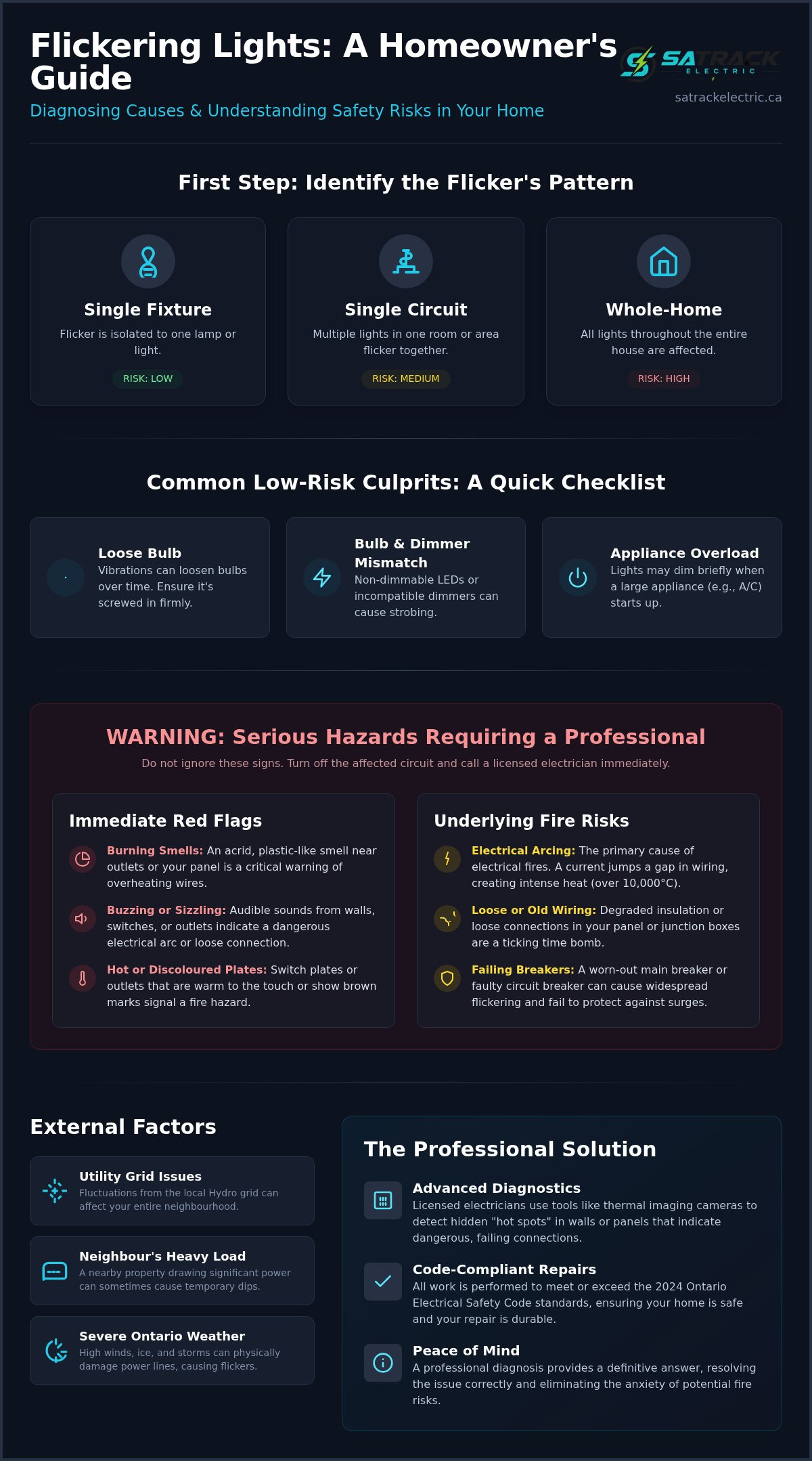
A flickering light is rarely just a random occurrence; it’s a signal from your home’s electrical system. To accurately assess the Common Causes of Flickering Lights and How to Fix Them, you must first define the behaviour. What is light flicker? Technically, it is any visible fluctuation in light output or colour consistency. Identifying whether the issue is isolated or widespread determines your next steps and the level of urgency required.
We categorize these fluctuations into three distinct levels of concern:
- Single Fixture: The flicker is limited to one specific lamp or light fixture. This is usually a local issue with the bulb or the fixture’s internal wiring.
- Single Circuit: Multiple lights in one room or area flicker simultaneously. This indicates a potential problem at the circuit breaker or a loose connection in a junction box.
- Whole-Home: Every light in the house fluctuates. This is a serious symptom that often points to a failing main breaker or an issue with the utility provider’s service line.
While some issues are minor, others require an immediate shift away from the DIY mindset. You should seek professional consultation if you notice these red flags:
- Acrid burning smells near switches, outlets, or the electrical panel.
- Audible buzzing, sizzling, or popping sounds coming from the walls.
- Wall plates that feel warm to the touch or show visible brown discolouration.
Identifying the Pattern of the Flicker
Observation is your best diagnostic tool. Determine if the flickering is constant or if it triggers only when a large appliance, like an air conditioner or clothes dryer, begins its cycle. If the lights dim momentarily when a heavy motor starts, you’re likely seeing a voltage drop. Constant, rhythmic flickering might suggest a mechanical fault in a specific device, whereas irregular, sporadic blinking often points to loose components. Identifying these patterns helps a licensed electrician pinpoint the fault quickly during a safety inspection.
The Difference Between a Nuisance and a Hazard
It’s vital to separate simple annoyances from genuine threats. A nuisance flicker often stems from using incompatible LED bulbs with older dimmer switches designed for incandescent loads. However, hazardous flickers are much more serious. They often result from loose wiring or overloaded neutral wires that can lead to arcing. Electrical arcing occurs when a current jumps across a gap in a circuit, creating intense heat and acting as a primary cause of residential fires. Because of these risks, the Ontario Electrical Safety Code mandates specific protections, and homeowners should never attempt to modify or repair the main electrical panel themselves.
Common Low-Risk Culprits: Bulbs, Sockets, and Dimmer Switches
When you begin investigating the Common Causes of Flickering Lights and How to Fix Them, it’s logical to start with the most accessible components. Often, a flicker is a simple mechanical issue rather than a systemic failure. The first step is to ensure the bulb is seated firmly in its socket. Over time, the vibration of the house or subtle shifts in the fixture can cause a bulb to back out just enough to break the electrical connection. Simply tightening the bulb often resolves the issue immediately.
The type of bulb you use matters significantly in modern homes. While incandescent bulbs are less sensitive to minor power fluctuations, modern LEDs are essentially small electronic devices. Low-quality LED bulbs often lack the robust circuitry needed to filter out minor voltage ripples in your home’s power supply. This results in visible flickering that wouldn’t occur with a higher-grade bulb. As noted by the U.S. Consumer Product Safety Commission on electrical hazards, staying vigilant about these small signs is a key part of maintaining a safe living environment.
Incompatible LED Bulbs and Dimmer Switches
Traditional dimmer switches operate by rapidly cutting off the power to the bulb to reduce its brightness. While this works for incandescent filaments, it often confuses the drivers inside modern LEDs. If the dimmer isn’t specifically rated for LED loads, such as CL or ELV dimmers, you might experience “ghosting” or a rhythmic “strobing” effect. Ensuring your bulbs are marked as “dimmable” and matched with a compatible switch is a fundamental part of routine electrical maintenance in any Quinte West residence.
Loose Bulbs and Faulty Fixture Sockets
In many older Ontario homes, fixture sockets undergo decades of heat expansion and contraction. This physical stress can cause the metal tab at the base of the socket to flatten or lose its spring tension. When this happens, the connection becomes intermittent, leading to a flicker that seems to happen at random. If you notice a flicker that persists even after tightening a new, high-quality bulb, the socket itself may be worn out or corroded. For your safety, always turn off the power at the wall switch before inspecting a socket tab to avoid accidental contact with live components.
Serious Electrical Hazards: Overloaded Circuits and Loose Wiring
Beyond simple bulb swaps, identifying the Common Causes of Flickering Lights and How to Fix Them often requires looking deep into your home’s infrastructure. When fluctuations aren’t isolated to a single lamp, you’re likely dealing with a systemic issue like an overloaded circuit or compromised wiring. These aren’t just inconveniences; they represent significant fire hazards. If you ever hear a distinct popping or sizzling sound accompanying the flicker, treat it as a critical emergency. This sound indicates active arcing, where electricity is jumping across a gap, creating temperatures high enough to ignite surrounding materials. In such cases, immediate professional electrical repairs in Belleville are necessary to secure the property and prevent structural damage.
Large Appliances Causing Voltage Drops
It’s common to see lights dim briefly when a high-draw appliance, such as a refrigerator or a central heat pump, cycles on. This happens because these motors require a large initial burst of current, causing a temporary “voltage drop” in the circuit. If the dimming lasts more than a second or is accompanied by a significant flicker, your system may be struggling to keep up with the demand. Modern electrical standards require dedicated circuits for these heavy loads to prevent interference with lighting and other sensitive devices. If the flicker is new or worsening, it could indicate a failing start capacitor or a motor that is drawing more current than it should, putting undue stress on your home’s wiring.
Arcing and Loose Connections in the Panel
The most dangerous flickering often originates at the main electrical panel or within hidden junction boxes. A loose “neutral” wire is particularly problematic because it can cause voltage fluctuations across multiple circuits simultaneously, potentially damaging electronics throughout the house. This is a frequent concern in older neighbourhoods around Quinte West where original installations may have settled or loosened over decades. Many homes in our region also still contain aluminum wiring. Because aluminum expands and contracts more than copper, connections can become loose over time, leading to overheating and arcing. If your home was built between the mid-1960s and late 1970s, you should consider specialized aluminum wiring replacement services to ensure your connections remain stable and safe. Ignoring these signs can lead to total circuit failure or, in the worst cases, an electrical fire.
External Factors: Grid Fluctuations and Neighbourhood Issues
Not all electrical issues originate behind your own walls. when investigating the Common Causes of Flickering Lights and How to Fix Them, it’s essential to look outside at the local infrastructure. If you notice lights flickering throughout your entire home, the first step is to check if your neighbours are experiencing the same phenomenon. If the streetlights or the houses next door are also dimming, the problem likely lies with the local Hydro grid or a shared transformer. In these instances, the solution is beyond your control and requires intervention from your utility provider rather than a private contractor.
Severe Weather and Hydro Grid Problems
Ontario’s climate presents unique challenges to electrical stability. High winds can cause overhead lines to sway, leading to intermittent contact or clashing that manifests as rapid flickering in nearby homes. During winter months, heavy ice buildup on the service mast or the service drop, which are the wires running from the utility pole to your house, can cause lines to sag or pull at the connections. These environmental stressors often lead to voltage surges or dips. if you suspect weather-related damage to the utility lines, you should report the issue to your local utility provider immediately, as these lines carry high voltage and are extremely dangerous to approach.
Shared Transformers and Heavy Local Demand
Many homes in a Quinte West neighbourhood often share a single transformer. If a neighbour is using high-draw equipment, such as a large welder or a powerful electric vehicle charging setup on an older grid, it can cause momentary voltage drops for everyone on that branch. This is especially common in growing areas where the existing infrastructure may be pushed to its limits. While a brief flicker when a neighbour’s heavy equipment starts up might be a minor nuisance, persistent fluctuations could indicate an aging transformer that’s failing to regulate voltage properly. If your home is the only one affected on the street, the issue is likely a loose connection at your specific service mast.
Identifying the source of the flicker is a process of elimination. If you’ve confirmed that the grid is stable and your neighbours have clear power, the issue is likely localized to your property’s service entrance or internal panel. For a definitive assessment of your home’s connection to the grid, book a safety inspection with our team to ensure your service mast and main breaker are functioning correctly and safely.
Professional Diagnosis: How Licensed Electricians Resolve Flickering
When the basic troubleshooting steps of tightening bulbs or checking neighbour’s lights fail to resolve the issue, a professional diagnostic approach is required. A licensed electrician treats flickering as a symptom of a larger systemic condition rather than an isolated event. Understanding the Common Causes of Flickering Lights and How to Fix Them involves moving beyond guesswork to precision measurement. Our team uses digital multimeters to measure voltage consistency at the point of use and compares it to the reading at the main service entrance. This methodical comparison allows us to identify exactly where resistance is occurring in the circuit, whether it’s a failing outlet or a loose busbar connection.
We also utilize advanced thermal imaging technology to detect hidden risks. Thermal cameras allow us to see through wall finishes and into the electrical panel to identify “hot spots” that are invisible to the naked eye. These hot spots indicate where loose connections are generating dangerous levels of heat due to high resistance. Identifying these areas early is a vital part of our commitment to safety and code compliance, as it allows us to rectify fire hazards before they escalate into structural damage.
Comprehensive Electrical Troubleshooting in Belleville
Our troubleshooting process follows a logical path from the affected fixture back to the main breaker. We don’t just fix the flicker; we verify the integrity of the entire circuit. This includes testing for proper grounding and bonding throughout the system to ensure that any fault current has a safe path to the earth. Once the inspection is complete, we provide a detailed report of our findings. This transparency ensures you understand the state of your home’s electrical health and the specific recommended repairs needed to bring the system up to modern standards.
Upgrading Your System for Modern Demands
Many homes in the Quinte region were originally designed with 60-amp or 100-amp services, which are often inadequate for modern lifestyles. The addition of electric vehicle chargers, heat pumps, and high-draw kitchen appliances can easily overwhelm an aging system, leading to persistent flickering and tripped breakers. In these cases, a professional electrical panel upgrade to a 200-amp service is often the most reliable solution. This upgrade provides the necessary headroom for your electronics and allows for the installation of Arc-Fault Circuit Interrupter (AFCI) breakers. These devices are a requirement under the 2024 Ontario Electrical Safety Code for most living areas, as they can detect the specific electrical signature of arcing and shut down the circuit before a fire starts. To ensure your home is both stable and safe, Contact Satrack Electric for a safety inspection today and let our experienced team provide a permanent solution to your electrical concerns.
Securing Your Home’s Electrical Stability
Understanding the Common Causes of Flickering Lights and How to Fix Them is the first step toward a safer household. You now know that while a loose bulb is a simple fix, persistent fluctuations often signal deeper issues like overloaded circuits or compromised wiring. These symptoms shouldn’t be ignored, especially when they involve the complex standards of the 2024 Ontario Electrical Safety Code. Maintaining a stable system requires more than just a quick swap; it requires a thorough understanding of how your home interacts with modern electrical demands.
Whether you’re dealing with incompatible LED dimmers or the aftermath of severe Ontario weather on your service mast, a methodical approach ensures your family’s peace of mind. As licensed and insured Ontario contractors serving Belleville, Trenton, and Quinte West, we prioritize a safety-first diagnostic process to identify hidden hot spots before they become emergencies. Our expertise in panel upgrades and repairs provides the reliability your modern electronics require.
Don’t let electrical uncertainty create unnecessary anxiety in your home. Book a Professional Electrical Inspection with Satrack Electric today to ensure your system is reliable and up to code. We’re here to help you maintain a bright and secure environment for years to come.
Frequently Asked Questions
Is it normal for lights to flicker when the air conditioner turns on?
Yes, a brief dimming is common when a large motor starts, but persistent flickering indicates an issue. High-draw appliances like air conditioners require a significant initial current, causing a temporary voltage drop. If the flicker lasts more than a second, your system may need a dedicated circuit. This is a frequent concern in older neighbourhoods where the existing electrical capacity struggles to meet modern cooling demands in the Quinte region.
Can a flickering light bulb cause a fire if left unattended?
A single loose bulb is rarely a fire hazard, but flickering caused by internal wiring issues is a serious risk. If the flickering stems from arcing or loose connections in a fixture, the resulting heat can ignite nearby materials. You should address any fluctuation that persists after a bulb change, as these are often precursors to electrical malfunctions. Statistics show that faulty wiring is a leading cause of residential fires across Canada.
Why do my LED lights flicker even when the switch is turned off?
This phenomenon usually occurs due to small amounts of residual current in the circuit or ghosting from smart switches. Some LED drivers are sensitive enough to illuminate with very low voltage that wouldn’t affect an incandescent bulb. It can also indicate a neutral wire issue or electromagnetic interference from parallel wires. While often a nuisance, a professional inspection ensures your grounding and bonding meet current Ontario Electrical Safety Code standards for home safety.
Does flickering in the whole house mean I need a new electrical panel?
Whole-home flickering often suggests a problem with the main service entrance or the utility grid, but a panel upgrade is frequently the solution. If your home still operates on a 60-amp or 100-amp service, it may be overloaded by modern appliances. Upgrading to a 200-amp panel provides the necessary headroom and allows for modern safety features like AFCI breakers, which are essential for preventing fires in older properties in Belleville.
How much does it typically cost to fix flickering lights in Ontario?
Repair costs vary significantly based on the root cause, ranging from simple component replacements to full system upgrades. Factors include the complexity of the diagnostic process, the cost of parts, and required ESA permit fees. While we cannot provide specific pricing here, investing in a licensed professional ensures the work complies with legal requirements. Addressing Common Causes of Flickering Lights and How to Fix Them early prevents much more expensive damage later.
What should I do if my lights flicker during a windstorm?
If flickering occurs during high winds, the issue is likely external and involves the service drop or local Hydro lines. Wind can cause overhead wires to sway or come into contact with tree branches, leading to intermittent power fluctuations. You should contact your local utility provider to inspect the lines running to your house. Avoid approaching any downed wires or the service mast, as these components carry dangerous levels of high-voltage electricity in storm conditions.
Are flickering lights a sign of a loose neutral wire?
Yes, a loose neutral wire is one of the more dangerous causes of flickering throughout a home. The neutral wire completes the circuit and balances the load; if it’s loose, voltage can fluctuate wildly, potentially damaging sensitive electronics. This condition often requires a methodical diagnostic approach using a multimeter at the panel. If you suspect a neutral issue, it’s vital to have a licensed professional secure the connections immediately to prevent equipment failure or fire.
Can I fix flickering lights myself or do I need a licensed electrician?
You can safely perform basic checks like tightening a bulb or testing a different lamp, but most repairs require a professional. In Ontario, it’s a legal requirement for a Licensed Electrical Contractor to perform work for hire. Attempting to modify your panel or internal wiring yourself can void your home insurance and create significant safety risks. A professional ensures that all Common Causes of Flickering Lights and How to Fix Them are addressed safely according to provincial regulations.