
Did you realize that the most stylish fixture in the showroom could become a safety hazard if it isn’t matched to the right electrical support? While many homeowners focus on blade colour or light kits, learning how to choose the right ceiling fan for your home is actually an electrical safety decision first and a decor choice second. You want a solution that lowers your electricity bills during a humid Quinte summer without the frustration of a wobbling, noisy motor.
We understand that the technical side of home upgrades can feel overwhelming, especially with new 2026 standards for smart home connectivity and motor efficiency. This article provides a clear path to selecting a fan that balances modern style with professional performance. You’ll discover how to identify energy-efficient DC motors that use up to 70% less electricity and learn why the latest 2026 National Electrical Code updates make fan-rated outlet boxes a mandatory safety requirement for your living spaces. From sizing your room to ensuring a secure installation, we’ll help you find a quiet, reliable fixture that enhances your comfort for years to come.
Key Takeaways
- Match the blade span to your room’s square footage to ensure efficient air circulation and consistent comfort.
- Select a Direct Current (DC) motor to realize significant energy savings, as these models use up to 70% less electricity than standard AC motors.
- Understand how to choose the right ceiling fan for your home by integrating modern smart features that comply with 2026 connectivity standards.
- Optimize airflow by choosing the correct mounting hardware and downrod length tailored to your specific ceiling height and architecture.
- Prioritize safety by confirming that your installation utilizes a fan-rated electrical box to prevent structural instability and motor wear.
Understanding Ceiling Fan Sizing and Room Dimensions
Selecting a fan involves more than finding a style that complements your decor. The blade span, which is the total diameter of the blades while they are spinning, is the most critical factor for effective air circulation. If the span is too small for the space, the motor will struggle to cool the room. Conversely, a fan that is too large can create an overwhelming downdraft and look out of place. While the history of ceiling fans demonstrates their evolution from belt-driven industrial machines to sleek household fixtures, the physics of airflow remains constant.
It’s also worth considering how the number of blades affects your comfort. Most residential fans use four or five blades to provide a quiet, gentle breeze. Fewer blades often move air more aggressively and can be noisier, which might not be ideal for a bedroom. When you’re learning how to choose the right ceiling fan for your home, remember that the goal is to balance the volume of air moved with the acoustic needs of the room. Accurate measurements are your best tool for avoiding an “oversized” look that dominates the room’s visual centre.
The Blade Span Cheat Sheet
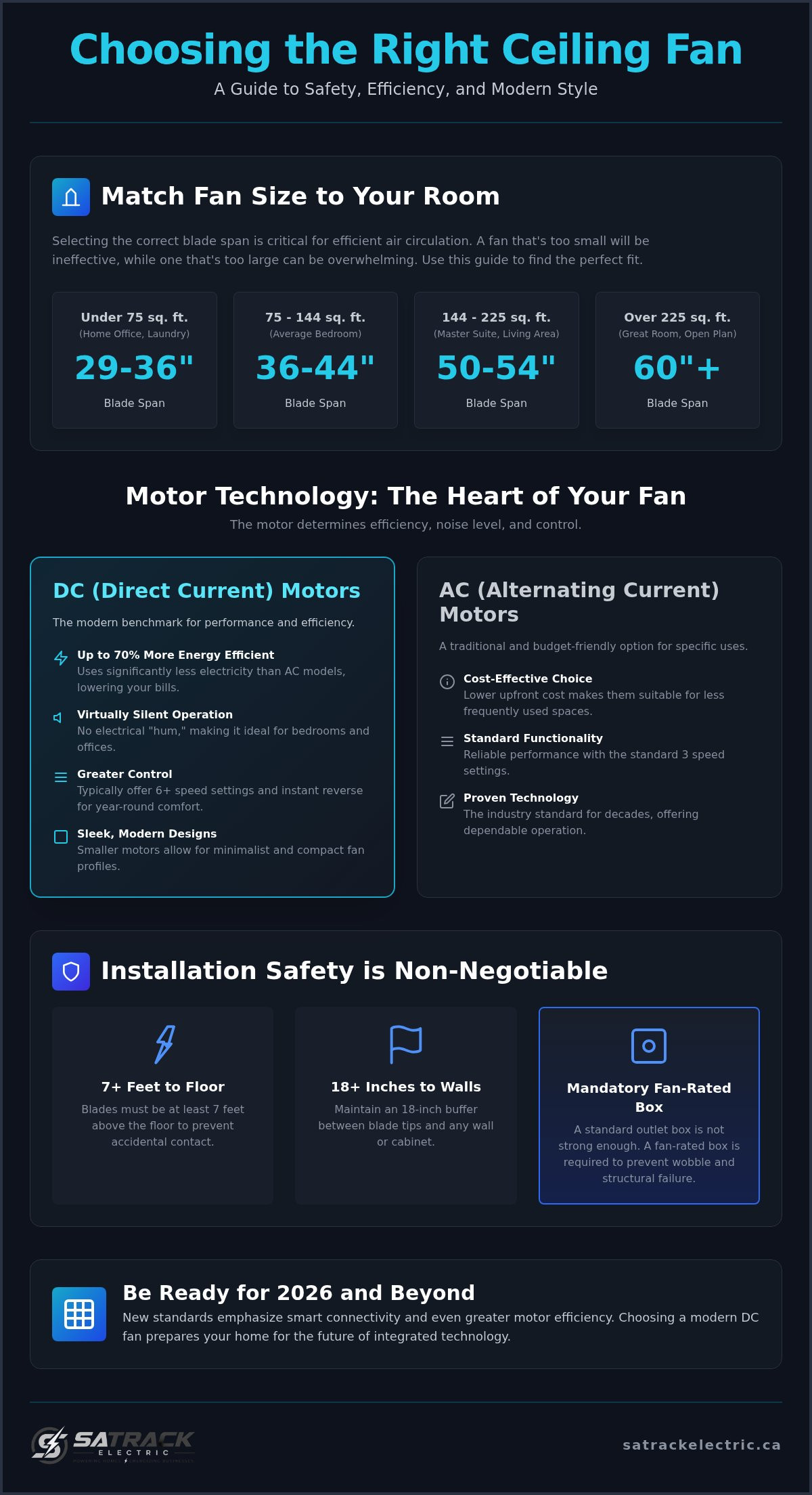
To determine the correct size, measure the square footage of your room by multiplying the length by the width. Use these general guidelines to find the appropriate diameter:
- Under 75 sq. ft.: 29 to 36 inches. These smaller units work well in home offices or laundry rooms.
- 75 to 144 sq. ft.: 36 to 44 inches. This range is standard for most average-sized bedrooms.
- 144 to 225 sq. ft.: 50 to 54 inches. These are designed for master suites and standard living areas.
- Over 225 sq. ft.: 60 inches or larger. Great rooms and open floor plans require these significant spans to circulate air effectively.
Clearance and Safety Buffers
Safety is a priority for any electrical installation in Ontario. You must maintain a minimum 18-inch buffer between the tips of the fan blades and any vertical surfaces like walls or cabinets. This space ensures the fan doesn’t create turbulent air that leads to noise and mechanical strain. Standard safety codes also require the blades to be at least 7 feet above the floor. In rooms with bunk beds or high-traffic zones, this clearance is vital to prevent accidental contact. If your ceiling is low, a flush-mount model can help you meet these safety requirements while still providing the comfort you need.
Motor Types and Performance: DC vs. AC Motors
Understanding motor technology is a vital part of learning how to choose the right ceiling fan for your home. The motor is the heart of the fixture, determining how much electricity it consumes and how much noise it generates during operation. While Alternating Current (AC) motors have been the industry standard for decades, Direct Current (DC) motors have emerged as the benchmark for high-performance, energy-efficient cooling. DC motors utilize an internal transformer to convert power, which allows them to operate with significantly higher torque while using up to 70% less electricity than traditional AC models. This efficiency is a primary reason why many modern units meet strict performance criteria, as outlined in this ENERGY STAR ceiling fan guide.
Beyond energy savings, the choice between AC and DC affects the daily ambiance of your living space. DC motors are remarkably quiet because they run cooler and don’t produce the electrical “hum” often associated with older AC fans. This makes them the superior choice for bedrooms or home offices where silence is a priority. While both motor types are built for longevity, DC motors often come with extended warranties because their design involves less internal friction and heat buildup over time.
The Rise of DC Motor Technology
DC technology has revolutionized the aesthetic possibilities of ceiling fans. Because the motors are smaller and lighter, manufacturers can create sleek, minimalist profiles that were previously impossible. You also gain much finer control over your environment. Most DC fans offer six distinct speed settings compared to the standard three found on AC models. These units also feature faster start and stop times, and the reverse function can be toggled instantly via remote control to help circulate warm air during Ontario winters.
When to Choose a Traditional AC Motor
Despite the advantages of DC technology, traditional AC motors remain a practical option for specific applications. They are generally more budget-friendly upfront, which makes them a sensible choice for guest rooms or laundry areas that don’t require constant use. AC fans are also compatible with a broader range of standard wall switches. If you prefer a simple wall-mounted slider or dial without the need for a specialized remote or smart interface, a high-quality AC motor provides proven reliability. Regardless of the motor type you select, ensuring your home’s wiring is safe and compliant is a critical step that often requires professional electrical upgrades to accommodate modern fixtures.
Mounting Options and Ceiling Height Considerations
Choosing the right mounting system is just as vital as selecting the motor or blade size. Many homeowners focus on the visual appeal of the fixture, but the vertical placement determines how much air actually reaches the living space. To understand how to choose the right ceiling fan for your home, you must first measure your ceiling height from the floor to the intended mounting point. This measurement dictates whether you require a flush-mount model or a downrod extension to maintain both safety and performance.
Safety remains the primary concern for any residential electrical installation in Ontario. You must ensure the blades sit at least 7 feet above the finished floor. This is a standard safety requirement designed to prevent accidental injury. If your ceiling is exactly 8 feet high, a flush mount is often the only safe option. However, if you have 9 feet of clearance or more, a downrod is preferable. A downrod allows the fan to sit away from the ceiling, creating a space where air can circulate above the blades. Without this gap, the fan’s efficiency drops because it cannot pull air down as effectively, a detail often overlooked in generic retail guides.
Flush Mount vs. Downrod: Which is Best?
Flush mount fans, often called hugger fans, are designed for ceilings that are 8 feet or lower. They provide the necessary head clearance, but you should realize that they generally move less air than downrod models due to their proximity to the ceiling. For standard 9-foot ceilings, a short 6-inch downrod is usually the ideal choice. It provides enough clearance for safety while keeping the fan in the optimal position for air movement.
If you are dealing with a grand foyer or a great room with ceilings between 10 and 20 feet, an extended downrod is necessary. A fan mounted too high will fail to circulate air at the floor level where you need it most. We generally recommend that the fan blades sit between 8 and 9 feet above the floor for the best cooling performance in high-ceiling environments.
Sloped Ceiling Solutions
Modern homes in the Quinte area often feature vaulted or cathedral ceilings. Installing a fan on these pitches requires specific hardware to ensure the motor remains vertical. Most fans come with a standard canopy that handles a slight slope, but steeper pitches up to 45 degrees require an angled ceiling adapter. You must also ensure the blades have enough clearance from the angled ceiling surface. If the blades are too close to the slope, you’ll experience air buffeting. This creates a repetitive thumping noise and puts unnecessary strain on the motor. Identifying fans with universal mounting systems allows for greater flexibility, ensuring the fixture remains level and stable regardless of your home’s architecture.
Style, Lighting, and Smart Features for 2026
While motor efficiency and sizing provide the technical foundation, the visual design is what truly integrates the fixture into your living space. When you are determining how to choose the right ceiling fan for your home, the style should complement your existing architecture. Industrial designs often feature matte black finishes and exposed hardware, making them ideal for modern lofts. Transitional styles offer a balance of clean lines and soft curves that fit most traditional Ontario homes. Learning how to choose the right ceiling fan for your home also means coordinating the blade finish with your flooring or cabinetry to create a cohesive look that feels intentional rather than an afterthought.
Integrated Lighting and Ambiance
Modern fans have moved beyond basic bulb sockets to integrated LED kits. These systems offer superior longevity and lower energy consumption. One detail often overlooked is the Kelvin rating, which determines the colour temperature of the light. A 3000K setting provides a warm, inviting glow suitable for bedrooms or living areas. In contrast, a 5000K setting mimics natural daylight, which is better for task-oriented spaces like home offices or kitchens. Dimmable LEDs are essential for multi-purpose rooms, allowing you to shift from bright utility lighting to a soft evening ambiance. Some premium models even offer uplighting, which reflects light off the ceiling to create depth and reduce harsh shadows in the room.
Smart Fans and Home Automation
By 2026, smart technology has become a standard expectation for premium ceiling fans. These fixtures now utilize universal connectivity standards to ensure they work seamlessly with your existing smartphone apps and voice assistants. You can schedule your fan to activate during peak heat hours or link it to a smart thermostat to assist with automated climate control. Many smart fans include an “Away Mode,” which varies the light and fan speed to simulate occupancy while you are travelling. Because these advanced fixtures often involve complex control modules and Wi-Fi receivers, we recommend a professional light fixtures installation to ensure every smart feature is configured correctly and safely.
The Importance of Professional Electrical Installation
Hanging a heavy, rotating appliance from your ceiling requires more than a steady ladder and a screwdriver. While many retail guides suggest that installation is a simple weekend task, the reality is that ceiling fans are dynamic loads. They create constant vibration and torque that a standard light fixture box was never designed to handle. If you want to know how to choose the right ceiling fan for your home, you must prioritize a safe foundation. A standard plastic junction box can easily fail under the weight of a 30lb fan, leading to the infamous “wobble” that eventually causes structural failure or motor burnout.
In Ontario, the Electrical Safety Code is clear about these requirements. Every new installation must use a box specifically rated for fan support. This ensures the fixture remains secure even at high speeds. Our team at Satrack Electric provides the expertise needed for residential electrical services in Belleville, ensuring your new upgrade meets every local regulation and safety standard.
Fan-Rated Junction Boxes
Standard light boxes are often rated for only 10 to 15 lbs of static weight. In contrast, fan-rated boxes are constructed from heavy-duty metal or reinforced plastic and are anchored directly to the ceiling joists. If your fan isn’t positioned directly under a joist, we use specialized “spread bars” that expand between the rafters to provide a rigid mounting point. This prevents the ceiling from sagging and eliminates the mechanical noise that occurs when a fan isn’t perfectly level. Identifying the right box is a safety step you can’t afford to skip if you want your fixture to remain a permanent part of your home.
Wiring and Control Configuration
Belleville is home to many beautiful heritage properties that may still contain older aluminum wiring or ungrounded circuits. Mixing modern fan controllers with legacy wiring requires a professional touch to prevent overheating or electrical interference. Proper grounding is also essential for eliminating the annoying electrical hum that can plague poorly installed motors. If you’re noticing flickering lights or inconsistent power, it’s best to book electrical repairs in Belleville before proceeding with a new installation. We can also configure dual switches, allowing you to organize your home’s lighting and fan speeds independently for maximum comfort and convenience.
Enhancing Your Home Comfort with Confidence
Selecting a fixture that balances modern aesthetics with technical efficiency ensures your space remains comfortable throughout the year. By understanding how to choose the right ceiling fan for your home, you can prioritize features like quiet DC motors and appropriate blade spans that truly serve your room’s dimensions. Whether you are updating a master suite or a high-traffic living area, the technical details of motor type and mounting hardware matter as much as the visual style.
A secure, code-compliant installation is the only way to avoid mechanical noise and structural risks. As a licensed Ontario Electrical Contractor, Satrack Electric has spent years serving the communities of Belleville, Trenton, and Quinte West. We bring specialized expertise to both heritage properties and modern builds, ensuring every fan-rated box and wiring configuration is handled with precision. Book Your Professional Ceiling Fan Installation with Satrack Electric to ensure your next home upgrade is safe, efficient, and built to last. We look forward to helping you create a more comfortable environment for your family.
Frequently Asked Questions
Do I need a special electrical box for a ceiling fan?
Yes, a fan-rated junction box is a requirement under the Ontario Electrical Safety Code. Standard light fixture boxes are designed for static loads, whereas fans create dynamic weight and vibration. Hanging a fan on an unrated box can lead to structural failure. We ensure every installation in the Quinte area utilizes a secure, braced metal box that can safely support the specific weight of your chosen model.
How many blades are best for a ceiling fan?
For most homes in Belleville, a four or five-blade fan is the ideal choice for quiet operation and a gentle breeze. While three-blade models move air more aggressively and can be noisier, five-blade versions are balanced to minimize sound. The number of blades is often an aesthetic choice, but more blades typically result in a smoother, quieter performance in bedrooms and living rooms.
What is the ideal height for a ceiling fan?
The optimal height for air circulation is between 8 and 9 feet above the floor. However, safety regulations in Ontario require the blades to be at least 7 feet high to prevent accidental contact. If your home in Trenton has high or vaulted ceilings, you’ll need an extended downrod to bring the fan into this effective range. Flush-mount models are the best choice for ceilings exactly 8 feet high.
Can I put an indoor ceiling fan on my outdoor porch in Ontario?
You should never install an indoor fan in an outdoor space. Ontario’s humidity and temperature swings will quickly warp indoor blades and rust the motor. For porches in Brighton or Picton, you must select a fan with a “Damp” or “Wet” rating. These models feature sealed motors and weather-resistant materials designed to withstand the outdoor elements without short-circuiting or degrading over time.
Why is my ceiling fan wobbling even though it is new?
A wobbling fan is usually caused by an imbalance in the blades or a mounting box that isn’t secure. Even new fans can wobble if the blades aren’t weighted equally or if the bracket isn’t tightened directly to a joist. Learning how to choose the right ceiling fan for your home includes ensuring it’s installed on a rigid, fan-rated box to eliminate mechanical instability and prevent premature motor wear.
How much does it cost to have an electrician install a ceiling fan in Belleville?
Professional installation costs in the Quinte region depend on the complexity of your home’s existing wiring. If we are replacing an existing fixture where a fan-rated box is already present, the labour is straightforward. However, if your Belleville home requires new wiring or a structural brace, the time involved will increase. We recommend a professional assessment to ensure your installation is safe and meets all current electrical codes.
Can I use a dimmer switch with my ceiling fan?
You should never use a standard light dimmer switch to control a ceiling fan motor. Doing so can damage the motor and create a fire hazard. While some AC motor fans are compatible with specialized fan speed wall controls, many modern DC models require a dedicated remote or smart app. If you’re unsure how to choose the right ceiling fan for your home’s wiring, we can help configure the correct control system.
How do I change the direction of my ceiling fan for winter?
Most fans have a small toggle switch on the motor housing or a button on the remote control. In the summer, the blades should spin counter-clockwise to create a cooling downdraft. During a Quinte winter, reversing the direction to clockwise at a low speed pulls cool air up and pushes trapped warm air down from the ceiling. This simple adjustment helps distribute heat more efficiently throughout your living space.