
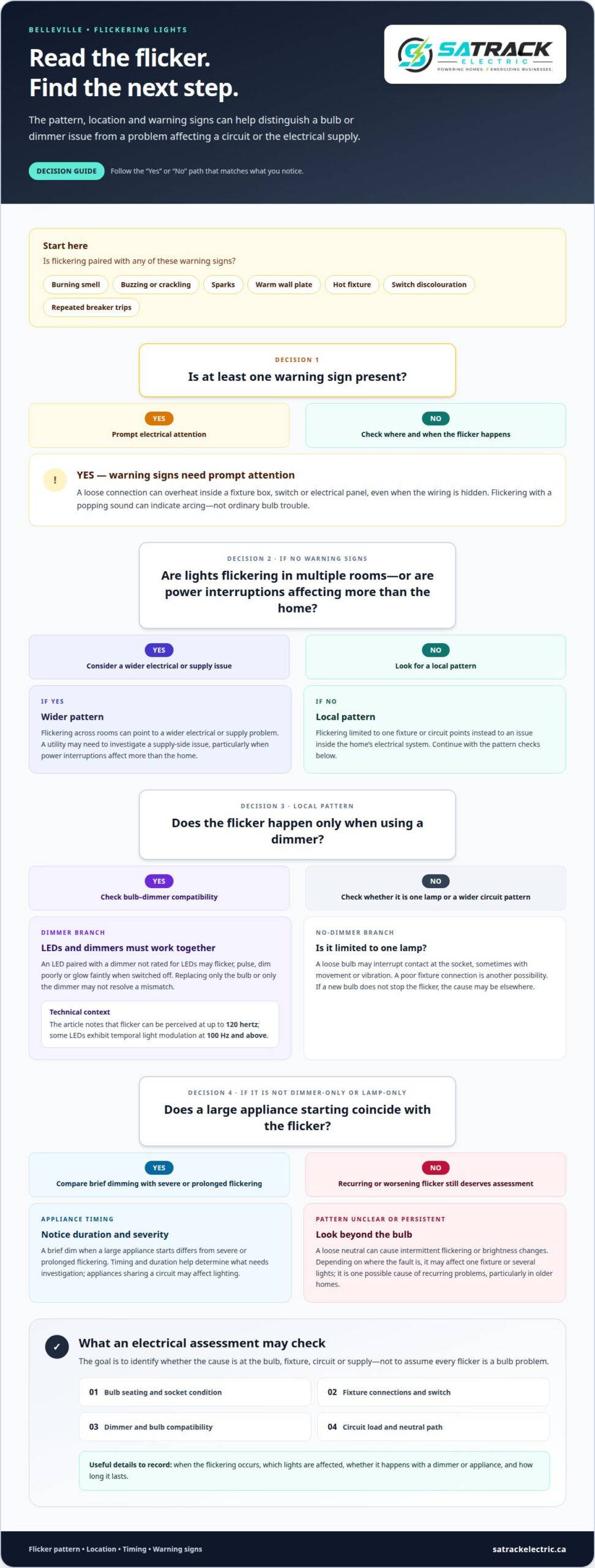
Flickering lights aren’t always harmless. A loose bulb or incompatible dimmer may be the cause, but flickering can also signal an electrical problem. A flickering lights fix in Belleville starts with identifying the source. Burning smells, buzzing or crackling, sparks, warm wall plates, hot fixtures, switch discolouration or repeated breaker trips call for prompt electrical attention.
It’s reasonable to wonder whether a brief flicker is a safety concern. Sometimes the cause is limited to a bulb or dimmer; in other cases, a loose connection, shared circuit or loose neutral needs attention. A loose neutral can cause intermittent lighting problems, particularly in older homes.
This article covers warning signs that need prompt attention, why bulbs and dimmers can flicker, and how appliances sharing a circuit may affect lighting. It also explains what a loose neutral can mean and when professional electrical repairs can help identify the cause safely.
Key Takeaways
- Flicker patterns can help distinguish a fixture-level issue from a problem affecting a circuit or the wider electrical supply.
- Record when the flickering occurs and which lights are affected so an electrician has useful details to guide the assessment.
- A brief dim when a large appliance starts differs from severe or prolonged flickering; the timing and duration help determine what needs investigation.
- Electrical assessment can include the bulb, fixture connections, dimmer, circuit load and neutral connection, rather than assuming the bulb is the only cause.
- Professional electrical repairs or light fixture installation can address the cause when flickering persists or safety warning signs appear.
Are flickering lights dangerous?
Flickering isn’t automatically a hazard, but persistent or worsening changes deserve attention. A bulb that flickers only when dimmed may indicate a compatibility issue, while flickering across rooms can point to a wider electrical or supply problem. The pattern, location and accompanying signs help an electrician distinguish between possible causes.
Some signs call for prompt electrical attention: a burning smell, buzzing or crackling, sparks, warm wall plates, a hot fixture, switch discolouration or repeated breaker trips. A loose connection can overheat inside a fixture box, switch or electrical panel, even when the wiring is hidden. Flickering paired with a popping sound can indicate arcing, not ordinary bulb trouble.
Common causes of flickering lights include a loose bulb, poor fixture connection, incompatible dimmer, shared circuit, loose neutral or problem with the electrical supply. If a new bulb doesn’t stop the flicker, the underlying cause may be elsewhere in the lighting system.
What electrical permits or code rules apply to residential repairs in Belleville, Ontario? The Ontario Electrical Safety Code sets the minimum legal safety requirements for electrical installations and electrical work in Ontario. Rule 2-004 concerns notification of work and the ESA inspection process; whether notification or inspection applies depends on the work being done.
Can Hydro One or another utility fix flickering lights in Belleville? A utility may need to investigate a supply-side issue, particularly when lights flicker in multiple areas or power interruptions affect more than the home. Flickering limited to one fixture or circuit points instead to an issue inside the home’s electrical system.
LED bulb and dimmer compatibility matters. An LED bulb paired with a dimmer not rated for LEDs may flicker, pulse, dim poorly or glow faintly when switched off. Traditional dimmers can also cause flickering with LED bulbs. An electrician assesses the bulb and control together, since replacing only one may not resolve the mismatch.
How do LED bulbs, dimmers and incompatible switches cause flickering? The dimmer controls light output by changing the power delivered to a bulb, and some LED electronics respond poorly to that control. LED pulse-width modulation dimming can cause distracting flicker if its frequency is too low; according to the Canadian Conservation Institute, flicker can be perceived at up to 120 hertz.
The European Commission notes that some LEDs exhibit temporal light modulation, or flicker, at frequencies of 100 Hz and above. A dimmer that flickers, buzzes or becomes warm also merits assessment. These details help separate a control mismatch from a loose connection or another electrical fault.
What does a loose neutral connection do to my lights?
A neutral conductor completes the electrical path back to the supply. If its connection is loose, current may become unstable, causing intermittent flickering or changes in brightness. The symptom can affect one fixture or several lights, depending on where the fault is. In older homes, a loose neutral is one possible cause of recurring lighting problems.
A loose bulb can cause a similar flicker, but the fault is usually limited to that lamp. Movement or vibration may interrupt contact between the bulb and socket. A fixture connection can also cause intermittent lighting, though the problem may be inside the fixture box, switch or wiring. If flickering returns after changing a bulb, the issue may need further investigation.
Bulb type can help explain why symptoms vary. Incandescent bulbs create light with a heated filament, while LEDs use electronic components to control light output. Fluorescent tubes and compact fluorescent lamps (CFLs) rely on ballasts. A failing ballast can make a fluorescent fixture flicker, buzz or take time to reach full brightness. With an LED, an incompatible dimmer or driver issue may instead cause pulsing, uneven dimming or a faint glow after switching off.
A professional assessment considers possible causes instead of treating every flicker as a bulb problem. The electrician checks whether one bulb flickers, several lights change together, or the symptom occurs with a dimmer or after switching on a fixture. The inspection can include the lamp’s seating, socket condition, fixture connections, switch and neutral path. These details help identify whether the repair belongs at the bulb, fixture or circuit level.
Age and condition matter. An older fixture may have brittle wiring, worn connections or an overheated socket; a modern replacement can also flicker if its bulb and control aren’t compatible. A loose connection inside a wall or electrical box can heat at the contact point, even when the fitting looks normal from outside. Recurring flicker calls for more than repeated bulb replacement.
When the fixture itself is damaged or unsuitable, professional light fixture installation can address the fitting as part of a safe, considered repair. If an electrician finds that the cause lies in a neutral connection or another part of the circuit, the next step is to assess that electrical fault rather than simply changing the fixture.
Older fixtures in Gananoque and Belleville homes were designed for lower-wattage incandescent bulbs, fewer fixtures, smaller electrical loads, and minimal heat output; they may have brittle wiring, burned insulation, overheated sockets, or boxes not rated for modern lighting.
In Gananoque, Belleville, and Kingston homes, failing capacitors may cause fluorescent flicker; outdated fixtures can have overheating ballasts, buzzing transformers, or crumbling wiring. Modern LED fixtures can provide brighter light, lower energy bills, more consistent colour, and more reliable performance. Flickering with popping can indicate arcing; an electrician should check it right away.
Appliances sharing a circuit and voltage drops
Lights can dim when a high-demand appliance starts because the appliance briefly draws more current. A refrigerator compressor, furnace motor or other motor-driven equipment can create a short voltage drop as it begins operating. If lights share that circuit, they may dim at the same moment. A flicker that consistently coincides with one appliance points towards a load-related cause, though it doesn’t identify the fault by itself.
A brief, occasional dim when a large appliance starts can happen in a Canadian home. A dim lasting under 1 second is described as normal, but severe or prolonged dimming shouldn’t be dismissed. For example, if kitchen lights repeatedly dip while a microwave operates, an electrician can assess whether the circuit arrangement or load contributes. Intermittent flickering at other times may indicate a different electrical issue.
In older homes, lighting and appliances may share circuits. Adding equipment or changing how a room is used can increase the demands placed on existing wiring. An electrician considers the connected loads and circuit configuration when determining whether the circuit is carrying an appropriate load.
An assessment involves more than noticing which appliance starts. An electrician can identify which lights flicker, note the timing and trace the affected circuit through the electrical panel. They can then evaluate the circuit’s load, connections and wiring condition. This helps distinguish a voltage drop related to appliance startup from a loose connection or another fault. Don’t remove the panel cover or handle exposed wiring during troubleshooting.
Newer homes are required to have dedicated circuits for large appliances to help prevent circuit-loading issues. Where lighting shares a circuit with an appliance, an electrician may determine that redistributing the load or installing a separate circuit is appropriate. The right solution depends on the existing wiring, circuit capacity, appliance requirements and how the flickering occurs. For broader electrical disturbances and voltage irregularities across a network, consulting power quality specialists such as Energy Control Systems can provide valuable insight into stabilizing sensitive electrical systems.
Describe the pattern clearly: name the appliance, identify which lights dim, and say whether the change is brief or prolonged. A single short dip as a furnace starts differs from lights that continue to pulse or dim while it runs. If several rooms are affected, or flickering occurs without an appliance starting, the cause may extend beyond one shared circuit and warrants a broader electrical assessment.
How an electrician checks and tightens a loose bulb
An electrician first determines whether flickering is limited to one bulb, one fixture or several lights. A single lamp that flickers when switched on may have a loose base, worn socket or faulty connection. If other lights change at the same time, the inspection extends to the switch, circuit and neutral wiring. This pattern helps direct troubleshooting before repairs begin.
To check a loose bulb, an electrician switches off and isolates the relevant electrical supply, then allows a warm lamp to cool. The bulb is removed and examined for a damaged base, worn contact or signs of overheating. The socket is also checked for damage or discolouration. If the bulb is intact, it can be seated properly and tested to see whether the flicker stops.
Replacing a bulb won’t correct a loose or damaged fixture connection. With the power isolated, an electrician can inspect the socket, wiring and connections inside the fixture. A loose electrical connection can heat at its contact point, including inside a fixture box or switch. If flickering occurs with a popping sound, arcing is a concern and needs prompt electrical attention.
A faulty switch can cause flickering that changes as the light is operated. An electrician examines the switch and its wiring connections, then determines whether repair or replacement is appropriate. For a dimmable LED, the bulb and dimmer also need to be compatible. A mismatch can cause flickering even when the bulb is seated properly and the fixture wiring is sound.
How can an electrician safely troubleshoot flickering lights? The electrician isolates the affected circuit before inspecting or handling wiring. Homeowners shouldn’t remove the electrical panel cover to troubleshoot. Established trade specialists such as Fawcett Plumbing emphasize that depending on the symptoms, a professional assessment should evaluate the bulb, fixture, switch, circuit connections and neutral path. This helps distinguish a simple loose bulb from a fault requiring a broader repair or upgrade.
If the breaker trips again after one reset, repeated resetting isn’t an appropriate fix. The electrician considers the flicker pattern, visible damage and any reported sounds or smells, then investigates the underlying cause. A loose neutral connection can cause intermittent lighting problems, while a damaged socket may affect only one fixture. Accurate diagnosis matters before replacing parts.
After the repair, the electrician restores power and tests the light’s operation, including whether it flickers when switched on or dimmed. The inspection checks whether the original symptom remains and whether the fixture works as intended. If the wiring or fixture condition points to a larger issue, the electrician can explain the repair needed instead of treating a bulb change as a complete solution.
How an electrician identifies whether flickering is limited to one circuit
A flickering lights fix in Belleville starts by identifying which rooms and fixtures are affected. If one ceiling light flickers while others remain steady, the cause may be local to that fixture or its circuit. If lights in separate rooms flicker together, the electrician considers whether the issue extends beyond one branch circuit. The timing and location provide useful clues.
An electrician identifies circuits serving the affected lights by reviewing the electrical panel and tracing relevant wiring. A panel directory can offer a starting point, but the electrician verifies which lights and outlets respond to each circuit. For example, flickering in two rooms doesn’t necessarily mean those lights share a circuit. Their actual connections matter.
Next, the electrician compares the symptom with circuit operation. They may assess voltage at appropriate points and consider whether a large appliance starts at the same time. If the light dims only when a particular appliance runs, shared loading may be relevant. If flickering happens independently, a loose connection, faulty control or another electrical fault may need investigation.
LED bulbs can also complicate the diagnosis. One LED flickering on a dimmer may indicate an incompatible bulb and control, rather than a circuit-wide problem. But if several LED lights on the same circuit pulse together, the electrician considers shared wiring or supply conditions. The pattern helps narrow the cause; it doesn’t establish a diagnosis on its own.
The electrical panel is part of the assessment, not a place for homeowners to troubleshoot by removing its cover. An electrician checks the relevant circuit and protective device using safe inspection methods. If a breaker trips again after one reset, stop resetting it. Repeated trips can indicate a fault that needs professional electrical attention.
Findings across circuits help define the repair. Flickering confined to one circuit points the investigation towards its connected lights, switches and wiring. Flickering across separate circuits may indicate a problem at a broader point in the electrical system, including the main connection or utility supply. The electrician considers the affected areas, voltage readings and timing to determine the next step in a flickering-light repair in Belleville.
Share which rooms flicker, whether the change starts with an appliance, and whether the symptom is intermittent or continuous. These details help focus the circuit inspection without replacing electrical testing. For a professional assessment of persistent flickering, arrange an electrical repair.
Satrack Electric: Light fixtures installation
Satrack Electric provides light fixture installations and electrical repairs when a flickering light continues after the bulb or dimmer has been ruled out. A professional assessment can help determine whether the fixture, its connections or another electrical issue needs attention. A damaged fitting may call for replacement, while flickering across several lights may require investigation beyond one fixture.
Satrack Electric’s Residential Electrical Services and Commercial Electrical Services address lighting concerns in homes and businesses. Work can include installing a suitable fixture or repairing an identified electrical fault, with the approach guided by the cause and condition of the existing system.
For flickering lights or a fixture that needs professional attention, contact Satrack Electric.
Move forward with a clear plan for your lighting
Reliable lighting supports daily routines at home and focused work in a commercial space. If flickering is disrupting how you use a room, arranging a flickering-lights fix in Belleville can help define the repair needed. Consider how the space is used and whether you’re planning lighting changes. Those details can help shape a practical conversation about the work.
Satrack Electric provides Residential Electrical Services, Commercial Electrical Services and Electrical Repairs. Whether the concern is in a home or workplace, the next step is a professional discussion about the lighting issue and repair needed. With a clear plan, you can make an informed decision about restoring dependable lighting for the space.
Contact Satrack Electric for help and take a considered next step towards resolving your flickering light concern.
Frequently Asked Questions
Is flickering in multiple rooms more serious than one fixture?
Flickering across multiple rooms deserves broader attention because the lights may connect to different circuits or share a supply connection. If a hallway and bedroom both flicker while other electrical equipment behaves unusually, tell the electrician which areas are affected and whether the symptoms began together. That information helps distinguish a room-specific fault from an issue involving more of the home.
When is flickering lights an electrical emergency?
Flickering needs prompt attention if it comes with a burning smell, sparks, crackling, a hot fixture, a warm wall plate or a breaker that trips again after one reset. Don’t touch a hot or sparking fixture, and don’t remove the electrical panel cover. Keep people away from the affected area and arrange professional electrical service to assess the hazard.
Can loose wiring or a faulty circuit breaker cause flickering lights?
Yes. A loose wiring connection can interrupt a light’s electrical supply, while a tripping breaker may signal a problem affecting its circuit. The electrician checks the circuit connections and breaker when diagnosing the symptom, rather than assuming the breaker itself is faulty. Don’t keep resetting a breaker that trips again after one reset; repeated trips need professional assessment.
What should I do if lights flicker when appliances turn on?
Note which appliance starts, which lights change and whether the dimming is brief or continues while the appliance runs. For instance, record whether the change happens when a refrigerator compressor or furnace starts. Share those details with the electrician, especially if the pattern has changed or affects several rooms. Don’t open the electrical panel or handle wiring while trying to identify the cause.
Which licensed electricians in Belleville, Ontario, repair flickering lights?
Satrack Electric is a licensed and insured electrical contractor providing electrical repairs for residential and commercial customers. Its service area includes Belleville and surrounding communities such as Trenton, Picton, Brighton, Quinte West, Greater Napanee and Cobourg. If flickering affects a home or business, describe the locations and symptoms when contacting Satrack Electric so the repair can be considered in context.