
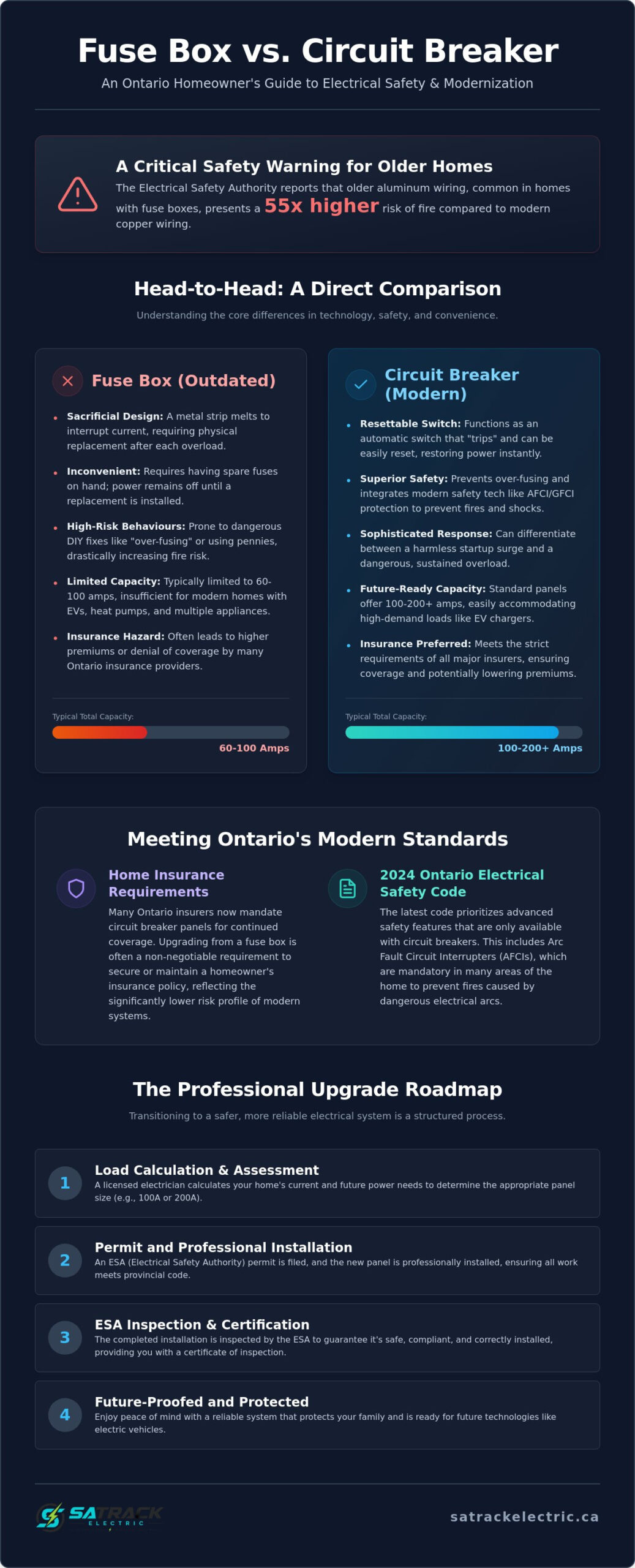
Did you know that the Electrical Safety Authority reports that aluminum wiring, frequently found in homes with older electrical systems, presents a 55 times higher risk of fire than copper alternatives? If you own an older property in the Quinte region, you’ve likely experienced the frustration of hunting for a replacement fuse in the dark or the stress of seeing your insurance premiums climb. When weighing the choice of a fuse box vs circuit breaker Ontario homeowners often find that the decision is driven by modern safety standards and strict insurance requirements.
Most residents realize that their aging electrical panels are simply not designed to handle the heavy loads of modern appliances or electric vehicle chargers. This 2026 guide provides a professional look at the safety benefits of modern panels, the latest requirements of the 2024 Ontario Electrical Safety Code, and why many insurers now mandate these upgrades for continued coverage. You’ll learn how to transition your home to a more reliable system that protects your family while ensuring your property remains fully compliant with provincial safety regulations.
Key Takeaways
- Learn the fundamental differences between sacrificial fuses and modern resettable breakers to ensure reliable overcurrent protection for your property.
- Understand how the fuse box vs circuit breaker Ontario debate directly impacts your home insurance premiums and long-term coverage eligibility.
- Discover why the 2024 Ontario Electrical Safety Code prioritizes modern circuit breakers and AFCI technology to significantly reduce residential fire risks.
- Get a clear roadmap for the professional upgrade process, including the necessity of ESA permits and calculating current load requirements.
- Realize the long-term benefits of future-proofing your electrical system to safely accommodate modern high-demand loads like electric vehicle chargers.
Understanding the Basics: What is the Difference Between a Fuse and a Breaker?
Every Ontario electrical system relies on overcurrent protection to maintain safety and prevent thermal damage to wiring. This mechanism acts as a critical fail-safe, stopping the flow of electricity when it reaches dangerous levels. When comparing a What is a Fuse? to a modern breaker, the primary difference lies in how they respond to these surges. Both technologies are designed to prevent fires, yet they achieve this goal through very different physical processes.
A fuse operates through a sacrificial metal ribbon designed to melt when current exceeds its specific rating. This physical destruction of the component effectively severs the connection, protecting the rest of the circuit from overheating. While this process is incredibly fast, it requires the physical replacement of the fuse before power can be restored. Because these are “one-and-done” components, homeowners often face the inconvenience of running out of replacements. This has historically led to extremely hazardous DIY practices in older properties, such as placing a copper penny behind a blown fuse. This bypasses the safety mechanism entirely, allowing wires to glow red-hot and significantly increasing the risk of a catastrophic electrical fire.
Conversely, a circuit breaker functions as a mechanical switch. Instead of melting, it “trips” to the off position during an overload or short circuit. A circuit breaker is a resettable safety switch designed to protect wiring from thermal overload. When evaluating the fuse box vs circuit breaker Ontario homeowners generally find that modern panels offer a level of convenience and safety that aging fuse systems cannot match.
The Anatomy of a Fuse Box
In many older Belleville homes, fuse boxes typically utilize two types of components: screw-in plug fuses for standard lighting circuits and cylindrical cartridge fuses for heavy-duty appliances like stoves or dryers. These boxes have a limited busbar capacity, meaning they were never engineered to support the electrical load of a 21st-century household. While they were the gold standard in Ontario construction before the 1960s, their physical limitations often result in frequent outages as modern families plug in more devices than the system can safely handle.
The Evolution of the Circuit Breaker Panel
Modern Ontario construction has shifted toward standardized 100-amp and 200-amp circuit breaker panels. These systems offer far more room for growth, allowing for the addition of basement suites or electric vehicle charging stations. The primary advantage is the simple “reset” flip of a switch, which eliminates the need to keep a stock of spare parts. When considering the primary keyword of fuse box vs circuit breaker Ontario residents should realize that the transition to breakers is not just about convenience; it is about providing a stable foundation for the modern electrification of the home.
Fuse Box vs Circuit Breaker: A Direct Comparison for 2026
When evaluating the fuse box vs circuit breaker Ontario homeowners often discover that while both technologies serve the same purpose, their performance profiles differ significantly. Fuses are technically faster in their response times. The metal ribbon inside a fuse reacts almost instantaneously to a massive short circuit. However, this speed comes with a lack of versatility. A fuse cannot distinguish between a momentary motor startup surge and a sustained, dangerous overload. Circuit breakers provide a more sophisticated response, using electromagnetic and bimetallic strips to handle various types of electrical faults without needing replacement.
Longevity and maintenance represent another major point of divergence. An aging fuse system carries hidden costs that go beyond the price of replacement parts. Over several decades, the connections in a fuse box can suffer from heat fatigue. This occurs because the repeated heating and cooling of the busbars causes screws to loosen, leading to “arcing” and increased fire risks. Modern circuit breaker panels are designed for the high-demand environment of 2026, where homeowners frequently add heavy loads like heat pumps or electric vehicle chargers. Attempting to scale a fuse box to meet these needs is often impossible under current codes because most fuse panels are physically limited to 60 or 100 amps of total capacity.
As you prepare your home for an electric vehicle, ensuring your household is ready for other driving-related requirements is a logical next step; learn more about booking your next road test to stay current with provincial licensing.
Safety and Fire Prevention
One of the most significant risks associated with older systems is “over-fusing.” This happens when a frustrated homeowner replaces a frequently blowing 15-amp fuse with a 20-amp version. This allows more current to flow than the household wiring can safely handle, which often leads to the wires melting behind the walls. Modern circuit breakers eliminate this human error through standardized sizing. Additionally, current Ontario household electrical safety standards prioritize Arc-Fault Circuit Interrupter (AFCI) technology. Unlike standard fuses, AFCI breakers can detect low-level, persistent arcing that doesn’t necessarily blow a fuse but can easily start a fire. These breakers are now mandatory for most living areas in Ontario to provide a higher tier of protection.
User Convenience and Functionality
The frustration of a “blown fuse” during peak appliance usage is a common pain point for residents in older properties. Identifying which fuse has failed often requires a visual inspection of every glass window in the dark. In contrast, a tripped breaker provides a clear visual indicator, as the switch moves to a centre or “off” position. By 2026, many homeowners are also integrating their panels with smart home monitoring systems. These digital interfaces allow you to track energy consumption in real-time and receive alerts on your phone if a circuit trips. If you are unsure if your current system can support these modern safety features, a professional electrical panel upgrade can provide the necessary foundation for a safer home.
Why Ontario Insurance Companies Prefer Circuit Breakers
Many Ontario homeowners believe their older electrical systems are protected by a “grandfather clause.” This is a common misconception. While the system may have been legal at the time of construction, insurance companies evaluate risk based on current fire data rather than the installation date. This is why insurance companies prefer circuit breakers; they significantly reduce the likelihood of a high-value fire claim. In the Quinte West region, maintaining an active fuse box can lead to substantially higher annual premiums. Some major provincial insurers may even refuse to renew a policy without a “Letter of Opinion” or a formal ESA inspection. The ongoing discussion of fuse box vs circuit breaker Ontario residents face is usually settled by these strict underwriting requirements.
Modern Load Demands and the 60-Amp Limit
Most fuse panels installed in the mid-20th century were rated for only 60 amps. This capacity was sufficient for basic lighting and a few small appliances, but it cannot support the electrification trends of 2026. Modern Ontario homes now require power for air source heat pumps, Level 2 EV chargers, and central air conditioning. When a 60-amp system is pushed to its limit, residents often resort to “daisy-chaining” power bars to compensate for a lack of outlets. This practice creates dangerous hotspots and increases the risk of a distribution fire. For example, preparing your home for hot tub wiring Belleville requires a robust panel that can safely handle the massive load without tripping the main service.
The Hidden Danger of Modified Fuse Boxes
Insurance providers are particularly wary of amateur modifications found in older properties. “Double-tapping,” where two separate wires are forced into a single fuse terminal, is a frequent discovery in older Quinte-area homes. These unauthorized changes create loose connections and arcing, which the ESA identifies as a leading cause of residential fires. A professional electrical panel upgrade Belleville restores insurance eligibility by bringing the home into alignment with the 2024 Ontario Electrical Safety Code. Beyond safety, an upgrade can lead to a premium reduction of 15 to 25 percent. When evaluating the fuse box vs circuit breaker Ontario homeowners should consider the long-term financial peace of mind that comes with a certified, modern installation.
The Upgrade Process: Moving from Fuses to Breakers in Ontario
Modernizing an electrical system is a structured process that requires precision and strict adherence to provincial safety standards. When navigating the choice of a fuse box vs circuit breaker Ontario homeowners must first determine their property’s total load requirements. While a 100-amp panel is the minimum standard, many families in the Quinte region now opt for a 200-amp service to accommodate high-demand equipment like electric vehicle chargers or heat pumps. This calculation ensures the new system can handle both current and future electrical needs without the risk of nuisance tripping or thermal damage to the wiring.
Once the load is calculated, the next critical step involves obtaining an Electrical Safety Authority (ESA) permit. In Ontario, DIY panel work is not an option; all residential panel upgrades must be performed by a licensed contractor to maintain insurance eligibility and safety. Your contractor will coordinate with local utilities, such as Elexicon or Hydro One, to schedule a temporary power disconnection. During the physical installation, the old fuse box is removed and replaced with a modern breaker panel. This includes grounding the system to the incoming water main according to current OESC standards. The process concludes with a final ESA inspection and the issuance of a Certificate of Acceptance, which serves as your proof of compliance for insurance providers.
Ontario Electrical Safety Code (OESC) Requirements
The 2024 OESC introduced several mandatory updates that must be addressed during a panel modernization. One of the most significant changes involves grounding; modern systems must be connected directly to the incoming metal water service to provide a reliable path for stray electricity. Additionally, the code now requires Arc-Fault Circuit Interrupter (AFCI) protection for most finished rooms and Ground-Fault Circuit Interrupter (GFCI) protection for outlets near water sources. The OESC requires all major electrical work to be inspected by the ESA to ensure compliance. These safety layers work together to prevent the distribution fires and electrocution risks often associated with aging fuse systems.
What to Expect During the Installation Day
A standard residential panel upgrade typically involves six to eight hours of downtime. During this period, your home will be without power while the new components are secured and wired. A professional installation includes meticulous labelling of the new breaker panel, which is essential for any future electrical repairs Belleville homeowners might need. After the utility restores power, your electrician will perform comprehensive testing of all outlets and major appliances to ensure the new breakers are functioning correctly. If you are ready to modernize your home’s safety, you can request a professional electrical panel upgrade to secure your property for the future.
Partnering with Satrack Electric for a Safer Ontario Home
Satrack Electric serves as a dedicated partner for residents across Belleville, Trenton, and the wider Quinte region. When homeowners face the choice of a fuse box vs circuit breaker Ontario regulations and insurance mandates can feel overwhelming. Our team provides professional assurance by managing every technical detail of your transition to a modern electrical system. As a licensed and insured contractor, we prioritize safety and competence in every installation. We realize that peace of mind comes from knowing your property is in the hands of seasoned experts who value integrity and thorough results.
Our approach is disciplined and methodical, mirroring a well-organized workflow that minimizes disruption to your daily life. We handle the entire bureaucratic process on your behalf, from filing the initial Electrical Safety Authority (ESA) permit to coordinating the final inspection. This end-to-end service ensures that your new panel is fully compliant with the 2024 Ontario Electrical Safety Code without you having to navigate complex regulatory requirements alone. By choosing a local authority, you ensure your home meets the highest standards of workmanship and safety.
Customized Solutions for Older Homes
Older properties in Picton and Brighton present unique electrical challenges that require specialized experience. Heritage homes often feature delicate structural elements and aging wiring that must be handled with extreme care during a panel modernization. We provide customized solutions that respect the integrity of your home while integrating modern safety features like whole-home surge protection. This proactive step shields your sensitive electronics from the voltage spikes that older fuse systems cannot manage. Additionally, our team can prepare your system for a future generator installation Belleville, ensuring your family remains protected during seasonal power outages.
Commercial and Residential Expertise
Our expertise extends beyond residential properties to serve local businesses throughout the Quinte West area. Commercial clients trust Satrack for electrical upgrades because we understand the critical nature of operational continuity. We focus on minimizing downtime through precise scheduling and efficient execution, allowing your business to transition to a higher-capacity system with minimal impact on productivity. Whether you are managing a historic storefront or a modern family residence, our goal remains the same: to deliver a stable, safe, and future-proof electrical foundation. Contact us today to organize a professional assessment of your current fuse box and take the first step toward a safer Ontario home.
Securing Your Home’s Electrical Future
Upgrading to a modern circuit breaker panel is a strategic investment that addresses both immediate safety concerns and long-term property value. By moving away from outdated fuse technology, you align your home with the 2024 Ontario Electrical Safety Code and satisfy the rigorous requirements of modern insurance providers. This transition not only reduces the risk of electrical fires but also ensures your infrastructure can reliably support the high-demand appliances and electrification trends of 2026.
When resolving the choice of a fuse box vs circuit breaker Ontario residents should prioritize systems that offer resettable convenience and advanced arc-fault protection. Ensuring your panel is ready for the future requires a methodical approach and professional oversight to guarantee a code-compliant installation. Making the switch today eliminates the inconvenience of blown fuses and provides the reliable power your modern lifestyle demands.
Upgrade your home’s safety with a professional electrical panel assessment from Satrack Electric. As a licensed and insured Ontario contractor, we include full ESA permit management and have proudly served the Belleville and Quinte regions for years. Taking this proactive step provides the stable foundation your home needs for a safe and efficient tomorrow.
Frequently Asked Questions
Is a fuse box illegal in Ontario in 2026?
No, fuse boxes are not illegal in Ontario if they were compliant with the safety codes at the time of their original installation. However, while they remain legal to own, they are often considered non-compliant with the 2024 Ontario Electrical Safety Code if any modifications or additions are made to the system. Most homeowners find that while the box itself is permitted, it cannot support modern safety requirements such as AFCI protection or the heavy loads required by today’s appliances.
How much does it cost to replace a fuse box with a breaker panel in Ontario?
The total investment for a panel modernization depends on several variables, including the current condition of your service entrance and whether you choose a 100-amp or 200-amp system. Factors such as the need for a new meter base or extensive grounding updates to meet OESC standards will influence the final cost. It is recommended to obtain a professional assessment to understand the specific technical requirements and labour involved for your property.
Can I replace a fuse box myself if I have an ESA permit?
You cannot legally replace an electrical panel yourself in Ontario even if you attempt to pull a homeowner’s permit for other minor tasks. Provincial regulations require that all service-level work, including the transition from a fuse box vs circuit breaker Ontario homeowners often seek, be performed by a Licensed Electrical Contractor. This ensures the work is fully insured, properly grounded, and inspected by the ESA to maintain your home’s safety and insurance validity.
Why does my insurance company require a 100-amp circuit breaker panel?
Insurers require a minimum 100-amp circuit breaker panel because it significantly reduces the risk of a distribution fire. Most older fuse boxes are limited to 60 amps, which was sufficient decades ago but is inadequate for the high-demand environment of 2026. By mandating the use of a fuse box vs circuit breaker Ontario insurance providers ensure your home has a resettable safety system that is less prone to the human error associated with over-fusing or amateur repairs.
Are fuses safer than circuit breakers because they react faster?
While the metal ribbon in a fuse reacts almost instantly to a massive surge, fuses are not considered safer than modern breakers. Fuses are unable to detect low-level arc faults or persistent overloads that do not reach a full short circuit. Modern AFCI and GFCI breakers provide a much broader range of protection, preventing fires and electrocution risks that a traditional fuse would simply ignore.
What happens if I use a fuse with a higher amperage than the circuit is rated for?
Using a higher amperage fuse than the circuit rating is a severe fire hazard known as “over-fusing.” If you place a 20-amp fuse on a 15-amp wire, the wire will overheat and potentially melt before the fuse ever blows. In this scenario, your household wiring becomes the weakest link in the system, which is a leading cause of catastrophic electrical fires in older properties.
How long does a typical electrical panel upgrade take to complete?
A standard residential panel upgrade is typically completed within a single working day, usually taking between six and eight hours. This timeframe includes the removal of the old fuse box, the installation of the new breaker panel, and the necessary grounding updates to the water main. Your power will be temporarily disconnected during this period, so it is best to plan for a full day of downtime while the work is finalized and tested.
Will a new circuit breaker panel increase my home’s resale value in Belleville?
Modernizing your electrical system can positively impact your home’s resale value by making the property easier to insure and finance for potential buyers. Many purchasers in the Belleville area are wary of older homes with fuse boxes due to the potential for high insurance premiums or the need for immediate renovations. A certified breaker panel provides tangible proof that the home’s infrastructure is safe, compliant, and ready for modern electrical demands.