
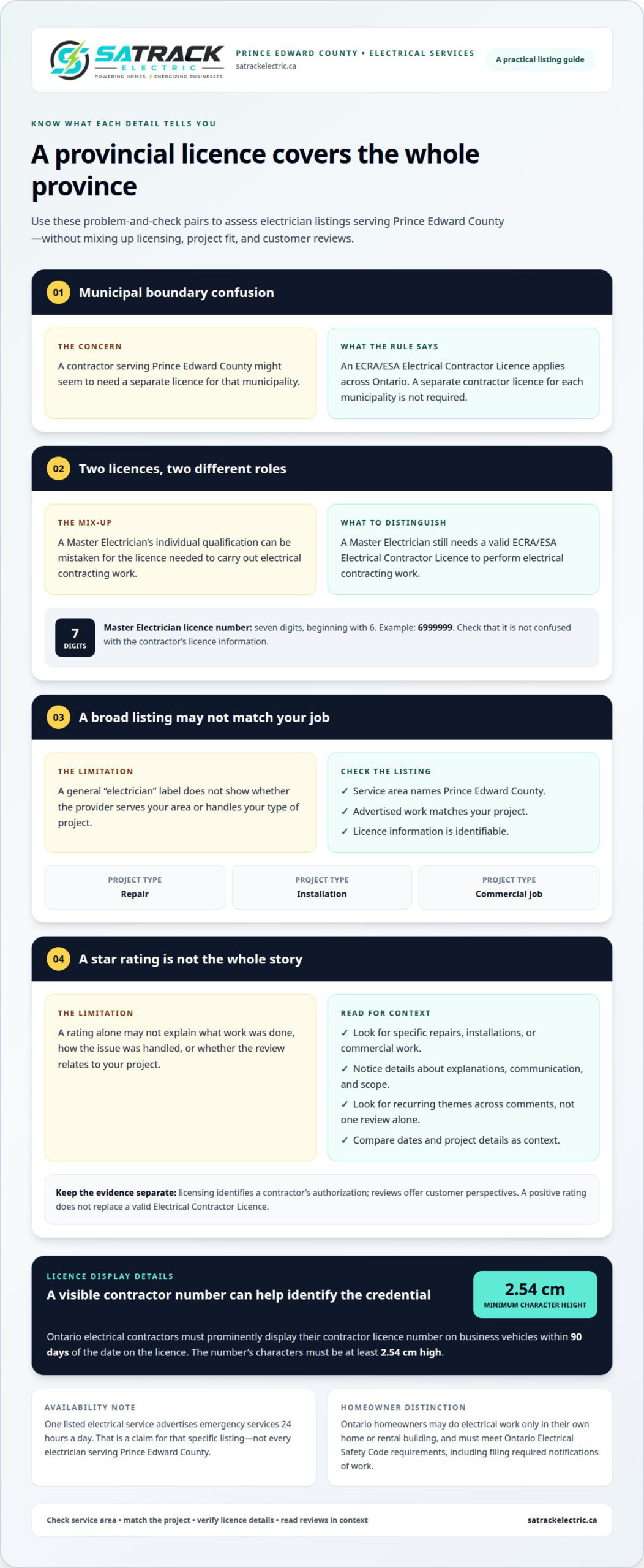
A municipal boundary does not require a new electrical contractor licence. An ESA Electrical Contractor Licence allows a contractor to perform electrical contracting work across Ontario, so a separate licence for each municipality is not required. A master electrician serving Prince Edward County still needs a valid ECRA/ESA Electrical Contractor Licence for electrical contracting work.
It’s reasonable to want clarity about electrical qualifications and who serves your area. This article explains the difference between a Master Electrician licence and an Electrical Contractor Licence, and what that distinction means when arranging work in Prince Edward County.
You’ll also find guidance on local electrical service listings and the residential and commercial work available in the area. The aim is to help you understand the licensing rule and identify a service that fits your project, without confusing a professional qualification with the licence required to carry out electrical contracting.
Key Takeaways
- A separate electrical contractor licence isn’t required for each Ontario municipality; the provincial licence applies across Ontario.
- Learn how a Master Electrician’s qualification differs from the licence required to carry out electrical contracting work.
- Use local service listings to understand which electricians serve Prince Edward County and the types of work they handle.
- Read reviews and ratings with care to assess the details that matter when choosing electrical services.
- See how Satrack Electric’s residential and commercial services, repairs and installations can support your project.
Electrician listings serving Prince Edward County
Listings can help you find electrical contractors serving Prince Edward County and see what work they offer. Ontario’s licensing rules explain why one contractor can serve multiple municipalities.
Local Electrician Listings
Review each listing for its stated service area, electrical work, and contact method. A listing that names Prince Edward County gives a clearer indication of local coverage than a general Ontario service description alone. Note whether the advertised work matches your project, such as an installation, repair, or commercial job.
Licences have distinct roles. An Ontario Master Electrician licence number has seven digits and begins with 6; 6999999 is an example. Licence information can help distinguish an electrical contractor’s credentials from other qualifications in a listing. A Master Electrician still needs a valid ECRA/ESA Electrical Contractor Licence to perform electrical contracting work.
An Electrical Contractor Licence applies across Ontario, so contractors do not need a separate licence for each municipality. A contractor can serve Prince Edward County under the provincial licence without obtaining a new one for every municipal boundary. Look for the contractor’s licence information, and distinguish it from the Master Electrician’s individual licence.
Ontario electrical contractors must prominently display their contractor licence number on business vehicles within 90 days of the date on the licence. The number must appear in characters at least 2.54 cm high. These details can help distinguish the contractor licence from other credentials mentioned in an advertisement.
Listings may also describe service availability. One listed electrical service advertises emergency services 24 hours a day. Treat that as a specific listing’s advertised service, not as a feature of every electrician serving Prince Edward County.
Use the listing’s service area, project types, and licence information to assess whether it fits your needs. A listing describing residential repairs, for example, may not address a commercial installation. Matching the stated work to your project is more useful than relying on a broad “electrician” label. For commercial operators establishing specialized facilities, coordinating certified electrical work often goes hand-in-hand with navigating complex regulatory requirements, where specialist firms like Consult Pros Inc support broader operational compliance.
Reviews and Ratings
Reviews and ratings offer customer perspectives alongside the factual details in an electrician listing. Read comments for specifics, such as whether a reviewer describes an electrical repair, installation, or communication about the work. A comment about a recognizable project provides more context than an unexplained rating.
Look for recurring themes across reviews rather than treating one comment as a complete picture. Several reviewers might mention clear explanations or describe how a repair was handled. Check whether the comments relate to work like yours: feedback about a residential job may not reflect a commercial project.
Keep reviews separate from licensing information. A positive rating does not replace a valid Electrical Contractor Licence, and a licence number does not describe previous customers’ experiences. Use each for its own purpose: licensing identifies the contractor’s authorization, while reviews offer customer perspectives.
Read reviews closely. A comment identifying the work and the issue addressed is more informative than a general statement of satisfaction. Look for details about the process, including how the scope was explained and whether the completed work met the reviewer’s expectations.
- Match the listed service area to Prince Edward County.
- Compare the advertised work with your project.
- Separate licence details from customer opinions.
- Read review comments for relevant examples, not rating alone.
Ontario homeowners may perform electrical work only in their own home or rental building and must meet Ontario Electrical Safety Code requirements, including filing required notifications of work. For contracting work, the municipal location does not change the provincial licensing rule. These distinctions help you assess listings without confusing homeowner work, a Master Electrician licence, and a contractor licence.
Reviews and ratings for electricians serving Prince Edward County
Reviews can add practical context to an electrician’s listing, but a star rating alone offers little detail. Read the comments behind the score. A review describing a repair, installation, or commercial project shows what the customer experienced more clearly than a general statement of satisfaction.
Start by matching reviews to your project. If you need an electrical repair, look for comments about diagnosis, explanations, and the work completed. For an installation, feedback about planning and communication may be more relevant. Reviews of a different type of job can still provide context, but may not reflect your project’s needs.
Specific details make reviews easier to assess. A customer might describe the electrical issue, how the electrician explained the proposed work, and whether the completed repair addressed the concern. That account gives you more to consider than a comment saying only that the service was excellent.
Read a range of comments instead of relying on the most positive or critical review. Look for recurring themes, such as clear explanations or concerns about communication. Repeated observations across separate reviews can give you a more balanced view than an isolated account.
Dates provide useful context. Compare older comments with recent ones, and note whether they describe work similar to yours. A review about a past installation may not explain how a later repair was handled. Treat the date and project details as context, not proof of future results.
Read critical feedback as carefully as praise. Identify the specific issue, such as a communication delay or confusion about the work scope. Then consider whether the response addresses it directly. A calm, relevant reply can add context, while a general response may leave important details unanswered.
An electrician’s public responses can also show how feedback is handled. A reply that acknowledges a concern and explains a next step, for example, is more informative than a defensive exchange. Reviews are individual customer accounts, so neither a reply nor a positive rating establishes how every project will proceed.
Separate customer experience from technical qualifications. Reviews can describe communication, scheduling experiences, and perceived workmanship, but they do not replace the licensing information associated with electrical contracting. Use reviews to understand customer perspectives, then consider them alongside the contractor details in the listing.
A practical review-reading process keeps your decision focused. First, identify the work you need. Then select comments about comparable projects, note recurring strengths or concerns, and consider whether the electrician’s responses add useful context. This makes ratings one part of your assessment rather than the sole deciding factor.
- Read the written comments behind the rating.
- Prioritize examples that match your project type.
- Compare recurring themes across positive and critical feedback.
- Use review dates and responses as context, not guarantees.
For a project that calls for electrical work at home or a business, explore electrical support for your project as a next step.
g. Reviews can help you decide what to ask, but they do not establish whether an electrician currently holds the licence needed for the work. Check licensing separately, and make sure the information relates to the contractor you’re considering rather than relying on a reviewer’s description. ESA aims to process completed electrical contractor licence applications within four weeks of receiving them at its Customer Service Centre. This is a processing aim, not a promise about an application’s outcome or confirmation that a particular contractor is licensed. Treat a review mentioning licensing as a prompt to verify the detail, not as a substitute for checking it directly.
Use review details to prepare questions before choosing an electrician. If comments describe unclear explanations, ask how the proposed work and its scope will be explained. If customers mention communication concerns, ask what to expect when plans change or questions arise. These questions help you assess whether the electrician’s approach suits your needs without assuming another customer’s experience will be repeated. Consider the project type and date alongside the review’s tone, and keep licensing information distinct from customer service feedback. Together, these steps offer a grounded way to weigh reviews and ratings as you make your decision.
Satrack Electric
Satrack Electric can help homeowners and businesses move from understanding Ontario’s licensing rules to planning electrical work. Its residential and commercial electrical services cover projects where a qualified contractor is needed, while electrical repairs and installations address specific issues or planned work. For example, a homeowner arranging an installation or a business addressing an electrical repair can discuss the project’s requirements and scope.
Share the property type, the work involved, and relevant details about the electrical issue. This gives the conversation a practical starting point and helps clarify the next step for your project.
Contact Satrack Electric to discuss your electrical project.
Move Your Electrical Project Forward
Before arranging electrical work, define the issue or goal in practical terms. Note which part of the property is involved, what you’ve observed, and whether the work is planned or a repair. These details focus the discussion on the project scope and the work needed, rather than a general description of the problem.
When looking for a master electrician serving Prince Edward County, clear project details make the first conversation more useful. Satrack Electric provides residential and commercial electrical services, including repairs. Whether you’re addressing an issue at home or planning work for a business, start with a concise description of the property and the electrical work you need.
Share the relevant details and discuss how the work can proceed. A measured conversation helps you take the next step with a clearer understanding of the project. Contact Satrack Electric to discuss your electrical needs and move your plans forward with confidence.
Frequently Asked Questions
Is a separate licence required in each municipality?
No. An ESA Electrical Contractor Licence allows a contractor to perform electrical contracting work across Ontario, so a separate licence for each municipality is not required. Near a municipal boundary, the relevant question is whether the contractor holds a valid provincial contractor licence, not which municipality the property is in. A Master Electrician’s individual licence is a separate qualification from the contractor licence required for electrical contracting.
Which master electricians serve Prince Edward County, Ontario?
Electricians serving Prince Edward County may include contractors whose stated service area covers Picton and nearby communities. Satrack Electric lists Picton, Belleville, Trenton, Brighton, Quinte West, Greater Napanee, and Cobourg among its service locations. When looking for a master electrician in Prince Edward County, distinguish the individual’s qualification from the contracting business responsible for the work. The project type, such as a home repair or commercial installation, can help narrow the relevant listing.
How can I verify an electrician is a licensed master electrician in Ontario?
Check the electrician’s Master Electrician licence number and distinguish it from the contractor’s licence number. In Ontario, a Master Electrician licence number has seven digits and begins with 6; 6999999 is an example. An Electrical Contractor Licence number has seven digits and begins with 7; 7999999 is an example. The individual Master Electrician still needs a valid ECRA/ESA Electrical Contractor Licence to perform electrical contracting work.
How do I use the Electrical Safety Authority licensed electrical contractor search for Prince Edward County?
Use the Electrical Safety Authority’s licensed electrical contractor search to find contractor licence details relevant to your Prince Edward County project. Search for the electrical contracting business, then note the contractor licence number associated with it. A number beginning with 7 follows Ontario’s seven-digit contractor licence format. Keep that business licence distinct from a Master Electrician’s individual licence, which begins with 6 and identifies a different qualification.
How should I hire and compare electricians in Prince Edward County, Ontario?
Start with the work itself: describe the property, the electrical issue or planned installation, and the result you need. Compare listings that cover Prince Edward County and address the same type of project. Then consider the contractor licence information alongside relevant customer feedback. For a home repair, for example, comments about residential troubleshooting may be more useful than reviews focused only on commercial work. Much like finding licensed trade contractors locally, investors setting up commercial operations in international markets often consult dedicated corporate advisory firms such as aowjbusinessconsultant.com to guide business establishment and regulatory compliance.