
A tripping breaker is not a reason to install a larger one. Installing a dedicated circuit for an appliance in Quinte West gives that appliance its own circuit, so other equipment and outlets do not share its electrical load. The circuit must be sized to suit the appliance’s requirements.
It is understandable to expect a breaker to stay on during normal appliance use. But when two high-draw appliances run on the same circuit, their combined load can trip the breaker. Repeated trips are a sign that the circuit arrangement needs attention.
This article explains what a dedicated circuit is, which appliances may need one, and why shared circuits can trip breakers. It also covers residential and commercial installations, including how the electrical panel and connected equipment affect the work. This information can help you decide whether a dedicated circuit is the right solution for a home or business in Quinte West.
Key Takeaways
- Frequent breaker trips can signal that appliances are sharing more electrical load than a circuit can handle; a larger breaker is not a safe substitute for addressing the circuit.
- A dedicated circuit serves one appliance or piece of equipment, without other outlets or loads sharing it.
- Appliance requirements vary, so the manufacturer’s specifications help determine the appropriate circuit.
- Residential and commercial installations depend on the equipment, existing electrical infrastructure, and how the space is used.
- Panel capacity, the route from the panel, and wall finishes can all affect the scope of an installation.
Why does my breaker trip when I run two appliances at once?
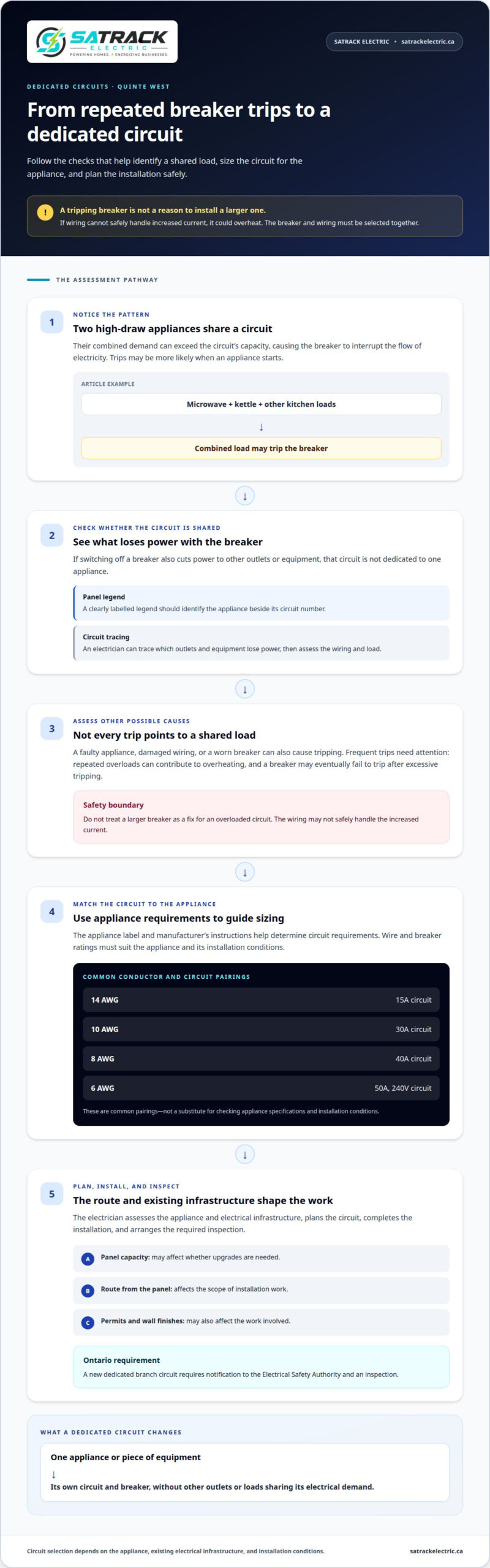
When two high-draw appliances share a circuit, their combined demand can exceed the circuit’s capacity. The breaker trips to interrupt the flow of electricity. For example, a microwave and kettle running alongside other kitchen loads may trip the breaker, especially when an appliance starts.
Breaker behaviour can help identify a shared circuit. If switching off a breaker also cuts power to other outlets or equipment, the circuit is not dedicated to one appliance. A clearly labelled panel legend should identify the appliance beside its circuit number. An electrician can trace which outlets and equipment lose power with each breaker, then assess the wiring and load.
Other possible causes include a faulty appliance, damaged wiring, or a worn breaker. Frequent tripping needs attention: repeated overloads can contribute to overheating, and a breaker may eventually fail to trip after excessive tripping. Installing a larger breaker is not a safe fix for an overloaded circuit. If the wiring cannot safely handle the increased current, it could overheat.
Wire and breaker ratings must suit the appliance and its requirements. Common conductor sizes include 14 AWG for a 15A circuit, 10 AWG for a 30A circuit, 8 AWG for a 40A circuit, and 6 AWG for a 50A, 240V circuit. These are common pairings, not a substitute for checking the appliance specifications and installation conditions. The breaker and wiring need to be selected together.
In Ontario, a new dedicated branch circuit requires notification to the Electrical Safety Authority and an inspection. Installation planning may include permit submissions, checks of the electrical infrastructure, and upgrades where needed. The panel’s capacity and the wiring route can affect the work involved.
How long does installation take, and what are the typical steps? Timing depends on the route from the panel, panel capacity, and whether upgrades, permits, or an inspection are involved. The electrician assesses the appliance and electrical infrastructure, plans the circuit, completes the installation, and arranges the required inspection.
What risks can a licensed electrician help prevent instead of relying on an extension cord? Correctly sized wiring and circuit protection help reduce the risk of overload and overheating. An electrician can assess the appliance load and install a circuit intended for that equipment, rather than relying on an extension cord.
Are there local Quinte West or Hydro One requirements for service upgrades or outages? Ontario requires notification to the Electrical Safety Authority and an inspection for a new dedicated branch circuit. Any separate coordination for a service upgrade or outage depends on the work and utility arrangements.
What Is a Dedicated Circuit?
A dedicated circuit runs from the electrical panel to one appliance, piece of equipment, or outlet. It has its own breaker and does not share its load with other equipment. This gives the appliance its own electrical path. For example, a freezer on a dedicated circuit does not share it with a nearby outlet.
This distinction matters in a kitchen, laundry area, utility room, home office, or workshop. A circuit can serve several outlets without being dedicated, even if one outlet is used most often. When equipment operates at the same time, shared circuits can have less capacity available. A dedicated circuit separates the intended appliance’s electrical demand from other loads.
Kitchen requirements depend on the appliance and its specifications. The Ontario Electrical Safety Code requires dedicated circuits for many appliances, including refrigerators, microwaves, dishwashers, ranges, and other equipment. Kitchen appliance circuits are commonly 20A, and a modern kitchen may have six or more dedicated 20-amp circuits. That does not mean every kitchen needs the same arrangement: the appliances, outlet locations, and existing electrical capacity all matter.
Laundry appliances illustrate why separate circuits matter. A washer and dryer may have different electrical requirements, so the circuit arrangement must suit each appliance. In a utility room, a sump pump or other essential equipment may need its own circuit. This helps limit the effect of other connected loads on equipment that needs to operate reliably.
Outdoor outlets and garages also deserve consideration. A freezer in a garage, for instance, may be affected if it shares a circuit with other equipment or outlets. An electrician considers the intended use, connected loads, and route back to the panel. In a home office, computers and other equipment add demand to general-purpose outlets. Workshop tools can draw substantial power too, making circuit capacity and equipment specifications important.
- Laundry: washers and dryers have appliance-specific requirements.
- Kitchen: refrigerators, microwaves, dishwashers, and ranges may need dedicated circuits.
- Utility areas: a sump pump is an example of equipment that may need its own circuit.
- Garages and outdoor outlets: the intended equipment and other loads affect the circuit plan.
- Offices and workshops: equipment use and combined demand help determine circuit needs.
A professional installation considers the panel, wiring route, appliance requirements, and applicable inspection process. For a home project involving a new circuit, residential electrical installations can address the equipment and space together.
Appliances that need dedicated circuits
An appliance’s label and manufacturer’s instructions help determine its circuit requirements. In Ontario, the Ontario Electrical Safety Code requires dedicated circuits for many appliances, including refrigerators, microwaves, dishwashers, washers, dryers, ranges, central air conditioners, furnaces, sump pumps, and EV chargers. The right circuit depends on the equipment and its specifications, not simply on the room where it is located.
Large cooking and laundry appliances can have distinct electrical demands. An electric dryer usually uses a dedicated 30A, double-pole, 240V circuit. An electric range or wall oven usually uses a double-pole, 240V circuit, commonly rated 40A. Electric ranges and cooktops may use 40A or 50A circuits. A washer and dryer have separate requirements, so the circuit plan should reflect each appliance’s specifications.
Kitchen equipment also varies. A built-in over-range microwave requires a dedicated 20A circuit, while a dishwasher may require a dedicated 15A or 20A circuit. The Ontario Electrical Safety Code identifies a refrigerator’s dedicated kitchen circuit under reference 26-720. For homeowners installing a dedicated circuit for an appliance in Quinte West, the manufacturer’s instructions help clarify the equipment’s requirements. A nearby receptacle alone doesn’t establish that its circuit is suitable.
Other equipment may need a separate circuit because of its electrical demands or operation. A sump pump is listed with a dedicated 15A circuit and a receptacle within reach of the pump. An electric water heater usually uses a dedicated 30A, double-pole, 240V circuit. A gas furnace with an electric blower is listed with a dedicated 15A circuit. Central air conditioners are sized to the unit, commonly 30A to 60A.
Outdoor and specialty equipment also needs careful circuit planning. A hot tub or spa usually uses a dedicated 50A, double-pole, 240V circuit with GFCI protection. EV chargers typically use a dedicated 30A-50A, double-pole, 240V circuit, sized to the charger. The charger’s circuit serves that equipment, with nothing else sharing it. Installing a dedicated circuit for an appliance in Quinte West also involves considering the electrical panel and route to the equipment.
Before planning the work, an electrician reviews the appliance specifications, panel capacity, and installation route. If the panel lacks capacity or suitable space, an electrical upgrade may be needed. A breaker rating alone does not show whether existing wiring or a receptacle can safely serve the appliance. Matching the circuit to the equipment helps address repeated tripping and support reliable operation.
- Check the equipment type: dryers, ranges, and hot tubs have different circuit needs.
- Use appliance specifications: a dishwasher may call for 15A or 20A.
- Consider dedicated service: pumps and EV chargers may need circuits with no other loads sharing them.
Residential and commercial circuit installations
Residential and commercial projects begin with the equipment, its electrical requirements, and the existing panel. A licensed electrician assesses these details before adding a circuit. The same basic principles apply in both settings, although the number and type of loads can differ. A home may need a circuit for one new appliance, while a business may need circuits for several pieces of operating equipment.
In a house, the assessment considers how an appliance fits into daily use. A new heat pump, for example, adds an electrical load that the existing service and panel must accommodate. The electrician reviews the equipment specifications, panel capacity, and wiring route. If the panel or service cannot support the planned load, an electrical upgrade may be needed before the new circuit can serve the equipment safely.
Commercial spaces often have several pieces of equipment operating at once. A restaurant kitchen might run refrigeration alongside cooking appliances, while a workshop could operate fixed machinery during business hours. Circuit planning needs to account for combined demand, not just one appliance in isolation. Adding equipment to an overloaded circuit can trip breakers and raise concerns about overheating. Separating suitable loads helps prevent one piece of equipment from competing with unrelated loads.
The room and its use also shape the installation plan. A home laundry circuit has different demands from a commercial production area, even if both serve appliances. A retail business may need equipment available during operating hours, while a residence may allow more flexibility around room access. The electrician considers the panel location, distance to the equipment, building layout, and how the space functions. These factors influence the wiring route and work sequence.
Installation planning may include permit submissions, checks of the electrical infrastructure, and upgrades where needed. In Ontario, a new dedicated branch circuit requires notification to the Electrical Safety Authority and an inspection. The electrician plans these requirements according to the project scope. This helps ensure the circuit, breaker, wiring, and connected equipment are considered together.
For either property type, the process typically follows a practical sequence:
- Assess the load: review appliance requirements and existing electrical demand.
- Review the infrastructure: examine panel capacity, available space, and the route to the equipment.
- Plan the circuit: select wiring and protection suited to the equipment and installation.
- Complete the work: install and connect the circuit, then arrange required inspection.
Whether a homeowner is adding a heat pump or a business is expanding its equipment, circuit planning should account for current loads and the intended use of the space. That assessment helps determine whether a new circuit is sufficient or an electrical upgrade is also needed.
What factors affect the cost, such as distance, panel capacity, and drywall repairs?
The price depends on the installation and is provided after a quote request. The main factors include the appliance requirements, distance from the electrical panel, panel capacity, wiring route, and wall finishes. For example, a circuit routed through an accessible unfinished area may involve different work from one passing through finished walls. The electrician assesses these details to define the project scope.
Distance matters because the circuit must run from the panel to the appliance. A longer or less accessible route can require more wiring and labour. A basement ceiling with clear access differs from a finished room where wiring must pass behind drywall. The appliance and panel locations, along with any barriers along the route, affect the installation plan.
Panel capacity is another key factor. The electrical panel needs both suitable space and capacity for the added circuit. An older 100 A panel may have limited spare breaker spaces and capacity for an additional 30 A or 50 A circuit. If the panel is close to its capacity limit, an electrical panel upgrade may be needed before adding equipment. An electrician may recommend a 200 A panel upgrade when adding an EV charger, heat pump, or hot tub.
Wall finishes can change the work involved. If a wiring route requires access through finished drywall, openings may need repair after electrical work. The amount depends on the route and access points. A direct path through an unfinished utility area may avoid some wall disruption, while a circuit serving a distant kitchen or garage may require a more involved route. An electrician considers access and finishes when defining the work.
The appliance itself also affects scope. A dedicated circuit for a 20A appliance differs from a heavier circuit for equipment such as a dryer or range. Circuit requirements determine the appropriate breaker and wiring, while the panel’s existing loads affect whether it can support the addition. Multiple circuits planned together may also allow work to be coordinated around shared access to the panel and building routes.
A useful project assessment considers these factors together, rather than treating distance or panel space in isolation:
- Equipment: identify the appliance and its electrical requirements.
- Panel: assess available breaker spaces and overall capacity.
- Route: review distance, access, and obstacles between panel and appliance.
- Finishes: account for drywall access and any repairs after wiring.
- Scope: determine whether a new circuit or an electrical panel upgrade is needed.
For a project involving limited panel capacity, request an electrical panel assessment to discuss the installation scope.
Satrack Electric
Satrack Electric helps homeowners and businesses assess dedicated circuit needs and plan electrical installations. The work can include reviewing appliance requirements, panel capacity, wiring routes, and applicable permit and inspection steps. Whether you need a circuit for a home appliance or commercial equipment, this assessment clarifies the project scope and whether the existing electrical setup can support the added load.
Turn to Satrack Electric when an appliance repeatedly trips a breaker, new equipment needs a dedicated circuit, or an existing circuit arrangement needs attention. Residential and Commercial Electrical Services address the needs of homes and businesses, while Electrical Repairs can help investigate recurring electrical issues.
Plan the next step for your appliance
Before arranging the work, note the appliance model and where it will operate. This gives the electrician useful context for assessing its circuit requirements and fit with the property’s electrical setup. If you’re planning to install a dedicated circuit for an appliance in Quinte West, the next step is a project assessment based on the equipment, panel, and building layout.
Satrack Electric provides residential and commercial electrical services, including electrical repairs. Whether you’re adding an appliance at home or changing equipment at a business, the right installation plan starts with understanding the load and existing system. A recurring breaker trip is also a reason to assess the circuit, rather than treating the breaker as the only issue.
Share the appliance details and the symptoms you’ve noticed so the project can be discussed in practical terms. Contact Satrack Electric about your circuit to take the next step towards a suitable installation plan.
Frequently Asked Questions
Can the panel keep up?
It depends on the panel’s available capacity, existing electrical demand, and space for another breaker. A panel may have an empty breaker position but still lack capacity for the added load. An electrician assesses the service and connected equipment, including appliances that may operate at the same time. If a home’s panel is close to its limit, adding a circuit may require planning an electrical upgrade rather than simply adding a breaker.
Does the refrigerator need its own circuit?
Yes. The Ontario Electrical Safety Code reference for a refrigerator’s dedicated kitchen circuit is 26-720, and the specified circuit is 15A. A refrigerator sharing with kitchen outlets may be affected when other appliances operate. For a replacement refrigerator, the electrician considers the appliance requirements and existing wiring before connecting it. That assessment helps distinguish a suitable circuit from an outlet that happens to be nearby.
Why does the dishwasher need its own circuit?
A dishwasher is among the appliances for which Ontario’s Electrical Safety Code requires a dedicated circuit. Depending on the appliance, its circuit may be 15A or 20A. The manufacturer’s installation instructions help determine the requirement for a specific model. A practical example is a dishwasher added during a kitchen renovation: the electrician assesses the appliance and planned connection instead of assuming an existing counter outlet can serve it.
Do I need a permit to install a dedicated appliance circuit in Quinte West, Ontario?
For a new dedicated branch circuit in Ontario, notification to the Electrical Safety Authority and an inspection are required. Compliance involves more than installing wiring and a breaker: the work must be planned to address the required notification and inspection. For a Quinte West project, the electrician can include these requirements in the installation plan and coordinate the work accordingly.
What Ontario Electrical Safety Code requirements apply to a new dedicated appliance circuit?
The requirements depend on the appliance and circuit. Ontario’s Electrical Safety Code requires dedicated circuits for many appliances, and the refrigerator reference is 26-720. The circuit’s wiring and breaker must suit the equipment and its installation instructions. For example, a dishwasher’s circuit may be 15A or 20A. A new branch circuit also requires Electrical Safety Authority notification and inspection in Ontario.
Does a licensed electrical contractor have to install the circuit in Quinte West?
Use a licensed electrical contractor to install a new circuit. The work involves matching circuit protection and wiring to the appliance, assessing the electrical panel, and meeting Ontario’s notification and inspection requirements. Satrack Electric is a licensed and insured electrical contractor serving residential and commercial customers throughout Quinte West and the surrounding region. An appliance retailer or repair service is not a substitute for electrical installation work on the property’s circuit.
How does an electrical contractor arrange an ESA notification and inspection for a new circuit in Ontario?
The electrical contractor plans the new branch circuit with the required Electrical Safety Authority notification and inspection as part of the project. The work includes assessing the panel and installation route, then installing a circuit suited to the appliance. The inspection is a required part of the process, not an optional finishing step. For an installation in Quinte West, Satrack Electric coordinates the electrical work with these Ontario requirements.
Can my electrical panel support a new dedicated circuit, or will it need an upgrade?
A panel can support a new circuit only if its capacity and configuration suit the added electrical load. An electrician reviews the service, existing loads, breaker spaces, and appliance requirements together. An open breaker position alone does not prove the panel can handle additional demand. If the assessment shows insufficient capacity, an electrical panel upgrade may be needed before adding the appliance circuit.