
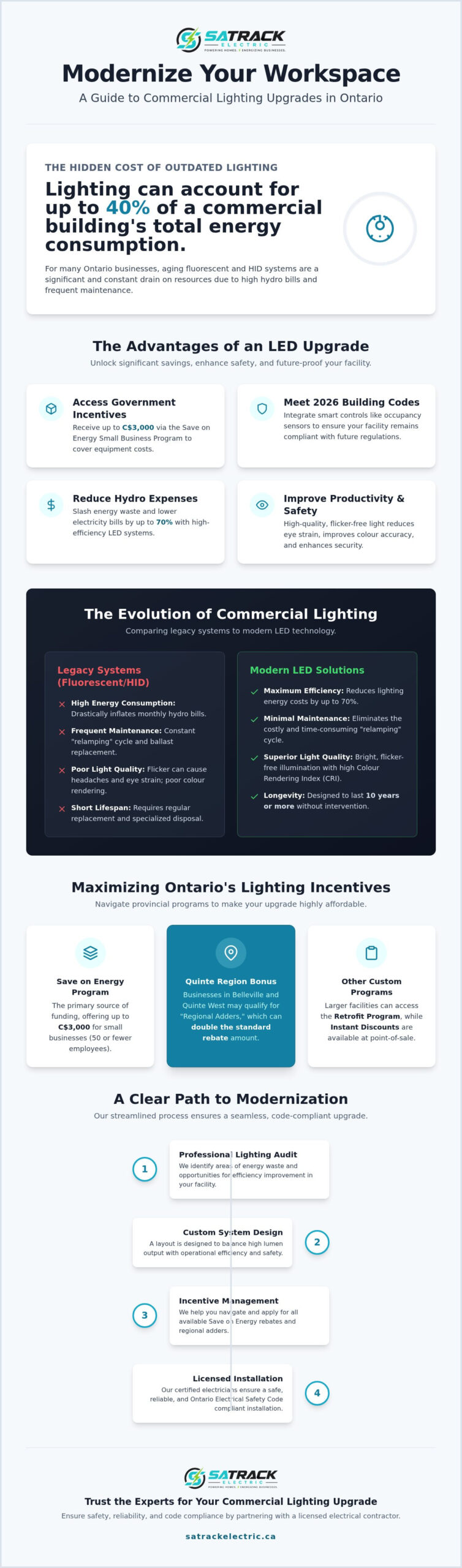
Did you know that lighting can account for up to 40% of a commercial building’s total energy consumption? For many facility managers, high hydro bills and the constant maintenance of aging fluorescent ballasts are a persistent drain on resources. Investing in a professional commercial lighting upgrade Ontario businesses trust is often the most effective way to stabilize these overhead costs. It’s understandable to feel overwhelmed by shifting regulations, but modernizing your workspace doesn’t have to be a complicated ordeal.
This guide provides a clear path to modernizing your facility while maximizing current government incentives. We will show you how to leverage Save on Energy programs, including the $3,000 Small Business Program cap and Regional Adders available in the Quinte region. You’ll learn how to transition to high-efficiency LED systems that meet the latest 2026 Ontario Building Code requirements. We also preview smart control trends and explain how a licensed expert ensures a code-compliant installation that prioritizes safety and reliability. This roadmap will help you lower overhead and improve workplace safety.
Key Takeaways
- Access up to C$3,000 in incentives through the Save on Energy Small Business Program to cover the cost of new lighting equipment.
- Realize significant long-term savings by implementing a commercial lighting upgrade Ontario businesses use to reduce hydro expenses by up to 70%.
- Integrate smart technology such as occupancy sensors and daylight harvesting to ensure your facility remains compliant with the 2026 Ontario Building Code.
- Identify hidden energy waste through a professional lighting audit and design a layout that balances high lumen output with operational efficiency.
- Guarantee safety and reliability by working with a licensed electrical contractor who specializes in code-compliant installations within the Quinte region.
Why Ontario Businesses are Prioritizing Lighting Upgrades in 2026
A commercial lighting upgrade in Ontario involves much more than simply swapping out a burnt-out bulb. It represents a comprehensive transition from legacy High-Intensity Discharge (HID) or fluorescent systems to integrated energy-efficient LED lighting and intelligent controls. In 2026, this shift has become a priority for businesses. Rising hydro rates have turned electricity into a significant line item on monthly balance sheets. By modernizing these systems, facility managers effectively cap their energy expenditure while future-proofing their operations against further rate hikes.
The hidden drain on business resources often lies in the “relamping” cycle. Old fluorescent ballasts and HID lamps require frequent replacement and specialized disposal. These maintenance tasks pull staff away from their primary duties and introduce ongoing equipment costs. Investing in a commercial lighting upgrade Ontario facility managers can rely on eliminates this cycle. Modern LED fixtures are designed for longevity, often lasting ten years or more without requiring intervention. This reliability allows business owners to focus on their core operations rather than managing a constant schedule of electrical repairs. Safety also remains a top priority. Meeting modern Ontario workplace lighting standards reduces liability and ensures all work complies with the Ontario Electrical Safety Code.
The ROI of Energy Efficiency
The financial return on a lighting retrofit is often realized faster than other capital improvements. In Ontario warehouses and retail environments, the average payback period for an LED transition typically ranges from two to four years. Beyond immediate hydro savings, a strategic commercial lighting upgrade Ontario project can also boost property value. High-quality lighting attracts premium tenants who value lower operating costs and modern aesthetics. These upgrades also help facilities align with provincial carbon reduction goals by slashing energy waste by up to 70%.
Beyond the Bill: Productivity and Safety
The quality of light directly impacts workplace performance. A higher Colour Rendering Index (CRI) allows employees in manufacturing and retail settings to see colours accurately, which reduces errors and improves product presentation. Flicker-free LED technology also addresses health concerns like eye strain and headaches, which are common complaints in offices with old fluorescent tubes. For properties in Belleville and Trenton, security is a vital consideration. High-output exterior LEDs provide consistent, bright illumination that protects assets and ensures staff feel safe when leaving the building after dark.
Maximizing Ontario Lighting Incentives and Rebates
Accessing financial support is a critical step in any commercial lighting upgrade Ontario project. The primary source of funding is Ontario’s Save on Energy programs, which are administered by the Independent Electricity System Operator (IESO). For small businesses with 50 or fewer employees, the Small Business Program remains a cornerstone of provincial support. It offers up to C$3,000 toward the cost of new lighting equipment. In many cases, this incentive covers a significant portion of the upfront hardware costs, making the transition to LED technology highly affordable.
One of the most overlooked opportunities in the Quinte region involves “Regional Adders.” These are localized incentives designed to reduce strain on the power grid in specific high-demand areas. Businesses in Belleville and Quinte West may qualify for these adders, which can effectively double the standard rebate amount. For larger facilities or those implementing complex systems like networked lighting controls, the Retrofit Program provides custom incentives based on projected energy savings. Additionally, the Instant Discounts program allows for immediate point-of-sale savings on eligible LED lamps and high bay fixtures through participating distributors. This variety of funding ensures that whether you are a small retail shop or a large industrial warehouse, there is a financial pathway to support your upgrade.
Eligibility Criteria for Ontario Businesses
To qualify for these programs, your facility must be an active hydro account holder in Ontario. The Small Business Program is specifically tailored for companies with 50 or fewer employees on-site. However, other sectors also have dedicated opportunities:
- Industrial: Incentives for high-output fixtures and specialized controls.
- Agricultural: Funding for greenhouse lighting and livestock facility upgrades.
- Multi-Unit Residential: Rebates for common area lighting in apartment buildings and condos.
How to Apply for Lighting Incentives
The most important rule for securing a rebate is the pre-approval requirement. You must receive official approval from the IESO or your local utility before you purchase equipment or begin any installation work. The application process involves gathering your recent utility bills, technical spec sheets for the proposed LED products, and a formal quote from a Licensed Electrical Contractor. Once the commercial lighting upgrade Ontario project is finished and verified, the rebate funds are typically disbursed. Consulting with a local electrical expert can help you navigate this paperwork and ensure your application meets all 2026 fiscal year requirements.
Strategic Technology: LEDs and Smart Controls
Selecting the right hardware is a pivotal decision during a commercial lighting upgrade Ontario businesses undertake. Facility managers often weigh the pros and cons of integrated LED fixtures versus LED tube replacements like T8 or T5 lamps. Integrated fixtures are engineered as a single unit, providing superior heat dissipation and precise light distribution. While LED tubes offer a lower initial price point by utilizing existing ballasts, integrated systems typically deliver a longer lifespan and better adherence to Canadian lighting efficiency standards. These integrated solutions are often the preferred choice for those seeking maximum reliability and performance.
In Quinte region warehouses and industrial bays, high-bay lighting solutions are essential for illuminating large, vertical spaces. These fixtures must provide high lumen output without creating excessive glare that could compromise worker safety. Integrating emergency and exit lighting into your overall upgrade plan is another professional best practice. It ensures your facility remains fully compliant with the Ontario Electrical Safety Code while streamlining your future maintenance schedules. By treating lighting as a unified system, you create a more resilient and safer environment for your staff.
Smart Lighting Controls
Smart controls are now a core component of modern energy management. Occupancy sensors and daylight harvesting systems automatically adjust light levels based on human presence and available natural light. This is particularly effective in Ontario offices where perimeter windows provide ample sunlight during the day. Dimming capabilities allow you to tailor light levels to specific tasks, which helps reduce eye strain and further lowers hydro costs. When choosing between wireless and wired control systems, consider your existing infrastructure. Wireless systems are often better suited for retrofits as they don’t require extensive new wiring. Implementing these advanced controls can also increase the total incentive amount available through provincial programs.
Durability and Lifespan
Understanding technical specifications like the L70 rating is vital for assessing long-term value. An L70 rating indicates the number of hours a fixture will operate before its light output drops to 70% of its original brightness. For quality commercial LEDs, this is often 50,000 to 100,000 hours. Heat dissipation is another critical factor. Quality housing made from die-cast aluminium helps pull heat away from the LED chips, preventing premature failure. For outdoor applications in the Quinte area, selecting weather-rated fixtures is mandatory. These units are designed to withstand the freeze-thaw cycles and moisture of Canadian winters. By choosing durable, well-engineered components, you ensure your commercial lighting upgrade Ontario investment remains reliable for years to come.
The Step-by-Step Lighting Retrofit Process
Executing a successful commercial lighting upgrade Ontario project requires a disciplined, methodical approach to ensure both technical performance and financial recovery. It isn’t merely a matter of swapping out old lamps; it’s a structured engineering process that prioritizes safety and efficiency. By following a logical progression, business owners can avoid common pitfalls that lead to incentive disqualification or code violations. This organized workflow ensures that every dollar spent contributes to a more productive and cost-effective workspace.
- Step 1: Conduct a professional lighting audit. This initial assessment identifies current energy waste and establishes a baseline for your hydro consumption.
- Step 2: Design a custom lighting layout. We create a plan that balances required lumen output with your energy-reduction goals, ensuring your facility isn’t under-lit or over-lit.
- Step 3: Secure ESA permits and programme pre-approvals. Administrative compliance is vital. You must receive official pre-approval from incentive providers before purchasing any equipment.
- Step 4: Professional installation. A Licensed Electrical Contractor (LEC) performs the installation to ensure all work meets the Ontario Electrical Safety Code.
- Step 5: Final inspection and payout. After the work is verified, the final documentation is submitted to trigger your incentive funding.
The Lighting Audit
The audit is the foundation of any commercial lighting upgrade Ontario facility managers undertake. During this phase, we measure current light levels in foot-candles to ensure your workplace remains compliant with provincial labour codes. We also pinpoint “over-lit” areas, such as corridors or storage bays that stay at full brightness despite low occupancy. By documenting existing ballasts and lamps, we provide the precise data required for a successful rebate application. This thorough documentation simplifies the approval process and guarantees that your new system is tailored to your specific operational needs.
ESA Compliance and Safety
In Ontario, every commercial lighting project must be accompanied by an ESA “Notification of Work.” This is a legal requirement that provides a record of the installation and ensures it meets rigorous safety standards. Engaging in uncertified electrical work is a significant risk that can lead to fire hazards and insurance claim denials. If your facility’s electrical infrastructure is aging, prioritizing electrical repairs Belleville professionals recommend will maintain the integrity of your entire system. Our team ensures that every component is installed safely and reliably. For a professional assessment of your facility, contact our licensed experts to begin your retrofit today.
Professional Lighting Upgrades with Satrack Electric
Satrack Electric serves as a dependable partner for businesses throughout the Quinte region. Our team provides specialized commercial lighting upgrade Ontario services that prioritize safety and long-term performance. As a Licensed Electrical Contractor (LEC) in Ontario, we carry the necessary insurance and qualifications to ensure your facility meets all provincial safety standards. This professional standing is vital for your peace of mind, as uncertified work often leads to insurance complications and potential safety hazards. We take pride in delivering thorough results that reflect our commitment to integrity and customer safety.
We offer turnkey solutions that manage every phase of your project. This includes the initial technical audit, the selection of high-performance materials, and the final ESA inspection. Our commitment to quality means we only install fixtures and controls designed to withstand the specific demands of Ontario business environments. By handling the complexities of code compliance and technical installation, we allow you to focus on your daily operations without the stress of managing multiple vendors or navigating complex regulations alone. We ensure a smooth, hassle-free experience that respects your time and your budget.
Your Local Quinte Electrical Partner
Choosing a local firm provides advantages that national contractors simply cannot replicate. We possess deep knowledge of Quinte region building conditions and maintain established relationships with local utility providers in Belleville, Trenton, and Napanee. This local insight is essential when navigating regional incentive structures and ensuring your project stays on schedule. Our experience with commercial electrical upgrades Belleville businesses rely on allows us to provide personalized service tailored to the unique infrastructure of our community. We understand the specific needs of local warehouses, retail spaces, and offices, ensuring your lighting system is optimized for your specific service area.
Get Started on Your Upgrade
Beginning your transition to energy-efficient LED technology is a straightforward process when working with a seasoned expert. To prepare your facility, it’s helpful to have your recent hydro bills and any existing maintenance records available for review. This information allows us to accurately calculate your potential savings and incentive eligibility. We invite you to schedule a consultation where we can assess your current system and design a modern solution that fits your operational goals. Contact Satrack Electric today for a professional commercial lighting assessment to ensure your facility is ready for the 2026 fiscal year and beyond.
Future-Proof Your Facility with Modern Lighting
Modernizing your facility’s electrical system is a strategic investment that pays dividends through reduced hydro bills and enhanced workplace safety. By leveraging the current C$3,000 Small Business Program cap and localized Regional Adders, you can significantly offset the initial costs of your project. A professional commercial lighting upgrade Ontario businesses trust involves more than just new bulbs; it’s about integrating smart controls and durable LED fixtures that meet the 2026 Ontario Building Code.
Satrack Electric provides the local expertise necessary to manage the technical audit and the final ESA inspection. As a Licensed Electrical Contractor (LEC) fully insured for commercial work, we ensure your installation is reliable and compliant. We take pride in serving the Belleville, Trenton, and Quinte region with high-quality workmanship that protects your long-term interests. Taking these steps now secures your facility against rising energy rates and future maintenance burdens.
Ready to lower your operating costs? Book a Commercial Lighting Audit with Satrack Electric to start your facility’s transition. We look forward to helping you create a safer, more efficient workspace.
Frequently Asked Questions
How much can a commercial business save with a lighting upgrade in Ontario?
Businesses can typically reduce their lighting-related electricity costs by up to 70% following a professional retrofit. Since lighting often accounts for 20% to 40% of a commercial building’s total energy use, these savings directly impact the bottom line. Beyond hydro bills, you save on maintenance costs because modern LEDs last significantly longer than fluorescent or HID lamps. A commercial lighting upgrade Ontario businesses invest in usually pays for itself within two to four years.
What is the Small Business Program $3,000 incentive?
The Save on Energy Small Business Program provides up to C$3,000 in incentives toward the cost of energy-efficient lighting equipment. This program is specifically designed for businesses with 50 or fewer employees on-site. It aims to cover a substantial portion of the hardware costs, such as LED fixtures and integrated controls. To receive this funding, you must obtain official pre-approval before purchasing any equipment or starting work to ensure the project meets technical standards.
Do I need a permit for a commercial lighting retrofit in Belleville?
Yes, every commercial lighting retrofit in Belleville requires an ESA “Notification of Work” to comply with provincial regulations. This is a mandatory requirement under the Ontario Electrical Safety Code. The process ensures that the installation is inspected by the Electrical Safety Authority to confirm it meets all fire and safety standards. Working without this notification can lead to insurance complications. A Licensed Electrical Contractor will manage this administrative step for you.
What are Retrofit Regional Adders and does my business qualify?
Regional Adders are localized financial bonuses that can double the standard incentive for businesses in areas with high electricity demand. In the Quinte region, including Belleville and Trenton, businesses may qualify for these extra funds because they help reduce strain on the local power grid. These adders are part of the Save on Energy Retrofit Program. Eligibility depends on your specific geographic location and the projected peak demand savings your new lighting system provides.
How long does a typical commercial lighting installation take?
The duration of an installation depends on the facility size and the complexity of the chosen system. A small retail space might be completed in a single day, while a large warehouse with high-bay fixtures could take a week or more. We coordinate our workflow to minimize disruptions to your daily business operations. A clear project timeline is provided after the initial audit and design phase, ensuring you know exactly what to expect during the transition.
Can I install my own LED tubes in a commercial setting?
Installing your own LED tubes is not recommended for commercial properties. Professional commercial lighting upgrade Ontario standards require that all electrical work be performed by a Licensed Electrical Contractor to maintain code compliance. Improperly installing LED tubes in existing ballasts can create fire hazards or void your insurance coverage. Furthermore, DIY installations are generally not eligible for Save on Energy incentives, as these programs require professional installation and verification for the final payout.
What is the difference between the Retrofit Program and the Small Business Program?
The Small Business Program is tailored for companies with 50 or fewer employees and offers a simplified application for up to C$3,000 in equipment incentives. Conversely, the Retrofit Program is designed for larger facilities or projects involving advanced controls. The Retrofit Program provides custom incentives based on the total kilowatt-hours saved. Both programs require pre-approval, but the Retrofit Program involves more detailed technical documentation to prove the long-term energy reduction of the system.
How do occupancy sensors impact the ROI of a lighting upgrade?
Occupancy sensors significantly accelerate your return on investment by ensuring lights are only active when a space is in use. In areas with intermittent traffic, such as storage rooms or restrooms, these sensors can reduce energy waste by an additional 30%. By pairing a commercial lighting upgrade Ontario with smart controls, you also maximize your potential incentive amounts from the IESO. This combination of lower hardware costs and reduced runtime leads to a faster payback period.