
Could your home’s original electrical panel be the only thing standing between you and the modern, energy-efficient lifestyle you’ve planned? As we move through 2026, many Ontario homeowners find that their existing systems simply cannot keep up with the demands of electric vehicles, heat pumps, and high-capacity appliances. It’s frustrating to receive wildly different quotes from contractors, especially when you’re trying to determine a realistic electrical panel upgrade cost Ontario for your specific project. You deserve a clear, professional assessment that prioritizes safety and compliance without the confusion of hidden fees or unexpected delays.
We understand that interpreting the latest regulations can feel overwhelming, but ensuring your home meets the 2024 Ontario Electrical Safety Code is essential for long-term peace of mind. This guide will help you understand the real-world factors that influence your investment, from ESA permit requirements to the technical differences between 100-amp and 200-amp service. We’ll also identify older hazard panel brands that may require urgent attention. By the end of this article, you’ll have a functional roadmap for budgeting your upgrade and ensuring your home remains a safe, reliable environment for your family.
Key Takeaways
- Understand why 200-amp service has become the modern standard for supporting electric vehicles and heat pumps under the latest Ontario electrical codes.
- Identify the primary technical variables that influence the electrical panel upgrade cost Ontario homeowners can expect in 2026, including service mast and meter base requirements.
- Learn how to ensure full compliance with the 2024 Ontario Electrical Safety Code to maintain your home insurance eligibility and long-term property value.
- Recognize the importance of mandatory ESA inspections and how professional oversight prevents the safety risks associated with outdated or hazardous panel brands.
- Discover how a modernized electrical system serves as the essential foundation for high-demand residential installations like hot tubs, spas, and backup generators.
What is an Electrical Panel Upgrade and Why is it Necessary?
Your home’s electrical system relies on a single central hub to distribute power safely to every room. This component, technically known as a What is a Distribution Board?, acts as the brain of your property. In Ontario, standard residential panels typically have a functional lifespan of 25 to 40 years. Beyond this window, internal components begin to degrade, and the system struggles to meet modern energy demands. While many homeowners research the electrical panel upgrade cost Ontario to prepare for a renovation, the primary driver is often the transition from a 60-amp or 100-amp service to a more robust 200-amp system.
It’s important to distinguish between a simple panel swap and a full service upgrade. A swap involves replacing the breaker box itself while keeping the existing service lines. A full upgrade replaces everything from the utility connection point to the interior circuits, including the service mast and meter base. This is usually required when your total home load exceeds the capacity of your current service, which is a common scenario in older Ontario homes that were never designed for electric vehicle chargers or high-efficiency heat pumps.
The Risks of Outdated Fuse Boxes and Breaker Panels
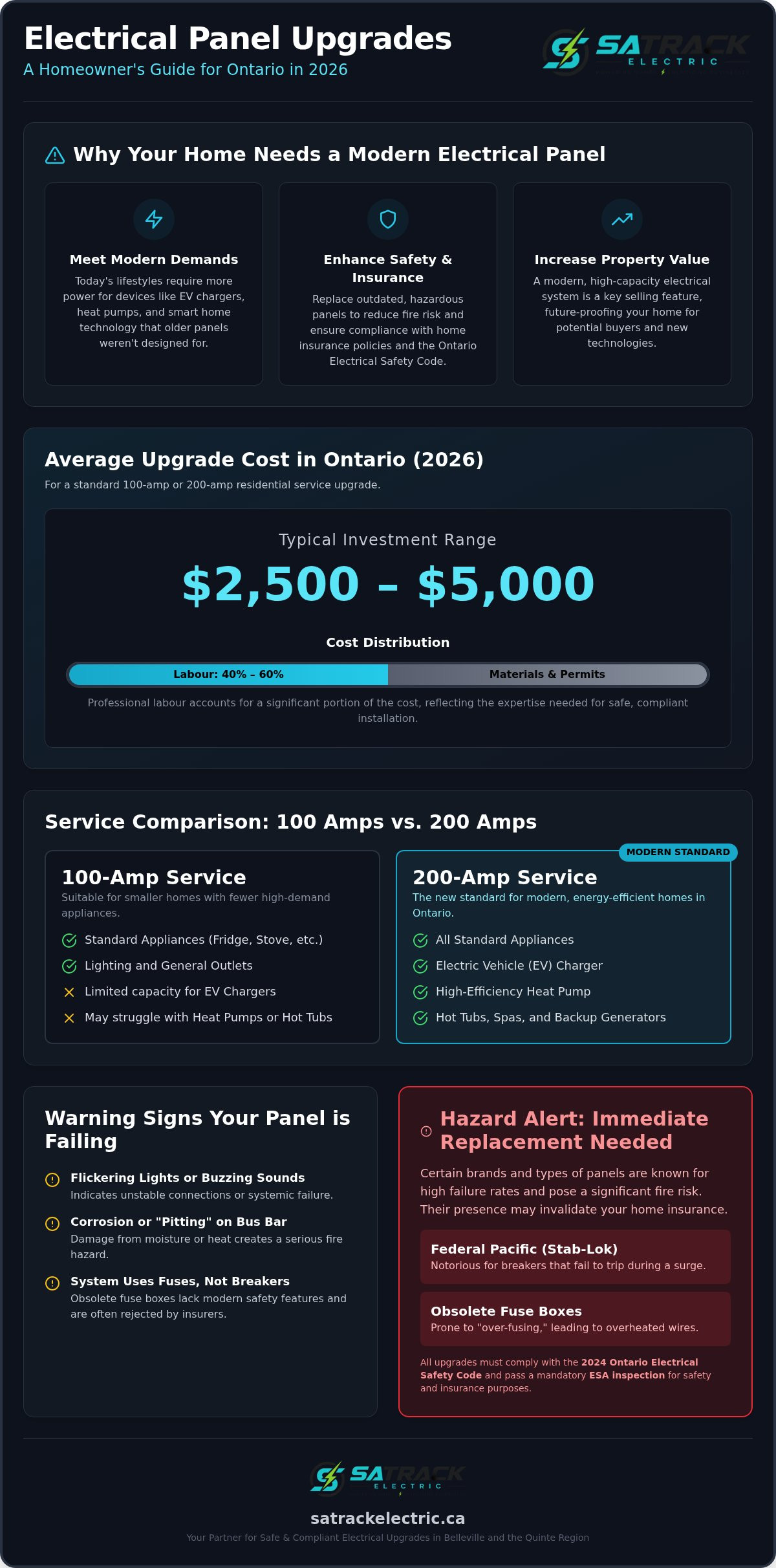
Older properties in the Quinte region often still feature fuse boxes. These systems are considered obsolete because they lack the sophisticated safety mechanisms of modern breakers. A common danger is “over-fusing,” where a resident installs a higher-rated fuse into a lower-rated circuit. This allows too much current to flow, overheating the wires and significantly increasing the risk of a house fire. Additionally, many Ontario insurance providers now require the replacement of fuse boxes before they will issue or renew a policy. Specific brands, such as Federal Pacific (often branded as Stab-Lok), are notorious for failing to trip during an electrical surge. These hazard panels require immediate professional replacement to ensure the safety of the occupants.
When a Repair is No Longer Enough
Maintenance can extend the life of a system, but some issues cannot be fixed with a simple repair. Corrosion or “pitting” on the bus bar, the main metal rail that distributes power to individual breakers, is a critical failure point. When moisture or heat causes this damage, the connection becomes unstable, leading to arcing and potential fire. Flickering lights or a buzzing sound near the panel are often symptoms of systemic failure rather than isolated circuit issues. Modern electronics, including smart appliances and home computers, are highly sensitive to the inconsistent power regulation typical of aging panels. If you notice these signs, a full electrical panel upgrade cost Ontario assessment becomes a necessary step for protecting your home’s infrastructure.
Average Electrical Panel Upgrade Cost in Ontario for 2026
Estimating the electrical panel upgrade cost Ontario homeowners should anticipate requires a detailed look at both technical requirements and current market rates. For 2026, a standard residential upgrade typically ranges from $2,500 to $5,000. This bracket covers the majority of 100-amp and 200-amp service increases. Professional labour constitutes a significant portion of this investment, usually accounting for 40% to 60% of the total project cost. This reflects the high level of expertise required to handle live utility connections and ensure every circuit meets the 2024 Ontario Electrical Safety Code.
Material prices also influence the final invoice. Components such as copper wiring and specialized arc-fault circuit interrupter (AFCI) breakers fluctuate in price based on supply chain conditions. While a 400-amp service is available for very large estates or commercial applications, it is significantly more expensive due to the heavier gauge wire and larger equipment required. Most modern families find that a 200-amp service provides the ideal balance of capacity and cost efficiency.
100-Amp vs. 200-Amp Service: Price and Value
The price difference between a 100-amp and a 200-amp upgrade is often smaller than homeowners expect. While the 200-amp hardware is more robust, the labour hours required for installation are quite similar. A detailed analysis of Electrical Panel Upgrade Costs suggests that the value lies in future-proofing. A 200-amp panel is now the baseline for Ontario homes, providing the necessary overhead for electric vehicle chargers, hot tubs, and heat pumps. Investing in the higher capacity now prevents the far greater expense of a second upgrade in the future.
Hidden Costs: Permits, Inspections, and Utility Fees
Budgeting for a panel project must include mandatory regulatory fees. Every legal installation in Ontario requires a permit from the Electrical Safety Authority (ESA). These permits typically cost between $150 and $300 depending on the scope of work. Your local utility provider may also charge a fee for the service disconnection and reconnection. These costs are non-negotiable and essential for maintaining your home’s insurance eligibility. When calculating the electrical panel upgrade cost Ontario families should budget for, it is vital to account for these hidden regulatory layers. For a transparent and professional estimate, it is best to speak with a contractor who specializes in an electrical panel upgrade for your specific region.
Technical Factors That Drive Electrical Service Upgrade Costs
The physical environment of your home plays a significant role in determining the final electrical panel upgrade cost Ontario homeowners will pay. While a standard estimate provides a baseline, technical variables often dictate the actual labour hours and material volume required. For instance, if your service entrance is a considerable distance from the nearest utility pole, the cost of heavy-gauge copper service wire increases proportionally. These technical nuances ensure your system operates safely under the load of modern life while adhering to strict provincial standards.
Grounding and bonding requirements are critical factors that are frequently overlooked in initial budget discussions. The 2024 Ontario Electrical Safety Code mandates specific grounding methods to protect your home from lightning strikes and utility surges. This often requires the installation of new ground rods or specialized plumbing connections to ensure a low-resistance path to the earth. Additionally, if your existing service mast or meter base is undersized or shows signs of weather-related degradation, these components must be replaced to support a 200-amp service increase. These foundational elements are non-negotiable for passing a mandatory inspection.
The Impact of Panel Location and Accessibility
The ease with which an electrician can access your system directly influences the project timeline. Panels located in open, unfinished utility rooms allow for efficient installation and clear wire management. Conversely, if your panel is tucked away in a tight crawlspace or hidden behind the finished walls of a basement, labour costs will rise. Technicians must spend more time “fishing” new wires through enclosed structures to avoid damaging your home’s interior. In some cases, moving the panel to a more accessible or safer location is the most professional choice, though this requires extending every existing circuit to the new centre.
Wiring Upgrades and Circuit Expansion
A panel upgrade provides the ideal opportunity to address underlying wiring issues. In many older Ontario homes, an aluminum wiring replacement is performed concurrently to ensure long-term reliability and insurance compliance. Modern codes also require the use of Arc-Fault Circuit Interrupter (AFCI) breakers for most residential circuits. While these breakers are more expensive than traditional models, they are essential for preventing electrical fires caused by damaged cords or loose connections. According to the Electrical Safety Authority guidelines, high-demand installations like EV chargers require dedicated circuits and specific wire gauges, which should be factored into your capacity planning during the upgrade process.
The Long-Term Value: Safety, Insurance, and Modern Capacity
Investing in your home’s electrical infrastructure provides returns that extend well beyond immediate safety. In Ontario’s evolving real estate market, a modernized 200-amp panel is a significant asset that increases property marketability and buyer confidence. Prospective buyers now prioritize homes that are already “EV-ready” or capable of supporting high-efficiency climate control systems without requiring immediate renovations. When you consider the initial electrical panel upgrade cost Ontario homeowners invest, it is best to view it as a capital improvement that preserves home equity and simplifies future sales negotiations.
A robust panel serves as the essential foundation for luxury and functional additions. For example, professional hot tub wiring requires a dedicated high-amperage circuit that older 60-amp or 100-amp panels cannot safely accommodate. Similarly, homeowners planning a generator installation must first ensure their main distribution point can handle the integration of a transfer switch. Upgrading your panel now eliminates the need for costly, piecemeal work when you decide to enhance your property later.
Meeting the Demands of an Electric Lifestyle
Modern Ontario households operate differently than they did three decades ago. A Level 2 EV charging station typically requires a dedicated 40-amp to 50-amp circuit, while whole-home heat pumps place a consistent, heavy draw on the system. Smart home technology also requires stable, clean power to function without signal interference or hardware resets. By moving to a 200-amp service, you effectively eliminate nuisance tripping. This problem occurs when multiple high-draw appliances, such as a dishwasher and an electric dryer, run simultaneously and exceed the capacity of an older, limited system.
Insurance Compliance and Peace of Mind
Insurance providers in Ontario are increasingly rigorous regarding aging electrical systems and outdated components. For homes older than 40 years, many insurers now mandate a formal ESA certificate of inspection before they will renew a policy or provide coverage for a new owner. Proactively upgrading your system helps you avoid the stress of sudden electrical repairs that often occur at the most inconvenient times. An ESA-certified upgrade provides documented proof of code compliance, which effectively shields the homeowner from liability in the event of an electrical incident.
If you are ready to secure your home’s future and improve its efficiency, contact our team to discuss your electrical panel upgrade needs today.
Professional Panel Upgrades in Belleville and the Quinte Region
Selecting a local partner for your electrical infrastructure requires a focus on proven competence and regulatory mastery. Satrack Electric maintains a methodical approach to every project, whether we are performing a residential service increase or a complex commercial installation. As a licensed and insured Ontario electrical contractor, we prioritize safety and adherence to the 2024 Ontario Electrical Safety Code. We understand that determining the electrical panel upgrade cost Ontario residents face involves more than just equipment; it requires a team that manages the entire ESA process on your behalf. From securing the initial permit to coordinating the final inspection, we ensure your home remains fully compliant with provincial standards.
Navigating the specific utility requirements in Belleville, Trenton, and Brighton demands local knowledge. Every regional grid has its own peculiarities regarding service mast heights and meter base placements. Our team coordinates directly with local providers to minimize downtime and ensure a seamless transition during your upgrade. This disciplined coordination is a hallmark of our service, providing you with a stable and trustworthy partnership for your domestic or professional needs.
What to Expect During Your Satrack Service Upgrade
A typical panel replacement is designed to be a one-day project to minimize disruption to your household. Our technicians arrive with a disciplined workflow, carefully removing the obsolete components and installing a modern, high-capacity system. We take pride in the final product, ensuring all circuits are clearly labelled and the workspace is left clean and organized. Once the installation is complete, we conduct a thorough walkthrough. This includes explaining the features of your new AFCI breakers and showing you how to manage your system’s expanded capacity safely.
Serving Our Community: From Picton to Napanee
Our commitment to the Quinte region is rooted in deep community ties. We provide reliable electrical solutions that address the unique challenges of both rural properties in Picton and urban homes in Napanee. By leveraging our local expertise, we help you avoid the common pitfalls of regional grid coordination that outside contractors might overlook. We prioritize a calm, steady demeanour that instills confidence in our clients throughout the process. If you are ready to modernize your home’s electrical system, Request a professional panel assessment from Satrack Electric today.
Secure Your Home’s Electrical Infrastructure
Modernizing your electrical system is a strategic investment that extends beyond daily convenience. By understanding the factors that influence the electrical panel upgrade cost Ontario homeowners should anticipate, you can plan effectively for high-capacity additions such as electric vehicle chargers and backup power systems. A successful upgrade ensures your property remains fully compliant with the 2024 Ontario Electrical Safety Code, protecting your insurance eligibility and long-term property value. This process requires a disciplined approach to safety and a thorough understanding of regional utility requirements.
Satrack Electric provides professional assurance through expert service upgrades in Belleville and Quinte West. As a licensed and insured Ontario contractor, we take pride in managing the entire ESA permit and inspection process to deliver a stress-free experience. Our team is dedicated to providing thorough results that prioritize your family’s safety and peace of mind. If you are ready to modernize your distribution system, Book Your ESA-Compliant Panel Upgrade with Satrack Electric today. We look forward to helping you build a safer, more efficient home for the years ahead.
Frequently Asked Questions
How much does it cost to upgrade from 100-amp to 200-amp service in Ontario?
The total investment for a service increase depends on technical variables such as the length of the new service entrance cable and the condition of your meter base. While we provide a standard industry range for budgeting, the final electrical panel upgrade cost Ontario homeowners pay is influenced by specific grounding and bonding needs. A professional on-site assessment is required to determine if your existing service mast requires replacement to meet current provincial utility standards.
How long does a typical electrical panel upgrade take to complete?
A standard residential panel replacement is typically completed within a single business day. Our team coordinates with the local utility provider to disconnect the power in the morning, allowing us to perform the installation and labelling throughout the day. Once the work is finished, the system is inspected and power is restored, usually within an eight to ten hour window. This methodical approach ensures minimal disruption to your household while maintaining a safe workspace.
Is an ESA permit mandatory for a panel replacement in Belleville?
Yes, an Electrical Safety Authority (ESA) permit is legally mandatory for any panel replacement in Belleville and across Ontario. It is a provincial requirement that ensures all work is performed by a Licensed Electrical Contractor and subsequently inspected for code compliance. Operating without a permit can lead to significant fines and may void your home insurance policy. We manage the entire permit and inspection process on your behalf to guarantee a fully compliant installation.
Will my home insurance rates go down after a panel upgrade?
While a panel upgrade does not always result in a direct premium discount, it is often a requirement for maintaining coverage. Many Ontario insurers refuse to provide policies for homes with obsolete fuse boxes or hazardous breaker brands. By modernizing your system and providing an ESA certificate of inspection, you demonstrate a commitment to fire safety. This proactive measure often prevents the high premiums or policy cancellations associated with aging electrical infrastructure.
Do I need a 200-amp panel to install an EV charger?
In most cases, a 200-amp panel is necessary to safely support a Level 2 EV charging station alongside other major appliances. A standard 100-amp panel often lacks the surplus capacity required for a dedicated 40-amp or 50-amp charger circuit. While load management systems exist, they can be restrictive. Upgrading your service ensures that you can charge your vehicle while simultaneously running your air conditioner, dishwasher, and dryer without the risk of nuisance tripping.
Can I replace my own electrical panel if I am a DIY enthusiast?
No, you should not attempt to replace your own electrical panel. While homeowners are permitted to perform some electrical work with a permit, a panel upgrade involves disconnecting the main service lines from the utility grid. This task involves working with live, high-voltage electricity that cannot be turned off at a simple switch. For your safety and to ensure the work is legally recognized by the ESA, you must hire a Licensed Electrical Contractor.
What is the difference between a fuse box and a circuit breaker panel?
The primary difference lies in how they protect your circuits from overloads. A fuse box uses a small wire that melts to stop the current, requiring a physical replacement every time it fails. Conversely, a circuit breaker panel uses a mechanical switch that trips and can be easily reset. Modern breaker panels are safer because they are less prone to tampering and include advanced protection, such as Arc-Fault Circuit Interrupter (AFCI) technology, which prevents electrical fires.
How do I know if my electrical panel is a “hazard brand”?
You can identify a hazard brand by checking the manufacturer’s label on the inside of the panel door or near the main breaker. Brands such as Federal Pacific (Stab-Lok), Sylvania, and Zinsco are widely recognized by industry professionals as high-risk systems. These panels have a documented history of failing to trip during an electrical surge, which can lead to overheating and fire. If you see these names, a professional safety inspection is strongly recommended.