
What if the most expensive line item on your 2026 budget isn’t a planned upgrade, but the cost of a single day of unplanned downtime? For facility managers across the Quinte region, the anxiety of a sudden electrical failure or a surprise ESA inspection is a constant reality. You understand that maintaining a complex facility requires more than just reacting to problems as they arise. It involves a steady commitment to safety that protects both your staff and your bottom line.
Staying current with commercial electrical maintenance Ontario standards is your best defence against the 1.9 per cent increase in ESA fees and the evolving requirements of the 29th edition of the OESC. This guide provides a comprehensive checklist to help you organize your maintenance schedule and satisfy insurance requirements. We will outline the mandatory inspections you need to prioritize, the impact of new 2026 plan review thresholds, and how a methodical approach to your electrical system ensures long-term operational stability.
Key Takeaways
- Learn how shifting from reactive repairs to proactive commercial electrical maintenance Ontario protects your capital investment and prevents unplanned downtime.
- Identify the essential visual inspections and mechanical testing procedures, such as exercising circuit breakers, required to keep your distribution equipment operational.
- Understand the current role of the Electrical Safety Authority (ESA) and how the OESC governs all maintenance and modifications to your facility’s electrical system.
- Determine the optimal frequency for professional inspections by considering your building’s age and the specific electrical demands of Ontario’s seasonal weather.
- Discover how to align your maintenance schedule with insurance requirements to reduce the risk of fire and ensure long-term safety compliance.
Why Regular Electrical Maintenance is Critical for Ontario Businesses
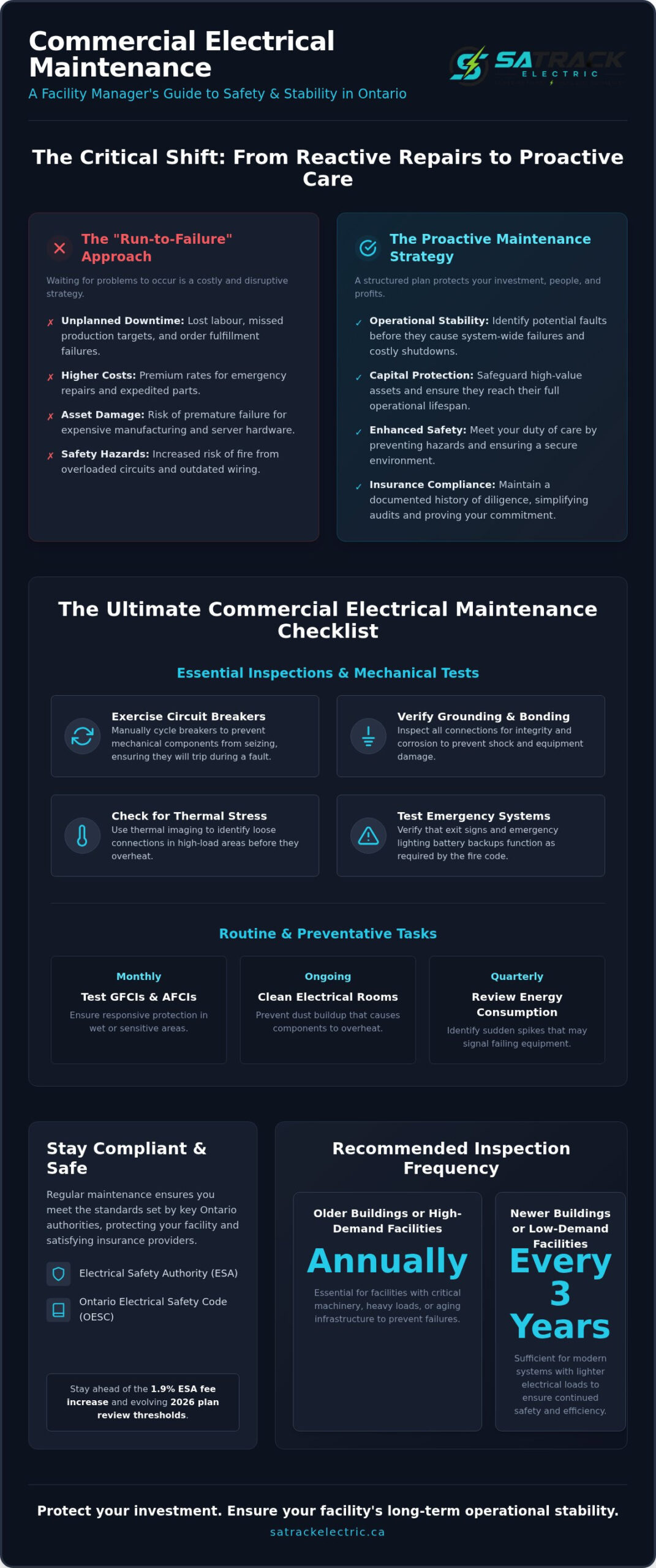
Facility management in Ontario requires a disciplined approach to power systems. Many organizations fall into the trap of reactive maintenance, only calling a technician when a breaker trips or a machine fails. This “run-to-failure” model is often more expensive than a structured plan. By applying established Maintenance Engineering Principles, businesses can transition to a proactive state where potential faults are identified before they cause a system-wide failure. Consistent commercial electrical maintenance Ontario businesses trust involves scheduled thermal imaging, torque testing of connections, and cleaning of sensitive components.
Regular inspections do more than just check boxes; they safeguard your significant capital investments. High-end manufacturing equipment and sensitive server hardware are vulnerable to power surges or voltage fluctuations caused by poor connections. A well-maintained commercial electrical panel distributes power evenly and safely. When you neglect this core component, you risk premature failure of the entire distribution system, which often costs tens of thousands of dollars to replace. Proactive care ensures that these assets reach or exceed their expected operational lifespan.
Protecting Your Business Continuity
The hidden costs of an electrical shutdown in the Quinte region extend far beyond the repair bill. You must account for lost labour hours, missed production targets, and potential damage to your reputation if you cannot fulfill client orders. Emergency-only repairs are inherently disruptive because they occur on the system’s schedule, not yours. They often require premium labour rates and expedited shipping for parts. Implementing a preventative care strategy ensures that your facility remains operational during peak hours, effectively eliminating the risk of sudden revenue loss due to preventable electrical failures.
Safety Standards and Occupant Peace of Mind
Facility managers have a legal and moral duty of care to ensure that employees and customers are safe within their premises. A system that is neglected is a system that presents risks. Overloaded circuits and outdated wiring are leading causes of commercial fires. By addressing these hazards through professional commercial electrical maintenance Ontario standards, you demonstrate a high level of professional management. This methodical approach instills confidence in your occupants and ensures that your facility meets all provincial safety expectations. A well-documented maintenance history also simplifies interactions with insurance providers, as it proves your commitment to fire prevention and workplace safety.
The Ultimate Commercial Electrical Maintenance Checklist for 2026
A reliable facility requires an organized approach to power. Relying on memory or informal checks often leads to gaps in safety. A structured checklist serves as a professional record of diligence. For facility managers, this document is essential for insurance audits and internal accountability. Effective commercial electrical maintenance Ontario protocols start with a thorough visual inspection of all distribution equipment and panelboards. You should look for signs of physical damage, moisture ingress, or discolouration on the busbars, which often indicates poor contact or overheating.
- Exercise Circuit Breakers: Mechanical components can seize if they remain in the “on” position for years. Manually cycling breakers ensures they will trip during an actual fault.
- Verify Grounding and Bonding: Inspect all connections for integrity and corrosion. A compromised ground system increases the risk of shock and equipment damage.
- Test Emergency Systems: Verify that exit signs and emergency lighting battery backups function as required by the fire code.
- Check for Thermal Stress: Use non-contact thermometers or thermal imaging to identify loose connections in high-load areas before they lead to a fire.
Monthly and Quarterly Maintenance Tasks
Routine care prevents small issues from escalating. You should test GFCIs and AFCIs in wet or sensitive areas monthly to ensure they remain responsive. Keeping electrical rooms clean is another priority; dust buildup acts as an insulator that causes equipment to overheat. Additionally, review your energy consumption patterns quarterly. Sudden spikes often signal that a motor or transformer is nearing the end of its life. Adhering to these Workplace Electrical Safety standards protects both your equipment and your personnel.
Annual Professional Inspection Requirements
While internal staff can handle basic checks, an annual audit by a licensed electrician is indispensable. This comprehensive review includes checking load calculations to confirm your system can handle the increased demands of 2026 technology, such as expanded server rooms or EV charging stations. Professionals will also inspect outdoor wiring for weather-related wear, which is common in Ontario’s fluctuating climate. If you require a detailed system audit, the team at Satrack Electric provides thorough commercial electrical maintenance tailored to your specific facility needs. This annual deep-dive ensures your business remains compliant with the latest provincial regulations.
Compliance with the Ontario Electrical Safety Code (OESC)
The Electrical Safety Authority (ESA) serves as the provincial regulator responsible for public electrical safety in Ontario. For any facility manager, the Ontario Electrical Safety Code (OESC) is the primary legal framework. It dictates how systems must be designed, installed, and maintained across all commercial properties. Adhering to these rules through consistent commercial electrical maintenance Ontario standards ensures that your facility avoids legal liability, potential fines, and costly stop-work orders. Compliance is a continuous process, not a one-time event.
The 29th Edition of the OESC, which became legally binding on May 1, 2025, introduced specific updates that directly impact commercial operations in 2026. For example, as of July 6, 2026, the ESA Plan Review threshold increased from 10 kW to 12 kW. This change affects how you plan for modifications and upgrades. Additionally, the ESA increased its wiring and licensing fees by 1.9 per cent on April 1, 2026. Facility managers must account for these regulatory shifts when budgeting for annual inspections and system modifications. Preparing for a potential ESA audit requires a centralized log of all electrical work, permits, and inspection reports.
The Role of Licensed Electrical Contractors
In Ontario, only a Licensed Electrical Contractor (LEC) is legally authorized to perform electrical work for hire. Satrack Electric is a licensed and insured contractor that ensures every repair or upgrade aligns with the latest provincial codes. When work is completed, we provide an ESA Certificate of Acceptance. This document serves as your official record that the installation was inspected and deemed safe. It’s a critical piece of evidence for insurance providers and safety auditors who require proof of professional diligence.
Emergency Systems and Safety Code Compliance
The OESC sets strict requirements for emergency lighting and backup power systems. These components must activate immediately during a primary power failure to guide occupants to safety. Compliance involves more than just functional lights; it requires regular testing of fire alarm electrical components and battery-backed exit signage. A methodical maintenance schedule ensures these systems remain operational, meeting the duty of care required for public spaces. Keeping detailed records of these tests is a mandatory part of professional facility management and is often a primary focus during safety inspections.
Frequency and Scheduling: When to Book Professional Inspections
Determining the correct interval for professional oversight depends on several variables. The age of your building and the intensity of your daily electrical load are the primary drivers. Older facilities in the Quinte region often possess legacy wiring that requires more frequent evaluation to ensure safety. Conversely, a modern facility with high-density server rooms or heavy machinery may experience thermal stress that necessitates quarterly reviews. A consistent commercial electrical maintenance Ontario schedule ensures that these variables are managed before they become liabilities.
Coordinating your maintenance with seasonal changes is a strategic way to manage facility health. Ontario’s harsh winters place significant demand on electrical heating systems and internal climate controls. Scheduling a professional inspection in the autumn allows you to identify weak points before the peak heating load begins. During these visits, technicians often use thermal imaging to detect heat signatures from loose connections or failing components. This technology allows us to see hidden issues that a standard visual inspection might miss, preventing unexpected failures during the coldest months of the year.
Maintenance for High-Demand Commercial Facilities
Manufacturing plants, retail centres, and busy office hubs face unique challenges. Facilities that operate 24/7 require continuous load monitoring because their systems never have a “cool down” period. In these environments, identifying “critical circuits” is essential. These are the lines powering IT infrastructure, life safety systems, or primary production lines. We recommend a quarterly professional review for these specific circuits to maintain 100 per cent uptime. If your facility operates under high-demand conditions, you can book a commercial electrical maintenance consultation to establish a tailored schedule that fits your operational needs.
Insurance and Liability Considerations
Documented maintenance is a primary requirement for most Ontario commercial insurers. When an incident occurs, adjusters will immediately ask for your maintenance logbook to verify that you met your duty of care. If you don’t maintain an organized record, you risk a claim denial after an electrical fire or equipment failure. A well-organized logbook including dates, names of licensed contractors, and specific tasks performed provides necessary proof of diligence. Maintaining detailed electrical records often qualifies a business for more competitive insurance rates by demonstrating a lower risk profile. It’s a professional practice that proves your facility is managed with safety as a top priority.
Reliable Commercial Electrical Maintenance Solutions in the Quinte Region
Satrack Electric serves as a dependable local authority for businesses throughout the Quinte region. Our team provides professional assurance by focusing on safety and technical competence in every project. We understand that a standardized approach doesn’t work for every facility. A retail space in Trenton has different power requirements than a manufacturing plant in Quinte West. By choosing a licensed and insured local contractor, you gain several practical advantages:
- Local Expertise: Deep familiarity with Ontario-specific safety codes and regional environmental factors.
- Proximity: Reduced travel times allow for more efficient scheduling and consistent oversight.
- Accountability: A business deeply rooted in its service area that values community reputation and integrity.
Our commitment to commercial electrical maintenance Ontario standards ensures that your facility remains a stable environment for your employees and clients. We prioritize long-term results over temporary fixes, ensuring that your electrical infrastructure supports your business goals without interruption.
Serving Belleville, Quinte West, and Surrounding Areas
The Quinte region features a diverse mix of commercial architecture. This includes heritage properties in Picton and Greater Napanee that often require specialized care to integrate modern power needs with older wiring systems. For businesses looking to expand or modernize, we provide professional commercial electrical upgrades in Belleville that align with current safety codes. Our local presence allows us to maintain efficient response times for facilities in Brighton and Cobourg. This proximity is a practical advantage for managers who need reliable oversight without the delays often associated with out-of-town contractors.
Comprehensive Support for Business Owners
Our service offerings cover the full spectrum of facility needs. We handle everything from routine visual checks to complex electrical repairs in Belleville and the surrounding communities. As we move through 2026, the demand for high-capacity infrastructure continues to grow. We help you prepare for these technological shifts by ensuring your panels and distribution systems can support new loads, such as electric vehicle charging or expanded data centres. Our methodical workflow is designed to provide a hassle-free experience that prioritizes safety and thorough workmanship.
If you’re responsible for a commercial property in the Quinte region, we invite you to consult with us on your maintenance strategy. A comprehensive electrical audit is a logical first step toward securing your facility’s future and ensuring total code compliance. Contact Satrack Electric today to discuss a tailored maintenance plan that provides the professional assurance your business deserves.
Securing Your Facility’s Future for 2026 and Beyond
Maintaining a commercial facility in Ontario requires a methodical approach to safety and compliance. You’ve seen how the proactive commercial electrical maintenance Ontario businesses rely on can prevent the high costs of unplanned downtime while ensuring adherence to the latest OESC standards. By following a structured checklist and keeping detailed logs, you protect your capital investments and maintain a safe environment for your staff.
A reliable partnership is the foundation of effective facility management. Satrack Electric is a licensed and insured Ontario contractor with specific expertise in OESC compliance and a deep commitment to the Quinte region. We invite you to Request a Commercial Electrical Maintenance Audit from Satrack Electric to verify your system’s integrity. Taking this step today ensures your facility remains operational, compliant, and ready for the technological demands of the coming year. We look forward to helping you achieve lasting peace of mind through professional electrical care.
Frequently Asked Questions
Is commercial electrical maintenance mandatory in Ontario?
Commercial electrical maintenance is mandatory for Ontario businesses to ensure workplace safety and compliance with the Occupational Health and Safety Act. The Ontario Electrical Safety Code requires that all electrical installations be maintained in a safe condition. Neglecting these requirements can result in fines from the Electrical Safety Authority or the Ministry of Labour. Consistent maintenance also ensures you meet the legal duty of care for employees and the public.
How often should a commercial building have an electrical inspection?
A commercial building should undergo a professional electrical inspection at least once every year. However, the frequency depends on the facility’s age, the intensity of the electrical load, and environmental factors. High-demand facilities in Quinte West or Belleville often benefit from quarterly reviews of critical circuits. Regular scheduling helps identify wear and tear from Ontario’s seasonal weather shifts before they lead to significant equipment failure or safety hazards.
What is the difference between an ESA inspection and a maintenance check?
An ESA inspection is a regulatory review conducted by the Electrical Safety Authority to verify that new installations or modifications meet the OESC. In contrast, a maintenance check is a proactive service performed by a licensed contractor to ensure existing systems remain operational and safe. While an ESA inspection results in a Certificate of Acceptance for specific work, commercial electrical maintenance Ontario businesses perform focuses on preventing future failures and extending equipment lifespan.
Can my in-house maintenance team perform electrical inspections?
In-house teams can perform basic visual checks and routine testing of emergency lighting, but they cannot perform electrical work for hire unless the business is registered as a Licensed Electrical Contractor. In Ontario, any repairs, upgrades, or complex diagnostic tasks must be completed by a licensed professional. Engaging an external partner like Satrack Electric ensures that your facility remains compliant with provincial laws and that all work is backed by professional insurance.
What are the most common electrical code violations for Ontario businesses?
Common violations include overloaded circuits, improper grounding or bonding, and the use of unapproved equipment. Another frequent issue is failing to maintain clear access to electrical panels, which is a safety requirement under the OESC. Many businesses also fall behind on testing GFCIs or fail to obtain the necessary permits for minor modifications. Professional commercial electrical maintenance Ontario services help identify these common errors before they are flagged during an official ESA audit.
How does thermal imaging help in commercial electrical maintenance?
Thermal imaging allows technicians to detect heat signatures emitted by loose connections, overloaded circuits, or failing components without de-energizing your system. These hot spots are often invisible to the naked eye but indicate potential fire hazards or imminent equipment failure. By identifying these issues early, facility managers in Belleville and Trenton can schedule repairs during planned downtime, effectively preventing the high costs associated with sudden, unplanned electrical shutdowns.
What documentation should I keep for my electrical maintenance?
You should maintain a comprehensive logbook that includes dates of service, names of licensed contractors, and specific tasks performed. Essential documents include ESA Certificates of Acceptance for any modified work, thermal imaging reports, and records of monthly emergency system testing. Keeping these files in a centralized location is vital for insurance audits and provincial safety inspections. This organized record proves your commitment to professional standards and workplace safety in Ontario.
Does regular maintenance help lower my commercial insurance premiums in Ontario?
Regular maintenance often helps lower commercial insurance premiums by demonstrating a reduced risk profile to your provider. Insurers in Ontario view documented electrical maintenance as evidence of fire prevention and professional facility management. If an incident occurs, having a complete history of inspections can prevent claim denials. A well-maintained system is less likely to experience the type of catastrophic failure that leads to expensive liability claims or property damage.