
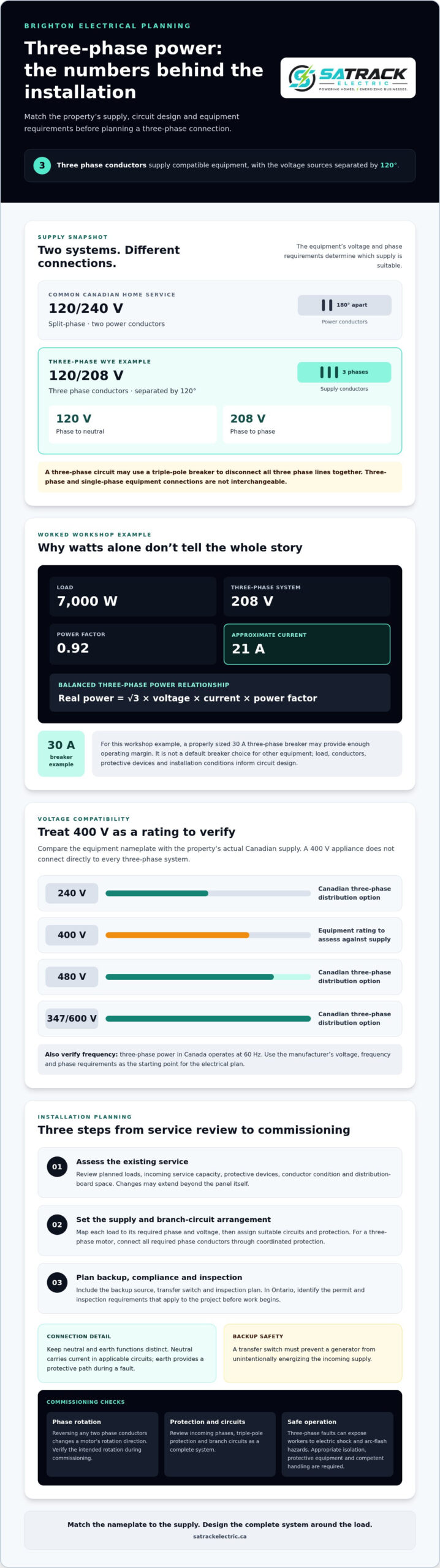
For a three-phase power installation in Brighton, the key difference is the type of electrical supply your property receives. Most Canadian homes use 120/240 V split-phase service, while three-phase power is distributed at 120/208 volts, with three phase conductors separated by 120 degrees. Three-phase supply can suit equipment and electrical loads designed for it, but it isn’t automatically the right choice for every home or business.
If you’re considering three-phase power installation in Brighton, you’ll want to understand what changes at the service, circuit and equipment levels. This guide explains how three-phase power works, how it differs from residential split-phase service, and how the incoming supply connects to circuits and higher-powered equipment. It also covers the practical considerations for deciding whether three-phase power suits your Brighton property.
Key Takeaways
- Match the supply and branch-circuit design to the equipment’s voltage, phase requirements and electrical load.
- A three-phase circuit may use a triple-pole breaker to disconnect all three lines together.
- Use the balanced three-phase power relationship to understand how voltage, current and power factor affect a load.
- Compare the appliance’s requirements with the available service before deciding whether three-phase power is useful for your property.
- For Brighton properties, assess the required voltage and service capacity as part of planning circuits for high-powered equipment.
Connecting incoming supply and branch circuits
Plan the incoming supply, distribution board and branch circuits as one electrical system. The three-phase connection must suit the equipment, circuit protection and backup arrangements.
Check or upgrade the mains connection
Step 1: Have the existing mains connection and distribution board assessed against the planned loads. Review the incoming service, available capacity, protective devices, conductor condition and space for new circuits. A three-phase installation may require changes beyond the panel itself. Avoid choosing a breaker or conductor size by appliance rating alone; circuit design must account for the equipment and installation conditions.
Arrange the new electrical connection
Step 2: Establish the required supply and connection arrangement before adding branch circuits. The chosen voltage and phase configuration must suit each item of equipment, while the distribution board needs suitable protection and circuit capacity. A three-phase circuit may use a triple-pole breaker, which disconnects all three phase lines together. Don’t connect three-phase equipment to a single-phase circuit as though they were interchangeable.
Plan backup connections and compliance checks
Step 3: Include the backup source, transfer switch and inspection plan in the design. In Ontario, identify the permit and inspection requirements applicable to the project before work begins; the work’s scope and connection arrangement affect what applies. Have a qualified Canadian electrician review complex three-phase installations for compliance with the Canadian Electrical Code. A transfer switch must prevent a generator from energizing the incoming supply unintentionally.
- Map each load to its branch circuit. Record whether equipment needs single-phase or three-phase power, then assign circuits and protective devices accordingly. For a three-phase motor, connect all required phase conductors through coordinated protection. Reversing any two phase conductors changes the motor’s rotation direction, so verify rotation during commissioning against the equipment’s intended operation.
- Keep neutral and earth functions distinct in the connection plan. The neutral carries current in applicable circuits; the earth connection provides a protective path during a fault. Do not treat the two as interchangeable at branch circuits. Show their intended terminations on the installation plan, and ensure the distribution-board arrangement matches the supply system.
- Review the complete system before energizing it. Check that the incoming phases, triple-pole protection, branch circuits and transfer switch work as designed. Three-phase faults can expose workers to electric shock and arc-flash hazards, so work requires appropriate isolation, protective equipment and competent handling. Include inspection of the finished installation and safe operation of backup equipment in commissioning.
Three-phase current and 400-volt power
Assess the voltage and phase arrangement equipment requires before planning a supply. A 400-volt rating needs careful comparison with Canadian three-phase options and the property’s electrical distribution.
- Read the equipment nameplate and record its voltage, frequency and phase requirements. Three-phase power in Canada operates at 60 Hz. A machine designed for a different frequency or voltage may not operate as intended on the property’s supply. Use the manufacturer’s rating as the starting point for the electrical plan.
- Understand how the three phases relate. A three-phase supply uses three phase conductors, with voltage sources separated by 120 degrees. This arrangement delivers power to compatible equipment across the phases. The phase relationship is part of the supply design, not simply a higher voltage setting that can be selected at an appliance.
- Distinguish line-to-neutral voltage from line-to-line voltage. On a 120/208-volt Wye system, 120 V is available between a phase and neutral, while 208 V is available between phases. Check whether equipment requires one of these connections. The correct circuit arrangement depends on its nameplate and the building’s supply.
- Use the three-phase power relationship to understand a load’s demand. For balanced loads, real power equals √3 multiplied by voltage, current and power factor. A 7,000 W workshop load on a 208 V three-phase system, with a 0.92 power factor, requires approximately 21 amps. This example shows why wattage alone doesn’t describe the full electrical requirement.
- Compare the calculated demand with the circuit design and operating conditions. A properly sized 30 A three-phase breaker may provide enough operating margin for the workshop example. That figure is not a default breaker choice for other equipment. The load, conductors, protective devices and installation conditions all inform circuit design.
- Treat 400 volts as an equipment rating to assess against the property’s actual Canadian supply. Canadian three-phase distribution options include 240 volts, 480 volts and 347/600 volts. These values don’t mean a 400 V appliance can connect directly to any of them. Compare the manufacturer’s voltage requirements with the available system, then plan compatible equipment and circuits. For practical electrical installation planning, use the nameplate and supply details as the starting point.
Three-phase versus residential split-phase service
Choose a service type based on the loads your property needs to run. For Brighton homes and businesses, equipment compatibility matters more than the panel’s amp rating alone.
- Identify the existing service before planning an upgrade. Most Canadian homes use 120/240 V split-phase power, with two power conductors 180 degrees out of phase. A 120 V household circuit uses one power conductor and neutral; a 240 V appliance connects across both power conductors. The grounding conductor provides protection and is not a substitute for neutral.
- Check whether the equipment needs three-phase power. Canadian three-phase distribution commonly includes 120/208 volts, with phase voltages separated by 120 degrees. This arrangement can supply compatible 120 V and 208 V loads. The equipment nameplate identifies the voltage and phase requirements that determine whether the existing service can run it.
- Don’t assume a larger residential panel means three-phase service. Standalone Canadian homes with 200A or 400A panels generally use split-phase power. Panel capacity describes the service rating, while phase describes the supply arrangement. A business with a large panel may still need different supply infrastructure for three-phase machinery.
- Assess motors by their size and operating needs. Three-phase motors run more smoothly because power continues to be delivered as an individual phase crosses zero. Three-phase power is generally preferable for facilities running motors over 5 hp. Motors smaller than 1 hp are generally more expensive in three-phase versions than comparable single-phase models.
- Compare the electrical demand, not just the number of conductors. At equivalent voltage, three-phase power can provide 1.7 times more power than a single-phase source. Three-phase systems can also use less conductor material for power transmission. The actual benefit depends on the load and the supply arrangement, so match calculations to the equipment.
- Consider how a phase disruption could affect equipment. A disruption to one phase may affect three-phase AC motors, so production equipment may need a planned response to supply interruptions. Identify which processes depend on these motors before deciding how the building should handle an outage.
- Choose the service type around the property’s actual use. For a household with standard 120/240 V appliances, split-phase may be suitable; a workshop operating larger motors may benefit from three-phase supply. Hot tub and spa wiring also depends on the equipment’s electrical requirements. Use the nameplate and total load to guide the assessment.
Applications for high-powered appliances
Assess each appliance using its rating plate and operating requirements. A sauna heater, industrial machine and electric vehicle charger can each have different supply needs.
- Before planning a circuit, record the appliance’s voltage, phase, current and power ratings. Use the manufacturer’s nameplate rather than the appliance’s general category, since similar machines can require different supplies. The ratings show whether equipment is designed for three-phase power or ordinary household circuits.
- Match the supply to the marked voltage and phase. A 400V/16A supply is described for applications such as saunas or industrial machinery, but treat it as an example, not a default Canadian specification. A Brighton installation must match the equipment rating to the Canadian supply available at the property.
- Separate high-power equipment from general-purpose circuits in your load plan. List each appliance’s running demand and when it operates. For example, a commercial kitchen may run heating equipment while motors operate elsewhere in the building. Mapping operating periods helps identify combined demand and plan the distribution system.
- Check whether loads can be distributed across the phases. Record each appliance’s phase requirements and expected use, then arrange compatible circuits to balance demand. This helps prevent too much connected load from accumulating on one phase. Before moving a circuit between phases, confirm its voltage and equipment compatibility.
- Distinguish equipment that needs three-phase power from equipment that simply draws substantial power. A regular 240 V Level 2 charger works for almost all home electric vehicles. That example shows why the appliance’s actual rating matters more than the assumption that every high-power device needs three phases.
- Include start-up and operating patterns in the equipment assessment. Motors and heating elements place different demands on circuits. Record which appliances start together, run continuously or cycle on and off. This schedule gives the electrical designer a clearer picture than maximum ratings alone.
- Before putting a circuit into service, check it against the appliance documentation. Confirm that the supply voltage, phase arrangement, protective device and connection suit the appliance’s rating. If equipment changes later, such as replacing a sauna heater or production machine, reassess its electrical requirements before connecting it to the existing circuit.
What three-phase voltages and service capacities are available in Brighton?
- Start with the equipment ratings and the property’s intended use. Canadian three-phase distribution includes 240 volts, 480 volts and 347/600 volts. These are different supply arrangements, not interchangeable settings. Record each machine’s required voltage, phase and operating demand before planning an upgrade. This gives the assessment a practical basis instead of assuming a familiar voltage will suit every load.
- Identify whether the equipment needs a neutral conductor. A 120V/208V three-phase service can support loads designed for that arrangement, including some farm applications. In some Canadian condos and mixed-use buildings, a 120/208 V Wye system provides 208 V between phases. The building’s distribution arrangement therefore matters when assessing equipment compatibility and new circuit connections.
- Distinguish service voltage from service capacity. Voltage describes the supply available to connected equipment; capacity concerns the total demand the service can support. There is no single capacity for every Brighton property. The existing supply, connected loads and planned equipment all help determine the capacity a business or residence needs.
- Prepare a load schedule before selecting service equipment. List each machine’s voltage, phase, nameplate rating and expected operating pattern, including loads that may run together, such as production equipment and heating appliances. This gives a clearer picture of combined demand than assessing each machine separately and helps guide decisions about the service and distribution system.
- Compare that schedule with the property’s existing electrical system. For example, 120/208 V Wye and 347/600 V services provide different voltages to equipment. The service, panel, conductors and protective equipment must work with both the supply and the connected loads. A voltage label alone doesn’t tell you how much remaining capacity the property has.
- For a three-phase power installation in Brighton, treat voltage options as starting points for a property-specific assessment, not as confirmation that every option is available at every address. The local supply arrangement and building loads shape the practical design. Bring equipment ratings and an operating-load schedule into the planning process before deciding what electrical work is needed.
- Use the assessment to define the required service and plan the next steps. A well-planned three-phase power installation in Brighton connects the equipment’s needs to the property’s incoming supply and distribution system. For a business, organize the equipment list and load schedule before planning an electrical upgrade. Plan your commercial electrical service around the required voltage and capacity.
Satrack Electric: Commercial Electrical Services
Satrack Electric provides Commercial Electrical Services for businesses planning electrical installations, upgrades or repairs. Engage the team when a project needs to account for equipment requirements, existing circuits and service capacity together. Assessing the building’s electrical needs helps shape practical work, whether you’re preparing for new equipment or addressing an issue with an existing system.
Satrack Electric also provides Residential Electrical Services, Electrical Repairs and Electrical Installations. The team handles electrical work in commercial and residential properties, with the scope tailored to the project’s requirements.
Contact Satrack Electric to discuss electrical work for your property.
Plan your next electrical project with confidence
Before committing to a three-phase power installation in Brighton, turn your equipment plans into a practical project brief. Note which machines or appliances you expect to add, how you’ll use them and any planned changes to the property. This gives the electrical assessment a clear starting point and connects your operational needs with the work required at the building.
Consider future needs as well as the immediate installation. Equipment changes can affect circuit planning, so think about how your business or household may use the space later. A considered plan supports informed decisions without assuming one supply arrangement suits every property.
Satrack Electric offers Commercial Electrical Services, Residential Electrical Services and Electrical Repairs. For help with your project, contact Satrack Electric about three-phase power. A clear next step can make it easier to plan the electrical work your property needs.
Frequently Asked Questions
What exactly does three-phase current mean for your home or business?
Three-phase current delivers power through three alternating phase conductors, each offset from the others. Compatible equipment can draw power across the phases rather than relying on a single-phase supply. For example, a business with a three-phase motor must match the supply and connection to the motor’s rating. This setup is not automatically suitable for household appliances designed for standard residential service.
Which electricians install three-phase power in Brighton, Ontario?
Satrack Electric is a licensed and insured electrical contractor serving residential and commercial customers in Brighton and nearby Ontario communities, including Belleville, Trenton, Picton, Quinte West, Brighton, Greater Napanee and Cobourg. Its Commercial Electrical Services and Residential Electrical Services include electrical installations for projects involving a property’s supply and equipment. In Brighton, this work can be planned around a building’s electrical needs, with the scope shaped by the installation and connected equipment.
Does a Brighton property need a three-phase electrical service upgrade?
A property may need a three-phase upgrade when planned equipment requires a three-phase supply and the existing service cannot provide the required connection. Compare the equipment nameplates with the current service and panel information. For example, a business adding a production motor should consider its voltage and phase requirements alongside existing building loads. If the equipment suits the present supply, changing the service type may not be necessary.
How do I apply for a three-phase service connection in Brighton?
Start with an inventory of the equipment, its nameplate ratings and the property’s existing electrical service. An electrical plan can identify the supply, distribution changes and connection work required. The project scope determines which utility coordination, permits and inspections apply in Ontario. Keep equipment details and proposed loads together so the connection requirements can be assessed as one project.
How long does a three-phase power installation take in Brighton?
The timeline depends on the installation scope, the work inside the property and coordination for the incoming supply. Adding circuits to a suitable existing three-phase service differs from arranging a new service connection or upgrading distribution equipment. Planning must also account for applicable permits and inspections. A schedule can be set once the project scope and required steps are clear.
What equipment and wiring are needed for a three-phase installation?
The installation requires equipment matched to the supply, along with suitable distribution equipment, conductors and circuit protection. A three-phase circuit may use a triple-pole breaker to disconnect all three phase lines together. The conductor arrangement, neutral connection and protective earth must suit the system and connected loads. Equipment ratings and installation conditions guide wire and protection choices, since no single cable size or panel arrangement suits every project.
Is three-phase power better than single-phase for a home or business?
Neither supply is better for every property. Most Canadian homes use 120/240 V split-phase service, which suits ordinary household loads. Three-phase can be a practical fit for businesses operating compatible larger motors or machinery. Consider the equipment’s phase and voltage ratings, the combined building load and the work needed to provide the right connection. Choose the arrangement that serves the actual loads, rather than upgrading based on panel size alone.