
Common DIY electrical mistakes to avoid in Brighton include incorrect wiring, poorly supported fixtures, mismatched breakers and wires, and overloaded circuits. Don’t keep resetting a tripped breaker without finding the cause, and use a licensed electrician when the work requires a permit. Warm or discoloured outlets and switches need attention.
It’s understandable to want to handle a small home project yourself, but electrical work can become unsafe when a connection, fixture or circuit is handled incorrectly. This guide to DIY electrical mistakes to avoid in Brighton explains what to watch for and when to leave a repair to a professional.
Learn what to watch for when working with hot, neutral and ground wires, replacing fixtures, matching breakers to wiring and managing circuit loads. You’ll also find out when it’s safer to stop and call a licensed electrician.
Key Takeaways
- Use a stud finder with electrical detection before drilling into a wall, and treat exposed wiring as a serious hazard.
- Before replacing a light fixture or ceiling fan, make sure the support and wiring are suitable for the installation.
- Breaker and wire sizes need to match; common pairings include 14-gauge conductors on 15-amp circuits and 12-gauge wire on 20-amp circuits.
- Repeated breaker trips, new flickering lights, buzzing sounds, or warm and discoloured outlets can signal a problem that needs attention.
- Hire a licensed electrician for work that requires a permit in your area, or when a wiring or circuit issue is beyond your experience.
1. Hot, neutral and ground wiring
Hot, neutral and ground wires serve different purposes in a household circuit. The hot conductor carries current to a device, while the neutral provides its return path. The ground provides a path for fault current if an electrical fault occurs. Mixing up these connections can make equipment unsafe, even if a light or receptacle appears to work. Loose connections can generate heat, and damaged insulation can expose energized conductors.
Don’t rely on wire colour alone to identify a conductor’s function. Previous work may have altered the wiring, or a conductor may be misidentified. Before opening a box, turn off the circuit at the breaker and use a suitable tester to confirm the conductors are de-energized. If you can’t identify each conductor confidently, stop instead of guessing. A switch that works after a repair doesn’t prove the wiring is correct.
Drilling into a wall can puncture hidden wiring. Before drilling, use a stud finder with electrical detection to scan the area. Treat its result as a warning, not proof that every wire has been located. Wiring may run in unexpected directions around switches, receptacles and openings. If you encounter a wire, stop drilling. Don’t push the bit past it or try to move the cable out of the way.
Ontario electrical code requirements apply to wiring work, while permit requirements depend on the task and local rules. Outdoor outlets should have GFCI protection. Smoke-alarm wiring must meet applicable requirements and the manufacturer’s instructions. Don’t improvise a connection or disable an alarm to finish a project.
Among the most dangerous mistakes are touching energized conductors, reversing connections, leaving bare wire exposed and damaging hidden cables. Even a small electrical current can cause severe injury or death. Damaged insulation, loose terminals and incorrect connections can also create heat and fire hazards, even when a device still works.
For a basic visual check, look for cracked insulation, exposed copper, scorch marks or a receptacle that sits loosely in its box. Don’t touch exposed conductors or remove a cover while the circuit may be live. Keep extension cords for temporary use, not long-term runs through windows or under doors, and use outdoor-rated cords outside. Electrical faults aren’t always visible, so stop if wiring is damaged, confusing or different from what you expected.
For a two-slot receptacle, the National Electrical Code allows replacement with a GFCI when its front is labelled “No Equipment Ground.” This approval applies only to that replacement and exact label; it does not mean the receptacle is grounded. Keep the label wording intact and ensure it is visible at the receptacle. If those conditions aren’t met, this rule does not establish that the replacement is approved. Don’t infer other wiring permissions from this one rule.
2. Replacing light fixtures and ceiling fans
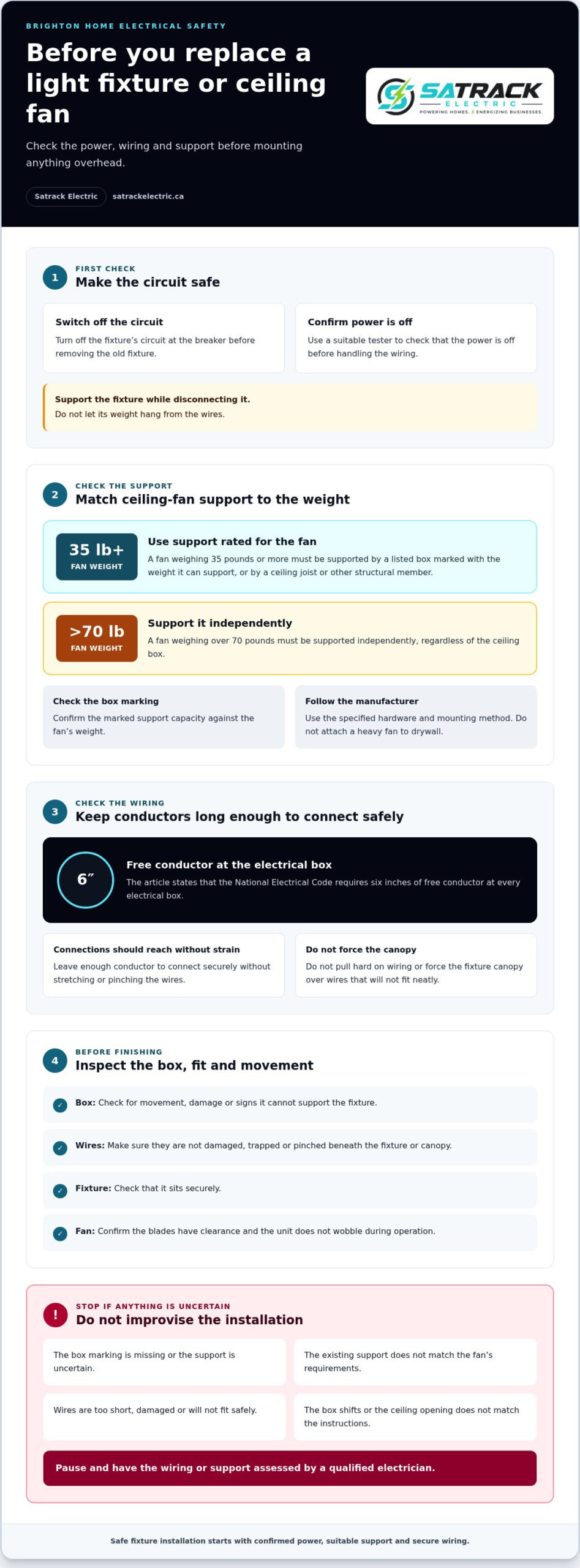
A replacement fixture may look straightforward, but its weight and mounting point matter. Before removing the old fixture, switch off its circuit at the breaker and confirm the power is off with a suitable tester. Support the fixture while disconnecting it instead of letting its weight hang from the wires. Check the electrical box for movement, damage or signs that it cannot support the new fixture. Address a loose or unsuitable box before continuing.
Leave enough conductor inside the box to make secure connections without stretching or pinching the wires. Keep six inches of free conductor at the electrical box. Short, damaged or crowded conductors can be difficult to secure. Don’t pull hard on wiring to gain working room, or force a fixture canopy over wires that won’t fit neatly. If the wires are too short to handle safely, stop instead of improvising an extension.
Ceiling fans need support suited to their weight and movement. A fan weighing 35 pounds or more must be supported by a listed box marked with the weight it can support, or by a ceiling joist or other structural member. A standard light-fixture box may not be suitable for a fan. Check the box marking and the fan’s weight before mounting it. If the marking is missing or the support is uncertain, stop instead of assuming the existing box will hold.
A fan weighing over 70 pounds must be supported independently, regardless of the ceiling box. The fan’s weight needs suitable structural support rather than relying on the box alone. Follow the manufacturer’s mounting instructions, including the specified hardware and support method. Don’t attach a heavy fan to drywall or use screws that don’t engage a structural member. If the ceiling opening or existing support doesn’t match the instructions, don’t improvise a bracket.
After mounting, check that the fixture sits securely and that the canopy doesn’t trap wires. For a fan, confirm that the blades have clearance and the unit doesn’t wobble during operation. Stop if the box shifts, wires are damaged, connections won’t fit, or the support doesn’t match the fan’s requirements. A qualified electrician can handle an installation where the existing box or wiring needs work. For help with a new fixture, consider professional light fixture installation.
The National Electrical Code requires six inches of free conductor at every electrical box. Treat this as a minimum to preserve while preparing the connection, not a reason to pull or stretch a short wire. Make sure the conductors can reach their connections without being pinched beneath the fixture or canopy. If they can’t, pause and have the wiring assessed rather than forcing the fixture into place.
Before finishing the installation, check the box and its support again. A secure-looking canopy doesn’t prove that the box can support a fixture or fan. Check the box marking against the fan’s weight and follow the manufacturer’s mounting instructions. If the support is uncertain or the wiring can’t be connected safely, leave the fixture uninstalled and contact a qualified electrician.
3. Breaker and wire sizing
A circuit breaker must be compatible with the wiring it protects. The breaker is designed to interrupt current when a circuit draws too much. If its rating is higher than the wiring can safely support, it may not protect the conductors as intended. Damaged or overheated insulation can create fire and shock hazards. Don’t replace a tripping breaker with a larger one just to stop it from tripping.
Common pairings are 14-gauge conductors on 15-amp circuits and 12-gauge wire on 20-amp circuits. Wire gauge describes conductor size, and a smaller gauge number generally means a thicker conductor. These pairings are a useful warning against mixing parts, not a complete guide for selecting wiring. Circuit conditions, cable type and installation details also matter.
Before doing any work, identify the breaker and the circuit it serves. Read the breaker marking and check the electrical panel labels, but don’t treat an old handwritten label as proof. The circuit may have changed since it was labelled. If you can’t establish which breaker controls the wiring, stop instead of guessing. Don’t work on energized conductors.
Matching the breaker’s amp rating is not enough. A replacement breaker must also be compatible with the panel and installed as intended. Breakers that look similar may not be interchangeable. A wire’s visible thickness doesn’t confirm its gauge or suitability either. Don’t use an unmarked offcut or substitute cable based on appearance. Leave the circuit’s existing configuration in place until a qualified person can assess it.
Consider a 20-amp breaker connected to wiring intended for a 15-amp circuit. The breaker may allow more current than those conductors are meant to carry before it trips. The mismatch can remain hidden during ordinary use, then become hazardous under heavier demand. A breaker that trips repeatedly also needs investigation, not a higher rating. The underlying cause could involve the circuit, connected equipment or a fault.
If the breaker marking and conductor size don’t seem to match, don’t assume one is wrong and replace it yourself. Note the breaker label and any visible cable markings without opening the panel or touching conductors. An electrician can assess the breaker, wiring, panel compatibility and circuit conditions together. This whole-circuit check matters: changing one component without understanding the others can leave the hazard in place.
4. Circuit loads and when to call an electrician
A circuit can trip when connected equipment draws more current than it can safely supply. For a basic estimate, multiply amps by volts to calculate watts. At 120 volts, a 15-amp circuit is described as able to handle 1800 watts. A 20 amp circuit is described as able to handle 2400 watts. These figures help explain circuit load, but don’t treat them as a reason to operate a circuit at its limit.
Add up the wattage shown on equipment labels to estimate the demand from devices used at the same time. For example, consider a work area where a high-draw tool and other equipment run together. If their combined demand approaches the circuit’s capacity, distribute high-draw tools across different circuits when possible. A tripping breaker is a warning, not a reason to install a larger breaker or keep resetting it.
Don’t repeatedly reset a breaker without finding the cause. Unplug equipment on the affected circuit and note what was running when it tripped. If it trips again, or you notice new flickering lights or buzzing, stop using the circuit and arrange an assessment. These symptoms can point to a wiring, equipment or circuit problem that needs investigation.
In Ontario, electrical work requiring an ESA notification or inspection must follow that process. Whether notification or inspection applies depends on the work. Don’t assume a task is exempt just because it looks small.
For DIY electrical work in Brighton, permit requirements depend on the task and local rules. If the work requires a permit, hire a licensed electrician rather than proceeding without the required permit or inspection. Confirm the scope before starting, especially for changes involving fixed wiring or a circuit.
Before electrical work, switch off the circuit at its breaker and prevent someone from turning it back on. Use a suitable tester to verify the power is off at the work location, and check the tester according to its instructions. A switch being off or a room going dark doesn’t prove every conductor is de-energized. Stop if you can’t identify the correct breaker or verify that conditions are safe.
Use extension cords temporarily, not as permanent substitutes for outlets. Don’t plug multiple power strips into one outlet: adding strips doesn’t increase circuit capacity. If flickering, buzzing or breaker trips continue after you disconnect equipment, leave the circuit alone and call an electrician.
5. When to hire a licensed electrician
Hire a licensed electrician when the work requires a permit in your area. For Brighton homeowners, the task and local permit requirements determine whether DIY work is appropriate. Don’t assume a repair is exempt because it seems small, such as moving a receptacle or changing fixed wiring.
Ontario homeowners should treat permission as specific to the task, not as blanket approval for all electrical work. If the planned work requires a permit, hire a licensed electrician instead of proceeding yourself. Confirm the work’s scope and permit requirements before opening a wall or electrical box.
Some warning signs need prompt attention. Stop using an outlet or switch that feels warm or looks discoloured, and arrange an electrical assessment. A new scorch mark, unusual odour or crackling sound is also a reason to stop work and avoid touching the affected fitting. Don’t cover the mark or keep using the outlet to see if it happens again.
Get professional help if existing wiring is damaged, its connections are unclear or the work differs from what you expected. For example, opening a box may reveal crowded conductors, an unexpected splice or cracked insulation. Don’t force wires into place or leave the box open while deciding what to do. Step back and keep others away from exposed wiring.
A licensed electrician is also the right choice when a project involves changes beyond a straightforward replacement. Work affecting fixed wiring, an electrical panel or a new circuit needs an assessment of the complete installation. The electrician can determine the work’s scope and whether an ESA notification or inspection applies. Avoid relying on an online tutorial to settle local permit requirements.
To find a licensed electrical contractor serving Brighton, look for a contractor who handles the work you need and is licensed for electrical work in Ontario. Describe the symptoms or planned project clearly, such as a warm switch, damaged wiring or an installation. That information helps define the work and the relevant next steps. For electrical work at home, arrange residential electrical service.
The practical rule is simple: stop if the task requires a permit, the wiring is damaged or warning signs appear. A warm or discoloured outlet is not a cosmetic issue to conceal. Leave the circuit unused and arrange a professional assessment rather than trying to repair it without understanding the cause.
DIY work is appropriate only when the task and local permit requirements allow it. A licensed electrician should handle work that requires a permit.
Work affecting fixed wiring, an electrical panel or a new circuit needs assessment by a licensed electrician, who can determine whether an ESA notification or inspection applies.
Permit and inspection requirements depend on the work’s scope and local rules. Confirm them before starting; a licensed electrician can determine whether an ESA notification or inspection applies.
Satrack Electric: Commercial Electrical Services
Satrack Electric provides residential and commercial electrical services, including repairs and installations. Turn to the team when a fixture, damaged wiring or recurring circuit issue needs professional attention, or when a project is beyond a safe DIY task. For homes and businesses in Brighton, Belleville, Trenton, Picton, Quinte West, Greater Napanee, Cobourg and surrounding communities, an assessment can address the underlying issue instead of relying on repeated resets or temporary fixes.
Describe what you’ve noticed, such as a warm switch, flickering lights or a breaker that trips during normal use. Details about the affected area and recent work can help explain the problem. Contact Satrack Electric to discuss electrical repairs or installations for your property.
Make your next electrical decision a safe one
Choosing what to tackle yourself is part of responsible home maintenance. If a project becomes uncertain, pause before making another connection or changing a component. Note what you were trying to do, what changed and any symptoms you noticed. Those details can help an electrician understand the situation and determine the next step.
The goal isn’t to master every repair. It’s to recognize when a task needs professional assessment and avoid turning uncertainty into a bigger problem. DIY electrical mistakes to avoid in Brighton often start with an unverified assumption, so take a measured approach and leave complex or permit-required work to a licensed professional.
Satrack Electric provides residential and commercial electrical services, including electrical repairs. For help deciding on a safe next step for your home or business, contact Satrack Electric. You can move forward with a clearer plan and greater confidence.
Frequently Asked Questions
What are common mistakes when replacing outlets, switches, or light fixtures?
Common errors include connecting conductors to the wrong terminals, leaving a receptacle loose in its box and choosing a fixture that the existing support can’t hold. A multi-way switch can also be wired incorrectly if you assume its connections match those of a standard switch. Before disconnecting anything, document the existing arrangement and compare it with the replacement device’s instructions. Stop if the wiring differs or its purpose is unclear.
Why should homeowners avoid oversized breakers, overloaded circuits, and incorrect wire sizes?
Breakers protect circuit wiring, so an oversized breaker may allow more current than the conductors are designed to carry. Incorrect wire size can overheat under demand, and an overloaded circuit may trip or show other warning signs. Adding power strips doesn’t increase a circuit’s capacity. Don’t treat a larger breaker as a fix for trips; have the cause assessed before changing circuit components.