
Could your facility’s current electrical infrastructure be the primary bottleneck preventing your business from adopting new, revenue-driving technologies? Most Ontario business owners recognize that keeping pace with modern power demands is essential, yet the prospect of a commercial electrical panel upgrade in Ontario often brings concerns about operational downtime and complex regulatory hurdles. You likely want a system that is safe and efficient without the stress of failing an inspection or facing insurance complications.
This guide provides the professional clarity you need to modernize your power infrastructure while remaining fully compliant with the 2024 Ontario Electrical Safety Code. You’ll learn how to manage ESA permits effectively, transition to higher-capacity systems, and ensure your facility meets the latest safety standards to protect your equipment. We provide a methodical look at the technical requirements and logistical steps necessary to future-proof your operations with confidence.
Key Takeaways
- Understand the legal requirements for a commercial electrical panel upgrade in Ontario, including the necessity of ESA permits and the mandatory use of Licensed Electrical Contractors.
- Identify the specific warning signs that your facility’s electrical capacity is reaching its limit, such as frequent breaker tripping or flickering lights during peak hours.
- Learn how professional load calculations and facility audits help you modernize your infrastructure to accommodate high-amperage equipment and future technology.
- Discover the methodical steps involved in coordinating with local utilities to ensure a safe, code-compliant transition that prioritizes business continuity.
Understanding the Importance of a Commercial Electrical Panel Upgrade in Ontario
A commercial electrical panel upgrade in Ontario involves more than just swapping out old breakers. It is a comprehensive modernization of your facility’s electrical service, typically involving an increase in total amperage and the replacement of obsolete hardware. This process ensures your building can safely handle the electrical loads required by modern equipment. The electrical panel acts as the central hub for power distribution. Understanding What is a Commercial Electrical Panel? is essential because this component serves as the “brain” of your building. It divides the main electrical power feed into subsidiary circuits while providing a protective circuit breaker for each.
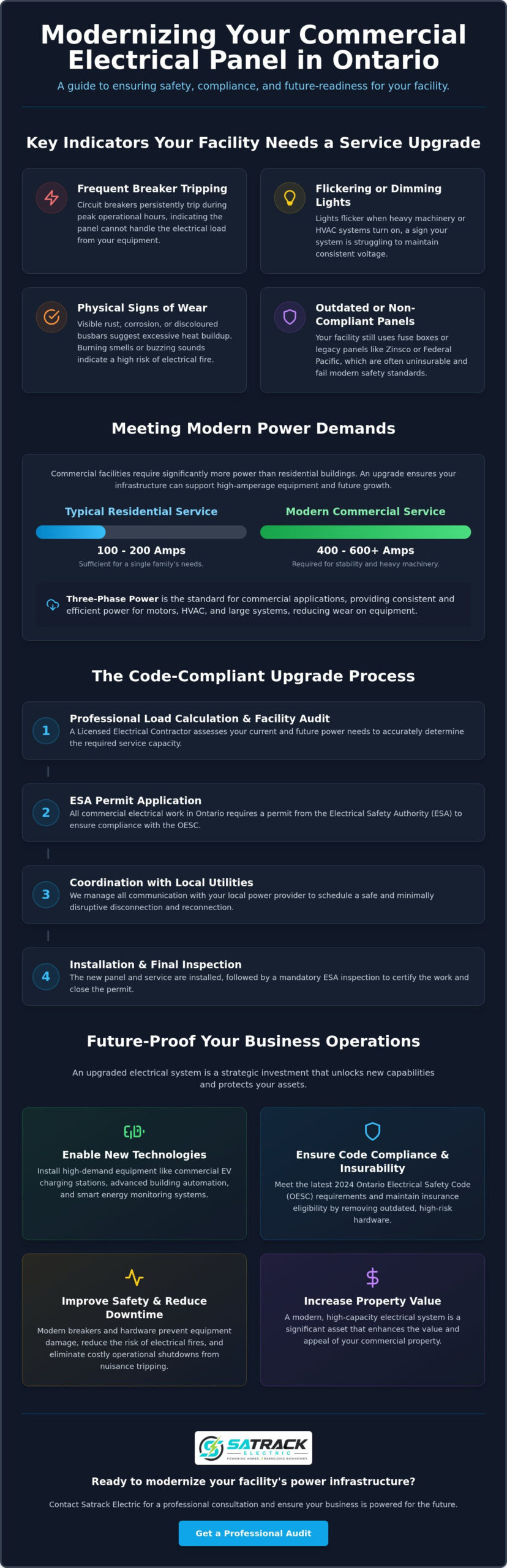
In 2026, Ontario businesses face unprecedented power demands. The push toward full electrification means facilities now require more energy for high-efficiency heat pumps and digital infrastructure than they did even five years ago. While a residential panel typically services a single family’s needs with 100 to 200 amps, commercial requirements are far more rigorous. A commercial electrical panel upgrade Ontario often moves a facility toward 400 or 600 amp services to maintain stability during peak operational hours. Failing to address these capacity needs can lead to equipment damage or unexpected shutdowns.
The Shift to Three-Phase Power for Modern Businesses
Standard residential systems use single-phase power, but this is rarely sufficient for industrial or large-scale commercial applications. Three-phase power is the delivery of three alternating currents to ensure consistent torque for motors. This consistency is vital for heavy machinery, large HVAC systems, and extensive lighting arrays. By distributing the load across three phases, your system operates with greater efficiency and less vibration in motorized equipment. This shift reduces wear and tear on expensive assets and lowers long-term maintenance costs for your facility.
Enabling New Technologies: EV Charging and Smart Systems
Modernizing your panel is often a prerequisite for adopting revenue-driving technologies. Outdated panels frequently act as bottlenecks that prevent the installation of commercial EV charging stations or advanced building automation. Preparing your facility for smart energy monitoring allows you to track consumption in real-time, which is a key strategy for managing overhead. There is also a direct link between modern panels and insurance eligibility. Many providers in Ontario now refuse to cover properties with legacy hardware, such as Federal Stab-Lok or Zinsco panels, due to their documented safety risks. Upgrading ensures your business remains insurable and protected from liability.
- Increased Amperage: Move from 200A to 400A or higher to support growth.
- Code Compliance: Meet the latest 2024 OESC requirements for safety.
- Reduced Downtime: Modern breakers prevent nuisance tripping and electrical fires.
- Future Readiness: Create space for smart building sensors and EV infrastructure.
Key Indicators Your Ontario Facility Requires a Service Upgrade
Identifying the need for a commercial electrical panel upgrade in Ontario requires consistent vigilance from facility managers. One of the most common signs is persistent circuit breaker tripping during peak operational hours. When multiple pieces of high-amperage equipment run simultaneously, an undersized panel cannot regulate the load. You might also notice lights flickering or dimming when heavy compressors or motors engage. These symptoms indicate that your system is struggling to maintain a consistent voltage, which often leads to long-term hardware damage. Adhering to Canadian electrical safety standards is the best way to ensure these issues don’t escalate into workplace hazards.
Physical inspection often reveals deeper mechanical issues. Check your electrical room for rust, corrosion, or discolouration on the panel’s busbars. Discoloured metal usually suggests excessive heat buildup, which can lead to a catastrophic failure. If you detect burning smells or hear a distinct buzzing sound near the enclosure, the risk of an electrical fire is high. Additionally, if your facility still relies on fuse boxes or outdated brands like Zinsco or Federal Pacific, your system is likely non-compliant with modern insurance requirements and should be replaced immediately. Older commercial buildings may also contain aluminum wiring replacement Ontario concerns, as unmitigated aluminum wiring can significantly increase insurance premiums and pose serious fire hazards that compound the risks of an already strained electrical system.
Analyzing Power Quality and Voltage Drops
Voltage drops are particularly damaging to sensitive commercial electronics. Point-of-sale (POS) systems, servers, and specialized industrial computers require stable power to function correctly. Frequent voltage fluctuations cause internal components to degrade prematurely. The cost of replacing a single industrial controller often exceeds the investment in a panel upgrade. Professional inspections now use thermal imaging to identify hot spots within the panel that aren’t visible to the naked eye. If you suspect your power quality is declining, scheduling regular electrical maintenance can help identify these hidden risks.
Capacity Planning for Business Expansion
Business expansion often pushes a standard 200A service beyond its safe limits. Simply adding a new circuit is not a viable solution if the main busbar is already at capacity. Many businesses resort to daisy-chaining power bars or extension cords to compensate for a lack of outlets. This practice is a significant fire hazard and a major code violation. If you are adding new floor equipment or expanding your office footprint, a full service upgrade is the only way to ensure reliable power distribution. Modernizing your panel provides the necessary headroom for growth without compromising the safety of your staff or property.
- Frequent Breaker Tripping: A clear sign the current load exceeds the panel’s capacity.
- Physical Deterioration: Rust or corrosion on the enclosure or internal components.
- Obsolete Hardware: The presence of legacy brands known for safety failures.
- Flickering Lights: Indicates voltage instability when heavy machinery starts up.
Navigating Ontario Electrical Safety Code (OESC) and Permit Requirements
Every commercial electrical panel upgrade in Ontario must begin with a formal permit application through the Electrical Safety Authority (ESA). This is a legal mandate established by the Ontario Electrical Safety Code (OESC), which serves as the primary provincial standard for all electrical installations. Attempting to bypass this process places your business at significant risk. Provincial fines for non-compliance are substantial, but the greater danger lies in insurance liability. If an electrical fire occurs and the work was not permitted and inspected, your provider will likely deny the claim, leaving your business to absorb the total cost of the damage.
Only a Licensed Electrical Contractor (LEC) can pull permits for commercial work in Ontario. Business owners or general maintenance staff are not authorized to perform these upgrades themselves. This regulation ensures that the person responsible for your facility’s power has the specific training and insurance required to meet 2026 safety standards. The current edition of the OESC includes updated rules for Electric Vehicle Supply Equipment (EVSE) and energy storage systems, reflecting the province’s shift toward electrification. Your contractor must be well-versed in these specific amendments to ensure your facility passes its review without delay. The same permit and inspection requirements apply to residential electrical projects as well; for example, understanding the hot tub wiring cost Ontario homeowners face illustrates how ESA permit fees and OESC bonding rules affect every type of electrical installation across the province.
The ESA Inspection Process for Commercial Properties
The inspection workflow typically follows a methodical three-stage process. First, a rough-in inspection occurs before any walls are closed, allowing the inspector to verify the wiring and grounding. The service inspection follows, focusing specifically on the new panel and its connection to the utility grid. Finally, the inspector conducts a final walkthrough once all equipment is connected and operational. Upon successful completion, the ESA issues a Certificate of Acceptance. You should keep this document in your permanent business records, as it is often requested during building sales or insurance renewals.
Liability and Insurance Compliance in Ontario
Hiring a professional ensures more than just a working panel; it provides a layer of legal protection. A qualified contractor maintains active WSIB coverage and significant liability insurance to protect your property during the installation. You can learn more about verifying these qualifications by consulting a licensed electrician Belleville to understand why credentials are the foundation of facility safety. Ensuring your contractor is fully licensed and insured mitigates the risks of workplace accidents and ensures that your commercial electrical panel upgrade Ontario meets every provincial regulation.
- LEC Requirement: Only Licensed Electrical Contractors can legally pull commercial permits.
- Certificate of Acceptance: Your proof of code compliance for insurance and legal records.
- WSIB Coverage: Protects your business from liability in the event of an on-site injury.
- OESC Compliance: Ensures your system meets the latest 2026 technological and safety standards.
The Step-by-Step Commercial Panel Replacement Process
A commercial electrical panel upgrade in Ontario follows a disciplined timeline to ensure safety and operational continuity. The process begins with a comprehensive load calculation and facility audit. This technical assessment determines your building’s peak power demand and ensures the new service can handle both current equipment and future growth. Once the requirements are confirmed, your contractor manages the logistics of securing ESA permits and coordinating with local utilities, such as Elexicon or Hydro One, to schedule the necessary service disconnect. This coordination is vital to prevent administrative delays during the installation phase.
Preparation is the foundation of a successful hardware swap. Technicians meticulously label every existing circuit to ensure an organized transition to the new system. If your facility houses sensitive data or perishable goods, we may implement temporary power solutions to keep critical systems online. The physical replacement involves removing the legacy enclosure and installing a modern, high-capacity distribution board. After the hardware is mounted and wired, the system undergoes rigorous testing. The final stage involves the ESA inspection and the creation of a detailed circuit map, which provides your facility manager with a clear directory of the building’s power distribution.
Minimizing Operational Downtime
Protecting your business from unnecessary disruption is a primary goal during a commercial electrical panel upgrade Ontario. We often schedule these upgrades during off-hours or over weekends when facility activity is at its lowest. For businesses that require constant uptime, such as medical clinics or data centres, the use of temporary generators keeps critical servers and refrigeration units operational. Clear communication with your staff and customers is also essential. Providing advance notice of a scheduled outage maintains professional trust and allows your team to plan their workflows accordingly.
Upgrading Subpanels and Distribution Boards
A main panel upgrade often necessitates the replacement of secondary subpanels to maintain system integrity. This ensures that the increased amperage flows safely throughout every section of your facility. Organizing the electrical room during this process improves accessibility and simplifies future electrical maintenance. Every new breaker must be correctly sized for its specific commercial load, from high-draw manufacturing machinery to standard office lighting. This methodical approach prevents nuisance tripping and ensures your entire electrical infrastructure operates at peak efficiency.
- Load Calculation: Verifying that your new service matches your facility’s actual power needs.
- Utility Coordination: Managing the disconnect and reconnect with providers like Hydro One.
- Circuit Mapping: Providing facility managers with a clear, updated directory of all breakers.
- Load Balancing: Distributing power evenly across phases to prevent system strain.
Future-Proofing Your Business with Satrack Electric’s Upgrades
Satrack Electric provides specialized commercial electrical services designed for the unique infrastructure of the Quinte region. We understand that a commercial electrical panel upgrade in Ontario is a significant investment in your facility’s operational future. Our team approaches every project with a focus on professional assurance and unwavering reliability, ensuring that your new system provides the stability required for high-demand environments. Our commitment to quality workmanship means we strictly adhere to the 2024 Ontario Electrical Safety Code (OESC), protecting your business from the risks associated with substandard installations.
Managing the administrative side of an upgrade can be a burden for busy facility managers. We handle the entire ESA permit and inspection workflow on your behalf, from the initial application to the final Certificate of Acceptance. This methodical approach ensures that your project remains on schedule and fully compliant with provincial law. Beyond the physical installation, we offer structured electrical maintenance plans. These long-term strategies are designed to monitor the health of your new distribution board, preventing minor issues from developing into costly equipment failures or unexpected downtime.
Serving the Quinte West and Eastern Ontario Business Community
Our team possesses deep knowledge of local utility requirements across Belleville, Picton, and Cobourg. Whether you operate a retail storefront, a manufacturing plant, or a professional office suite, we provide electrical solutions tailored to your specific sector. We recognize that different industries have varying power profiles; industrial motors require different load management than high-density server rooms. For more detailed information on local regulations and regional service standards, you can explore our commercial electrical upgrades in Belleville to see how we support business owners in the area.
Requesting Your Commercial Consultation
The first step toward a safer facility is a professional load assessment. We don’t believe in generic estimates; instead, we conduct a thorough audit of your current consumption and future growth plans before providing a quote. This accuracy allows us to deliver transparent timelines and comprehensive downtime management plans that respect your operational needs. We prioritize clear communication so you know exactly when to expect service interruptions and when your new system will be fully online. Contact Satrack Electric today for a professional commercial electrical panel upgrade in Ontario and secure a dependable power foundation for your business.
- Local Expertise: Serving Belleville, Trenton, and the surrounding Quinte region.
- Regulatory Management: Full coordination of ESA permits and inspections.
- Industry-Specific Solutions: Tailored upgrades for retail, industrial, and office facilities.
- Transparent Planning: Detailed load assessments and downtime management strategies.
Securing Your Facility’s Power for the Future
Modernizing your electrical infrastructure is an essential step for maintaining operational safety and business continuity. By adhering to the 2024 Ontario Electrical Safety Code and recognizing the early warning signs of system strain, you protect your property from the risks of electrical failure and insurance complications. A methodical approach to your power distribution ensures that your building remains capable of supporting the high-capacity technologies required in today’s market.
Investing in a commercial electrical panel upgrade Ontario is a strategic decision, and it’s one that requires a partner who values safety and precision. Satrack Electric is a fully licensed and insured Ontario electrical contractor with over a decade of experience serving Belleville, Trenton, and the surrounding Quinte region. Our expertise in OESC compliance ensures that every installation meets the highest provincial standards. We invite you to Book Your Commercial Electrical Consultation with Satrack Electric to discuss your facility’s specific needs. Taking this step now provides the peace of mind that your business is powered by a safe and reliable system built for long-term growth.
Frequently Asked Questions
Do I legally need a permit to upgrade my commercial electrical panel in Ontario?
Yes, you legally require an Electrical Safety Authority (ESA) permit for any commercial electrical panel upgrade in Ontario. This mandate ensures that the installation meets the provincial safety standards established by the Ontario Electrical Safety Code. Failing to secure a permit can lead to significant provincial fines and may invalidate your property insurance coverage in the event of an electrical fire or equipment failure.
How long does a commercial electrical panel upgrade typically take?
Most commercial panel replacements are completed within a single business day, typically taking between 8 and 12 hours of active work. However, the total project timeline includes several weeks of preparation for load calculations, permit approvals, and utility coordination. Larger industrial facilities or complexes requiring extensive subpanel work may need a multi-day phased approach to ensure all circuits are correctly integrated and tested.
What is the difference between a residential and commercial panel upgrade?
The primary differences lie in power capacity and phase configuration. While residential panels use single-phase power for standard household loads, a commercial electrical panel upgrade in Ontario often involves transitioning to three-phase power to support heavy machinery and large HVAC systems. Commercial panels are built to handle much higher amperage and voltage levels than the 100 or 200-amp services found in most homes. Residential electrical projects, such as understanding the hot tub wiring cost in Ontario, demonstrate how even single-phase residential panel capacity directly affects the feasibility and safety of high-draw home installations.
Will my business lose power during the electrical panel replacement?
Yes, a scheduled power outage is required to safely disconnect the existing service and install the new distribution board. We work closely with facility managers to schedule these outages during off-hours, such as evenings or weekends, to minimize the impact on your operations. For businesses with critical systems that cannot be powered down, we can often arrange for temporary generator power to keep essential services running.
How much does a commercial electrical service upgrade cost in Ontario?
The total investment for a service upgrade depends on several variables, including the required amperage, the condition of existing wiring, and utility connection fees. Other factors that influence the final amount include the cost of the Electrical Safety Authority permit and any necessary structural modifications to the electrical room. Every facility has unique requirements, so a professional load assessment is necessary to determine the specific scope of work for your property.
Can I upgrade my own business’s electrical panel if I am the owner?
No, business owners in Ontario are not legally permitted to perform their own commercial electrical work. Provincial law requires that a Licensed Electrical Contractor (LEC) with a valid ECRA/ESA licence completes all commercial installations and upgrades. This regulation exists to ensure that high-voltage systems are handled by qualified professionals who carry the necessary liability insurance and WSIB coverage to protect the property and the public.
What is the Electrical Safety Authority (ESA) and why do they inspect panels?
The Electrical Safety Authority (ESA) is the administrative body responsible for enforcing the Ontario Electrical Safety Code across the province. They inspect electrical panels to verify that the installation is safe and compliant with current regulations. An ESA inspection provides an independent safety audit, ensuring that the work performed by your contractor meets the rigorous standards required to prevent electrical hazards and property damage.
How often should a commercial electrical panel be inspected or upgraded?
It’s advisable to have a professional inspection of your commercial panel every three to five years to check for loose connections or thermal damage. An upgrade is usually necessary when you add new high-draw equipment, expand your facility, or when the existing panel exceeds 25 years of age. Regular maintenance helps identify when your current infrastructure can no longer safely support your business’s evolving power demands.