
That “plug-and-play” hot tub deal might seem like a bargain until the first January blizzard hits and your water temperature starts to plummet. You’ve likely spent weeks researching the perfect spa, only to realize the electrical requirements are more complex than just finding a spare outlet. It’s common to feel overwhelmed by the technical jargon surrounding your hot tub wiring cost Ontario project, especially when you’re worried about your home’s electrical panel capacity or hidden permit fees.
You deserve a backyard retreat that is both safe and efficient. This guide simplifies the budgeting process by breaking down the essential investment factors, from the $181 ESA permit fee to the critical 2024 OESC bonding rules that protect your family from stray voltage. We will explore how dedicated circuits ensure your tub stays hot during an Ontario winter and why a professional installation is the only way to validate your home insurance. By understanding these requirements now, you can ensure your investment remains a source of relaxation rather than a series of unexpected technical hurdles.
Key Takeaways
- Learn about the mandatory ESA permit process and how the 2024 Ontario Electrical Safety Code updates impact your specific installation requirements.
- Identify the primary factors that influence your hot tub wiring cost Ontario, including cable distance and the necessity of a dedicated GFCI disconnect.
- Compare the performance of 120V versus 240V systems to ensure your spa can efficiently maintain temperature during extreme winter weather.
- Understand the importance of a professional load calculation to determine if your current electrical panel can safely handle the additional demand.
- Protect your property and investment by verifying that all work meets the standards required to keep your home insurance and manufacturer’s warranty valid.
What Influences Hot Tub Wiring Cost in Ontario?
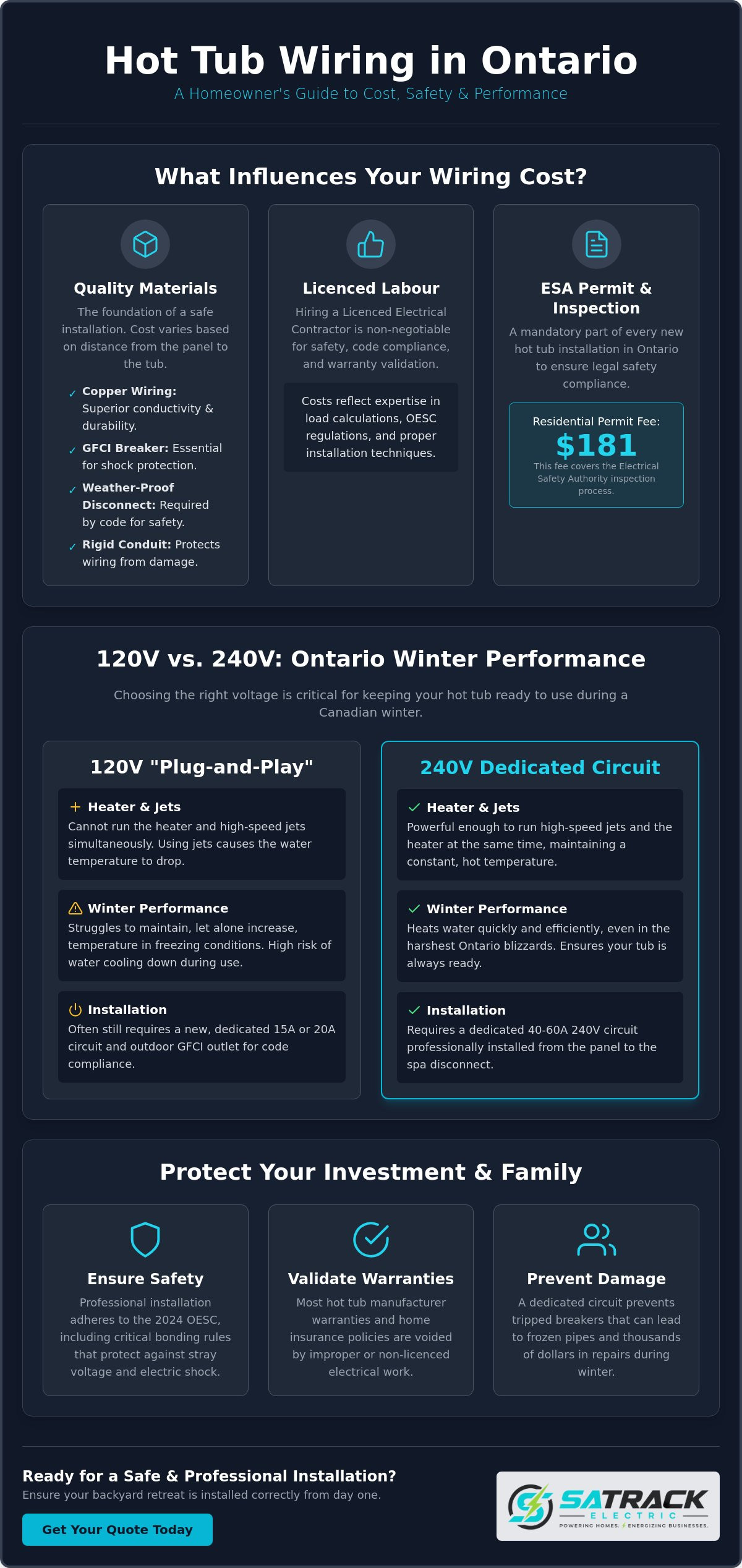
Professional hot tub wiring refers to a dedicated electrical circuit that runs directly from your main electrical panel to the spa unit. This setup is a requirement for both safety and peak performance. When calculating your hot tub wiring cost Ontario project, you must account for three primary pillars: high-quality materials, skilled labour from a licensed contractor, and mandatory regulatory fees. Even “plug-and-play” models, which are often marketed as simple additions, usually require a dedicated outdoor outlet to comply with the Canadian Electrical Code (CEC) and Ontario-specific amendments. Relying on an existing general-purpose outlet can lead to overloaded circuits and potential fire hazards.
The physical distance between your electrical panel and the tub location is one of the most significant variables in any estimate. Longer runs require more copper wire and conduit, which adds to the material expense. They also increase the time needed for installation, particularly if the route involves trenching through a backyard or navigating through a finished basement. Every additional metre of wiring adds to the complexity of the job and the total investment required for a safe installation.
The Role of a Dedicated Circuit
A dedicated circuit ensures your spa doesn’t share power with other household appliances like air conditioners or kitchen equipment. This isolation is critical for preventing nuisance tripping. If a breaker trips while you’re away during a freezing Ontario winter, the water could freeze within hours. This often leads to burst pipes and thousands of dollars in equipment damage. This isolation also protects the sensitive digital control boards of modern spas from power surges caused by other high-draw appliances in your home. It’s a fundamental step in protecting your investment.
Materials and Component Quality
Quality components are non-negotiable for high-amperage loads. Licensed professionals typically prioritize copper wiring because it handles heat more effectively than aluminum in these specific applications. While aluminum is sometimes used for main service entries, copper is the standard for the final run to a hot tub due to its superior conductivity and durability. If your home was built between the 1960s and 1970s, you may also want to review our comprehensive guide to aluminum wiring replacement in Ontario before proceeding, as existing aluminum wiring in your home can affect the safety and compatibility of your new spa circuit. Several factors that influence the final hot tub wiring cost Ontario homeowners pay include the choice of these high-grade materials:
- GFCI Breakers: These are essential life-safety components that shut off power instantly if a ground fault is detected, preventing electric shock.
- Weather-proof Disconnect: A manual shut-off switch must be located within sight of the hot tub but at a safe distance to meet safety codes.
- Rigid Conduit: Using durable, weather-proof conduit protects the wiring from moisture, UV rays, and physical damage over time.
Regulatory fees also play a part in the total budget. In Ontario, an Electrical Safety Authority (ESA) permit is mandatory for all new spa installations. As of April 2026, the fee for a residential hot tub or spa permit is $181. This fee covers the inspection process, which is necessary to ensure the work complies with the 2024 Ontario Electrical Safety Code. Choosing high-quality materials and following these regulations reduces long-term maintenance expenses and provides total peace of mind.
Ontario Electrical Safety Code (OESC) and ESA Permit Requirements
Compliance with the Ontario Electrical Safety Code (OESC) is a legal obligation under Ontario Regulation 164/99. This regulation ensures every high-voltage installation meets rigorous standards to prevent fire and electrocution. Every new spa installation in the province requires an Electrical Safety Authority (ESA) permit. This permit is more than just a line item in your hot tub wiring cost Ontario budget; it is your verification that the work is safe. Attempting to bypass this process can lead to significant fines and may compromise the safety of your family.
The ESA Permit and Inspection Cycle
When you hire a professional for residential electrical services, they handle the administrative burden of the ESA process. The cycle begins with a “Notification of Work” filed before the installation starts. This alerts the ESA that a high-amperage installation is occurring at your address. A licensed contractor manages this coordination, ensuring that the inspector arrives at the correct phase of construction, such as when trenches are open but before they are backfilled. Once the wiring is complete and inspected, the ESA issues a “Certificate of Acceptance”. The current permit fee of $181 is a fixed cost that ensures an independent inspector validates the wiring, grounding, and bonding of your new spa.
Safety Clearances and Grounding
Specific safety components are non-negotiable under the 2024 OESC. A Ground Fault Circuit Interrupter (GFCI) must be installed to detect tiny leaks of current and shut off power in milliseconds. Additionally, the manual disconnect switch must follow the “5-foot rule”. It must be located at least 1.5 metres (approximately 5 feet) from the water’s edge to prevent someone from touching the switch while still in the tub, yet it must remain within sight of the spa for emergency access. The code also dictates strict clearances for surrounding infrastructure. For instance, hot tubs cannot be placed directly under overhead power lines without significant vertical clearance. Existing receptacles within 3 metres of the tub must be GFCI protected or moved to a safer distance.
Recent updates in 2026 have introduced more stringent bonding requirements to mitigate the risk of electric shock from stray voltage. A No. 6 AWG bare copper bonding wire must now be installed in a ring shape around the perimeter of tubs placed on the ground or on a concrete slab. This ring must be buried between 100 mm and 150 mm deep. This “equipotential bonding” prevents dangerous voltage differences between the ground and the water. Securing a “Certificate of Inspection” upon completion is vital for maintaining your home insurance coverage. Most providers will deny claims related to electrical fires if unpermitted work is discovered during an investigation. This document acts as a legal shield, proving that your installation was performed by a qualified professional according to the highest provincial standards.
120V vs. 240V: Performance Costs in Canadian Winters
Choosing between a 120V “plug-and-play” model and a hardwired 240V system is a decision that impacts your hot tub wiring cost Ontario project and your long-term satisfaction. While a 120V tub offers a lower entry price, it often struggles to meet the demands of a local winter. The primary performance limitation is that 120V heaters typically provide only 1kW of power. This is rarely enough to offset the rapid heat loss that occurs when the ambient temperature drops below freezing. In contrast, a 240V system utilizes a 4kW to 5.5kW heater, providing the thermal output necessary to maintain a steady 104°F even during a Quinte West cold snap.
Performance limitations extend to how the spa operates. Most 120V models cannot run the heater and the jet pump on high speed simultaneously. When you turn on the jets for a massage, the heater shuts off, causing the water temperature to drop steadily while you’re using the tub. A 240V circuit provides the “headroom” required to power all components at once. This reduces the amperage strain on individual parts, which often leads to a longer lifespan for the pumps and control boards. Adhering to the Ontario Electrical Safety Code requirements for hot tubs ensures that whichever voltage you choose, the installation remains safe and compliant with provincial standards.
Heating Efficiency in Cold Climates
The physics of heat loss are unforgiving in sub-zero temperatures. When you open the cover of a hot tub in an Ontario January, the steam rising represents a massive energy transfer to the cold air. A 120V heater simply lacks the wattage to recover this lost heat in real-time. This often results in a soak that starts at 104°F but drops to 98°F before you’re ready to get out. A 240V electrical connection is essential for year-round outdoor use in Ontario to ensure the water remains at a safe and comfortable temperature regardless of the external weather conditions. This reliability is why most homeowners eventually regret the 120V “convenience” once the first blizzard arrives.
Long-Term Operating Costs
Investing more in your initial hot tub wiring cost Ontario budget for a 240V line actually saves money on your monthly utility bills. Research indicates that a 240V hot tub in Ontario costs between $25 and $40 per month to operate, while a 120V model costs approximately $15 to $20. However, these figures don’t tell the full story. Because a 120V heater must run for significantly longer periods to reach or maintain temperature, it experiences more wear and tear. A 240V system is more efficient because it reaches the target temperature faster and stays there with less effort. Furthermore, installing a 50-amp dedicated line is a form of future-proofing. It adds tangible value to your property, as future buyers will appreciate having the infrastructure already in place for a full-sized, high-performance spa.
The Installation Journey: Preparing Your Panel and Property
Installing a high-performance spa involves a structured, multi-step process that ensures your home remains safe and compliant. The journey begins with a formal load calculation. This technical assessment determines if your home’s current service can handle an additional 40 to 60 amps without compromising other essential systems. If your home already utilizes an electric range, dryer, and central air conditioning, adding a hot tub could push a standard service to its limit. This calculation is a critical component of your hot tub wiring cost Ontario estimate, as it identifies the need for infrastructure changes before any physical work begins.
Once the capacity is confirmed, the electrician determines the most efficient cable route. An interior route through a basement or crawlspace often protects the wire from the elements and can be more cost-effective. However, if the basement is finished, an exterior route using weather-proof conduit might be the preferred option to avoid cutting into drywall. For a broader understanding of how exterior cable routes must meet provincial standards, our comprehensive guide to outdoor electrical wiring in Ontario covers the 2024 OESC requirements for weatherproof installations in detail. The final stage involves the physical installation of the GFCI disconnect and the ground ring. Every connection is tightened to specific torque requirements to prevent arcing, followed by a final ESA inspection to close the permit and verify the installation’s safety.
Is Your Electrical Panel Too Small?
Older homes in Ontario often feature 100-amp electrical panels. While this was sufficient decades ago, modern high-draw spas frequently require a residential electrical panel upgrade to 200 amps. Signs that your panel is struggling include flickering lights when large appliances start or breakers that trip for no apparent reason. In some cases, installing a dedicated outdoor sub-panel can be a strategic way to manage power distribution for your spa and future backyard lighting without a full service boost. If you are unsure about your home’s capacity, contact a licensed electrician for a professional load assessment.
Conduit and Trenching Standards
Under OESC Section 68, buried electrical lines must meet specific depth standards to remain safe from gardening tools and the natural movement of the earth. For direct-buried cables, this typically means a depth of 600 mm. If the wire is protected by rigid conduit, this depth can sometimes be reduced, though local conditions in the Quinte region often dictate deeper trenches to account for the heavy frost line. Choosing between PVC and rigid metal conduit depends on the level of physical protection required. While PVC is common for its moisture resistance, rigid metal offers superior protection in high-traffic areas. Proper trenching minimizes backyard disruption while ensuring the long-term integrity of your hot tub wiring cost Ontario investment.
Why Professional Installation is Essential for Your Warranty and Safety
Attempting a DIY installation to reduce the initial hot tub wiring cost Ontario homeowners face often leads to significant long-term liabilities. Mixing water and high-voltage electricity requires a level of precision that goes beyond basic household wiring. Mistakes in grounding or bonding create immediate fire hazards and risks of lethal electric shock. Beyond physical safety, unpermitted electrical work has severe insurance implications. If an electrical fire occurs and an investigation reveals the spa was wired without an ESA permit or a licensed professional, insurance providers frequently deny the claim entirely. This leaves the homeowner responsible for the total cost of property damage and potential liability. Homes with pre-existing aluminum wiring replacement Ontario concerns face even greater scrutiny from insurers, making professional compliance all the more critical.
Protecting Your Investment
Modern spas rely on complex digital control boards and high-efficiency pump motors that are sensitive to even minor voltage fluctuations. Improper wiring or loose connections can cause arcing; this quickly burns out these expensive components. Most major spa brands specifically state in their warranty terms that the unit must be installed by a professional. To process a warranty claim for a failed heater or pump, you will typically need to provide a copy of the invoice from a licensed contractor. Choosing a certified electrician in Belleville, Ontario, ensures your system is tested under load before the first soak. This professional validation protects your financial investment and provides the peace of mind that your backyard retreat is a safe environment for your family.
Local Expertise from Belleville to Greater Napanee
Satrack Electric brings years of experience to properties across the Quinte region, including Trenton, Picton, Brighton, and Cobourg. We understand the local soil conditions that affect trenching and the specific expectations of regional inspectors. This local knowledge allows us to move through the permit and inspection process efficiently, avoiding the administrative delays that can occur with less experienced contractors. Our methodical approach ensures that the wiring process respects your landscaping and property. We prioritize clean, organized installations that minimize disruption to your outdoor living space.
When you eventually sell your Ontario home, having a “Certificate of Inspection” for your hot tub is a significant asset. It proves to potential buyers and home inspectors that the electrical system is fully compliant with the 2024 OESC and was installed safely. This document removes a common hurdle during the home-selling process and reinforces the overall value of your property. By prioritizing a professional installation, you ensure that your spa remains a reliable source of relaxation for years to come. Our commitment to safety and adherence to provincial regulations ensures that your hot tub wiring cost Ontario project is an investment in both quality and security.
Prepare for a Seamless Backyard Transformation
Investing in a high-quality spa requires a matching commitment to professional electrical standards. You now understand how a dedicated 240V circuit ensures efficient heating during our coldest months and why a professional load calculation is the first step in protecting your home’s infrastructure. Managing your hot tub wiring cost Ontario budget effectively means accounting for these essential safety and performance factors from the very beginning. It’s the only way to ensure your investment remains protected by both your manufacturer’s warranty and your home insurance policy.
Satrack Electric is a licensed and insured Ontario electrical contractor with deep expertise in ESA permit and inspection management. We provide reliable residential electrical services across Belleville, Trenton, Picton, and the Quinte region. Our methodical approach ensures that every connection is secure and every provincial regulation is met with precision. We take pride in delivering results that prioritize your safety and long-term peace of mind.
Book Your Professional Hot Tub Electrical Consultation with Satrack Electric to start your project with confidence. We look forward to helping you create a safe and efficient backyard retreat that your family will enjoy throughout every season.
Frequently Asked Questions
Do I really need an ESA permit for a hot tub in Ontario?
Yes, an ESA permit is mandatory for all new hot tub installations in Ontario. This process begins with a Notification of Work filed before the project starts. It ensures that an independent inspector verifies the safety of the wiring and grounding. Without this permit and the subsequent Certificate of Acceptance, your installation is considered illegal. This can lead to significant fines and the potential denial of insurance claims if an electrical fire occurs.
Can I use an extension cord for a plug-and-play hot tub?
No, you should never use an extension cord to power any hot tub, including 120V plug-and-play models. Extension cords are not designed to handle the continuous high-amperage draw required by a spa’s heater and pump. Using one creates a severe fire risk and causes a significant voltage drop that can damage the tub’s electronic components. All spas must be plugged directly into a dedicated, GFCI-protected outdoor receptacle that meets provincial standards.
How far does the disconnect switch need to be from the hot tub?
The manual disconnect switch must be located at least 1.5 metres from the water’s edge but remain within sight of the spa. This distance ensures that a person cannot touch the switch while still in the water, which is a critical safety requirement of the Ontario Electrical Safety Code. The switch must also be easily accessible in an emergency. This allows anyone to quickly shut off power to the unit if a mechanical or electrical fault occurs.
What happens if I install my hot tub without a dedicated circuit?
Installing a spa without a dedicated circuit leads to frequent nuisance tripping and potential equipment failure. When a hot tub shares a circuit with other household appliances, the combined load often exceeds the breaker’s capacity. In winter, a tripped breaker can lead to frozen pipes and cracked shells within hours. A dedicated line is a vital part of the hot tub wiring cost Ontario homeowners must prioritize to protect their property and ensure consistent performance.
Will a hot tub significantly increase my monthly electricity bill in Ontario?
A 240V hot tub typically adds between $25 and $40 to your monthly electricity bill in Ontario, depending on usage and local rates. While 120V models appear cheaper at $15 to $20 per month, they often run longer to maintain heat. This can lead to higher cumulative energy consumption during extreme cold. Investing in a well-insulated tub and a high-efficiency 240V heater helps manage these ongoing operational expenses effectively over the long term.
How do I know if my electrical panel has enough room for a hot tub?
Determining if your panel has sufficient room requires a professional load calculation rather than just looking for an empty slot. While physical space for a new breaker is necessary, the total amperage capacity of your main service is the limiting factor. If your home already powers an electric vehicle charger, heat pump, or electric range, you may need an electrical panel upgrade to safely accommodate the 40 to 60 additional amps required by a spa.
Does my hot tub need to be bonded to the ground?
Yes, modern safety standards require your hot tub to be bonded to prevent electric shock from stray voltage. This involves connecting all metal components and the surrounding ground with a No. 6 AWG bare copper wire. For tubs on concrete or the ground, a perimeter bonding ring is now a mandatory requirement. This system ensures that all surfaces around the spa remain at the same electrical potential, protecting users from dangerous voltage differences while entering or exiting.
Can a general handyman do the wiring for my hot tub legally?
No, a general handyman cannot legally perform hot tub wiring in Ontario. Provincial law requires that all electrical work for hire be completed by a Licensed Electrical Contractor (LEC) who is registered with the ESA. Hiring an unlicensed individual voids your equipment warranty and poses a significant safety risk. Using a professional ensures that your hot tub wiring cost Ontario includes the expertise and liability coverage necessary for a safe, compliant installation that meets all legal requirements.