
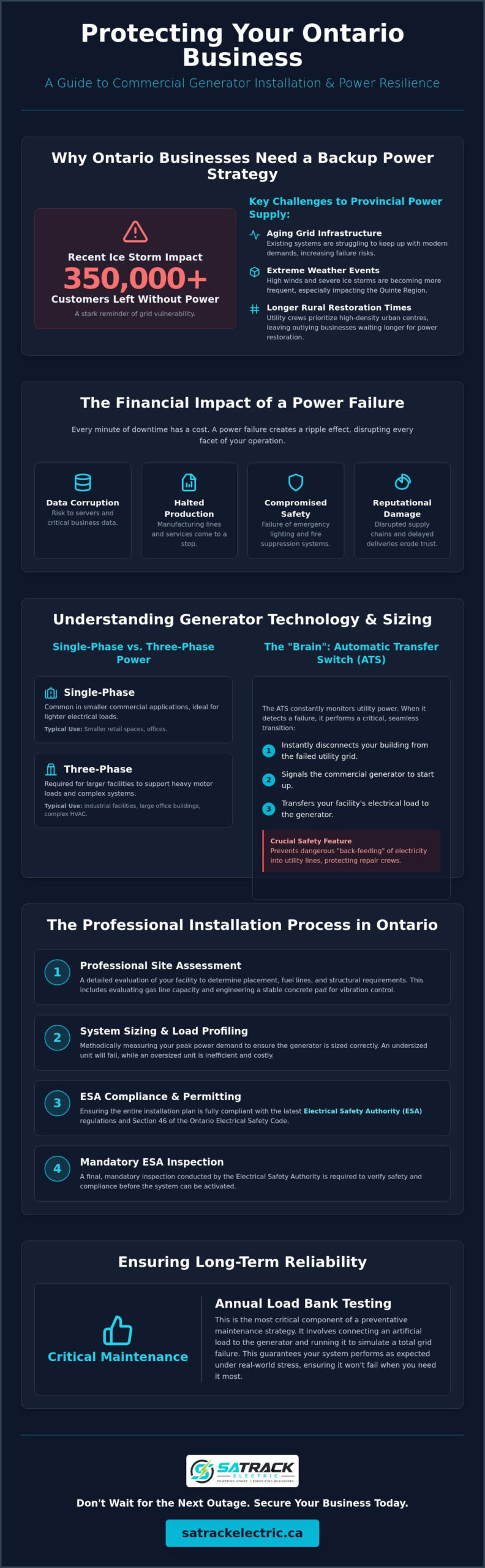
In March 2025, a severe ice storm across the province left over 350,000 customers without power, serving as a stark reminder of how vulnerable local business operations can be. For most owners, the primary concern isn’t just the darkness; it’s the immediate financial impact of lost data, halted production, and compromised safety systems. You likely recognize that waiting for the grid to recover isn’t a viable strategy for maintaining a competitive edge. This is why a professional commercial generator installation in Ontario is no longer a luxury but a fundamental component of a modern business continuity plan.
We’ll guide you through the process of protecting your facility with a system that’s both reliable and fully compliant with the 2024 Ontario Electrical Safety Code. You’ll learn how to navigate the complexities of sizing your equipment, selecting the right fuel source, and ensuring you meet all mandatory Electrical Safety Authority inspection requirements. By following this structured approach, you can eliminate the anxiety of future outages and ensure your business remains operational when your competitors cannot. This guide provides the technical clarity you need to make an informed investment in your company’s resilience.
Key Takeaways
- Identify how aging grid infrastructure in Ontario impacts your business and learn to calculate the true cost of potential downtime.
- Understand the technical differences between single-phase and three-phase power to ensure your equipment is sized correctly for your specific electrical service.
- Ensure your commercial generator installation Ontario project remains fully compliant with the latest Electrical Safety Authority (ESA) regulations and Section 46 of the provincial code.
- Discover the essential steps of a professional site assessment, from evaluating gas line capacity to engineering a stable concrete pad for vibration control.
- Learn why annual load bank testing is a critical component of a preventative maintenance strategy to guarantee your system performs during a total grid failure.
Why Ontario Businesses Require a Robust Backup Power Strategy
Ontario’s electrical grid is currently navigating a period of significant transition. As demand for electricity grows and the existing infrastructure ages, the consistency of the provincial power supply faces new challenges. For a local business, a sudden loss of power is far more than a minor inconvenience. It represents a direct threat to your operational stability and financial health. Opting for a professional commercial generator installation Ontario project ensures that your facility remains powered during these unpredictable grid failures. Beyond maintaining your daily output, you have clear legal and safety obligations to keep emergency lighting and fire suppression systems active. When the grid fails, these systems must remain functional to protect your staff and ensure you remain compliant with provincial safety regulations.
Calculating the Financial Impact of Power Failures
Every minute of downtime carries a specific price tag. To understand your risk, you must first identify your mission-critical systems. These might include server rooms, climate-controlled storage, or specialized manufacturing lines that cannot tolerate even a brief interruption. A power failure often creates a ripple effect that extends well beyond your facility. It disrupts your supply chain, delays customer deliveries, and can quickly erode the trust you’ve spent years building. Viewing Standby Generator Technology as a specialized insurance policy is a logical approach. It protects your operational budget by preventing the high costs associated with data corruption, spoiled inventory, and potential equipment damage.
Ontario Climate Resilience and the Quinte Region
The local environment in the Quinte and Belleville areas presents specific challenges for grid stability. High winds and severe ice storms frequently impact overhead power lines. If your business is located in a rural or semi-rural part of the province, you likely face longer restoration times than those in larger urban centres. Utility crews are often forced to prioritize high-density areas during major outages, which can leave outlying businesses waiting for days to regain power. This geographic reality makes independent power a necessity rather than an option.
Weather data indicates that these extreme events are increasing in frequency. Looking toward 2026 climate projections, businesses must prepare for more volatile weather patterns across Ontario. Establishing an independent power source is the most effective way to build genuine resilience. A commercial generator installation Ontario provides the professional assurance that your doors will stay open and your systems will stay online, regardless of the weather conditions outside. This proactive strategy allows you to maintain service while your competitors are forced to wait for utility repairs.
Understanding Commercial Generator Technology and Sizing
Selecting the right equipment for a commercial generator installation Ontario project requires a clear understanding of electrical ratings. You will encounter both Kilowatts (kW) and Kilovolt-Amps (kVA). While kW represents the actual power that performs work, kVA represents the total amount of power being used in a system. For most commercial applications, matching the generator to your existing phase is critical. Smaller retail spaces often utilize single-phase power. Larger industrial facilities and office buildings typically require three-phase power to support heavy motor loads and complex HVAC systems. This technical alignment ensures your equipment operates within its designed parameters without causing premature wear.
The Automatic Transfer Switch (ATS) acts as the brain of the backup system. It monitors the utility grid constantly. When a failure occurs, it instantly disconnects your building from the grid and starts the generator. This prevents back-feeding, which is a dangerous situation where your generator sends electricity back into the utility lines. This component ensures a seamless transition. It allows your business to continue operating without the need for manual intervention, providing the professional assurance you need during a crisis.
Sizing Your System: Load Profiling for Efficiency
Load profiling is the methodical measurement of peak power demand over time. Proper sizing is essential for long-term reliability. If you undersize the unit, you risk equipment damage and total system failure when the building’s demand exceeds the generator’s capacity. Conversely, oversizing leads to “wet stacking” in diesel engines and unnecessary fuel consumption. Professional electrical installations ensure your system is optimized for your specific load profile, preventing these costly operational errors.
Choosing the Right Fuel Source for Your Facility
The choice of fuel depends on your location and your specific reliability requirements. Natural gas is a common choice due to its continuous supply. However, it remains dependent on the integrity of the gas pipeline. Diesel is the standard for high-stakes environments like medical centres because it allows for on-site fuel storage. Propane serves as a versatile alternative for businesses in rural areas where natural gas infrastructure is unavailable. A successful commercial generator installation Ontario plan relies on choosing a fuel source that aligns with your local infrastructure. Regardless of the fuel type, you must adhere to Ontario’s generator maintenance requirements to ensure the system remains ready for an emergency.
Navigating Ontario Electrical Safety Code and Regulations
Compliance with the Ontario Electrical Safety Code (OESC) is a non-negotiable aspect of any commercial generator installation Ontario project. The 2024 edition of the OESC, which became effective on May 1, 2025, sets strict standards for how backup systems must be integrated into existing infrastructure. Section 46 is particularly critical; it outlines the requirements for emergency power supply systems that support life-safety equipment, such as exit signs, fire pumps, and elevators. For installations involving high-capacity generators or those serving complex facilities, an ESA plan review is mandatory. This technical review must be completed before any physical work begins to ensure the design meets all safety benchmarks from the outset.
Local municipal requirements in Belleville and Quinte West add another layer of complexity. These cities have specific zoning bylaws and noise ordinances that dictate where a generator can be placed and how loudly it can operate. For instance, a unit positioned too close to a property line or a residential neighbour might violate local sound limits, leading to fines or orders to relocate the equipment. Professional planning accounts for these setbacks and sound-dampening requirements during the design phase to avoid these costly mid-project corrections.
The ESA Inspection and Notification Process
A licensed electrical contractor is required to file a notification of work with the Electrical Safety Authority before starting the installation. This process creates a formal record of the project and triggers the necessary inspections. During the final site visit, ESA inspectors verify that the transfer switch is approved to prevent back-feeding and that all wiring meets the current code. Once the inspector is satisfied, they issue a Certificate of Inspection. This document is vital for your records; it’s often required by insurance providers to maintain coverage and by building owners to demonstrate due diligence in facility management.
Environmental and Building Code Compliance
Fuel management falls under the jurisdiction of the Technical Standards and Safety Authority (TSSA). If your system uses a large diesel tank or a permanent natural gas connection, it must meet TSSA standards for storage and handling to prevent leaks or fire hazards. Additionally, proper exhaust venting is a major safety concern. Generators must be positioned at a safe distance from building openings to prevent carbon monoxide from entering the workplace. Finally, the system must be integrated with your existing fire alarm and life-safety systems. This ensures that during a power failure, the building’s critical safety protocols remain fully functional without interruption, protecting both the occupants and the physical asset.
The Commercial Generator Installation Process in Ontario
A professional commercial generator installation Ontario project is a structured engineering task that requires precise coordination between several trades. The process begins with a comprehensive site assessment where we evaluate your existing electrical panels, gas line capacity, and available physical space. This stage is crucial for identifying potential bottlenecks before any equipment arrives on-site. We examine the main distribution centre to determine how the Automatic Transfer Switch (ATS) will be integrated into your current infrastructure. This methodical approach ensures that the eventual installation proceeds without unexpected technical delays or safety concerns.
The physical foundation of the system is just as important as the electrical components. We design and install a reinforced concrete pad specifically engineered to support the generator’s weight. This pad isn’t just a level surface; it’s designed for vibration dampening to prevent mechanical noise from transferring into the building’s structure. Once the foundation is cured and the unit is set, the electrical integration begins. This involves installing the ATS and making the necessary modifications to your building’s main power feed to allow for a safe, automatic transition during a grid failure.
Site Preparation and Logistics
Choosing the optimal location for your generator involves balancing accessibility with municipal noise ordinances. The unit must be positioned to allow technicians easy access for future Electrical Maintenance while remaining far enough from windows and air intakes to meet safety clearances. Logistics also include coordinating with local gas utilities. If your facility uses natural gas, the utility provider may need to perform a meter upgrade or extend a high-pressure line to accommodate the generator’s peak demand. Ensuring the site is perfectly level and clear of obstructions is a prerequisite for a stable, long-term installation.
Final Commissioning and Staff Training
The final phase of the project is commissioning, which includes a rigorous “black start” test. During this procedure, we simulate a total utility failure to verify that the ATS detects the loss of power, starts the generator, and transfers the load within the required timeframe. We also perform load bank testing to ensure the engine can handle its full rated capacity without overheating or losing frequency stability. This provides the verifiable proof that your investment will perform when the grid fails during a commercial generator installation Ontario project.
Our team provides comprehensive training for your facility staff before we hand over the system. Your personnel will learn basic operation, how to read the controller’s diagnostic messages, and the location of emergency shut-off procedures. We also establish a physical logbook for your mandatory weekly and monthly self-tests. This disciplined approach to documentation is a key part of maintaining your system’s reliability and ensuring you remain compliant with all provincial standards.
Ensuring Long-Term Reliability with Professional Maintenance
Securing a professional maintenance contract is the final step in a successful commercial generator installation Ontario project. Without regular oversight, even the most advanced system can fail when it’s needed most. Mechanical components require consistent lubrication and cooling, but true reliability is only proven through annual load bank testing. This procedure forces the generator to operate at its full rated capacity for a sustained period. It’s the only way to ensure the engine and alternator can handle your building’s peak demand without losing frequency or voltage stability. This testing also helps prevent “wet stacking,” a condition where unburnt fuel accumulates in the exhaust system of diesel units, which can lead to reduced efficiency and engine damage over time.
As your business expands, your power requirements will naturally change. You may need to revisit your commercial electrical upgrades in Belleville to ensure your distribution panel and generator remain compatible with new machinery or technology. Choosing a local contractor for your commercial generator installation Ontario needs provides a critical layer of security. During regional emergencies, such as the severe ice storms common in Eastern Ontario, having a partner based in Belleville ensures a faster response time for troubleshooting and repairs. This proximity allows for more efficient service when road conditions are poor and utility resources are stretched thin across the province.
The Maintenance Checklist for Ontario Businesses
A comprehensive maintenance programme focuses on the small details that prevent major system failures. Our technicians follow a rigorous checklist to ensure your facility remains prepared for any disruption:
- Oil and coolant level checks: These are the basic indicators of engine health for any standby unit. We monitor for leaks and ensure fluids are changed according to the manufacturer’s specified intervals.
- Battery testing and replacement: Battery failure remains the leading reason generators fail to start during an outage. We test voltage and cold-cranking amps to ensure the starter has the power it needs.
- Control panel diagnostics: We review the system log for any intermittent fault codes that could indicate an underlying issue with the automatic transfer switch or engine sensors.
It’s vital to treat these tasks as a non-negotiable part of your operational budget. You can read more about budgeting for these services in our guide on generator installation cost in Ontario. If your facility also supports residential properties or you manage mixed-use buildings, our detailed resource on home generator maintenance Ontario homeowners and property managers rely on provides additional guidance on keeping all standby systems ESA-compliant and ready for seasonal demands.
Partnering with Satrack Electric for Your Facility
At Satrack Electric, we prioritize professional assurance in every project we undertake. Our team understands the specific challenges faced by businesses in Quinte West and the surrounding areas. We focus on providing stable, code-compliant solutions that protect your operations from the financial risks of downtime. By partnering with a local authority, you gain a dependable expert who values the resilience of our shared community. We take pride in delivering thorough results that provide peace of mind for our clients. Our methodical approach ensures that your backup power strategy is disciplined, efficient, and ready to perform the moment the grid fails.
Securing Your Business Future with Reliable Backup Power
Establishing a resilient power strategy is a technical necessity for any organization that values operational stability. You now understand that a successful commercial generator installation Ontario project relies on precise load profiling, strict adherence to the latest OESC safety standards, and a disciplined maintenance program. These steps ensure your facility remains functional during the most severe regional weather events. Proactive planning today prevents the significant financial losses associated with unexpected downtime tomorrow.
Satrack Electric is a licensed and insured electrical contractor with over a decade of experience serving Belleville, Quinte West, and the surrounding regions. We specialize in ESA code compliance and have the technical expertise required to manage complex installations from the initial plan review to the final inspection. We invite you to Request a Professional Site Assessment for Your Ontario Business to begin designing your custom backup solution. Protecting your revenue and your reputation starts with a system you can trust. We look forward to helping you achieve total peace of mind.
Frequently Asked Questions
Do I need a permit for commercial generator installation in Ontario?
Yes, every commercial generator installation in Ontario requires a notification of work filed with the Electrical Safety Authority (ESA). This process ensures that the installation is inspected for compliance with the provincial electrical safety code. Failing to obtain an inspection can result in significant fines and may void your business insurance coverage. A licensed electrical contractor typically handles this filing on your behalf before starting the project.
How much space is required for a commercial standby generator?
The space required depends on the unit’s kilowatt rating and specific provincial clearance codes. Generally, you need enough room for the concrete pad plus a minimum of 1.5 metres of clearance from building openings like windows or vents. Accessibility for maintenance is also a factor. Our team evaluates your property to ensure the chosen location meets all safety setbacks while remaining accessible for future service and fuel deliveries.
What is the difference between a standby generator and a portable generator for business?
A standby generator is a permanent fixture that activates automatically via an automatic transfer switch during a power failure. In contrast, a portable generator requires manual setup, fueling, and connection, which can lead to significant downtime. For most businesses, a standby system is the preferred choice for a commercial generator installation Ontario project because it provides seamless continuity without requiring staff intervention during an emergency.
How often should a commercial generator be tested in Ontario?
You should perform a brief automated self-test weekly to ensure the engine starts and the battery is charging correctly. Monthly tests under load are also recommended to exercise the transfer switch and internal components. Beyond these routine checks, a professional inspection and full system test should be conducted annually. This disciplined approach identifies minor issues before they become critical failures during a real-world grid disruption.
Can a commercial generator run my entire facility or only critical loads?
A generator can be configured to power your entire facility or just specific critical loads like servers, emergency lighting, and security systems. The decision depends on your operational requirements and the capacity of the unit you select. During the site assessment, we help you categorize your electrical loads to determine if a whole-building solution or a targeted backup strategy is the most efficient choice for your budget.
What fuel source is best for a business in the Belleville area?
Natural gas is often the most convenient choice for businesses in urban Belleville because it offers an uninterrupted fuel supply. However, for facilities requiring the highest level of reliability, such as healthcare centres, diesel is often preferred due to the ability to store fuel on-site. Propane remains an excellent alternative for rural properties in the Quinte region that lack access to natural gas infrastructure.
How long does the installation process typically take for a commercial property?
The physical installation usually takes between one and three weeks, depending on the complexity of the electrical integration and gas line work. However, the entire project timeline includes several weeks of prior planning, including ESA plan reviews and equipment procurement. We coordinate every stage of the process to minimize disruptions to your daily operations, ensuring the transition to backup power is handled methodically and professionally.
Is a load bank test mandatory for commercial generators in Ontario?
Yes, load bank testing is mandatory for generators that serve as the emergency power supply for life-safety systems, as outlined in the CSA C282 standard. Even when it isn’t legally required for your specific business type, it remains a highly recommended best practice. This test verifies that the engine can maintain its full rated output without overheating, providing the only verifiable proof that your system is ready for a total grid failure.