
You walk into your kitchen and notice the overhead lights are bright, yet the microwave won’t turn on and the refrigerator has gone silent. This unsettling scenario is a common sign of a partial power outage in house Brighton, leaving many homeowners caught between confusion and the fear of a potential electrical fire. It’s frustrating to have one room functioning perfectly while the next is draped in darkness, especially when you aren’t sure if the fault lies with Hydro One or your own electrical panel.
We understand how vital a stable power supply is for your family’s safety and comfort. This guide provides the professional clarity you need to navigate this situation without unnecessary stress. You’ll discover exactly why half your home has lost power and learn the specific troubleshooting steps to take before you decide to contact a licensed electrician. We will examine the mechanics of split-phase power, explain how to inspect your breakers safely, and help you determine if a professional panel upgrade is the right long-term solution for your property’s electrical health.
Key Takeaways
- Understand the mechanics of split-phase power and how a lost utility leg results in only half of your home losing electricity.
- Learn how to verify if a partial power outage in house Brighton is a localized issue or a broader problem affecting your street.
- Master safe troubleshooting techniques, including the importance of isolating sensitive electronics to prevent damage from voltage fluctuations.
- Discover why certain repairs must be handled by a licensed professional to protect your property and maintain insurance validity.
- Evaluate how upgrading your electrical service can prevent future disruptions caused by modern high-load installations like heat pumps.
What Causes a Partial Power Outage in a Brighton House?
A partial power outage occurs when electricity is lost in specific circuits while other areas of the home remain fully functional. This isn’t a total blackout, but rather a targeted failure that can leave you with a working living room but a dark kitchen. In Brighton, these issues often stem from a combination of severe weather events and the aging electrical infrastructure found in many of our historic neighbourhoods. The influence of Lake Ontario can bring intense wind and ice, which places significant stress on local utility lines and residential service masts.
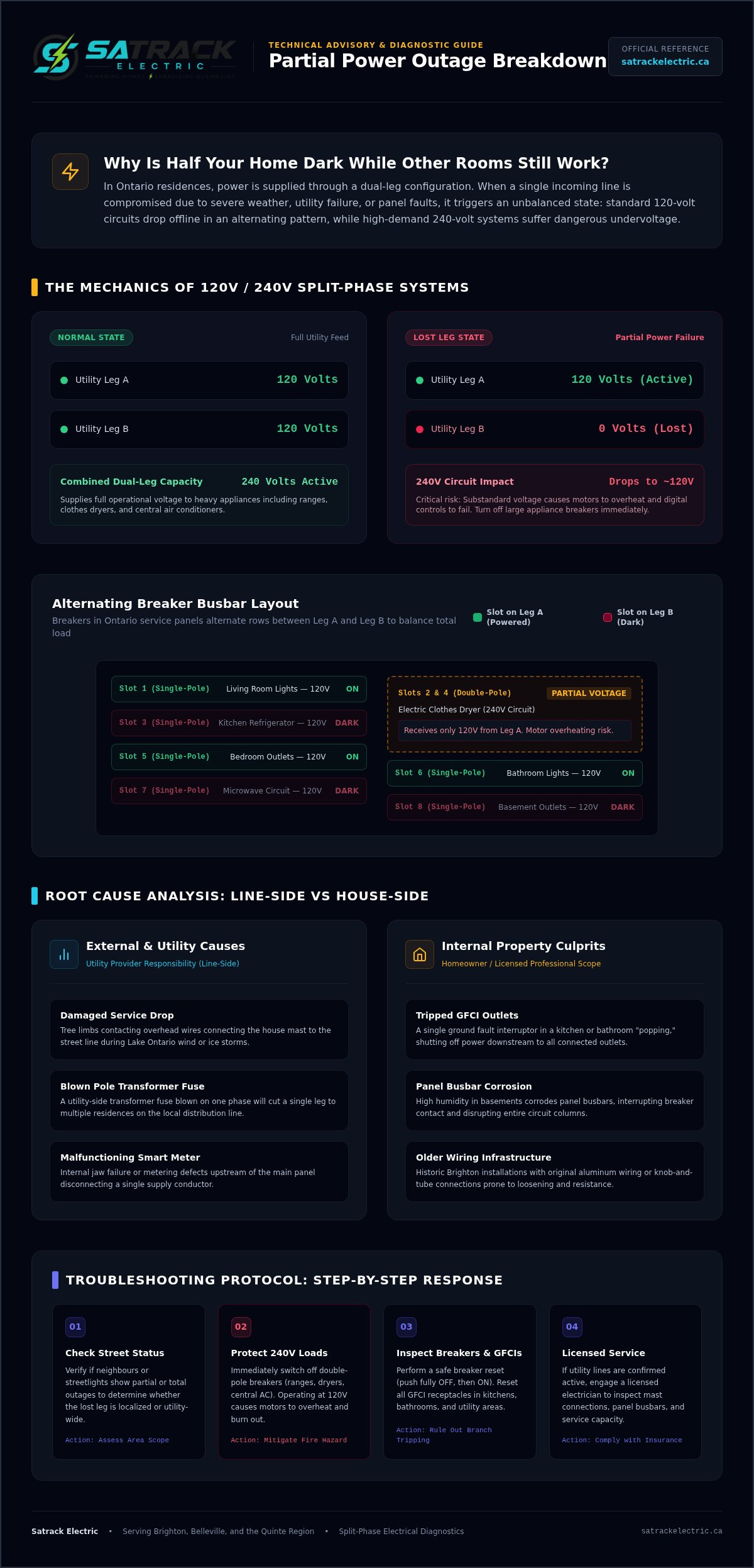
It’s vital to distinguish between a simple tripped breaker and a systemic failure. A tripped breaker usually affects one room or a specific appliance group. However, a partial power outage in house Brighton often signals a deeper issue within the split-phase electric power system. In Ontario, residential properties receive power through two 120-volt “legs” that combine to provide 240 volts for heavy appliances. Breakers in your panel are staggered, alternating between these two legs. If one leg fails, approximately half of your 120-volt circuits will lose power entirely, while 240-volt appliances like your dryer or stove will cease to function correctly.
Common Internal Culprits
Internal failures are frequently linked to modern demands on older systems. Many Brighton homes still feature original aluminum wiring or even legacy knob-and-tube components that haven’t been fully modernized. These older materials are prone to loose connections and corrosion, which can interrupt the flow of electricity to specific sections of the house. Addressing these issues often requires professional electrical repairs in Belleville and the surrounding Quinte region. Other common internal causes include:
- Overloaded Circuits: High-draw appliances like space heaters or air conditioners can trip breakers if the circuit isn’t rated for the load.
- Tripped GFCI Outlets: A single Ground Fault Circuit Interrupter in a bathroom or kitchen can “pop,” killing power to every outlet downstream on that line.
- Panel Corrosion: Humidity in a basement can lead to corroded busbars, preventing breakers from making a solid connection and causing a partial power outage in house Brighton.
External and Utility Issues
Sometimes the fault lies outside your walls. Brighton residents often deal with utility-side failures following high winds or heavy snowfall. If a tree limb damages the service drop, the wires connecting your house mast to the street, you might lose one of the two power legs. Similarly, a blown transformer fuse on the utility pole or a malfunctioning smart meter can cause a partial outage. In these cases, the issue is on the “line side” of your meter, meaning the responsibility for the repair usually rests with the utility provider. Identifying whether the issue is internal or external is the first step toward a safe resolution.
The Science of Split-Phase Power: Why Half Your House is Dark
Most residential properties in Ontario operate on a 120/240-volt split-phase system. This configuration delivers two separate 120-volt “legs” of power from the utility transformer to your electrical panel. When both legs are functional, they combine to provide the 240 volts required by heavy-duty appliances. However, if one leg is interrupted due to a utility fault or a damaged service mast, you will experience a partial power outage in house Brighton. This results in exactly half of your standard 120-volt outlets losing power while the other half remains active.
This situation poses a significant risk to 240-volt appliances such as electric ranges, clothes dryers, and central air conditioners. Because these devices require both power legs to operate, losing one leg means they may only receive 120 volts. This insufficient voltage can cause motors to overheat or electronic controls to fail. Following FEMA power outage safety guidance, it’s advisable to turn off the breakers for these large appliances immediately to prevent permanent damage from voltage fluctuations.
Visualizing Your Electrical Panel
You can often identify the pattern of the outage by looking at your panel’s layout. Inside the enclosure, the metal busbars that hold the breakers are designed to alternate between the two legs of power. In a typical column of breakers, every second slot is connected to a different leg. This alternating pattern ensures the electrical load is distributed evenly across the incoming service.
- Single-pole breakers: These occupy one slot and provide 120 volts to standard lights and outlets.
- Double-pole breakers: These occupy two slots and connect to both legs simultaneously to provide the 240 volts needed for high-demand equipment.
- Staggered configuration: If you notice that every other circuit in a row is dead, it’s a classic sign of a dropped leg from the utility.
The Dangers of an Unbalanced Load
A partial outage isn’t always caused by a lost hot leg; it can also result from a failing neutral wire. This creates an “unbalanced load” where voltage fluctuates wildly. You might notice lights in one room becoming dangerously bright while others grow dim. This symptom often precedes a total partial power outage in house Brighton and indicates a serious fire hazard that requires immediate attention.
Ignoring these signs can lead to fried circuit boards in expensive electronics or even electrical fires. If your lights are behaving erratically, it’s time to seek professional Residential Electrical Services to diagnose the root cause and ensure your system is balanced and safe. A steady, reliable power supply is essential for protecting your home’s infrastructure and your family’s peace of mind.
Step-by-Step: Troubleshooting Your Partial Power Loss
If you experience a partial power outage in house Brighton, your first priority is safety. Never attempt to touch your electrical panel if you detect the smell of burning plastic, hear buzzing sounds, or see visible sparks. These are signs of a severe fault or arc flash risk. Adhering to professional OSHA electrical safety standards is vital even in a residential setting, as mishandling a panel can lead to life-threatening injuries. If the environment is safe, start by checking with your neighbours. If their homes are also partially dark, the issue is likely a utility problem on the street rather than an internal fault.
If the issue is isolated to your home, you can attempt the “Main Breaker Flip.” This involves turning your main service breaker fully to the ‘off’ position and then back to ‘on.’ This reset can sometimes re-establish the connection to both 120-volt legs if one has experienced a temporary surge or dip. To confirm a lost leg, try turning on a 240-volt appliance like an electric stove. If the burners don’t heat up or the clock display is dim, you have confirmed that one of the two incoming power lines is compromised.
Checking the Breaker Panel Safely
Identifying a tripped breaker isn’t always straightforward. Some breakers don’t flip all the way to the ‘off’ side; they may simply look slightly loose or feel “mushy” to the touch. To reset them correctly, you must push the handle firmly to the ‘off’ position until it clicks before flipping it back to ‘on.’ While you are at the panel, check if any breakers feel warm. A warm breaker is a red flag for a dangerous overload or a failing connection that requires immediate professional attention to prevent a fire. If you find multiple tripped breakers, do not keep resetting them, as this indicates a persistent short circuit.
Determining Who to Call
Deciding whether to contact Hydro One or a local contractor depends on where the failure occurred. If your neighbours are reporting similar issues or you see a damaged service mast where the wires meet your house, contact the utility provider immediately. However, homeowners must realize that utility companies only fix issues up to the service point. If the fault is within your panel or specific branch circuits, you will need to contact a professional for electrical repairs in Belleville and the surrounding Brighton area. Identifying the source early ensures you call the right team for the job and avoids unnecessary service fees.
When to Call a Professional Electrician in Brighton
If you experience a partial power outage in house Brighton, the problem often lies within the “line side” of your electrical panel. This area contains the main lugs and busbars that receive high-voltage current directly from the utility. Attempting to inspect these components without professional training is extremely dangerous due to the risk of arc flashes and severe shock. It’s essential to rely on experts for electrical repairs in Belleville and Brighton to ensure your home’s infrastructure is handled with technical precision. While basic troubleshooting like checking for a tripped breaker is safe for most homeowners, opening the panel cover exposes live parts that require specialized safety gear.
A “lost neutral” is perhaps the most hazardous scenario you might encounter. When the neutral connection fails, your 120-volt circuits lose their balance. This can cause voltage to spike toward 240 volts in certain outlets, which will immediately destroy sensitive electronics like computers and smart appliances. If you see lights getting brighter when a heavy appliance starts up, this is a red flag. Using a licensed and insured contractor ensures that your repairs meet provincial safety standards and keeps your home insurance valid. DIY electrical work can sometimes lead to claim denials if a fault occurs later.
Signs of a Serious Electrical Fault
Watch for acrid smells that resemble burning plastic or ozone. Buzzing sounds coming from the panel or visible discolouration on the breaker handles are signs of arcing or heat damage. If you have a recurring partial power outage in house Brighton that seems to resolve itself only to return later, you likely have a loose connection. These intermittent issues are often the precursors to an electrical fire and should never be ignored. A loose wire can generate intense heat even if the breaker does not trip.
Diagnostic Tools Professionals Use
Licensed electricians use specialized equipment to find faults that aren’t visible to the naked eye. Thermal imaging cameras allow us to see “hot spots” where loose wires are generating dangerous heat levels. We also use advanced circuit tracing to locate hidden junction boxes or broken conductors buried behind walls. Finally, load testing ensures your existing panel can safely handle the demands of modern Brighton life before you add new high-draw equipment. Book a safety inspection today to secure your home’s electrical system and protect your electronics from voltage instability.
Preventing Future Outages with System Upgrades
Modern Brighton households consume more electricity than ever before. The addition of Level 2 EV chargers, energy-efficient heat pumps, and luxury items like hot tubs puts immense strain on systems designed decades ago. Many older properties in our region still operate on 60-amp or 100-amp services, which aren’t equipped for these concurrent loads. When a system is pushed to its limit, components overheat and connections loosen, often leading to a recurring partial power outage in house Brighton. Upgrading your service is the most effective way to ensure your home remains powered and safe.
Investing in an electrical panel upgrade in Belleville and Brighton provides a foundation for modern reliability. Beyond adding capacity, these upgrades allow for the integration of whole-home surge protection. This technology safeguards your expensive electronics from the “ghost” outages and voltage spikes discussed in previous sections. Routine maintenance remains your best defence, as it allows a professional to identify signs of wear before they escalate into a systemic failure.
Modernizing Your Brighton Home
Many mid-century developments in Brighton contain aluminum wiring, which requires specific maintenance to prevent oxidation and loose connections at terminal points. Transitioning from an outdated fuse box to a modern breaker panel significantly improves safety and ease of use. Increasing your service capacity to 200 amps is a proactive step that accommodates future growth, such as adding a secondary suite or switching to an electric vehicle. This modernization eliminates the root causes of many systemic outages and ensures your home meets current safety standards.
The Value of Professional Maintenance
An annual safety inspection can catch minor issues, such as a loose lug or a corroded busbar, before they cause a partial power outage in house Brighton. Our team ensures that all specialized installations, including hot tub wiring in Belleville and surrounding areas, comply with the latest Ontario electrical codes. Creating a comprehensive electrical plan with a local expert provides the peace of mind that your home’s infrastructure is stable, efficient, and ready for whatever demands your lifestyle requires. Consistent care is the most reliable way to avoid the frustration of a dark house.
Restoring Reliability to Your Brighton Residence
Addressing a partial power outage in house Brighton requires a methodical approach to safety and diagnosis. Understanding that your home depends on a balanced split-phase system is the first step in identifying whether the fault is a utility-side dropped leg or an internal failure within your panel. By recognizing the warning signs of loose connections or overloaded circuits early, you can prevent minor disruptions from escalating into significant electrical hazards or damaged electronics.
As licensed and insured Ontario contractors, we bring specialized expertise to Brighton residential systems. Whether you need a precise diagnostic inspection or a comprehensive service upgrade to support modern high-draw appliances, our team provides the reliable, professional workmanship necessary for your peace of mind. Contact Satrack Electric today for expert electrical troubleshooting in Brighton and ensure your home’s electrical infrastructure remains stable for years to come. We look forward to helping you maintain a safe and efficient home environment.
Frequently Asked Questions
Is a partial power outage a fire hazard in my Brighton home?
Yes, a partial power outage in house Brighton can be a serious fire hazard. If the issue stems from a loose neutral or arcing connections in your panel, it can generate significant heat. This heat can ignite surrounding insulation or materials. If you smell burning or notice discoloured breakers, you should isolate the power and contact a professional immediately to prevent a potential structure fire.
Why do some of my lights work but others are dim or flickering?
Dim or flickering lights often indicate a “floating neutral” or a failing connection in your service entrance. When the neutral wire is compromised, voltage can fluctuate wildly between your two power legs. This causes some lights to receive too little power while others receive too much. This imbalance is dangerous for your home’s infrastructure and requires a licensed electrician to diagnose the specific point of failure.
Can a bad outlet cause half the house to lose power?
A single bad outlet typically only affects its own circuit, but it won’t cause half the house to lose power. Losing exactly half the house usually points to a dropped 120-volt leg at the main panel or the utility mast. While a failed GFCI outlet can kill power to several downstream plugs, a widespread partial power outage in house Brighton is almost always a systemic issue rather than a single faulty receptacle.
Does insurance cover repairs for a partial power outage?
Home insurance policies often cover repairs if the outage was caused by a sudden, accidental event like a lightning strike or a fallen tree limb. However, if the failure resulted from long-term neglect or aging infrastructure, the claim might be denied. It’s essential to work with a licensed and insured contractor to ensure all repairs meet Ontario electrical codes, which helps maintain your policy’s validity and ensures professional workmanship.
What should I do if my stove works but my fridge doesn’t?
This scenario occurs because your stove is a 240-volt appliance that uses both power legs, while your fridge uses a single 120-volt leg. If one leg fails, the fridge loses power entirely, but the stove might still show some signs of life or partially function. You should turn off the breakers for your 240-volt appliances immediately to prevent motor burnout caused by insufficient voltage and backfeeding through the secondary windings.
How much does it typically cost to fix a partial power outage in Brighton?
The cost to resolve a partial outage depends on the root cause, which can range from a simple breaker replacement to a full service mast repair. Most licensed contractors in the Quinte region charge a standard diagnostic fee to identify the fault. Once the issue is found, we provide a detailed quote based on the specific parts and labour required. Routine maintenance is always more cost-effective than unexpected emergency repairs.
Is Hydro One responsible for fixing a partial outage on my property?
Hydro One is generally responsible for the power lines coming from the street up to the point of attachment on your house, including the meter. If the fault is in the wires on the street or the transformer, they will handle the repair. However, the service mast, the meter base, and the internal panel are the homeowner’s responsibility. A professional can help you determine where the utility’s duty ends and yours begins.
Can I still use my electronics during a partial power outage?
You should avoid using sensitive electronics during a partial outage. Voltage instability can cause permanent damage to circuit boards in computers, televisions, and smart appliances. Low voltage can be just as damaging as a high-voltage surge. It’s best to unplug your most valuable devices and turn off the main breaker until a qualified professional confirms that your system is stable and safe to use for your household needs.